NASA Study Concludes When Civilization Will End, And It’s Not Looking Good for Us

Tom McKay in PolicyMic:

ScreenHunter_612 May. 10 17.48Civilization was pretty great while it lasted, wasn't it? Too bad it's not going to for much longer. According to a new study sponsored by NASA's Goddard Space Flight Center, we only have a few decades left before everything we know and hold dear collapses.

The report, written by applied mathematician Safa Motesharrei of the National Socio-Environmental Synthesis Center along with a team of natural and social scientists, explains that modern civilization is doomed. And there's not just one particular group to blame, but the entire fundamental structure and nature of our society.

Analyzing five risk factors for societal collapse (population, climate, water, agriculture and energy), the report says that the sudden downfall of complicated societal structures can follow when these factors converge to form two important criteria. Motesharrei's report says that all societal collapses over the past 5,000 years have involved both “the stretching of resources due to the strain placed on the ecological carrying capacity” and “the economic stratification of society into Elites [rich] and Masses (or “Commoners”) [poor].” This “Elite” population restricts the flow of resources accessible to the “Masses”, accumulating a surplus for themselves that is high enough to strain natural resources. Eventually this situation will inevitably result in the destruction of society.

More here.

Pledges of Allegiance

Ayad Akhtar in The New York Times:

Cover-sub-sfSpanTen days after 9/11, self-professed “Texas loud, Texas proud” Mark Stroman walked into a Dallas mini-mart, pulled out a gun and asked the brown man working behind the counter where he was from. The hesitation in the clerk’s reply was enough to unleash Stroman’s hatred for Muslims, whom he referred to as people with “shawls on their face.” Stroman pulled the trigger, but his victim, Raisuddin Bhuiyan, an enterprising immigrant from Bangladesh — and a Muslim, indeed — would survive. The other two victims from the fortnight’s vigilante shooting spree, immigrants from India and Pakistan, would not. So begins Anand Giridharadas’s “The True American,” a richly detailed, affecting account of two men bound, as it turned out, by more than just an act of violence.

Bhuiyan’s misfortune served as an introduction to certain stark realities of American life: The day after being admitted to the hospital, he was asked to leave. The injury was serious, yes, but he was told he would be fine. What Bhuiyan didn’t know was that, without insurance, the hospital assessors saw bills mounting that weren’t going to be paid. They saw a “fledgling immigrant and gas station clerk,” Giridharadas writes, and assumed he wouldn’t be good for the money. One of the many satisfying twists of this trauma-filled book is that he would be. Another is the conclusion Bhuiyan comes to about American debt: that it “contradicted those attributes of the republic for which he had left” Bangladesh. In America, debt “bound you to history, and kept you who you were, and replaced the metaphor of the frontier with that of a treadmill.”

More here.

rana dasgupta’s delhi

0511-bks-Subramian-master675-v2Samanth Subramanian at the New York Times:

The financial heart of India has long been Mumbai, but it is Delhi, increasingly, that seems to be driven by money, galvanized by it, besotted with it. Delhi is India’s capital. It is where the nation’s networks of crony capitalism converge, where money seeks license to earn more money. Delhi talks to itself about money — about what money can buy, about the cabinet minister pocketing kickbacks, about the suburban swatch of land that a lawyer’s untaxed, all-cash fee has purchased and, in near-reverential tones, about the ingenious and illegal ways more money can be made. This last subject, in particular, exercises the city’s soul enormously. Delhi is flatulent with greed.

When Rana Dasgupta moved to the city from New York in 2000, the reimagination of Delhi had just begun, and there was, he writes toward the beginning of “Capital,” a thrilling anticipation and a “utopian clamor” to the city’s first paddles into the global market economy. Even as Dasgupta watched, however, the transition went off-kilter: “The land grabs and corruption-as-usual that became so blatant in those later years, the extension of the power of elites at the cost of everyone else, the conversion of all that was slow, intimate and idiosyncratic into the fast, vast and generic — it made it difficult to dream of surprising futures any more.”

more here.

the poetry of Derek Walcott

Derek-Walcott-012Fiona Sampson at The Guardian:

At more than 600 pages, this new selection from 15 collections over 65 years ofDerek Walcott's poetry is clearly no taster. But then Walcott is a generous writer in every sense. The expansive, celebratory texture of his verse is instantly recognisable. It moves with ease between city and country, between “the snow still falling in white words on Eighth Street” and the way “Sunshine […] stirs the splayed shadows of the hills like moths”.

This vivid engagement with the sensory world doesn't desert Walcott even in elegy, of which the later books include an increasing amount. In “For Oliver Jackman”, in White Egrets: “They're practising calypsos, / they're putting up and pulling down tents, vendors are slicing / the heads of coconuts around the Savannah, men /are leaning on, then leaping into pirogues.” Poets have long pointed out that life continues in the face of death: WH Auden in “Musée des Beaux Arts” among them. But few capture that life in such full and affirming detail.

Much of this detail draws on the landscape and life of Walcott's native St Lucia.

more here.

Eleanor Marx: A Life

C1256dee-d70f-11e3-907c-00144feabdc0Lisa Jardine at The Financial Times:

Eleanor Marx joked that she had inherited her father’s nose but not his genius and, if she anticipated that it was her fate to be overshadowed by the author of Das Kapital, then she could only be proved correct. Yet contemporaries who knew her work as an activist, writer and translator would have protested nonetheless at the injustice. Now, in Rachel Holmes’ fine biography, we have all the evidence we need to revise this modest self-assessment.

Eleanor was born on January 16 1855 in a two-room garret in Dean Street, London, the sixth child of Karl Marx and Jenny von Westphalen. Only two of her siblings survived into adulthood – her sisters Jenny and Laura, 11 and 10 years older than her, respectively. The eldest son, Edgar, died of tuberculosis 12 weeks after Eleanor’s birth and from that point her father seems to have invested all his hopes and affection in the family’s most recent arrival. He and Eleanor would be soulmates until his death in 1883.

more here.

Stress Gives You Daughters, Sons Make You Liberal

Dalton Conley in Nautilus:

3251_504c296f8eb5fd521e744da4e8371f28In 1973, Robert Trivers and Dan Willard put forth the hypothesis that the sex of offspring is not, in fact, a random draw. The argument was based on the fact that, in many mammal species where investments in offspring are high, females are a safer evolutionary bet than males.

That is, with few exceptions, a female who wants to have offspring can pretty much accomplish that—they just need to rope a male in for a few moments. In a competitive environment, females want to choose the “best” sperm to produce their offspring (in balance with the desire to have a father around who will contribute to the care of said offspring).

So when resources are scarce, or when a female’s health is not in tip-top shape, or when she is at the bottom of the hierarchy, she skews toward the safer investment: daughters. This has been shown in red deer, cows, and even our cousins, the Barbary macaques.1 I say, she skews, because the general theory is that such sex selection is accomplished by signaling within the mother’s body that leads to the spontaneous abortion of male blastocysts (early embryos). A lower level of blood glucose tells the womb that things are not pretty out there…

We found that—contrary to prior studies, which failed to exclude non-biological children—sons, not daughters, made parents (of both sexes) more liberal and more likely to vote Democratic. Curiously, while daughters made parents more Republican, they also made them more pro-choice. When we dug deeper, we found that the only issues on which the gender of offspring affected parental opinion were related to sexuality. Other partisan debates—guns, foreign policy, taxes, immigration, welfare, and so on—were unaffected. And while daughters caused parents to adopt more conservative views toward sexuality, they paradoxically made them more pro-choice. Or perhaps it isn’t so paradoxical but really just rational: Given that the costs of teenage, premarital childbearing are disproportionately born by the mother, parents of girls might prefer a more chaste sexual landscape and yet also prefer abortion to be legal just in case.

Of course, it’s hard to know whether our sons and daughters are actually changing us through social interaction. Does a baby girl’s actions make Mom and Dad see the world in a new light? Or does she merely tip the scales in terms of incentives? For example, Abigail Weitzman, a Ph.D. candidate at New York University, finds that across the less developed world bearing a daughter carries what she calls a “tax” that is borne by the mother. Mothers of first-born daughters are not only more likely to be abandoned or abused, they have to go to work at higher rates. Evidently, fathers want the mothers of their sons to stay home and raise them. But they aren’t willing to forsake additional family income in the case of nurturing daughters.

Read the rest here.

Saturday Poem

My Aunts

Always caught up in what they called
the practical side of life
(theory was for Plato),
up to their elbows in furniture, in bedding,
in cupboards and kitchen gardens,
they never neglected the lavender sachets
that turned a linen closet to a meadow.

The practical side of life,
like the Moon’s unlighted face,
didn’t lack for mysteries;
when Christmastime drew near,
life became pure praxis
and resided temporarily in hallways,
took refuge in suitcases and satchels.

And when somebody died–it happened
even in our family, alas–
my aunts, preoccupied
with death’s practical side,
forgot at last about the lavender,
whose frantic scent bloomed selflessly
beneath a heavy snow of sheets.
Don’t just do something, sit there.

And so I have, so I have,
the seasons curling around me like smoke,
Gone to the end of the earth and back without sound.

by Adam Zagajewski
from Without End: New and Selected Poems
translation: Clare Cavanaugh
Farrar, Straus, and Giroux, 2002

Friday, May 9, 2014

Death is not final: Eben Alexander and Ray Moody support the motion; Sean Carroll and Steve Novella oppose

If consciousness is just the workings of neurons and synapses, how do we explain the phenomenon of near-death experience? By some accounts, about 3% of the U.S. population has had one: an out-of-body experience often characterized by remarkable visions and feelings of peace and joy, all while the physical body is close to death. To skeptics, there are more plausible, natural explanations, like oxygen deprivation. Is the prospect of an existence after death “real” and provable by science, or a construct of wishful thinking about our own mortality?

And more by Sean Carroll about the debate here.

Clarence Thomas’s Counterrevolution

Clarence_Thomas_official_SCOTUS_portrait1

Corey Robin in Jacobin:

Nikhil Singh said that more than any other figure in the African American canon, Malcolm X is someone who everyone thinks they know. Clarence Thomas, I’ve discovered in the past six months, is also a figure who everyone thinks they know. In the interest of dispelling that expectation, which I suspect many of you share, I’d like to present five facts about Clarence Thomas that perhaps you didn’t know.

1. The first time Clarence Thomas went to Washington, DC, it was to protest the Vietnam War. The last time that Clarence Thomas attended a protest, as far as I can tell, it was to free Bobby Seale and Erikah Huggins.

2. Clarence Thomas does not believe in color-blindness: “I don’t think this society has ever been color-blind,” he said in 1985, in the third year of his tenure as head of the EEOC. “I grew up in Savannah, Ga., under segregation. It wasn’t color-blind and America is not color-blind today … Code words like ‘color-blind’ aren’t all that useful.” Or, as he told Juan Williams in 1987, “There is nothing you can do to get past black skin. I don’t care how educated you are, how good you are — you’ll never have the same contacts or opportunities, you’ll never be seen as equal to whites.”

3. When Clarence Thomas was in college he memorized the speeches of Malcolm X; two decades later, he could still recite them by heart. “I’ve been very partial to Malcolm X,” he told a libertarian magazine in 1987. “There is a lot of good in what he says.”

4. There’s a law review article about Clarence Thomas that’s called “Clarence X?: The Black Nationalist Behind Justice Thomas’s Constitutionalism.”

5. Clarence Thomas resents the fact that as a black man he’s not allowed to listen to Carole King.

Now, the truth is that there’s nothing all that surprising about the fact that Clarence Thomas is black and conservative. There’s a long tradition of black conservatism in this country. And from Edmund Burke to Ayn Rand, conservatism always and everywhere has been the work of outsiders, men and women who hail from the peripheries or margins of the national experience.

More here.

Cradle of Civil Disobedience

0511-bks-THOTTAM-tmagSF

Jyoti Thottam reviews Ramachandra Guha's ‘Gandhi Before India’ in the NYT (image MSMDNYC):

At the end of the 19th century, Mohandas Gandhi was a young lawyer living in Durban, South Africa. He left his house in Beach Grove every morning for an office on Mercury Lane, where he spent much of the day helping his fellow Indian immigrants navigate the onerous colonial bureaucracy. He kept meticulous records, including a logbook of correspondence — from an English missionary and local planters, and a series of letters exchanged with the Protector of Indian Immigrants about the treatment of indentured laborers. In January of 1897, and again a few months later, he heard from another lawyer who was, like him, a Gujarati who had studied in England and then struggled to establish a practice in Bombay. The contents of these letters are unknown. In a remarkable new biography, “Gandhi Before India,” Ramachandra Guha gingerly speculates about what they might have been. Expressions of support for Gandhi’s nascent activism? Or perhaps “explorations of interest in a possible career in South Africa”? Guha wisely stops there. What is not in doubt is the name in Gandhi’s logbook — “M. A. Jinnah,” Muhammad Ali Jinnah, who would become the founder of Pakistan. “All we now know is that, a full 50 years before partition and the independence of India and Pakistan, the respective ‘Fathers’ of those nations were in correspondence.”

More here.

Philosophers of Babel

Ross Perlin in The New Inquiry:

K10097[The Dictionary of Untranslatables] is at its best not so much when unpacking keywords from disparate national traditions or when wading into the depths of wide-angle comparative philosophy, given that a deep comparison of European “nature” with Chinese ziran would pose many more problems than anything attempted here. But the Dictionary is revealing for the way it sketches, lexically, a set of parallel but alternate intellectual traditions. What language teachers call “false friends” are everywhere, inspiring a constant alertness to nuance. Did you know that French classicisme summons up Versailles (which we’d call baroque) but it was German Klassizismus that crystallized our idea of the “neoclassical”? Or that the vital feminist distinction between “sex” and “gender,” current in English since the 1970s, was “nearly impossible to translate into any Romance language,” not to mention the problems posed by the German Geschlecht, as Judith Butler writes in the Dictionary? Further probing may even make us wonder whether the nature/culture distinction so sharply drawn (and now promoted) by the English idea of “sex” vs. “gender” is the right distinction—the languages of the world offer many other possibilities.

This is the kind of “philosophizing through ­languages” that the Dictionary’s editors have in mind, and they’re right: philosophy has always been about bending (and coining) words to work in particular ways, about consciously harnessing and creating abstraction out of linguistic systems already engaged willy-nilly in much the same task. A century ago, analytic philosophers such as Bertrand Russell and Ludwig Wittgenstein saw the problems of philosophy as all boiling down to unclear language; contributors to the Dictionary lay a similar stress on words but revel in their contested indeterminacy. They chart a middle course between Anglo-American “ordinary language philosophy,” which harvests the way we actually talk, and quasi-mystical etymology spinning and neologism making in the style of Martin Heidegger (though the Dictionary doesn’t shrink from taking on such translation-proof Heideggerisms as Dasein and Ereignis). Though generally grounded in intellectual and linguistic history, the Dictionary’s authors sometimes seem to forget that they’re handling actual words rooted in and shaped by spoken languages, not just talismans passed down and swapped back and forth by a transnational philosopher tribe. Occasional cross-referencing with Urban Dictionary is strongly recommended, likewise Raymond Williams’s Keywords and Flaubert’s Dictionary of Received Ideas.

Read the rest here.

Hans Christian Andersen: European Witness

Robert Douglas-Fairhurst in The Telegraph:

Andersen-pea_2905060bOn June 11 1857, Hans Christian Andersen arrived at Charles Dickens’s house, having previously arranged to stay for a week. A month later he was still there. “We are suffering a great deal from Andersen,” Dickens wrote to a friend on July 10, and when his guest finally left he put a note on the mantelpiece that read: “Hans Andersen slept in this room for five weeks – which seemed to the family AGES!” His daughter Katey was even harsher, declaring that Andersen was “a bony bore” who “stayed on and on”.

While Andersen was undeniably a difficult man – vain, self-absorbed and painfully insecure – he might have expected a more sympathetic reception from Dickens. Both were writers at the top of their profession who had fought their way up from the depths. Andersen’s father was a shoemaker who had died of tuberculosis, his mother was an alcoholic washerwoman who ended up being committed to an asylum, and when little Hans was put to work in a cloth mill, the other employees, on hearing him sing, tore off his clothes to find out if he was a boy or girl.

More here.

the topic of revolution

ThirdofmayLewis Lapham at Lapham's Quarterly:

To look back to the early 1960s is to recall a society in many ways more open and free than it has since become, when a pair of blue jeans didn’t come with a radio-frequency ID tag, when it was possible to appear for a job interview without a urine sample, to say in public what is now best said not at all. So frightened of its own citizens that it classifies them as probable enemies, the U.S. government steps up its scrutiny of what it chooses to regard as a mob. So intrusive is the surveillance that nobody leaves home without it. Tens of thousands of cameras installed in the lobbies of office and apartment buildings and in the eye sockets of the mannequins in department-store windows register the comings and goings of a citizenry deemed unfit to mind its own business.

The social contract offered by the managing agents of the bourgeois state doesn’t extend the privilege of political revolt, a point remarked upon by the Czech playwright Vàclav Havel just prior to being imprisoned in the late 1970s by the Soviet regime then governing Czechoslovakia: “No attempt at revolt could ever hope to set up even a minimum of resonance in the rest of society, because that society is ‘soporific,’ submerged in a consumer rat race…Even if revolt were possible, however, it would remain the solitary gesture of a few isolated individuals, and they would be opposed not only by a gigantic apparatus of national (and supranational) power, but also by the very society in whose name they were mounting their revolt in the first place.”

more here.

Grand Unified Theory of Female Pain

800x725xjamison_01_cmyk.jpg,qitok=IcFue6cb.pagespeed.ic.zThWl5ud3vLeslie Jamison at VQR:

Different kinds of pain summon different terms of art: hurt, suffering, ache, trauma, angst, wounds, damage. Pain is general and holds the others under its wings; hurt connotes something mild and often emotional; angst is the most diffuse and the most conducive to dismissal as something nebulous, sourceless, self-​indulgent, and affected. Suffering is epic and serious; trauma implies a specific devastating event and often links to damage, its residue. While wounds open to the surface, damage happens to the infrastructure—​often invisibly, irreversibly—​and damage also carries the implication of lowered value. Wound implies en media res: The cause of injury is in the past but the healing isn’t done; we are seeing this situation in the present tense of its immediate aftermath. Wounds suggest sex and aperture: A wound marks the threshold between interior and exterior; it marks where a body has been penetrated. Wounds suggest that the skin has been opened—​that privacy is violated in the making of the wound, a rift in the skin, and by the act of peering into it.

more here.

W.G. Sebald’s A Place in the Country

Ehrenreich_singleluminescence_ba_img_0Ben Ehrenreich at The Nation:

The book is structured in roughly chronological order, beginning with an essay on Johann Peter Hebel (born 1760, died 1826: forgive yourself if you’ve never heard of him) and ending with the contemporary German painter Jan Peter Tripp. Rousseau was Hebel’s elder by nearly half a century, but starting with Hebel allows Sebald to open by juxtaposing an already anachronistic prelapsarian notion of a “world in perfect equilibrium”—the lapse in this case being the French Revolution, and the beginning of the modern era—against an “eschatological vision unparalleled in German literature.” From that vantage point—“the doom-laden glimmering of a new age which, even as it dreams of humanity’s greatest possible happiness, begins to set in train its greatest possible misfortune”—the essays that follow trace the downward spiral of modernity, which is, seen from another angle, the confident ascendancy of the European bourgeoisie.

Via the Romantic poet Eduard Mörike, we witness the taming of the radical aspirations of the late eighteenth century in “the becalmed waters” of the post-Napoleonic years. Via the Swiss novelist and poet Gottfried Keller, we read of the defeat of the revolutions of 1848 and the growing “havoc which the proliferation of capital inevitably unleashes upon the natural world, upon society, and upon the emotional life of mankind.” The grand cataclysms of the twentieth century remain outside the frame, bracketed by Tripp and Walser, whose descent into madness Sebald reads as an act of “inner emigration,” a flight from Europe’s looming implosion.

more here.

Time to settle the synthetic controversy

Volker ter Meulen in Nature:

Syn_bio_logoThe creation of an artificial yeast chromosome shows that synthetic biology is getting closer to what most scientists want: to be able to deliver benefits to society. The field has already found cheaper ways to produce medicines, and is making progress in applications from water purification to materials design. The topic is, however, controversial, and that is jeopardizing its promise. Environmental groups argue that it poses risks to health and the environment and have called for a global moratorium. We have been here before: exaggerated fears and uncritical acceptance of claims of the risks of genetic modification led to excessively cautious regulation and a block on innovation that not only slowed the development of new products, but also deterred basic science. The debate over synthetic biology is now entering a critical phase.

…In the case of synthetic biology, the world needs to commit to addressing several priorities. First, the scope of synthetic biology needs be determined. We describe it as the construction of customized biological systems to perform new and improved functions, through the application of principles from engineering and chemical synthesis.

More here.

Why Language and Thought Resemble Russian Dolls

Gary Stix in Scientific American:

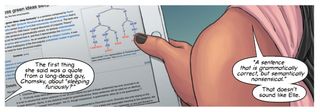
K10297You wrote a book in the last few years called The Recursive Mind. What is recursion and why is it important?

Recursion can refer to a procedure that references itself or similar procedures, or to a structure that contains an embedded structure of the same type. It is important because it allows one to build entities of theoretically unlimited complexity by progressively embedding structures within structures.

Some scholars think that language may be built on the use of recursive building blocks. Isn’t that a fundamental tenet of the modern linguistics pioneered by Noam Chomsky.

Yes, Chomsky’s view of language is that it is recursive, and this gives language its potential for infinite complexity—or what he has also called “discrete infinity.” In recent formulations, this is achieved through an “unbounded Merge,” in which elements are merged, and the merged elements can then themselves be merged—a process that can be repeated without bounds. To Chomsky, though, language is essentially internal thought, a mental monologue, known as I-language, and not a means of communication. The structure of language is therefore a by-product of internal thought. This implies a common structure, called “universal grammar,” that underlies all languages. But there is growing doubt as to whether such a structure exists.

More here.

Friday Poem

Bull Song

For me there was no audience
no brass music either,
only wet dust, the cheers
buzzing at me like flies,
like flies roaring.

I stood dizzied
with sun and anger,
neck muscle cut,
blood falling from the gouged shoulder.

Who brought me here
to fight against walls and blankets
and the gods with sinews of red and silver
who flutter and evade?

I turn, and my horns
gore blackness.
A mistake, to have shut myself
in this cask skin,
four legs thrust out like posts.
I should have remained grass.

The flies rise and settle.
I exist, dragged, a bale
of lump flesh.
The gods are awarded
the useless parts of my body.

For them this finish,
this death of mine is a game:
not the fact or act
but the grace with which they disguise it
justifies them.

by Margaret Atwood