Pirzada Qasim – Zakham Dabay Tu Phir Naya Teer Chala Diya Karo

There is a tradition in Urdu poetry of poets singing their own poems a capella in melodies of their own devising. This is a good example of a contemporary poet doing just that. Pirzada Qasim is an accomplished scientist and educator in addition to being a poet. He has served as Vice Chancellor of Karachi University.

This post is dedicated to Robert Pinsky for whom I sang the first two couplets of this poem recently. He seemed to like it. Well, at least he was polite enough not to say otherwise! Enjoy. 🙂

Democracy Causes Economic Development?

Daron

Daron Acemoglu, Suresh Naidu, James A Robinson and Pascual Restrepo in Vox EU:

A belief that democracy is bad for economic growth is common in both academic political economy as well as the popular press. Robert Barro’s seminal research in this area concluded that “More political rights do not have an effect on growth…The first lesson is that democracy is not the key to economic growth” (Barro 1997, pp. 1 and 11). Meanwhile, reacting to the rise of China, New York Times columnist Tom Friedman argues:

“One-party nondemocracy certainly has its drawbacks. But when it is led by a reasonably enlightened group of people, as China is today, it can also have great advantages. That one party can just impose the politically difficult but critically important policies needed to move a society forward in the 21st century []

In “Democracy Does Cause Growth”, we present evidence from a panel of countries between 1960 and 2010 challenging this view. Our results show a robust and sizable effect of democracy on economic growth. Our central estimates suggest that a country that switches from nondemocracy to democracy achieves about 20% higher GDP per capita in the long run (over roughly the next 30 years). These are large but not implausible effects, and suggest that the global rise in democracy over the past 50 years (of over 30 percentage points) has yielded roughly 6% higher world GDP.

There are several challenges in estimating the impact of democracy on growth. First, existing democracy indices are typically subject to considerable measurement error, leading to spurious changes in the democracy score of a country even though its democratic institutions do not truly change.

More here.

On Joyce and Syphilis

0076-GettyImages-Harpers-1407-390 (1)

Kevin Birmingham in Harper's blog (James Joyce © Photo Researchers/Getty Images):

In 1917, while walking down a street in Zurich, James Joyce suffered an “eye attack” and remained frozen in agony for twenty minutes. Lingering pain left him unable to read or write for weeks. Joyce had endured at least two previous attacks, and after the third he allowed a surgeon to cut away a piece of his right iris in order to relieve ocular pressure. Nora Barnacle, Joyce’s partner, wrote to Ezra Pound that following the procedure Joyce’s right eye bled for days.

Joyce was suffering from a case of glaucoma brought on by acute anterior uveitis, an inflammation of his iris. It was, unfortunately, nothing new. Joyce’s first recorded bout of uveitis was in 1907, when he was twenty-five years old, and the attacks recurred for more than twenty years. To save his vision, Joyce had about a dozen eye surgeries (iridectomies, sphincterectomies, capsulectomies) — every one of them performed without general anesthetic. He lay in dark rooms for days or weeks at a time, and his post-surgical eye patches became his trademark. Doctors applied leeches to siphon blood from his eyes. They gave him atropine and scopolamine, which cause hallucinations and anxiety, to dilate his pupils. They administered vapor baths, sweating powders, cold and hot compresses, endocrine treatment and iodine injections. They prescribed special diets (oatmeal and leafy vegetables) and warmer climates. They disinfected his eyes with silver nitrate, salicylic acid, and boric acid; instilled them with dionine to dissipate nebulae; and doused them with cocaine to numb the pain. Nothing really helped.

More here.

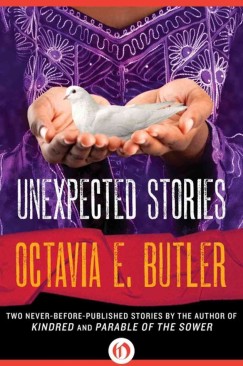
On Octavia Butler’s “Unexpected Stories” and Margaret Mitchell’s “Gone With the Wind “

9781497601376_custom-9804f2ef49a1f2e61e32d2d56952e55b10ac3375-s6-c30-243x366

Noah Berlatsky in The LA Review of Books:

The utopia in Gone With the Wind is predicated on the insistence that black people in the South found slavery to be a pretty good life. In the voice of its heroine, the novel asserts that “slaves were neither miserable nor unfortunate. The negroes were far better off under slavery than they were now under freedom, and if she didn’t believe it, just look about […]!” — as if looking around would offer reassurance.

Mitchell takes care to make her black characters — or at least her “good” black characters — constantly express their enthusiasm for the antebellum hierarchy. Mammy, Scarlett’s longtime nurse and companion, may be “black, but her code of conduct and her sense of pride were as high as or higher than those of her owners.” Mitchell means that Mammy looks down on poor whites and field slaves alike; she is fiercely protective of the social standing of the O’Haras’. In the world of this novel, Mammy sees herself as a member of the family, and her service is based on love and affection, rather than on fear that she might be whipped, raped, or shot at will. Blacks in Gone With the Wind identify so closely with their white families that when Atlanta is invaded, the slaves are panic-stricken, actually afraid of freedom, as if they’re children about to be robbed of their parents. In Mitchell’s portrayal of Reconstruction, “good” black people, like Scarlett’s former foreman, Big Sam, express as much horror at the new, fallen world as the whites do. A group of Yankees “ast me ter set down wid dem, lak Ah wuz jes’ as good as dey wuz,” Sam says, with mixed indignation and confusion. Visions of utopia in Gone With the Wind become forces for imperialism in themselves. In this case, the prey is actively enthusiastic about being fed on by the mosquitoes. For Mitchell, happiness legitimizes, and enables, slavery.

Octavia Butler’s final book, the vampire novel Fledgling,explicitly draws the links between blood, slavery, and happiness. The narrator is an “Ina” — a young, black female vampire — named Shori. Shori uses her bite, which is physically and emotionally addictive, to surround herself with a number of dependent “symbionts” who love and serve her, sexually and otherwise. The novel, which is told from Shori’s point of view, encourages the reader to sympathize with her as she builds a small, utopian community ruled by herself as benevolent mistress. However, as Isaac Butler points out on my website, the Hooded Utilitarian, if you read against the novel just a little bit, the subtext is disturbing.

More here.

The Argentina Debt Case

Cristina_Fernandez_Comandante_en_Jefe

Jayati Ghosh in Naked Capitalism (image from wikimedia commons):

Ever since it bought Argentine bonds at around 20 per cent of the face value in 2008, it has been pursuing the case both legally and physically. In 2012, it hired mercenaries to detain and try to seize an Argentine ship where it was docked off the coast of Ghana; at another time it even attempted to grab the Argentina Presidential plane from an airport—as “collateral” for its supposed holding of debt. Legally, NML Capital and another vulture fund, Aurelius Capital Management LP, have been pursuing a case in a New York district court, demanding full payment on their debt, of the value of around $1.5 billion. It has been estimated by the Argentine government that this could amount to a return of more than 1600 per cent on the initial investment made by these vulture funds.

In 2012, U.S. District Judge in New York Thomas Griesa ruled in favour of the hedge funds, which was both extraordinary in law and devastating in its potential implications not just for Argentina but for finance in general. The Argentine government appealed against it, but this appeal has now been dismissed by the U.S. Supreme Court.

Consider just some elements of this U.S. court decision. First, it is based on a peculiar and unprecedented interpretation of the pari passu (equal treatment) clause, which holds that all bond holders must be treated alike. The courts have interpreted this to mean that a sovereign debtor must make full payment on a defaulted claim if it makes any payments on restructured bonds. So if the bondholders who agreed to restructure 93 per cent of the Argentine debt are being paid according to their agreement, then the other resisting bond holders must also be paid the full value of their debts!

The immediate effect of this would be to disable Argentina from repaying $832 million of debt to other bondholders (who have already received around 90 per cent of their debt) unless it also pays the holdouts in full, thereby forcing the country into technical default. Economy Minister Alex Kicilloff noted in a speech to the United Nations that this contradicts Argentina’s own laws and its clear agreements with creditors in the restructuring process that it would not treat other creditors differently. An official statement from the Argentine government called this judgement “senseless and unheard of”, and pointed out that by attempting to block the payment, the judge “has abused his power and gone outside of his jurisdiction because the holders of restructured bonds are not the object of this litigation.”

This is effectively leaving the country no choice but default on its other legal obligations. “Not paying while having the resources and forcing a voluntary default is something that is not contemplated in Argentine law. It would be a clear violation of the debt prospects.”

This absurd interpretation of the pari passu clause does indeed have systemic implications. It effectively makes a mockery of all debt renegotiation agreements, since there would be no incentive for any creditor to accept less than full value of the debt if some other creditor will be paid in full. It is therefore also in contradiction to the United States’ own bankruptcy laws under Chapter 9 and Chapter 11. Indeed, bankruptcy laws are in place in most market economies precisely to ensure that there can be an orderly workout when debts cannot be repaid in full.

There is a reason for this. No credit system can function or has ever functioned with zero default. This possibility of default is embedded into credit contracts through the interest rate, with interest rate spreads operating as the market estimate of the probability of a default.

More here.

Sunday Poem

“Before the beginning is the end of another beginning.” —R.Bob

History of the Future

Again a new era has been promised. It’s
already here, curled like a fetus. About to be born.
They say it’s a new world. But here is the history of its future:

Somewhere at some point in time
documents and papers will be required.
There will be a receptionist at a government office
or a security screener at an airport, but
in every era somewhere in the world
a gendarme is liable to demand papers.

This means: Somewhere in the world a passport will be forged.

And someday an army will invade a city, called
Prague or Baghdad
or New York. Any name is possible.
Many things will happen under cover of night.
Knocks on the door.
Arbitrary arrest.
A father torn from the arms of his child,
His disappearance.

Many things will happen in broad daylight.
Looting
rape
slaughter.
In the marketplace and the stock market, trade will continue as usual. So will
the pogrom.

Very soon the mob will join in:
Spraying slogans against one minority or another
for one reason or another. A demand
will be made to prohibit entry to the continent, the country
or the grocery store.
At its door a puppy will wait for its master.
Someone will leave behind books and photos,
an old blanket, a magnificent armchair of happiness.
And someone he loves.
But he will not forget to take a coat.
With pockets. As long as he leaves in time
with his face. And with cash.
Many will flee on foot.
Some will escape by train.

There is no escapee without a pursuer.
There is no shelter without a storm.
The world is a rifle butt
The night — flashing police cars.

At least one person — perhaps even you? — will lose
the way, pray it ends. There he is, look,
leaning on the parapet of the dark;
boats going by downriver
and cars on the bridge
grab him
for a fraction of a second.
He jumps.
Or stays. But manages to fall away
like a view through a window.

Your window, perhaps?
.

by Shachar Mario Mordechai
from Toldot ha atid
publisher: Even Hoshen, Raanana, 2010

it is not anti-Semitic to say: not in my name

Laurie Penny in New Statesman:

BoyPeople of Jewish descent have every reason to be hyper-vigilant about anti-Semitic language and it is stupid to pretend that there’s none of it in the global movement for Palestinian freedom. It’s stupid to pretend that nobody ever conflates Jews with Zionists, or labels the Jewish people bloodthirsty and barbarous. And it hurts like hell to hear hoary old words of hate trickling through a movement that is about justice, about freedom, about protecting some of the world’s most persecuted people. It hurts just as much, however, to hear right-wing Israelis tell Jews around the world that the violence is for us, for our ancestors, for our children.

It is not anti-Semitic to suggest that Israel doesn’t get a free pass to kill whoever it likes in order to feel “safe”. It is not anti-Semitic to point out that if what Israel needs to feel “safe” is to pen the Palestinian people in an open prison under military occupation, the state’s definition of safety might warrant some unpacking. And it is not anti-Semitic to say that this so-called war is one in which only one side actually has an army. It is not hate speech to reiterate the wild disparity in casualties. More than 600 Palestinians have been killed this past week, most of them civilians. Fewer than 30 Israelis have died, and most of them were soldiers. To speak of proportionality is not to call, as at least one silverback columnist has claimed, for “more dead Jews”.

More here.

On the Slaughter: A political poem’s ironic new life

Peter Cole in The Paris Review:

And cursed be he who cries out: Revenge!
Vengeance like this, for the blood of a child,
Satan has yet to devise.
Let the blood fill the abyss!
Let it pierce the blackest depths
and devour the darkness
and eat away and reach
the rotting foundations of the earth.

Bialik_parisreview-001Political poems lead strange lives—they often wither on the vines of the events they’re tied to. Old news gives way to new, and the whole undertaking starts to seem, well, an expense of spirit in a waste of shame. For many and maybe most American readers, “poetry and politics just don’t mix.” But sometimes they do. Quite violently. On June 12, three Israeli teenagers were kidnapped while hitchhiking home together from their West Bank yeshivas. They were murdered—most likely within hours of being taken—and, eighteen days later, after an extensive search, their bodies were discovered under some rocks in a field near Hebron. Israel mourned, and raged. Emerging from a cabinet meeting convened just after the corpses were found, Prime Minister Benjamin Netanyahu expressed his condolences to the families and quoted the great modernist Hebrew poet Hayim Nahman Bialik: “Vengeance … for the blood of a small child, / Satan has not yet created.” He went on in his own words: “Hamas is responsible—and Hamas will pay.” For good measure, the Prime Minister’s office tweeted the lines as well.

…Several days before Israel deployed its Protective Edge, a New York Times article quoted Netanyahu quoting Bialik; a few days later, the paper’s editorial deplored the metastasizing racist rhetoric. “Even Mr. Netanyahu,” the paper wrote, “referenced an Israeli poem that reads: ‘Vengeance for the blood of a small child … ’ ” Then it carefully weighted the paragraph for the usual pantomime of equal time, noting that Israelis have long had to live with Hamas’s violent ways and put up with hateful speech from Palestinians. Never mind that the poem intoned by Mr. Netanyahu wasn’t Israeli: it was written long before the state was founded and very far from it. “On the Slaughter” was the thirty-year-old Odessan Hayim Nahman Bialik’s immediate response to the April 1903 pogroms in the Bessarabian town of Kishinev, where some forty-nine Jews were slashed, hacked, and cudgeled to death, or drowned in outhouse feces, and hundreds were wounded over the course of several days. Women and girls were raped repeatedly. The Jewish part of town was decimated. Netanyahu quoted just two lines, carefully avoiding the one preceding them: “Cursed be he who cries out: Revenge!”

More here. (Thanks to C.M. Naim).

Saturday, August 2, 2014

Laughter in Ancient Rome

Gregory Hays in the New York Review of Books:

Hays_1-071014_png_250x938_q85In 1984 the American satirist Veronica Geng was asked to introduce a reprint of Dwight Macdonald’s Parodies: An Anthology from Chaucer to Beerbohm—and After. Rather than writing a conventional preface, she decided to depict the authors in the anthology as characters from the Travis McGee mysteries of John D. MacDonald—or rather, from their jacket blurbs: “Cyril Connolly—whose bait box harbored a poisonous cargo”; “Robert Benchley—the Vietnam vet who drifted freely between the glittering cabanas of the Fun Coast and the oil-stained walkways of a derelict marina”; “Jane Austen—bright, petite, blonde, suntanned—she couldn’t get a license to open her health spa, but she didn’t need a license to kill.”

Why is this piece funny? The answer, according to one popular theory, is that humor is grounded in incongruity. Certainly a good part of the fun here lies in encountering familiar figures in an unfamiliar light: H.L. Mencken as ill-fated condo salesman, or Ring Lardner as “human flotsam” churned up by the “Colombia drug-smuggling underground.” And of course the whole piece rests on a basic crossing of verbal wires (what if Dwight Macdonald were John D. MacDonald?).

A rival explanation holds that laughter springs from a feeling of superiority—a “suddaine Conception of some Eminency in our selves,” as Hobbes put it, “by Comparison with the Infirmityes of others.” Geng’s squib might seem to offer less support for this theory. But look again. Obviously the piece requires some generic familiarity with hard-boiled detective novels and their blurbs. But it also helps to know something about the individual authors. For the descriptions are not as arbitrary as they may appear. “Petite, blonde” Jane Austen’s unlicensed “health spa” is Bath transported to the Gulf Coast. The real Cyril Connolly’s bait box really did harbor a poisonous cargo. Benchley was adrift in his later years, his talent drained by Hollywood (“the Fun Coast”) and the bottle (the “derelict marina”).

More here.

How Death Valley’s ‘sailing stones’ move on their own

Becky Crew in Science Alert:

ScreenHunter_734 Aug. 02 22.52Located above the northwestern side of Death Valley in Eastern California's Mojave Desert, an exceptionally flat dried lake called Racetrack Playa contains a peculiar phenomenon. Dozens of large stone stabs made of dolomite and syenite – often weighing as much as 318 kilograms – move across the cracked mud, leaving a series of smooth trails behind them.

Some of these trails stretch for a whopping 250 metres. They often form a nice, lightly curved line, but sometimes they form sharp, zig-zagging angles, implying a sudden shift to the right or left. These ‘sailing stones’, as they’ve been nicknamed, are so common on the the Racetrack Playa, they make it look like a well-worn racetrack, hence the name. (Playa is another word for ‘dried lake’.)

It’s obvious that these stones are moving because of the trails, but how? No one knew. Since the 1900s researchers and casual observers were fascinated by the stones but no one could explain how they moved. And the biggest factor that kept the answer obscured over a century was that to this day, no one’s ever seen them move.

According to Marc Lallanilla at LiveScience, while the less informed guesses included everything from aliens and magnetic fields to good old-fashioned pranksters, a popular theory among researchers was that dust devils, which are strong, relatively long-lived whirlwinds, were pushing the stones around as they swept across the playa. But this theory, and others that cropped up, were all disproved.

And then in 2006, planetary scientist Ralph Lorenz from the Johns Hopkins University Applied Physics Laboratory in the US started investigating the sailing stones. He came to the Racetrack Playa with an interest in studying its similarities to a hydrocarbon lake on Saturn’s moon, Titan, and stayed to put an end to a long-standing mystery.

To do so, all he needed was a small rock, some water, and an ordinary Tupperware container. Lorez put the small rock in the bottom of the Tupperware container and filled it with a few centimetres of water. Then he put the whole thing in the freezer.

More here.

Top 10 Reasons I Don’t Believe in God

Greta Christina in AlterNet:

God1: The consistent replacement of supernatural explanations of the world with natural ones.

When you look at the history of what we know about the world, you see a noticeable pattern. Natural explanations of things have been replacing supernatural explanations of them. Like a steamroller. Why the Sun rises and sets. Where thunder and lightning come from. Why people get sick. Why people look like their parents. How the complexity of life came into being. I could go on and on.

All these things were once explained by religion. But as we understood the world better, and learned to observe it more carefully, the explanations based on religion were replaced by ones based on physical cause and effect. Consistently. Thoroughly. Like a steamroller. The number of times that a supernatural explanation of a phenomenon has been replaced by a natural explanation? Thousands upon thousands upon thousands.

Now. The number of times that a natural explanation of a phenomenon has been replaced by a supernatural one? The number of times humankind has said, “We used to think (X) was caused by physical cause and effect, but now we understand that it's caused by God, or spirits, or demons, or the soul”?

Exactly zero.

More here.

War and Peace: the history of Russia during the Napoleonic campaign

James Wood in The Guardian:

War-and-peace-009Henry James once said that “really, universally, human relations stop nowhere,” and that the exquisite problem of the writer is to draw the circle “within which they shall happily appear to do so”. James would never have nominated War and Peace – he famously thought it a “loose baggy monster” – but Tolstoy's novel is surely the greatest attempt in the history of the genre to represent and embody the branching infinity of human relations of which James spoke. And there is no better example of that challenge than the way in which Tolstoy's project kept growing. He wrote War and Peace between 1863 and 1868, and intended, at first, to write a domestic chronicle in the manner of Trollope (whom Tolstoy, with a few qualifications, admired). The novel would be set in 1856, and concern an aristocratic revolutionary and his return from exile in Siberia. It would be called, improbably, All's Well That Ends Well. But in order to explain the atmosphere of Russia just after the Crimean war, Tolstoy felt he had to go back to 1825, when the Decembrists, a group of largely upper-class rebels, were arrested, and either executed or exiled. And 1825, he later said, could not be described without going back to the momentous year of 1812, when Napoleon invaded Russia and occupied Moscow for a month. Yet 1812 obviously needed 1805 as a proper prelude – which is where War and Peace begins.

Inexorably, what began as Russianised Trollope widened and deepened, until it became nothing less than the attempt to write the history of Russia during the Napoleonic campaign – in fact, it became the quarry that Tolstoy had identified as a young man, in his journal: “To write the genuine history of present-day Europe: there is an aim for the whole of one's life.” And as this originally “English” novel became more complex and ambitious, so it became singular and unconventional. Tolstoy claimed that it was “not a novel”, at least in the familiar, European sense. We Russians, he said, produce strange misfits, awkward black sheep, like Gogol's unfinished picaresque, Dead Souls, and Dostoevsky's semi-fictionalised account of his time in a Siberian prison camp, The House of the Dead. Gustave Flaubert seemed to agree. Admiring and horrified, he complained that Tolstoy “repeats himself, and he philosophises”: sins good formalist novelists should not commit.

More here.

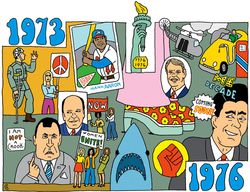
A Distant Mirror: modern conservative movement in America from1973 to 1976

Frank Rich in The New York Times:

RichNext to the more apocalyptic spells of American history, the dismal span of 1973 to 1976 would seem a relative blip of national dyspepsia. A period that yielded the blandest of modern presidents, Gerald Ford — “a Ford, not a Lincoln,” as he circumspectly described himself — is not to be confused with cataclysmic eras like the Civil War, the Great Depression and the Vietnam ‘60s. The major mid-70s disruptions — the Watergate hearings and Richard Nixon’s abdication, Roe v. Wade, the frantic American evacuation of Saigon, stagflation, the dawn of the “energy crisis” (then a newly minted term) — were adulterated with a steady stream of manufactured crises and cheesy cultural phenomena. Americans suffered through the threat of killer bees, “Deep Throat,” the Symbionese Liberation Army, a national meat boycott, “The Exorcist,” Moonies and the punishing self-help racket est, to which a hustler named Werner Erhard (né Jack Rosenberg) attracted followers as diverse as the Yippie Jerry Rubin and the Apollo astronaut Buzz Aldrin. Even the hapless would-be presidential assassins of the Ford years, Lynette (Squeaky) Fromme and Sara Jane Moore, were B-list villains by our national standards of infamy.

“I must say to you that the state of our Union is not good,” our unelected president told the nation in January 1975. That was true enough. America’s largest city was going bankrupt. Urban crime was metastasizing. The C.I.A. was exposed as a snake pit of lethal illegality. The nostalgic canonization of the Kennedy presidency, the perfect antidote to the Nixon stench, was befouled by the revelation of Jack Kennedy’s mob-moll paramour. Yet the mood of the union was not so much volatile as defeated, whiny and riddled by self-doubt. As Americans slouched toward the Bicentennial celebrations of July 4, 1976, pundits were wondering whether the country even deserved to throw itself a birthday party. “Everyone wanted to be somewhere else,” Rick Perlstein writes in “The Invisible Bridge.”It says much about Perlstein’s gifts as a historian that he persuasively portrays this sulky, slender interlude between the fall of Nixon and the rise of Reagan (as his subtitle has it) not just as a true bottom of our history but also as a Rosetta stone for reading America and its politics today.

More here.

Afghanistan’s Prison Children

Mike Healy on the Al Jazeera show 'People and Power':

Children_in_badam_bagh_prison

Badam Bagh prison (Credit: Anja Niedringhaus/AP)

Once we got there, perhaps the biggest surprise was just how young the majority of the children were. But actually it made sense that the very youngest children including newborns in need of the greatest care remained with their mothers — in prison. When the fathers have to travel hundreds of miles to find work, it is left to relatives to care for the children who remain outside prison. One father described how he is forced to lock his children in the house for their own safety while he is out working. Even when they are at home, they are imprisoned.

However, in a country where reputation is everything, the children of prisoners are often disowned and left to live off the streets. Needless to say, these children are more vulnerable to dangers such as drug addiction, and inevitably, crime. On the inside, the children growing up in prison are desensitised to their environment and likely under the influence of genuine criminals. Inside or out, the system encourages criminality and despair.

The numbers of figures involved are difficult to estimate, especially as the children may have spells in prison followed by time with relatives outside, but its thought to be in the hundreds at least. There are also orphanages and children's centres throughout Afghanistan, some of them excellent, like the USAID-funded centre in Mazar-e-Sharif, but others of a poor standard where abuse is rife. It is understandable if incarcerated mothers are reluctant to trust their babies to the care of strangers miles away.

We interviewed a local psychologist on the subject. He described how vulnerable children will struggle to understand their predicament. For example, if their mothers insist that they are innocent and yet they are living in jail, this will give them a skewed understanding of morality and justice, and a lack of motivation therefore to be good citizens.

In addition, they may come to resent their own mothers for the lives they have given them. And even if the mothers were innocent to begin with, they may become damaged and cynical parents as the years pass. Both mothers and children may eventually become institutionalised and feel safer behind the prison walls, especially when life outside is so harsh.

Read the rest and watch the segment here.

Saturday Poem

The Death of the Hired Man

Mary sat musing on the lamp-flame at the table
Waiting for Warren. When she heard his step,
She ran on tip-toe down the darkened passage
To meet him in the doorway with the news
And put him on his guard. ‘Silas is back.’
She pushed him outward with her through the door
And shut it after her. ‘Be kind,’ she said.
She took the market things from Warren’s arms
And set them on the porch, then drew him down
To sit beside her on the wooden steps.

‘When was I ever anything but kind to him?
But I’ll not have the fellow back,’ he said.
‘I told him so last haying, didn’t I?
If he left then, I said, that ended it.
What good is he? Who else will harbor him
At his age for the little he can do?
What help he is there’s no depending on.
Off he goes always when I need him most.
He thinks he ought to earn a little pay,
Enough at least to buy tobacco with,
So he won’t have to beg and be beholden.
“All right,” I say, “I can’t afford to pay
Any fixed wages, though I wish I could.”
“Someone else can.” “Then someone else will have to.”
I shouldn’t mind his bettering himself
If that was what it was. You can be certain,
When he begins like that, there’s someone at him
Trying to coax him off with pocket-money,—
In haying time, when any help is scarce.
In winter he comes back to us. I’m done.’

‘Sh! not so loud: he’ll hear you,’ Mary said.

‘I want him to: he’ll have to soon or late.’

‘He’s worn out. He’s asleep beside the stove.
When I came up from Rowe’s I found him here,
Huddled against the barn-door fast asleep,
A miserable sight, and frightening, too—
You needn’t smile—I didn’t recognize him—
I wasn’t looking for him—and he’s changed.
Wait till you see.’

Read more »

Chris Blattman on Cash, Poverty, and Development

VZ0ZtHnC

Russ Roberts over at EconTalk interviews Chris Blattman:

Russ: So, you have been writing a series of articles and done quite a bit of research, and I hope we get into much of that. Arguing that giving people cash rather than more complicated forms of development or welfare might be the right way to go for helping people who are desperately poor. What's the basic argument?

Guest: Well, the basic argument is not necessarily that cash is more effective than other forms of assistance, but that it's effective relative to its cost. It isn't always; but it can be very, very, very inexpensive to deliver. So if you have any kind of utilitarian view of the world and you want to help as many people as possible, then you pay attention to that. And so the question is: What is it good at? And there's a two-part answer. One is, like anywhere, people can use cash to buy the things they need. Maybe that's just shelter and food. And that can be here or that can be in the poorest country. But I think especially in a poorer country where a lot people have potential to be self-employed. Mainly because there aren't firms, so there aren't jobs, they are held back from self-employment because they don't have capital. And one of the cheapest ways to get them capital, to help [?] by a lot of things; but capital is really important. And cash can be one of the effective ways to put capital into their hands. But then the question is: When the poorest get cash, especially what people might think of as the more vulnerable or the more risky, high-risk young men for example, what kinds of decisions do they make with cash? We weren't surprised they didn't have access to it. But I think the big question has been: Do they invest it or do they spend it on “good things”?

More here.

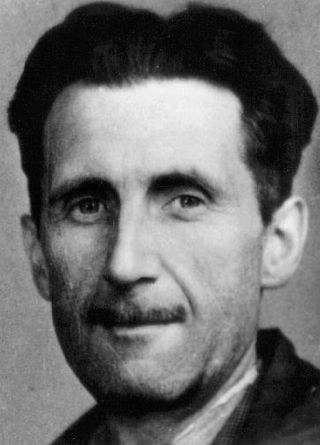
Forever Orwell

George_Orwell_press_photo

Francis Mulhern in New Left Review:

Rob Colls’s intellectual portrait George Orwell: English Rebel joins an already substantial body of commentary—his introduction lists some twenty predecessors, who themselves are only a sub-set of the much larger corpus of writing devoted to the man, the works and their afterlife.[1] Where he differs from these is in his particular interest in Englishness, which has been his speciality as a historian over the past thirty-odd years. That too has been a busy field, and the result is a book of conspicuous learning, more than a quarter of its length given over to the scholarly apparatus. It is also, within its simple chronological scheme, a digressive book, here taking off to explore some aspect of a general situation, there pausing over some circumstance or consideration, as if wanting to find room for everything. In this, Colls is faithful to his general understanding of Englishness as a historical formation: the title of his principal work on the topic, a loose-limbed discussion ranging from the Middle Ages to the present, is an awkward, telling epitome of his position. Identity of England (2002) finds its form by negation of the more obvious and fluent phrasings to hand in the book itself. (Omit the essentializing or stipulativeThe . . . while avoiding an easy, evasive plural or the deceptive calm of English Identity: national character is a singular not a plural, yet indeterminate and changeful.) Colls’s understanding of Orwell is of a piece with this. ‘I am not saying that Englishness is the key to Orwell . . . There is no “key” to Orwell’, he writes in his Introduction, ‘any more than he is a “box” to open.’ But then, in a parting sentence whose placing and manner are worth noting for later consideration: ‘His Englishness, though, is worth following through.’

This is the optic through which Colls reviews the familiar course of Orwell’s life: private schooling and service in the Imperial Indian Police (1922–28); the rejection of Empire and return to England with the aim of becoming a writer; living hand to mouth in Paris, hop-picking and tramping in the South of England, a self-styled Tory anarchist discovers the poor (1928–31); the early novels and the decisive encounter with the North of England working class (1932–36); a socialist fighting in Spain, fighting at home, against fascism, Stalinism and war (1937–39); the herald of revolutionary patriotism (1940–43); the fabulist of political betrayal (1943–50). The turning-point in the sequence comes in 1936, and its significance, as Colls reads it, is that during his two months of fieldwork for the publishing commission that became The Road to Wigan Pier, Orwell ‘for the first time in his life found an England he could believe in’, a popular, proletarian Englishness that would serve him as a political stimulus and test from then onwards, inspiring his wartime advocacy of revolutionary patriotism.

The test applied in two ways. It served to justify Orwell’s unrelenting campaign against the left intelligentsia, whom he portrayed as a menagerie of grotesques, rootless eccentrics with a fatal weakness for abstraction and hard-wired doctrine, gullible in the face of Soviet boosterism and nihilistic in their attitude towards English institutions. Colls relays these themes in a kindred spirit, as contemptuous as Orwell if not so inventively abusive in his treatment of abstractions, systems, ‘set-squares and equations’, dogmas asserted in disregard of personal experience and what is ‘reasonably assumed to be the case’—everything that is suggested to him by the word ‘ideology’. However, he goes further and applies the test to Orwell himself. The ‘ludicrous’ anti-intellectualism, as he sees it, was at least in part a projection of the feelings of deracination that Orwell recognized and feared in himself.

More here.

Friday, August 1, 2014

China’s Bad Dream

Gene-Frieda

Gene Frieda in Project Syndicate:

China’s debt/GDP ratio, reaching 250% this month, remains significantly lower than that of most developed economies. The problem is that China’s stock of private credit would normally be associated with a per capita GDP of around $25,000 – almost four times the country’s current level.

There are strong parallels between China’s current predicament and the investment boom that Japan experienced in the 1980s. Like China today, Japan had a high personal savings rate, which enabled investors to rely heavily on traditional, domestically financed bank loans. Moreover, deep financial linkages among sectors amplified the potential fallout of financial risk. And Japan’s external position was strong, just as China’s is now.

Another similarity is the accumulation of debt within the corporate sector. Corporate leverage in China rose from 2.4 times equity in 2007 to 3.5 times last year – well above American and European levels. Nearly half of this debt matures within one year, even though much of it is being used to finance multi-year infrastructure projects.

Making matters worse, much of the new credit has originated in the shadow-banking sector at high interest rates, causing borrowers’ repayment capacity to become overstretched. One in five listed corporations carries gross leverage of more than eight times equity and earns less than two times interest coverage, weakening considerably these companies’ resilience to growth shocks.

More here.

Should Buying Sex Be Illegal?

Sex_work_protest_ap_img

Michelle Goldberg in The Nation:

[D]efining “trafficking” can be politically fraught; there is a gray area between absolute exploitation and total free agency. “Most cases of trafficking are not the media-popular story of somebody being forcibly taken out of their home and forcibly chained to a bed,” says the Red Umbrella Fund’s van der Linde. “In my experience, most cases of trafficking are about women who were actually already working as a sex worker but decided to work somewhere else as a sex worker, and came into a situation where they faced some form of exploitation.”

However they ended up in the country, some women working as prostitutes in the Netherlands are being coerced. Majoor is no abolitionist, but her off-the-cuff estimate is even larger than that of the National Threat Assessment. “I think between 5 and 10 percent of sex workers are actually trafficked,” she says—which, given 20,000 prostitutes in the Netherlands, would mean somewhere between 1,000 and 2,000 people.

Academic evidence suggests that trafficking is exacerbated by legalization. A 2012 article by the scholars Seo-Young Cho, Axel Dreher and Eric Neumayer, published in the journal World Development, concluded that “countries with legalized prostitution have a statistically significantly larger reported incidence of human trafficking inflows. This holds true regardless of the model we use to estimate the equations and the variables we control for in the analysis.”

This can seem counterintuitive—shouldn’t legalization reduce the role of force in the industry, since it allows more women to enter sex work legally? The explanation, according to Cho, Dreher and Neumayer, is that while more women enter prostitution voluntarily in a legal market, the increase in the number of clients is even greater. Demand outstrips supply.

More here.