
Category: Recommended Reading
Thursday Poem
Liberation
.
Captives
Arise
rise and chisel the mountains
mountains of dead traditions
mountains of blind beliefs
mountains of cruel hatreds.
In the prisons of our bodies
countless restless bodies
and grieving souls sob
they wander ’round from stairway to stairway
asking when we shall free them.
Our existence is for the future generations
we owe them,
those who will come into being
through us come into existence.
The severed head which gives birth to thousands of heads
is no longer just a story.
That which throbs in the blood,
is whining,
thousands of eyes from the veins of the body,
peering restless eyes
are saying this:
Captives
These, who sleep in a house,
of yellow stone
wrapped in sheets of insensitivity
tell them
to rise
and chisel the mountains.
We have to think of liberation.
by Rukhsana Ahmad
from We Sinful Women: Contemporary Urdu Poetry
The Women's Press, London, 1991
Wednesday, December 17, 2014
Today, for us young citizens, Pakistan feels like a country empty of dreams

Fatima Bhutto in Scroll (Photo Credit: Rizwan Tabassum/AFP):
There is no word for a parent who buries a child. No equivalent of widow or orphan in any language that I know, we do not have the language to describe a parent who lays his child into the earth before his time. So with what tongue do we speak of the dead now? It is a sorrow too large to bear.
But with sorrow, there is anger in Pakistan today. There is anger at those who turned their eyes away from terror and let the cost be paid in human lives. There is anger at those who offered the killers silence, refusing to condemn them by name. There is anger at those who saw some expediency in the deaths of innocents. There is anger, there is anger and then there is shame.
There is shame to read of the three first aid instructors who had come to teach the children of Peshawar’s Army Public School about emergency aid when they were killed.
There is shame to know that most of the dead, most of the children killed, were shot in the head.
There is shame towards those whom we cannot apologise to, to the countrymen we did not, could not, protect. Shahrukh Khan, 16 years old and asked to recount the horrors of the day told the press that the men who came to kill him and his classmates looked under the school benches, making sure they had left no one alive. Shahrukh, who was shot in both legs, stuffed his tie in his mouth to stop himself from screaming. What language do we have to reassure Shahrukh? When it comes to words, I have none.
Taliban, it bears noting, means students in Arabic.
What kind of student brings blood into a place of learning?
In the aftermath of the carnage in Peshawar, India announced a two-minute silence across their schools, a two-minute silence of grief and solidarity. Turkey called for a day of mourning. And in Pakistan today, we grapple with language. How do you eulogise a woman burned to death in front of her students? Who is a Taliban when so many public figures – anchor-men, politicians, and disaffected, alienated youth – trade in nothing but hate? How have we spoken this long of the terror we all face – the attack on the Istiqlal school in Kabul that killed six Afghans and injured many others, the women raped as they rode night buses in Delhi, and the children of Peshawar – without compassion for each other?
More here.
The Endlessly Examined Life: A most chronic depression
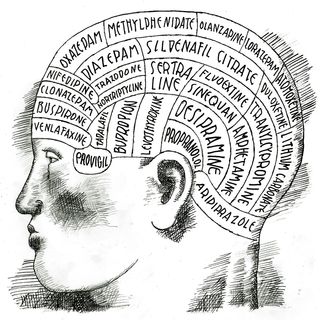
George Scialabba in The Baffler (illustration by Brad Holland):
My mental health file whirs to life in 1969 in Cambridge, Massachusetts. I’d recently left Opus Dei, the Catholic religious order to which I’d committed my young soul, and a major depression had followed. The records printed below are out of the mouths of my many caretakers; they chronicle my treatment at various medical offices and psychiatric clinics in the Boston area, from then until 2012.
How did I come by them? As I headed into a depression two years ago, a friend who was helping out thought it would be useful to see my records, so I asked for them. Why publish them now? Certainly not because I think these extracts from my treatment notes display any special literary facility or reveal an exceptionally interesting psyche, nor because I intend the slightest scandal to be visited on my therapists, employers, or insurance company. All proper names have been altered.
Our distractible human intelligence needs as many ways of talking about depression as can be provided—that’s all. Plus, given the longevity of this particular demon, it seems important to try to squeeze some insight from the mass of words and array of prescription drugs applied against its havoc. Even the most comprehensively bureaucratized medical knowledge can be made to speak, if only we are willing to listen closely to the blank spaces, the paraphrases. Even acronyms have feelings.
A note on medications: Fifty-plus years into the Antidepressant Age, it’s still not clear that drugs are better than placebos. There aren’t many long-term studies of efficacy or side effects, and the FDA requires surprisingly few trials before approval. Each of the drugs comes with a more or less plausible scientific explanation for why it should work. But all we know is that some people get better after taking them, some people don’t, and some people get better without taking them.
Of course, from a patient’s point of view, this is all moot. If you’re jumping out of your skin and the doctor says to take some pills, you take them. In my case, none of them worked spectacularly well. But only a couple had intolerable side effects or made the depression worse.
More here.
The Rise of ‘Welfare Chauvinism’

Thomas B. Edsall in the NYT:
The United States and Europe reveal the contrasting ways in which political systems in advanced democracies cope with factors as diverse as globalization, depressed wages, cultural tension, welfare policy, immigration and nontraditional family structures, along with racial, ethnic and religious division.
In the United States, the besieged two-party system has remained intact, protected by a 200-year-old tradition and an electoral system that cuts short any bid to create a viable third party.
There are two major costs to this stability: recurrent gridlock, which constricts legislative action, and a failure to provide full representation to the most aggrieved constituencies.
European democracies have taken a different path.
Parliamentary elections, often in conjunction with proportional representation, have allowed multiple parties — at both ends of the political spectrum — to flourish. In many cases, the European system has empowered anti-immigrant populist parties on the right. These parties have adopted a strategy that might seem strange on its face but actually makes sense, according to the logic of their grievances: exclusionary nationalism combined with generous support for safety-net programs available only to legal residents.
Here and abroad, there are striking similarities in the dynamic that is forcing major adjustments in the political system.
The working class on both sides of the Atlantic is struggling to adapt. “The separation, if not alienation, of the ‘working class’ from the traditional center-left parties” is a “global phenomenon shared by all post-industrial democracies,” Herbert Kitschelt, a professor of international relations at Duke, wrote in an email to me.
More here.
biopolitics, the Anthropocene and neoliberalism
Mat Coleman and Kathryn Yusoff interview Elizabeth Povinelli in Society and Space:
Elizabeth Povinelli: I must admit I have changed my use of the phrase late liberalism since publishing Economies of Abandonment. Whereas, you’re right, there I distinguished late liberalism from neoliberalism, I now use the phrase “late liberalism” to indicate a period, or development, in “liberalism” that stretches loosely between the late 1950s and the 00s. So late liberalism is meant as a way of periodizing and spatializing liberal formations. The argument is that from the 50s through the 70s, liberal governments—liberal governmentality—were shaken by two severe legitimacy crises. On the one hand, anticolonial, Native, and radical social movements shook the legitimacy of paternalistic liberalism and, on the other hand, Keynesian stagflation shook the legitimacy of the capitalist management of markets. From the perspective of these two slow moving events the politics of recognition and economics of neoliberalism should be seen as strategic containments of potentially more radical futures. It’s unclear whether in the wake of 9/11 multiculturalism remains the key mode of containing the radical otherwise and in the wake of the financial crisis of 2008 neoliberal market forms will mutate into something else.
More here.
Why there would have been no CIA torture without the psychologists
Steven Reisner in Slate:

The psychologists were vital to the torture program for one additional reason: The Justice Department’s Office of Legal Counsel had determined that the presence of psychologists and physicians, monitoring the state and condition of the prisoner being tortured, afforded protection for the CIA leadership and the Bush administration from liability and potential prosecution for the torture. Later, the OLC applied the same rules to the Defense Department’s “enhanced interrogation program,” which, according to an investigation by the Senate Armed Services Committee, was created and overseen by a team led by a clinical psychologist, and eventually overseen exclusively by clinical psychologists.
More here.
How horizontal gene transfer changes evolutionary theory
Ferris Jabr in Aeon:

Neochrome’s origins have long eluded scientists. As far as anyone knew, the gene that codes for neochrome existed in only two types of plants separated by hundreds of millions of years of evolution: ferns and algae. It was extremely unlikely that the gene had been passed down from a common ancestor, yet somehow skipped over every plant lineage between algae and ferns. About two years ago, while searching through a new massive database of sequenced plant genomes, Li found a near-exact match for the neochrome gene in a group of plants not previously known to possess the light-sensitive protein: hornworts. Through subsequent DNA analysis of living specimens – like those he collected in Florida – Li confirmed his suspicion: ferns did not evolve neochrome on their own; rather, they took the gene from hornworts.
More here.
Very Famous Ethical Puzzle: The Frege-Geach Problem
In search of the ‘New Turkey’

If a time traveller had come to visit me in the early 1990s and foretold a future where Turkey's conservatives would install an 81km-long underground railway network, with 65 stations, in Istanbul – a city of overcrowded buses and chronic traffic – I would have laughed at him. But, once in government, the AKP did indeed modernise the city to a great degree. In the preceding decades, defenders of Turkey's old political elite had adapted an isolationist, Eurosceptic and statist tone, and the economy they had created favoured only the privileged bureaucratic classes. This meant the closing of doors to “strivers” from the poor, rural communities. Yet the shifts that have taken place in the last decade, where Turkey's economic growth has brought migrants from those rural communities into the heart of its cities, have led to an uneasy reconciliation between religion and modernity. Conflicts between these two spheres became increasingly pronounced. Pious politicians asked for alcohol-free neighbourhoods and there were tighter regulations on events like rock concerts, which rang alarm bells for the secular youth; in response, members of the upper middle classes became more vocal in their complaints about Arab tourists and Syrian refugees, whom they accused of being backward.
In the first half of the noughties, a democratic, Islamic and pluralistic Turkey was an attractive proposition for Western observers who had been searching for ways of reconciling Islam and democracy in their own countries, especially after 9/11. In the West, Turkey was increasingly presented as a model for its Arab neighbours, while in the wake of Egypt's revolution in 2011 Erdogan surprised many Islamists in other countries by praising Turkey's secular model at a Muslim Brotherhood rally in Cairo.
more here.
The eloquent silences of Albert York and Judith Scott
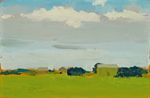
Generations of readers have puzzled over the opening lines of William Carlos Williams’s best-known poem: “so much depends / upon // a red wheel / barrow.” What exactly does depend on it? The poet, content to keep a secret, stays mum. There happens to be a red wheelbarrow in a 1974 painting by Albert York, whose work is now the subject of a beautiful retrospective in Manhattan at the Matthew Marks Gallery, through December 20. The wheelbarrow could be called pink, but I imagine that it’s a red that has faded from long exposure to the elements. And besides, York’s palette never included bright colors; pale, shadowy hues stood in for the whole spectrum. Whatever he painted he painted with uncanny concentration, as if nothing else existed for him except his perception or imagination of his subject in that moment. So much depended on it, though what he could never say. As the very first review of York’s work, in Art News in 1963, put it: “He is a specialist in very tiny, important differences.”
York, who died five years ago at age 80, was notoriously reclusive, so he might have been mortified by the show at Matthew Marks. But then, his viewpoint was singular: he would not attend exhibitions of his own work, and when he finally did—in 1989, at the Parrish Museum in Southampton, New York, just a few miles from his home—the result was devastating. What he’d done was “pretty bad. It has no relation to good painting,” he later told Calvin Tomkins, in the only interview he ever gave, for a New Yorker profile reprinted in the Matthew Marks catalog.
more here.
Ants Are Cleaning Up the Streets of NYC
Joe Turner in Scientific American:
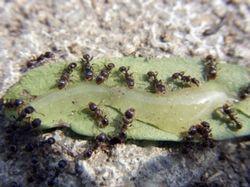
Over a period of six days, a team from North Carolina State University dropped hot dogs, cookies and potato chips around a 150-block section of New York City to study how much food-waste scavengers could eat in 24 hours. They found that arthropods—invertebrates with an exoskeleton, including insects and spiders—act as a rapid trash-clearance service. Pavement ants in particular are voracious consumers of food waste and together with other arthropods are capable of eating up to 6.5 kilograms (about 14 pounds) of waste per block per year. This chomping adds up to 60,000 hotdogs, 200,000 cookies or 600,000 potato chips across Broadway and West Street. The study was published December 2 in Global Change Biology. The researchers used insect traps to capture 32 different ant species around the city. They found more ant species in parks than in streets—but the ants of the street consumed more food. The important difference, it seems, is the presence of the introduced pavement ant (Tetramorium sp. E), one of the most common urban ant species in America. The pavement ant is a warrior species, emerging in the spring to fight other ants for the best real estate in battles that frequently leave ant body parts strewn across the sidewalk. They are not fussy eaters: they will converge on any discarded junk food they can get their mandibles on. Lead author Elsa Youngsteadt says the pavement ant’s environment might explain its aggressive eating habits. Youngsteadt thinks that the warm, dry conditions on the streets could be “amping up” the ants so that they can “run faster, eat more, and [get] thirstier than in parks, resulting in faster processing of food.”
More here.
The Invention of Clumsiness

One afternoon in May of 1853, the painter Eugène Delacroix went for a walk in the forest with two old friends. As they walked, the three men returned to topics they had discussed before: questions of spontaneity, how finished pictures are “always somewhat spoiled” compared to sketches. Together they admired a famous oak tree. They talked about Racine. Then they went back to Delacroix’s house for dinner. After the meal, Delacroix later recalled, “I made them try the experiment which I had done myself, without planning it, two days before.” The experiment was simple. First, he passed around a set of unusual pictures, photographic calotypes that Eugène Durieu, a pioneer in the new medium of photography, had taken at his request.1 In these small amber images, a naked man and woman appeared—sometimes alone, sometimes together; sitting, standing, or kneeling; often staring warily back at the lens. The naked couple are memorable to posterity, because they were among the first humans to be photographed without clothes. If they weren’t the Adam and Eve of photographic nakedness, they were among the earliest citizens of that now fairly populous realm. But they didn’t beguile or even impress the great painter and his companions. “Poorly built, and oddly shaped in places,” as Delacroix drily put it, the two models were “not very attractive generally.”
more here.
Tuesday, December 16, 2014
Did Salaita Cross the Line of ‘Civility’?
Joseph Levine in the New York Times:

While many of Salaita’s critics in the media accused him of anti-Semitism, the main issue seems to be — at least in the language of the university’s explanation of it’s action — whether Salaita’s tweets violated a norm of “civility” that is supposed to govern academic and political dispute (at least within the academy). I am not concerned here with the question of whether or not it was right to rescind the offer; to my mind, it was wrong — a straightforward violation of intellectual and academic freedom. Rather, I want to explore the notion of “civility,” particularly as it relates to one of the controversial tweets.
Here is the tweet in question:
Let’s cut to the chase: If you’re defending #Israel right now you’re an awful human being.
11:46 PM – 8 Jul 2014
At that point, Israel had begun intensive bombing of Gaza, and quite a few civilians had been killed, including children. (By the time a cease-fire went into effect in late August, according to the United Nations, more than 2,100 Palestinians had been killed, over two-thirds of them civilians, among whom almost 500 were children; 11,000 Palestinians were wounded, 20,000 homes were destroyed, and 500,000 people over all were displaced. During this period 70 Israelis were killed, 64 of whom were soldiers, and one of whom was a child.) So, was this tweet an illegitimate breach of civility? I believe not in the end, yet I must confess to some initial ambivalence on the question. Here is how I resolved that ambivalence.
More here.
Poem
Forgetfulness
The name of the author is the first to go
followed obediently by the title, the plot,
the heartbreaking conclusion, the entire novel
which suddenly becomes one you have never read,
never even heard of,
as if, one by one, the memories you used to harbor
decided to retire to the southern hemisphere of the brain,
to a little fishing village where there are no phones.
Long ago you kissed the names of the nine Muses goodbye
and watched the quadratic equation pack its bag,
and even now as you memorize the order of the planets,
something else is slipping away, a state flower perhaps,
the address of an uncle, the capital of Paraguay.
Whatever it is you are struggling to remember
it is not poised on the tip of your tongue,
not even lurking in some obscure corner of your spleen.
It has floated away down a dark mythological river
whose name begins with an L as far as you can recall,
well on your own way to oblivion where you will join those
who have even forgotten how to swim and how to ride a bicycle.
No wonder you rise in the middle of the night
to look up the date of a famous battle in a book on war.
No wonder the moon in the window seems to have drifted
out of a love poem that you used to know by heart.
by Billy Collins, from here. For Carla Goller.
Nurses: The white army
NB: This article, published two days ago, seems particularly relevant in light of today's horrific killing of more than a hundred schoolchildren in Peshawar, Pakistan.
Halima Mansoor in the Express Tribune:
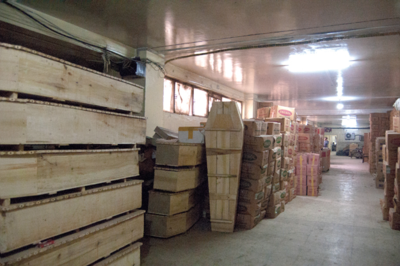
Coffins in storage area at Lady Reading Hospital, Peshawar. Photo: Halima Mansoor
On the surface, Peshawar is acclimated to bomb attacks — the city witnessed 39 blasts up until November this year according to the South Asia Terrorism Portal. For a city which goes boom by the hour, unless frantic sirens follow and the death counter careens towards double digits, it seems perfectly okay to turn over in bed and go back to sleep after an attack.
However, what is less obvious at first glance is that the resting rate of the city has changed — the heart does not beat 60 or 80 times per minute but pounds in synchronicity with the reverberations of the blasts. This seems even truer for the 600-odd nurses at the Lady Reading Hospital (LRH) — the default hospital for all emergencies in the city — who watch over the city of flowers, their green thumb weeding out the bullets, snipping off the gangrene and building armatures and grafts for broken bones. As four senior LRH nurses recall their run-in with death and suffering in the wake of a blast, the effect of these traumatic experiences can be seen in their posture, gesticulations and the lines under their eyes.
When terror strikes
“When a blast happens, the patients come straight to our casualty trauma room,” explains Nasreen Qayyum, the head nurse who has been working at the LRH since 1979. The trauma room is where the bulk of the aid is dispensed: first aid, IVs and even on-the-spot X-rays. As nurses triage patients, those in critical condition are sent onwards to surgery or the relevant ward. “We see the patient’s condition, how serious it is and treat them accordingly until they stablise or refer them onwards,” adds another nurse, Gulshanara. The trauma ward has at least five beds along with some space in the basement but victims are also shifted to regular wards in emergency situations. “We have even accommodated hundreds here [during catastrophic events] — that’s when we resort to doubling,” explains Nasreen, referring to the practice of having more than one patient on one hospital bed.
Read the full article here.
Anne Carson’s Dialogue of Grief

With their clear references to the myth and their book-length scope, we might be inclined to approach these books as contemporary heroic tales, and so we’d take the broad perspective of an ancient Greek audience in the day-lit amphitheater of Dionysus, apprehending the outlines of a tragedy like Euripides’ Herakles from afar. Carson, who has herself translated Euripides in Grief Lessons (New York Review of Books, 2006), and also translated numerous other Greek plays, reminds us that from this perspective “you can read the plot of a play off the sequence of postures assumed by its characters.” A play becomes a series of “tableaus,” each telegraphing a specific pose, from prostrate supplication to upright championship to flattened death. Each of these Geryon-Herakles books holds us with an agile and inventive plot that moves its characters through a progression of revealing tableaus. We could follow Geryon as young antihero under the sway of Herakles through a coming-of-age trajectory inAutobiography of Red: a flattened exchange between a mother and an adolescent “monster” at the kitchen table; that red boy on an nighttime adventure with his new tough boyfriend, standing high and triumphant on an overpass above “blowing headlights like the sea”; much later, his sliding off of Herakles’ bed and slinking out the exit alone into “the debris of the hotel garden” where he is laid flat by a punch from Herakles’ jealous new boyfriend; and, finally, Geryon taking flight into a volcano with his camera.
more here.
John Burnside on Seamus Heaney

It was Auden who famously claimed that “poetry makes nothing happen”, though what he meant by “nothing” is open to discussion. Yet if we choose to take that dictum at face value, there is no better test of its veracity than the work collected here – where, at the very least, poetry makes compassion happen (and compassion in turn gives rise to other events). There are, also, merits in its refusals – in what it will not aid and abet, as when the poet, returning from New York to Belfast, is confronted on the train by his old adversary, the man of violent action, in “The Flight Path”:
So he enters and sits down
Opposite and goes for me head on.
“When, for fuck’s sake, are you
going to write
Something for us?” “If I do write
something,
Whatever it is, I’ll be writing for myself.”
And that was that. Or words to that effect.
This is a dilemma Heaney also works through carefully in “Weighing In”, where he interrogates the efficacy (through the figure of the mocked and crucified Jesus), of “the power/Of power not exercised, of hope inferred//By the powerless forever”. Yet although it may be easy, in moral terms at least, to reject the gunman’s invitation to “drive a van/Carefully in to the next customs post”, it is also the case that, in a world where the balance no longer holds, the temptation to “Prophesy, give scandal, cast the stone” becomes harder to resist.
more here.
the funny parts of Geoff Dyer

The great risk of this essay is that I analyze to death any love, affection, or appreciation anyone might have for the funny bits in Geoff Dyer’s books. My defense comes down to this: seeing as there are so many funny bits in his books, isn’t it odd that they get discussed so seldom? The comedy in Dyer’s oeuvre, it seems to me, is taken as a given, as the light ground to the text that allows the dark, serious, big stuff to stand forth.
That’s one risk, to add to the two general risks we admiring Dyer critics run. Firstly, of taking an academic approach to a writer who took such great delight in burning in disgust a collection of academic essays on D.H. Lawrence—“How could it have happened? How could these people with no feeling for literature have ended up teaching it, writing about it?” And secondly, of saying anything too directly complimentary about a writer who states he has “little instinct for personal reverence and, though I’ve not exactly been inundated with offers, I know I would hate to be revered myself.”
He does make it clear that it’s reverence for the person that is unacceptable. Reverence for the work is fine—for about ten seconds. Perhaps this would be a good point to bring in his line (I’m not quite sure where it originates, but it crops up in plenty of interviews) about writing an inch from life: “I like to write stuff that’s only an inch from life, from what really happened, but all the art is of course in that inch.”
more here.
An Introduction to Homeopathy
Harriet Hall in The Skeptical Inquirer:

Homeopathic remedies are usually labeled with the notation X or C, corresponding to ten and one hundred. 15C would mean that one part of remedy was diluted in 100 parts of water, one part of the resulting solution was again diluted in 100 parts of water, and the process was repeated fifteen times. Hahnemann died before Avogadro’s number was available to calculate how many molecules are present in a volume of a chemical substance. Today we can calculate that by the thirteenth 1:100 dilution (13C), no molecules of the original substance remain. Hahnemann typically used 30C remedies.
More here.