
Category: Recommended Reading
Love in the Time of Military Courts
Fawzia Naqvi in Kafila:
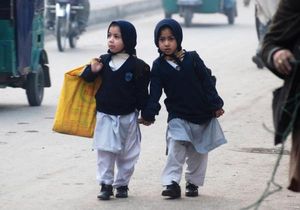
The time has come for each of us to recall what it was we were doing when our children were being executed in Peshawar. Is there even a word which encompasses the horror when 135 children are executed? Make no mistake it was our collective shrug which has tipped Pakistan over the edge and into this very dark abyss. It was our collective indifference which let these children be stalked by death at the hands of cold blooded murderers who went from child to child executing them that December 16 morning in Peshawar. We let our children die alone and scared, with no one to comfort them except other wounded and dying children.
More here.
Friday Poem
Bloodlines
I.
Even in the dark, I’m ashamed of my lemon breasts,
my peach-fuzzed midsection. I want to go back
home to my father. To my bed with the threadbare
blanket, the hand-carved cross over the headboard.
I want a God-fearing man, hands roughed by fields.
Augusto is a pretty boy with a new blue bicycle.
He rides into the next town, buys all the things
my mother assures me will make for a good life.
But the patch of blood on the bed sheets promises
different, promises thorns no bread or gold can dull.
II.
In America, I’m a maid at the Ramada , I
rent an apartment on Market Street. Broken English
and bad fruit. Pigeons as pets. My two children
in a one-bedroom. A Technicolor TV with antennas
sky-high. Double-locked doors. Barred windows.
An ironbound city, the unfamiliar cacophony: honks
of trailer horns, the bloody spur of factory smoke,
the brandied laughter of construction workers. I try
to sing the lullaby I’d hum to my brothers in the dark
over the news anchor’s Más lluvia para mañana!
III.
Tonight, my granddaughter sits in my kitchen
and considers the importance of bloodlines, waits
for the words to pop like champagne grapes.
Blood from my veins into her veins
until we are both blue with life. Outside, the song
gulls sing as they look for food separates the wind
from the hymn of pine needles. She writes a poem
to remember me, to remember it all— sweat and tears,
Portuguese ancestry, and of course, blood, to run roots
through my future great-granddaughter’s bones.
.
by Maria Carreira
from Acentos Review
November 2014
Thursday, January 15, 2015
LAWRENCE OSBORNE’S THE BALLAD OF A SMALL PLAYER
Paul French in the Los Angeles Review of Books:
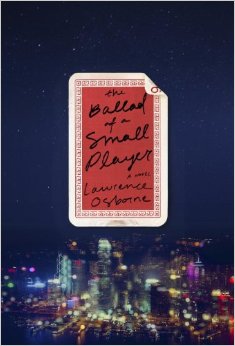
Macau, the former Portuguese colony off the coast of southern China, is a distinctly little written-about place. It deserves more. In the 1930s, Macau gained a reputation for sin and wickedness, epithets that have long lingered over the place. The American noir writer Sherwood King wrote If I Die Before I Wake in 1938. The book became the basis for the Orson Welles-Rita Hayworth film The LadyFrom Shanghai in 1947. In the novel, Elsa Bannister, a White Russian of dubious reputation, born of refugees in Chefoo, on the China coast, explains her past: “Chefoo is the second wickedest city of earth.” The first? “Macau,” she exclaims, without a moment’s hesitation.
More here.
The golden ratio has spawned a beautiful new curve: the Harriss spiral
Alex Bellos in The Guardian:

“It’s not hard to make something that no one has seen before,” he said. “It’s more difficult to make something mathematically satisfying that people haven’t seen before.”
His first concern was that maybe someone else had had, in fact, drawn the spiral “One thing about mathematical discoveries and mathematical art is that even if the process is completely new there is no guarantee that someone else has not already explored it.”
It turned out that the ratio 1.325, which gives you the rectangle that creates the Harriss spiral has been written about – it is known as the “plastic number” – but Harriss could find no previous drawings of the spiral. (In fact, the ratio is a number that begins 1.32472… and carries on forever).
More here.
The Palestinians’ decision to join the ICC deserves support
Ken Roth in the Los Angeles Times:

Given the outcry, one would think this move targets only Israel, but the ICC doesn't work that way. Rather, the court will be empowered to prosecute war crimes committed in or from Palestinian territory — that is, crimes committed by Israelis or Palestinians. The court's prosecutor is not dependent on formal complaints by ICC members but can now initiate cases on her own.
Many of the Western objections are based on the argument that having the Palestinians in the ICC will somehow undermine Israeli-Palestinian peace negotiations — moribund as they have been. The U.S. State Department opined that it would “damage the atmosphere” for peace.
But the broad parameters for peace have been known for years. What has been lacking is the trust between the two sides to make the painful decisions necessary for a peace accord. Nothing undermines that trust more than impunity for the war crimes that Human Rights Watch has found continue to characterize the conflict, whether settlement expansion, Hamas rocket strikes or Israel's lax attitude toward civilian casualties in Gaza. By helping to deter these crimes, the ICC could discourage these major impediments to peace.
More here.
Best Ever Sherlock Holmes/Jeremy Brett Quotes
why john updike loved cartoons
“I can’t remember the moment when I fell in love with cartoons, I was so young,” John Updike once recalled in Hogan’s Alley magazine. “I still have a Donald Duck book, on oilclothy paper in big-print format, and remember a smaller, cardboard-covered book based on the animated cartoon Three Little Pigs. It was the intense stylization of those images, with their finely brushed outlines and their rounded and buttony furniture and their faces so curiously amalgamated of human and animal elements, that drew me in, into a world where I, child though I was, loomed as a king, and where my parents and other grownups were strangers.”
This is one of many passages where Updike talks about his childhood love of comics, a theme that recurs not just in essays but also in poems and short stories. What deserves attention in this passage is not only what Updike is saying but the textured and sensual language he’s using when he recalls the “oilclothy paper” and the “buttony furniture.” His tingling prose, where every idea and emotion is rooted in sensory experience, owes much to such modern masters as Joyce, Proust, and Nabokov, but it was also sparked by the cartoon images he saw in childhood, which trained his eyes to see visual forms as aesthetically pleasing. Indeed, the comparison with Nabokov is instructive since the Russian-born author of Lolita was also a cartoon fan.
more here.
HOLLYWOOD’S MEXICAN WAVE
Iñárritu is not the only Mexican searching out flesh tones amid the steel of the Hollywood blockbuster. In “Gravity” Alfonso Cuarón signed George Clooney and Sandra Bullock, cast them adrift in outer space, took all the technical resources that pummel us in the summer months and bent them to a stripped-down tale of survival, with explosions ripping soundlessly across the screen and the audience holding their breath while Bullock struggled for hers. Then there is Guillermo del Toro, more of a genre fiend than his compatriots, but on such intimate terms with the gnarled old souls of his monsters—in films like “Pan’s Labyrinth”, “Hellboy” and “Pacific Rim”—that the whole notion of heroism, let alone super-heroism, is left outclassed.
The three directors are friends and run a production company together. But unlike earlier South American directors, who defined themselves in vocal opposition to the Hollywood machine, the three amigos are the children of globalism, as conversant in franchise formulas as they are in Mexico’s indigenous cinema. Working away at the fault-line that separates north from south, blockbuster export from indie import, they are bilingual, speaking Hollywoodese but making up their own grammar and syntax.
It had to happen. Hollywood’s global supremacy over the last 30 years was always going to bring its own form of blowback.
more here.
‘Sympathy for the Devil: Four Decades of Friendship with Gore Vidal’
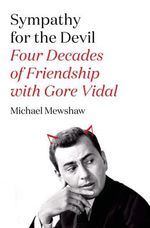
Vidal (1925-2012) was for more than half a century the wittiest gadfly on the American scene, almost a latter-day Mark Twain — but without the lovability of that white-suited curmudgeon. Like Twain, Vidal published best-selling books (“Burr,” “Lincoln”), experimented with literary forms (the gender-shifting comedy “Myra Breckinridge”), produced scores of cultural and political pieces (the collected essays, titled “United States,” run to a thousand pages) and was a charismatic storyteller and performer.
But where Twain cultivated his plain-folks image, Vidal was clearly a patrician, a scion of the American aristocracy. His immediate family included a grandfather who was a distinguished senator, a gold-digger mother (who once slept with Clark Gable) and a father who had starred on the gridiron at West Point, competed in the Olympics and helped build the American airline industry. During one of his mother’s marriages, Jacqueline Bouvier (later Mrs. John F. Kennedy) became a kind of stepsister.
more here.
As a Muslim, I’m fed up with the hypocrisy of the free speech fundamentalists
Mehdi Hasan in New Statesman:
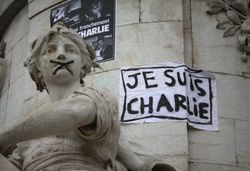
Has your publication, for example, run cartoons mocking the Holocaust? No? How about caricatures of the 9/11 victims falling from the twin towers? I didn’t think so (and I am glad it hasn’t). Consider also the “thought experiment” offered by the Oxford philosopher Brian Klug. Imagine, he writes, if a man had joined the “unity rally” in Paris on 11 January “wearing a badge that said ‘Je suis Chérif’” – the first name of one of the Charlie Hebdo gunmen. Suppose, Klug adds, he carried a placard with a cartoon mocking the murdered journalists. “How would the crowd have reacted? . . . Would they have seen this lone individual as a hero, standing up for liberty and freedom of speech? Or would they have been profoundly offended?” Do you disagree with Klug’s conclusion that the man “would have been lucky to get away with his life”?
More here.
Making History: First Free Climb of Yosemite’s Dawn Wall
Andrew Bisharat in National Geographic:

…Free climbing means using one's hands and feet to ascend a rock's natural features, employing ropes and other gear only to stop a fall. At roughly 3,000 feet (915 meters) tall, the Dawn Wall comprises 32 “pitches”—or 32 rope-lengths—of climbing. Caldwell's and Jorgeson's goal was to free climb all 32 pitches—without falling and without returning to the ground in between. If one of them fell while attempting a pitch, he would have to try that individual pitch from its beginning again. (Read about Jorgeson's attempts to catch up to Caldwell.) They began their ascent on December 27, and committed to living up on the side of El Cap for as long as it took each of them to free climb every pitch in succession. Their base camp consisted of three portaledges—each one a six-foot by four-foot (2-meter by 1-meter) platform with tent fly, suspended by nylon straps and hanging from bolts in the sheer granite wall. For breakfast they ate whole-wheat bagels topped with cream cheese, red bell pepper, cucumber, and salami or salmon. At night, they sipped whiskey. Every few days, one of the friends waiting on the ground ascended 1,200 feet (366 meters) of rope to bring the team a new cache of supplies and water.
More here.
Thursday Poem
Expect Nothing
Expect nothing. Live frugally
On surprise.
become a stranger
To need of pity
Or, if compassion be freely
Given out
Take only enough
Stop short of urge to plead
Then purge away the need.
Wish for nothing larger
Than your own small heart
Or greater than a star;
Tame wild disappointment
With caress unmoved and cold
Make of it a parka
For your soul.
Discover the reason why
So tiny human midget
Exists at all
So scared unwise
But expect nothing. Live frugally
On surprise.
.
by Alice Walker
Wednesday, January 14, 2015
Unreal Islam
Ali Minai in Brown Pundits:
More here.
How Ulhas Kashalkar became one of the greatest musicians of our time
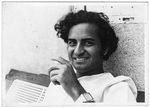
MINUTES BEFORE THE LIGHTS DIMMED and the Hindustani vocalist Pandit Ulhas Kashalkar walked onto the stage at Mumbai’s National Centre for the Performing Arts, the eminent singers Ashwini Bhide-Deshpande and Padma Talwalkar took their seats in the front row. The vocalist and veteran critic Amarendra Dhaneshwar sat a few rows behind them. Other listeners looked around to see who else had come. Several younger singers were there as well: Noopur Kashid, Rutuja Lad, Amita Pavgi-Gokhale and Saylee Talwalkar. The turnout for Kashalkar’s concert, held last September, was not unusual; for at least a decade, he has been considered a musicians’ musician. Still, expectations were high: what would the maestro sing for this audience?
Kashalkar’s performance was dedicated to jod ragas, a particularly challenging melodic form. When singing a jod raga, the musician must fully elaborate two conjoined ragas—the complex melodic modes at the centre of Indian classical music. Each raga evokes a range of moods, and in a jod raga, the musician moves from one to the other only through their common swaras, or notes, attempting to keep the ambience of each distinct. Even while presenting a single raga, the singer faces the challenge of sustaining an emotional intensity, so that the rendition does not lapse into dry, mechanical exercise.
more here.
the extermination of the passenger pigeon
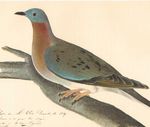
The passenger pigeon (Ecotopistes migratorius), so-called because of its wandering, unpredictable migratory behaviour, ranged in enormous flocks from Canada to Florida, probably accounting for more than a quarter of all birds in North America. As a metaphor for the environmental impact of colonial settlement in the sixteenth, and population explosion in the nineteenth century, its extinction has many lessons. When European settlers made first contact with North America, they encountered an environment teeming with wildlife of incredible abundance. The awesomeness of American nature in the eyes of travellers from the Old World is well represented in accounts from the sixteenth and seventeenth centuries.
Even before permanent settlement, the vast codfish shoals off Newfoundland were well-known to Europeans. By the 1630s French missionaries in Quebec were talking about une infinité de Tourtelles (turtle doves), feeding on wild raspberries, strawberries, acorns, grapes and the seeds of the forest – oak acorns, beech mast, red maple and American elm seeds, hazel and alder. The core range of the wild pigeon corresponded with the eastern and southern deciduous trees, and ultimately its fate was bound up with the fate of the forests.
more here.
Faith and Suspicion: On Marilynne Robinson’s ‘Lila’

Marilynne Robinson’s novels are beautifully rendered works of realism, which is perhaps our most distinguished literary genre. They are intellectually complex and emotionally compelling. Miraculously, they also manage to be accessible, popular and commercially successful. So in many ways Robinson is a mainstream author, but in others she is in direct opposition to the traditions of Anglo-American literature.
Despite our various personal and political commitments to religion, when it comes to literature we have become a decidedly secular nation. The presence of religious doctrine, or Scripture, or theology, in mainstream fiction is scant. Religion seems directly at variance with the skeptical, rational, pragmatic realism that dominates our literary tradition. Whatever question the novel poses, God is not the answer.
In Virginia Woolf’s novel To the Lighthouse, Mrs. Ramsay muses, with conventional piety, “We are in the hands of the Lord. But instantly she was annoyed with herself…she had been trapped into saying something she did not mean…. The insincerity…roused her, annoyed her.” Now she wants to purify that lie “out of existence” and goes on to think, “How could any Lord have made this world?… there is no reason, order, justice: but suffering, death, the poor. There was no treachery too base for the world to commit; she knew that.” Mrs. Ramsay’s calm pronouncement affirms that it is possible to love the world, and the people in it, without a belief in God.
How would religion enter into fiction anyway?
more here.
The contents of the bowels of an Italian medieval warlord have revealed his nefarious cause of death nearly 700 years later
Michelle Starr in CNet:
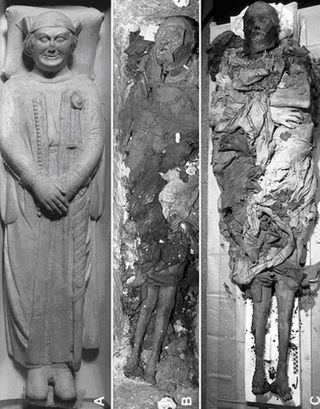
Take Cangrande I della Scala. Born in 1291, he rose to rule Verona in 1311 at the age of 20, and was a skilled warrior and ruler, claiming several additional territories for his family's rule. He was also the most prominent patron of poet Dante Alighieri, and was considered a brave, yet merciful man.
In the year 1328, at the age of 37, he took possession of the Padua region, after 16 years of bloody conflict. In 1329, he prepared to move on Mantua, formerly the seat of a trusted ally with whom he had become estranged, but postponed the action due to a change of government at Treviso, a territory long contested and the last slice of the Veneto region to fall into his control.
But his triumphal procession into Treviso was spoiled by a sudden, sharp illness. Rumour had it that Cangrande had become ill after drinking from a polluted spring a few days before. The most powerful man in Verona's history reached his lodgings four days after entering Treviso, took to bed and promptly died on 22 July 1329, at the age of 38. Immediately, rumours proliferated that someone had poisoned the nobleman.
Now, a study published in the Journal of Archaeological Science has revealed that the rumoured poisoning was actually the case.
More here.
Qatar and Saudi Arabia ‘have ignited time bomb by funding global spread of radical Islam’
David Blair in The Telegraph:
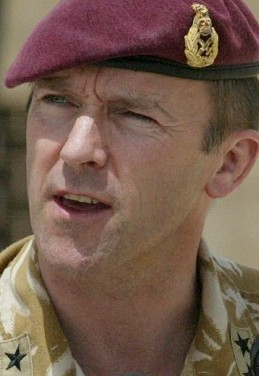
General Jonathan Shaw, who retired as Assistant Chief of the Defence Staff in 2012, told The Telegraph that Qatar and Saudi Arabia were primarily responsible for the rise of the extremist Islam that inspires Isil terrorists.
The two Gulf states have spent billions of dollars on promoting a militant and proselytising interpretation of their faith derived from Abdul Wahhab, an eighteenth century scholar, and based on the Salaf, or the original followers of the Prophet.
But the rulers of both countries are now more threatened by their creation than Britain or America, argued Gen Shaw. The Islamic State of Iraq and the Levant (Isil) has vowed to topple the Qatari and Saudi regimes, viewing both as corrupt outposts of decadence and sin.
So Qatar and Saudi Arabia have every reason to lead an ideological struggle against Isil, said Gen Shaw. On its own, he added, the West's military offensive against the terrorist movement was likely to prove “futile”.
“This is a time bomb that, under the guise of education, Wahhabi Salafism is igniting under the world really. And it is funded by Saudi and Qatari money and that must stop,” said Gen Shaw. “And the question then is 'does bombing people over there really tackle that?' I don't think so. I'd far rather see a much stronger handle on the ideological battle rather than the physical battle.”
More here.