Indifference is a Power

Stoic-Man-on-Sand-Dune

Lary Wallace in Aeon (Photo by Raymond Depardon/Magnum):

[I]ndifference really is a power, selectively applied, and living in such a way is not only eminently possible, with a conscious adoption of certain attitudes, but facilitates a freer, more expansive, more adventurous mode of living. Joy and grief are still there, along with all the other emotions, but they are tempered – and, in their temperance, they are less tyrannical.

If we can’t always go to our philosophers for an understanding of Stoicism, then where can we go? One place to start is theUrban Dictionary. Check out what this crowdsourced online reference to slang gives as the definition of a ‘stoic’:
stoic
Someone who does not give a shit about the stupid things in this world that most people care so much about. Stoics do have emotions, but only for the things in this world that really matter. They are the most real people alive.
Group of kids are sitting on a porch. Stoic walks by.
Kid – ‘Hey man, yur a fuckin faggot an you suck cock!’
Stoic – ‘Good for you.’
Keeps going.

You’ve gotta love the way the author manages to make mention of a porch in there, because Stoicism has its root in the word stoa, which is the Greek name for what today we would call a porch. Actually, we’re more likely to call it a portico, but the ancient Stoics used it as a kind of porch, where they would hang out and talk about enlightenment and stuff. The Greek scholar Zeno is the founder, and the Roman emperor Marcus Aurelius the most famous practitioner, while the Roman statesman Seneca is probably the most eloquent and entertaining. But the real hero of Stoicism, most Stoics agree, is the Greek philosopher Epictetus.

He’d been a slave, which gives his words a credibility that the other Stoics, for all the hardships they endured, can’t quite match. He spoke to his pupils, who later wrote down his words. These are the only words we know today as Epictetus', consisting of two short works, theEnchiridion and the Discourses, along with some fragments. Among those whom Epictetus taught directly is Marcus Aurelius (another Stoic philosopher who did not necessarily expect to be read; hisMeditations were written expressly for private benefit, as a kind of self-instruction).

More here.

A Brand New World In Which Men Ruled

Jodi Kantor in the NYTimes (via Longreads):

Top_1920In the history of American higher education, it is hard to top the luck and timing of the Stanford class of 1994, whose members arrived on campus barely aware of what an email was, and yet grew up to help teach the rest of the planet to shop, send money, find love and navigate an ever-expanding online universe.

They finished college precisely when and where the web was stirring to life, and it swept many of them up, transforming computer science and philosophy majors alike into dot-com founders, graduates with uncertain plans into early employees of Netscape, and their 20-year reunion weekend here in October into a miniature biography of the Internet…

The reunion told a more particular strand of Internet history as well. The university, already the most powerful incubator in Silicon Valley, embarked back then on a bold diversity experiment, trying to dismantle old gender and racial barriers. While women had traditionally lagged in business and finance, these students were present for the creation of an entirely new field of human endeavor, one intended to topple old conventions, embrace novel ways of doing things and promote entrepreneurship…

Yet instead of narrowing gender gaps, the technology industry created vast new ones, according to interviews with dozens of members of the class and a broad array of Silicon Valley and Stanford figures. “We were sitting on an oil boom, and the fact is that the women played a support role instead of walking away with billion-dollar businesses,” said Kamy Wicoff, who founded a website for female writers.

Read the rest here.

Top Science Longreads of 2014

Ed Yong in Not Exactly Rocket Science:

Ed_Yong_Not_Exactly_Rocket_Every year, I pick my favourite science features—or ‘longreads’, as they have been rebranded as—from the previous 12 months. It’s always hard. Despite much hand-wringing about how the internet is killing journalism/reading/attention/civilisation, I see a constant stream of great long pieces, written by writers who are at the top of their game, and published by organisations willing to pay well. So, without further ado, here are my favourite dozen from the year, and a dozen more runners-up. In no particular order:

1) One of a Kind, by Seth Mnookin, for The New Yorker. A magnificently told, and often heartbreaking, story about a family trying to solve their son’s unique genetic mystery.

“That fall, Bertrand was rushed to the emergency room after suffering a series of life-threatening seizures. When the technicians tried to start an I.V., they found Bertrand’s veins so scarred from months of blood draws that they were unable to insert a needle. Later that evening, when Cristina was alone with Matt, she broke down in tears. “What have we done to our child?” she said. “How many things can we put him through?” As one obscure genetic condition after another was ruled out, the Mights began to wonder whether they would ever learn the cause of their son’s agony. What if Bertrand was suffering from a disorder that was not just extremely rare but entirely unknown to science?”

2) How “Titanic” is helping a South Pacific tribe understand why their island is disappearing, by Brooke Jarvis, for Matter. In this beautiful, moving piece, Jarvis meets the people most affected by climate change.

“A large, brown bone washed against my calf. At first I thought it belonged to some sort of marine mammal, maybe a dugong, and picked it up. But then I saw what was clearly a human jaw, five teeth still embedded in the bone, in the water next to me. I stared at the bone in my hand, shocked to realize that I was gripping a person’s femur. Once I started to see them, it seemed there were bones everywhere. Vertebrae swirled around my feet.”

More here.

What is the value of toleration?

Piers Benn in Prospect:

ToleanceMany people living in liberal societies take it for granted that toleration and freedom of expression are positives. They support the view that no one has the right to impose their political, religious or moral views on others; that almost all views have the right to be heard, and especially, that no one should be hounded by the law, censored or ostracised simply for holding certain beliefs. Yet today as much as ever, free expression is under threat when it comes to matters deemed “sensitive.” Index on Censorship reports numerous recent cases. In September over 30 student organisations at Yale University protested against the inclusion of the campaigner Ayaan Hirsi Ali in its visiting speaker programme, on the grounds that, as a vocal apostate from Islam, her words might be offensive to Muslim ears. The Chancellor of the University of California at Berkeley recently sent a memo to students, saying that free speech should be qualified by “civility”, meaning that it should be permitted only in so far as it allowed others to feel “safe and respected” [my italics]—two words which are, of course, not synonymous. And in Turkey, where the curious crime of “insulting the Turkish Nation” is already on the statute book, people who “insult” the President can also find themselves in trouble. The list goes on.

Of course, many liberal minded people are appalled by these restrictions. But others worry that their support for toleration comes from a general “non-judgmental attitude”, a lack of personal conviction, or even a relativistic denial that there is such a thing as the truth about, say, religious or ethical matters. For this reason, in the eyes of some critics, toleration is merely another name for indifference.

More here.

It might be possible to restore lost memories

From KurzweilAI:

Synapse1New UCLA research indicates that lost memories can be restored, offering hope for patients in the early stages of Alzheimer’s disease. For decades, most neuroscientists have believed that memories are stored at the synapses — the connections between brain cells, or neurons — which are destroyed by Alzheimer’s disease. The new study provides evidence contradicting the idea that long-term memory is stored at synapses. “Long-term memory is not stored at the synapse,” said David Glanzman, a senior author of the study, and a UCLA professor of integrative biology and physiology and of neurobiology. “The nervous system appears to be able to regenerate lost synaptic connections. If you can restore the synaptic connections, the memory will come back. It won’t be easy, but I believe it’s possible.” The findings were published recently in eLife, a highly regarded open-access online science journal.

Glanzman’s research team studies a type of marine snail called Aplysia to understand the animal’s learning and memory. The Aplysia displays a defensive response to protect its gill from potential harm, and the researchers are especially interested in its withdrawal reflex and the sensory and motor neurons that produce it.They enhanced the snail’s withdrawal reflex by giving it several mild electrical shocks on its tail. The enhancement lasts for days after a series of electrical shocks, which indicates the snail’s long-term memory. Glanzman explained that the shock causes the hormone serotonin to be released in the snail’s central nervous system. Long-term memory is a function of the growth of new synaptic connections caused by the serotonin, said Glanzman, a member of UCLA’s Brain Research Institute. As long-term memories are formed, the brain creates new proteins that are involved in making new synapses. If that process is disrupted — for example by a concussion or other injury — the proteins may not be synthesized and long-term memories cannot form. (This is why people cannot remember what happened moments before a concussion.)

More here.

Wednesday Poem

Another Day Without an Uprising

everything that's wrong
looms before us, everything
we want seems just
out of reach, a dream
of a garden and you
lower yourself into life
ripe, moist, joyful but
beyond the gate, poison
lurks sneering, strutting
around the bend and
taking up far too much space.
I'm holding this object
wondering about you and
the uprising, the fertile ground
the seeds, the waiting furrow and
the water flowing, the tears
irrigating this heart felt plot
this ground where vibrancy
overwhelms the darkness just
outside the boundary of
the swamp, on that hill
attended by so many empty
hands and the tight closed fists
of your worst nightmares.
under all the ugly asphalt
beneath the dull concrete sleeps
more gardens then we can count.
all it takes to start these seeds
is the water we carry with us.

by Don Ogden
from Bad Atmosphere
Levellers Press, Amherst, MA

The World Is Not Falling Apart

Steven Pinker and Andrew Mack in Slate:

141212_FOR_ISISBombing.jpg.CROP.promo-mediumlargeIt’s a good time to be a pessimist. ISIS, Crimea, Donetsk, Gaza, Burma, Ebola, school shootings, campus rapes, wife-beating athletes, lethal cops—who can avoid the feeling that things fall apart, the center cannot hold? Last year Martin Dempsey, chairman of the Joint Chiefs of Staff, testified before a Senate committee that the world is “more dangerous than it has ever been.” This past fall,Michael Ignatieff wrote of “the tectonic plates of a world order that are being pushed apart by the volcanic upward pressure of violence and hatred.” Two months ago, the New York Times columnist Roger Cohen lamented, “Many people I talk to, and not only over dinner, have never previously felt so uneasy about the state of the world. … The search is on for someone to dispel foreboding and embody, again, the hope of the world.”

As troubling as the recent headlines have been, these lamentations need a second look. It’s hard to believe we are in greater danger today than we were during the two world wars, or during other perils such as the periodic nuclear confrontations during the Cold War, the numerous conflicts in Africa and Asia that each claimed millions of lives, or the eight-year war between Iran and Iraq that threatened to choke the flow of oil through the Persian Gulf and cripple the world’s economy.

How can we get a less hyperbolic assessment of the state of the world? Certainly not from daily journalism. News is about things that happen, not things that don’t happen. We never see a reporter saying to the camera, “Here we are, live from a country where a war has not broken out”—or a city that has not been bombed, or a school that has not been shot up. As long as violence has not vanished from the world, there will always be enough incidents to fill the evening news. And since the human mind estimates probability by the ease with which it can recall examples, newsreaders will always perceive that they live in dangerous times. All the more so when billions of smartphones turn a fifth of the world’s population into crime reporters and war correspondents.

More here.

Song without music: Auden’s “For the Time Being: A Christmas Oratorio”

Cynthia Haven in The Book Haven:

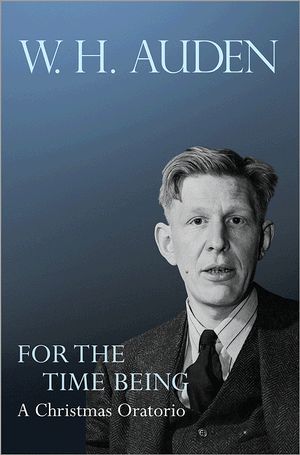
Auden-christmasW.H. Auden learned of the death of his mother, Constance Rosalie Bicknell Auden, by telephone in August 1941, while he was staying in Rhode Island. The international call was taken by his lover Chester Kallman, who came to Auden’s bedroom and told him they would not be attending a party that evening. Then he told him why.

“Auden was stunned and grieved, not only because he had been very close to his mother all his life. He was already in a state of emotional fragility, having learned just the month before that Kallman, whom he loved and to whom he considered himself married, had been having sex with other men and meant to continue the practice,” writes Alan Jacobs,editor of Princeton University Press’ splendid critical edition of Auden’s For the Time Being: A Christmas Oratorio. Thursday is only the first of the Twelve Days of Christmas – if you haven’t seen the book already (it was published last year), you still have plenty of time to find it before Twelfth Night.

Auden would later write, “When mother dies, one is, for the first time, really alone in the world and that is hard” – Jacobs adds, “that experience of isolation was surely made far more intense through its arriving in the midst of hopes already ruined.”

A few weeks after the death, Auden moved to my own alma mater, the University of Michigan, to begin a year of teaching (his daunting course syllabus is here). And shortly after that he was applying to the Guggenheim to write “a long poem in several parts about Christmas, suitable for becoming the basis of a text for a large-scale musical oratorio.” That long poem was his attempt to see Christmas in double focus: as a moment in the Roman Empire and in Jewish history, and as an eternal and ever-new event.

More here.

Tuesday, December 23, 2014

Mathematicians Make a Major Discovery About Prime Numbers

Erica Klarreich in Wired:

ScreenHunter_925 Dec. 23 21.30In May 2013, the mathematician Yitang Zhang launched what has proven to be a banner year and a half for the study of prime numbers, those numbers that aren’t divisible by any smaller number except 1. Zhang, of the University of New Hampshire, showed for the first time that even though primes get increasingly rare as you go further out along the number line, you will never stop finding pairs of primes that are a bounded distance apart — within 70 million, he proved. Dozens of mathematicians then put their heads together to improve on Zhang’s 70 million bound, bringing it down to 246 — within striking range of the celebrated twin primes conjecture, which posits that there are infinitely many pairs of primes that differ by only 2.

Now, mathematicians have made the first substantial progress in 76 years on the reverse question: How far apart can consecutive primes be? The average spacing between primes approaches infinity as you travel up the number line, but in any finite list of numbers, the biggest prime gap could be much larger than the average. No one has been able to establish how large these gaps can be.

“It’s a very obvious question, one of the first you might ever ask about primes,” said Andrew Granville, a number theorist at the University of Montreal. “But the answer has been more or less stuck for almost 80 years.”

This past August, two different groups of mathematicians released papers proving a long-standing conjecture by the mathematician Paul Erdős about how large prime gaps can get. The two teams have joined forces to strengthen their result on the spacing of primes still further, and expect to release a new paper later this month.

More here.

The resumption of US – Cuban relations is a real victory but Cuban workers face renewed economic liberalization with little political opening

Samuel Farber in Jacobin:

One-Month-in-Cuba-Road-CheOn December 17, 2014, Washington and Havana agreed to a pathbreaking change in a relationship that, for more than fifty years, was characterized by the United States’ efforts to overthrow the Cuban government, including the sponsorship of invasions, naval blockades, economic sabotage, assassination attempts, and terrorist attacks.

The new accord set free the remaining three members of the “Cuban Five” group held in US prisons since 1998 and, in exchange, Cuba freed the American Alan Gross and Rolando Sarraf Trujillo, a previously unknown US intelligence agent imprisoned on the island for almost twenty years, in addition to over fifty Cuban political prisoners. Far more consequential are the resumption of official diplomatic relations and the significant relaxation of travel restrictions and remittances to Cuba.

The agreement covers the political normalization but not the full economic normalization of relations: that would require Congress repealing the Helms-Burton Act, signed into law by President Clinton in 1996.

More here. [Thanks to Corey Robin.]

A brand new electrical phenomenon has been discovered – a huge electric field in a thin film of laughing gas

From Science Alert:

ScreenHunter_924 Dec. 23 18.23Scientists in Denmark have made a curious and awesome discovery – cooled down, solid laughing gas can contain an enormous electric field.

The discovery occurred when physicists at Aarhus University were observing how electrons travel through nitrous oxide, or 'laughing gas', frozen to minus 233 degrees Celsius. When brought down to this temperature, the gas formed a thin, solid film, about one tenth of a micron thick, hovering over a strip of gold.

It was supposed to be a routine experiment, but the team soon realised something was amiss. A potential of around 14.5 volts appeared spontaneously on the film, which in turn produced an enormous electrical field of more than 100 million volts per metre. Based on widely accepted notions in physics, there should have been no electric current whatsoever.

“They came upstairs and knocked on my door, saying ‘David, there's something not right’. At first we thought the experiment had gone wrong, because it wasn't supposed to be possible for a current to pass through the film and be detected. No external voltage was applied,” physicist David Field told Lise Brix at ScienceNordic.

Further testing confirmed that what they’d found is a brand new electrical phenomenon, which Field is calling ‘spontelectric’. The team has published their findings in the journal Physical Chemistry Chemical Physics.

More here. [Thanks to Steve Chasen.]

Cutesters: the Horrific New Trend That’s Consuming London

Clive Martin in Vice:

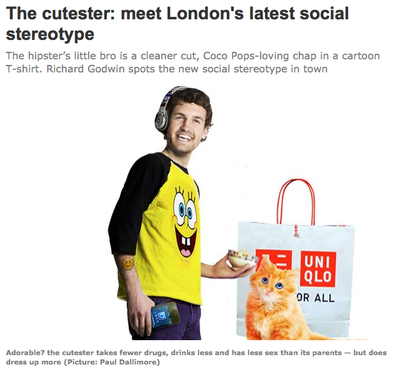
Cutesters-and-london-body-image-1419260598The change is interesting and very much real, I think. But for me, the question isn't, What is a cutester?—that has, more or less, already been answered. The question for me is: Where the fuck did the cutester come from? How did one of the world's most oppressive and unforgiving cities give birth to something so infantile and inane?…

It would be easy to pin the cutester on the usual suspects—to lay into BuzzFeed, the Cereal Cafe, Secret Cinema, “free hugs,” and Boris Johnson's breakfast burritos for siring this epidemic of the infantile. But London wasn't always like this. I personally had a very different image of the city growing up. To me, it was a city of knife amnesties, Irish fighting pubs, cruising saunas, City boy hooligans, Crystal Palace players with Streets of Rage haircuts, debutantes with blocked noses and clubs like Caesars in Streatham. The closest thing there was to a mayor was probably crime boss Terry Adams, and a “secret cinema” was a place you went to jerk off in public without getting your head kicked in, not dress up like a character from Back to the Future in public without getting your head kicked in.

But somewhere along the line, that changed, and undoubtedly it took a concerted effort for that to happen. It's hard to place the blame anywhere in particular. If there was any grand social project drawn up, it's one that has never been made public— there was no great speech made, it just kind of started to happen and never really stopped, in that ceaseless way that money has where it needs to keep creating more room for itself.

However, if I were forced to pinpoint the origins of the great shift that has led to the cutesters becoming as defining an image of London as the street gang Peel Dem Crew once were, I wouldn't choose the moment where Boris was elected, or when the first Krispy Kreme landed here, but the point when London decided to re-market itself as the knot of villages it ceased to be with the advent of trains in the 19th century. When London devolved into some weird former version of itself but with fewer dead infant chimney sweeps and more ads; a hybrid of the shopping center at Bluewater, Disney World, and a quaint town that never actually existed. When London became a poorly-travelled American's impression of itself.

Read the rest here.

Families in Literature: the Flytes in Brideshead Revisited

Moira Redmond in The Guardian:

BridesIf you read Brideshead Revisited for the first time in your teens (as so many of us do) you can come away with the idea of a Cinderella story: middle-class Charles is scooped up by the happy aristocracy – the deserving poor boy looking longingly through the window is allowed in, gawps at the magnificence, is grateful for the attention, and of course falls in love with Sebastian. But when you read it again, you see that Brideshead is not a book about Oxford, or homoerotic love, or social climbing: it’s a book about religion – and about families. It is Sebastian who is in love with Charles, jealously wanting to keep him to himself:

I’m not going to have you get mixed up with my family. They’re so madly charming. All my life they’ve been taking things away from me. If they once got hold of you with their charm, they’d make you their friend not mine, and I won’t let them.

Charles has no idea of family life – he lost his mother in an absurd Waugh manner during the first world war, and while his father is occasionally kind he is vague and not very paternal. Then he discovers the Flytes. “That summer term with Sebastian,” he says, “it seemed as though I was being given a brief spell of what I had never known, a happy childhood.” The sadness is that Sebastian wants to grab on to Charles in order to get away, while Charles wants to belong. Brideshead is “where my family live”, says Sebastian, prompting Charles to reflect: “I felt, momentarily, an ominous chill at the words he used – not, ‘that is my house’, but ‘it’s where my family live’.”

More here.

Dare to Dream of Falling Short

Richard Friedman in The New York Times:

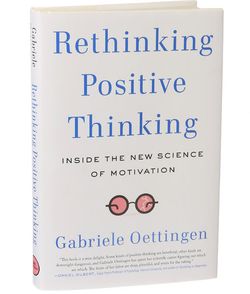
BookEver hear the joke about the guy who dreams of winning the lottery? After years of desperate fantasizing, he cries out for God’s help. Down from heaven comes God’s advice: “Would you buy a ticket already?!” Clearly, this starry-eyed dreamer is, like so many of us, a believer in old-fashioned positive thinking: Find your dream, wish for it, and success will be yours. Not quite, according to Gabriele Oettingen, a psychology professor at New York University and the University of Hamburg, who uses this joke to illustrate the limitations of the power of positive thinking. In her smart, lucid book, “Rethinking Positive Thinking: Inside the New Science of Motivation,” Dr. Oettingen critically re-examines positive thinking and give readers a more nuanced — and useful — understanding of motivation based on solid empirical evidence.

Conventional wisdom has it that dreams are supposed to excite us and inspire us to act. Putting this to the test, Dr. Oettingen recruits a group of undergraduate college students and randomly assigns them to two groups. She instructs the first group to fantasize that the coming week will be a knockout: good grades, great parties and the like; students in the second group are asked to record all their thoughts and daydreams about the coming week, good and bad. Strikingly, the students who were told to think positively felt far less energized and accomplished than those who were instructed to have a neutral fantasy. Blind optimism, it turns out, does not motivate people; instead, as Dr. Oettingen shows in a series of clever experiments, it creates a sense of relaxation complacency. It is as if in dreaming or fantasizing about something we want, our minds are tricked into believing we have attained the desired goal.

More here.

Monday, December 22, 2014

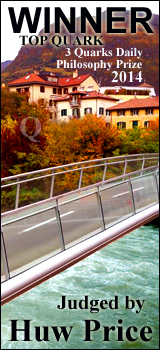
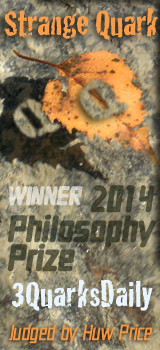
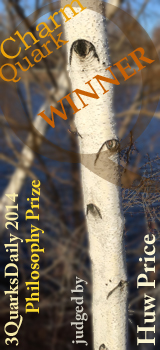
The Winners of the 3QD Philosophy Prize 2014

PhilTop2014 Philosophy Strange Quark 2014 (1) 2014 philosophy

Huw Price has picked the three winners from the nine finalists:

  1. Top Quark, $500: Grace Boey, Is applied ethics applicable enough? Acting and hedging under moral uncertainty
  2. Strange Quark, $200: Ryan Simonelli, Nāgārjuna, Nietzsche, and Rorty’s Strange Looping Trick
  3. Charm Quark, $100: Marcus Arvan, The Case for Libertarian Compatibilism

Here is what Professor Price had to say about them:

Like most academics, I spend far too much of my time practising the three Rs: reading, rating, and ranking. But I relished this particular task, because 3QD has long been one of my favourite escapes from these and other academic chores. Tired of making decisions, feeling outranked and over-rated, I'll relax with Raza's Reliable Recommendations —what a pleasure to let someone else do the choosing! (“No need to think, entrust the job to us”, as the sign at Trusty's Dyers and Cleaners used to say, many years ago.) So it was a treat, as well as an honour, to be asked to reciprocate by making some choices of my own from a field selected by 3QD's readers and editors.
I read all the nine shortlisted pieces eagerly and twice, when Abbas first announced the shortlist. Conveniently, I found that I had three clear favourites. I then came back to the entire field three busy, 3R-filled weeks later, and was pleased to find that my opinions hadn't changed. The same three were my favourites. I had my winners.
That was the easy bit. Ranking the final three was very hard indeed. They are very different pieces, and I liked them for very different reasons. How should I rank their competing virtues? Indeed, how should I deal with my uncertainty about what the standards should be, in a competition of this kind? Happily, this question led me to my top choice, which is Grace Boey's lovely piece, Is Applied Ethics Applicable Enough? Acting and Hedging Under Moral Uncertainty. This is just what the informative, expository kind of philosophy blog post should be, in my view. It is admirably fresh, lively, clear, accessible, and concise, and introduces its fortunate reader to a novel and fascinating philosophical topic.
With that settled, there was just one hard choice to make. At this point, no matter how much I tried to apply myself with solidarity to the task, I couldn't silence my ironic voice. It kept reminding me of the contingency that lies at the foundations not only of of my present choice, but of our entire evaluative lives! But that gave me my tie-breaker: second prize goes to Ryan Simonelli's Absolute Irony: Nāgārjuna, Nietzsche, and Rorty’s Strange Looping Trick. This is a longer and more ambitious piece than Boey's, but remains nicely coherent despite its length. It is held together by a strong and interesting theme, philosophical irony itself, which is the backbone of a little intellectual narrative, in several episodes. And it has one of my favourite pictures of Rorty at the top! How could I have been in any doubt?
Third prize, then, to Marcus Arvan's Flickers of Freedom: The Case for Libertarian Compatibilism. This is easily the most ambitious of the three —some may think over-ambitious— but enjoyable for its sheer philosophical chutzpah. Arvan argues that we can find evidence that we live in a computer simulation, a kind of vast P2P botnet, in the nature of some of our most profound puzzles in physics and philosophy. It would be an understatement to say that I didn't find it entirely convincing —some of the 'X is just like Y' claims seemed a little under-developed, for one thing! —but it is entertaining, thought-provoking, well-written and fun.
Congratulations to all three winners, and warm thanks to 3QD and its readers for giving me this opportunity, and to all the philosophical bloggers who make the blogosphere such a distracting place!

Congratulations also from 3QD to the winners (remember, you must claim the money within one month from today—just send me an email). And feel free, in fact we encourage you, to leave your acceptance speech as a comment here! And thanks to everyone who participated. Many thanks also, of course, to Huw Price for doing the final judging and for his liking of 3QD.

The three prize logos at the top of this post were designed by me, Carla Goller, and Sughra Raza. I hope the winners will display them with pride on their own blogs!

Details about the prize here.

Sunday, December 21, 2014

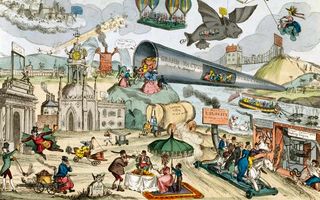
How the Victorians Invented the Future

90728623

Iwan Rhys Morus in Aeon (image by SSPL/Getty):

Before the beginning of the 19th century, the future was only rarely portrayed as a very different place from the present. The social order, like the natural order, was supposed to be static, with everything in its proper place: as it had been, so it would be. When Sir Isaac Newton thought about the future, he worried about the exact date of Armageddon, not about how his science might change the world. Even Enlightenment revolutionaries usually argued that what they were doing was restoring the proper order of things, not creating a new world order.

It was only around the beginning of the 1800s, as new attitudes towards progress, shaped by the relationship between technology and society, started coming together, that people started thinking about the future as a different place, or an undiscovered country – an idea that seems so familiar to us now that we often forget how peculiar it actually is.

The new technology of electricity seemed to be made for futuristic speculation. At exhibition halls in London, such as the Adelaide Gallery or the Royal Polytechnic Institution, early Victorians could marvel at electrical engines that promised to transform travel. Inventors boasted that ‘half a barrel of blue vitriol [copper sulphate] and a hogshead or two of water, would send a ship from New York to Liverpool’. People went to these places to see the future made out of the present: when Edgar Allen Poe in 1844 set out to fool the New York Sun’s readers that a balloon flight had just made it across the Atlantic, he made sure to tell them that the equipment used had been ‘put in action at the Adelaide Gallery’.

Bringing the future home, Alfred Smee, then surgeon to the Bank of England, told readers of his Elements of Electro-Metallurgy (1841) how they would ‘enter a room by a door having finger plates of the most costly device, made by the agency of the electric fluid’. The walls would be ‘covered with engravings, printed from plates originally etched by galvanism’, and at dinner ‘the plates may have devices given by electrotype engravings, and his salt spoons gilt by the galvanic fluid’. It was becoming impossible to talk about electricity at all without talking about the future.

More here.