Imagining traditions

Sandali in HimalSouthAsian:

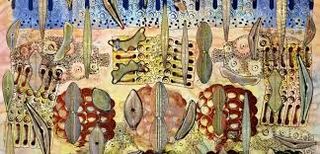
Article_mithila_kohbarTara Books, a feminist publishing house located in Chennai, has been collaborating with ‘folk’ and ‘tribal’ artists for the last few years to produce illustrated books for both children and adults. Many of the art forms they have worked with are believed to have evolved from women’s creative expressions within the household, created for the purposes of ritual and decoration. On the occasion of International Women’s Day on 8 March this year, Tara Books inaugurated a photo exhibition titled ‘From Floor to Book: Women’s Everyday Art Traditions’ at their office, the Book Building. The exhibition, which ran until the end of July, traced the journey of select art traditions across the country, from their original contexts to newer canvases and spaces. A few years ago, Zubaan, another feminist publishing house located in Delhi, showcased artworks by rural women in a travelling exhibition titled ‘Painting Our World: Women’s Messages through Art’ in several cities across the country. As part of Zubaan’s larger project of mapping the women’s movement through visual material, the exhibition aimed to document rural women’s voices on issues ranging from violence, health, communalism and domestic work to marriage, livelihood and the environment, expressed through ‘folk’ and ‘tribal’ art and embroidery practices. While Zubaan’s exhibition captured the overtly political discursive articulations stemming from the women’s movement, Tara Books’ concern seems to lie in understanding meaning-making processes of women – the ways in which they comprehend gender and other social relations through the interplay of quotidian and critical consciousness.

The first of the three sections of Tara Books’s exhibition is titled ‘Everyday Art’. It showcases aspects of an art form difficult to categorise, lying perhaps somewhere at the interstices of craft, art, household labour, tradition and practice. The exhibition shows viewers that women’s everyday art is ‘created’ and ‘displayed’ in the context of the household, and is by nature ephemeral.

More here.

Through the nanoscope: A Nobel Prize gallery

Richard Van Noorden in Nature:

CellThis year’s Nobel Prize for Chemistry was awarded to three researchers who developed ways to capture images of living cells at nanoscale resolution — well below the 200 nanometres thought to be the best possible resolution for visible-light microscopes.

A fourth recently-developed super-resolution technique, called structured illumination microscopy (SIM), illuminates samples with stripes of light. A computer program analyses the interference patterns formed by the stripes (usually combining composite pictures with stripes in different orientations) to reconstruct a picture of a cell at about double the resolution limit of optical microscopy. This SIM image shows a three-dimensional view of a human bone cancer cell with actin in purple, DNA in blue, and mitochondria in yellow.

More here.

Tuesday, October 14, 2014

The Real Christopher Columbus

Howard Zinn (1922 – 2010) was an American historian, author, playwright, and social activist. The following is adapted from his acclaimed A People's History of the United States.

Howard Zinn in Jacobin:

ScreenHunter_836 Oct. 14 18.12Columbus would never have made it to Asia, which was thousands of miles farther away than he had calculated, imagining a smaller world. He would have been doomed by that great expanse of sea. But he was lucky. One-fourth of the way there he came upon an unknown, uncharted land that lay between Europe and Asia—the Americas. It was early October 1492, and thirty-three days since he and his crew had left the Canary Islands, off the Atlantic coast of Africa. Now they saw branches and sticks floating in the water. They saw flocks of birds.

These were signs of land. Then, on October 12, a sailor called Rodrigo saw the early morning moon shining on white sands, and cried out. It was an island in the Bahamas, the Caribbean Sea. The first man to sight land was supposed to get a yearly pension of 10,000 maravedis for life, but Rodrigo never got it. Columbus claimed he had seen a light the evening before. He got the reward.

So, approaching land, they were met by the Arawak Indians, who swam out to greet them. The Arawaks lived in village communes, had a developed agriculture of corn, yams, cassava. They could spin and weave, but they had no horses or work animals. They had no iron, but they wore tiny gold ornaments in their ears.

This was to have enormous consequences: it led Columbus to take some of them aboard ship as prisoners because he insisted that they guide him to the source of the gold. He then sailed to what is now Cuba, then to Hispaniola (the island which today consists of Haiti and the Dominican Republic). There, bits of visible gold in the rivers, and a gold mask presented to Columbus by a local Indian chief, led to wild visions of gold fields.

More here.

For the Motherboard: The Rubáiyát of Omar Khayyám

Hodgkinson and Bridle in The White Review:

Rubaiyat-web-1-1200x700There’s a marvellous lecture by Tim Berners-Lee (‘How the world wide web just happened’) in which he talks about how he came to create what turned out to be the world wide web. He describes growing up as the child of Computer Scientist parents who had worked at Bletchley Park, and building his first circuits from bits of wire, wrapped around nails, hammered into a piece of wood. Once he’d got the hang of that, he was just in time for the invention of the transistor, and then the integrated circuit. As the components available to him got ever smaller, the complexity of the machines they could power increased exponentially. As Berners-Lee tells it – with some modesty – it was a simple, natural progression from crystal radio, to building his own computer, to putting in place the fundamental transfer protocol that most of us use to access the internet. As things shrank, they also became more powerful, more networked, leading inevitably to an almost total, sublime connectivity.

…This book, For the Motherboard: The Rubáiyát of Omar Khayyám, takes into account some of the limitations of working at scale across digital devices. The first of these is the display size: in an era of ‘retina screens’, where the pixel density of our displays begins to surpass in definition the clusters of rods and cones in the human eye, we are still limited in print by the apertures of our ink nozzles. This is not a new problem: For the Motherboard… is set in Bell Centennial, a font commissioned by AT&T from the designer Matthew Carter in 1975, to replace Bell Gothic, which it had been using in its phone directories since 1938. Between those years, the number of telephones in the United States alone grew from some twenty million to around 140 million. Carter’s Bell Centennial typeface exists because of explosive, networked growth, addressing both this increased technological density, by condensing the character width, and the limitations of contemporary printing, by adding ‘ink traps’ to the letters, minute nicks in the letterforms to absorb and counter the ink spread caused by rapid printing on newsprint. When printed at sufficient size on coated paper, these traps remain visible, tiny reminders of previous technological limitations.

More here.

Isaiah Berlin’s run-ins with Isaac Deutscher show what a bitch Berlin could be

Christopher Bray in Spiked:

Isaiah_berlinOne evening in December 1966, the great American writer and critic Edmund Wilson had Sir Isaiah Berlin over for dinner. And a good time they doubtless had of it, but later that night Wilson recorded in his diary that he found Berlin prone to ‘violent, sometimes irrational prejudice against people’. On the evening in question the object of Berlin’s ire was the philosopher and political theorist Hannah Arendt, whose book about the trial of the Nazi officer Adolf Eichmann, Eichmann in Jerusalem, he excoriated without, Wilson claimed, his ever having troubled to read it.

On that last point at least, Wilson seems to have been wrong. Granted the evidence marshalled in David Caute’s Isaac & Isaiah: The Covert Punishment of a Cold War Heretic, it is fair to conclude that Berlin had not only read Arendt’s bestseller, but had also likely arranged for his close friend John Sparrow, then warden of All Souls College at Oxford, to give the book a kicking in the pages of the Times Literary Supplement. Since TLS reviews were printed without bylines back then, why didn’t Berlin write about the book himself? Because, Caute argues, he had for some reason ‘always avoided referring to Arendt in print’. Privately, though, he was happy to rubbish her work. A few years earlier, he had written Faber & Faber a report on Arendt’s The Human Condition. It opened by telling them he ‘could recommend no publisher to buy the UK rights of this book. There are two objections to it: it won’t sell, and it is no good.’

Fans of Berlin’s waspish wit will relish those last two clauses (invert them, as the logic of the sentence dictates, and the wit is gone), but did Arendt’s most considered work really merit such a stinging rebuke?

More here.

40,000 year-old indonesian cave paintings

Pras11edit.jpg__800x600_q85_cropHelen Thompson at Smithsonian Magazine:

Modern critics would probably hail the up and coming rock artists that once inhabited Indonesia. About a hundred caves outside Moras, a town in the tropical forests of Sulawesi, were once lined with hand stencils and vibrant murals of abstract pigs and dwarf buffalo. Today only fragments of the artwork remain, and the mysterious artists are long gone.

For now, all we know is when the caves were painted—or at least ballpark dates—and the finding suggests that the practice of lining cave walls with pictures of natural life was common 40,000 years ago. A study published today in Nature suggests that paintings in the Maros-Pangkep caves range from 17,400 to 39,900 years old, close to the age of similar artwork found on the walls of caves in Europe.

“It provides a new view about modern human origins, about when we became cognitively modern,” says Maxime Aubert, an archaeologist at Griffith University in Australia. “It changes the when and the where of our species becoming self-aware and starting to think abstractly, to paint and to carve figurines.”

more here.

the life of Walter Kempowski

Lipkin_gatheringfates_ba_imgMichael Lipkin at The Nation:

Walter Kempowski’s writing career began on a winter evening in 1950, nineteen years before he published his first novel. Then 21, he was serving time for espionage in an East German prison at Bautzen. For two years, he had passed the time by going from bunk to bunk and plying his fellow prisoners with questions about their lives. He met a glassblower from the Vogtland, a businessman who had worked in Persia, a bank president. He discovered Auschwitz survivors sleeping above former camp commandants, Americans alongside Finns and Brits, and a Frenchman who had been stationed at Dien Bien Phu. One evening, as Kempowski trudged through the yard for his nightly exercise, he found himself thinking how painful it was that the conversations going on throughout the prison at that moment should be lost, like the choir of voices swirling around the Tower of Babel. The guard on duty told Kempowski to pay attention. “Those are your comrades in the cells,” he said. “They’re telling you something.”

By the time of his death in 2007, Kempowski had earned an international reputation as Germany’s premier chronicler—a quirky old uncle spending time in his attic, surrounded by faded photographs and dusty junk.

more here.

Turning to Darwin to Solve the Mystery of Invasive Species

Carl Zimmer in the New York Times:

ScreenHunter_835 Oct. 14 16.09Invasive species are both a fact of life and a scientific puzzle. Humans transport animals and plants thousands of miles from where they first evolved — sometimes accidentally, sometimes intentionally. Many of those species die off in their new homes. Some barely eke out an existence.

But some become ecological nightmares. In the Northeast, emerald ash borers are destroying ash trees, while Japanese barberry is blanketing forest floors, outcompeting native plants. Scientists aren’t certain why species like these are proving superior so far from home.

“If natives are adapted to their environment and exotics are from somewhere else, why are they able to invade?” asked Dov F. Sax, an ecologist at Brown University.

A big part of the answer may be found in the habitats in which invasive species evolve. Many alien species in the northeastern United States, including the emerald ash borer and Japanese barberry, invaded from East Asia. But the opposite is not true. Few species from the northeastern United States have become problems in East Asia.

In a new study published in the journal Global Ecology and Biogeography, Dr. Sax and Jason D. Fridley, a biologist at Syracuse University, argue that this is not a coincidence. They offer evidence that some parts of the world have been evolutionary incubators, producing superior competitors primed to thrive in other environments.

More here.

Atheism, Islam and liberalism: This is what we are really fighting about

Andrew O'Hehir in Salon:

Affleck_maher_harris2Here’s a news flash: None of these heated public debates about atheism and religion, or about how Western “liberals” should think about Islam, ever reach a satisfactory conclusion. There are many reasons for this, including the fact that talk-show hosts and movie stars (just for instance) aren’t necessarily the best people to bring nuance or thoughtfulness or clarity to these conversations. An even bigger reason may be that religion in general, and fundamentalist religion in particular, is a major sore spot in Western culture, a source of tremendous vulnerability and anxiety.

One of the few propositions that Reza Aslan and Sam Harris might both agree with is that God’s return to the world-historical stage long after Nietzsche supposedly killed him off, as both an internal and external enemy of the Western secular-capitalist order, is a dangerous phenomenon for which our society has no clear answer. Our exaggerated response to ISIS is a dead giveaway: They may be a stateless desert army of bloodthirsty nutjobs, but they have something we lost a long time ago and can’t get back.

Fundamentalist Christianity appeared to be on a long, slow decline in the United States. Now right-wing Christians have mounted a vigorous counterattack against reproductive rights, largely by cloaking themselves (ingeniously, it must be said) in pseudo-liberal sheep’s clothing, as an oppressed and disenfranchised group entitled to legal protection. Similarly, fundamentalist Islam seemed to be on the run in the Middle East, although that required the expenditure of trillions of dollars, hundreds of thousands of human lives and the last reservoir of goodwill toward America in the Arab world. Then came the rollout of ISIS, with its genocidal mass killings and its beheading videos: an al-Qaida 2.0 for the YouTube age, with better graphics and an even more deranged vision.

More here.

Derrida: Ten years dead

Derrida-top-smGil Anidjar in a forum remembering Derrida at the LA Review of Books:

SOMETIME AROUND 1989, Jacques Derrida must have agreed to give the opening keynote at the UCLA conference entitled “Nazism and the ‘Final Solution’: Probing the Limits of Representation.” Derrida must have agreed since, on 26 April 1990, in front of an undoubtedly sizable audience, he delivered that lecture, a reading of Walter Benjamin’s “Critique of Violence” that has since become one of Derrida’s most influential and most generative texts.

The academic equivalent of a star-studded event — in Los Angeles no less! — the conference had been explicitly and centrally organized as a defensive call to arms against those who might question, in the name of historical probity, the historical profession’s strenuous policing of Holocaust testimony, evidence, and representation. The conference singled out Hayden White, himself a historian, as representative of the risks — and negationist, even fascistic, inclinations, however unwitting — courted by “postmodernist” claims. White participated in the conference, and he was duly included, along with numerous detractors of his, in the published proceedings. Derrida was not.

more here.

How to Quarantine Against Ebola

Siddhartha Mukherjee in The New York Times:

SidONE feature of the tragic case of Thomas Eric Duncan, the first traveler known to have carried the Ebola virus into the United States, rankles me as a physician: Even if every system in place to identify suspected carriers had been working perfectly, he may have still set off a mini-epidemic in Dallas. Mr. Duncan, recall, was screened before his flight and found to have a normal temperature. Asked specifically about exposures, he denied any contact with the ill. On Sept. 25, when he first presented to the emergency room with a fever, he was discharged. He returned three days later with fulminant infection. But the fact remains that even if Mr. Duncan had been identified and isolated on the first visit, it may have been too late. He had probably been exuding the virus for days. The news that a nurse who helped treat Mr. Duncan has now tested positive for the disease, evidently because of a breach of safety protocols, adds to the picture of disorder.

In the wake of the Duncan case, three strategies to contain the entry and spread of Ebola in the United States have been proposed. The first suggests drastic restrictions on travel from Ebola-affected nations. The second involves screening travelers from Ebola-affected areas with a thermometer, which the federal government is beginning to do at selected airports. The third proposes the isolation of all suspected symptomatic patients and monitoring or quarantining everyone who came into contact with them. Yet all these strategies have crucial flaws. In the absence of any established anti-viral treatment, we may need to rethink the concept of quarantine itself. “Quarantine” sounds like a medieval concept because it is. Invented in the mid-1300s to stop the bubonic plague, the word derives from the Italian for “40 days,” the time used to isolate potential carriers. Although the practice of quarantine has been reformed over the centuries, pitfalls remain. They are especially evident during this epidemic.

More here.

Monday, October 13, 2014

Monday Poem

Old Movies

Screw physics!
days gain speed,
no doubt —

this ellipse is being spun post haste,
the moon almost cannot keep up,
solar winds rush through my hair,
its thin ends whip around the sun
in tender furies

the leaves of months are ripped as they were in old films
suggesting passing time with bygones overlaid,
accelerating as strips of perforated cellulose fly by,
each frame a day, sometimes so fast
this car's momentary wheels spin back
like buckboard spokes and Model-As
—its scenes collect on a reel of years
much closer to its hub than I am now
on the fringes of a still unknown galaxy
whose recollected hurricanes of breath and dust
now seem more like flurries

still clinging to its spiral tip
someday I'll lose this grip
and slip beyond the lip
of breath and worries
.

by Jim Culleny
10/12/14

Perceptions

Caribou Migration
Subhankar Banerjee. Caribou Migration I. 2002.

“The coastal plain of the Arctic National Wildlife Refuge is the core calving area of the Porcupine River caribou herd. It is also the most debated public land in the United States history – whether to open up this land to oil and gas development or to preserve it has been raging in the halls of the United States Congress for over thirty years. This caribou herd has symbolized the Arctic Refuge – both for its ecological and cultural significance. Individual caribou from this herd may travel more than three thousand miles during their yearly movements, making it one of the longest terrestrial migrations of any land animal on the planet. Numerous indigenous communities living within the range of the herd have depended on the caribou for subsistence food. The Gwich'in people of Alaska, and the northern Yukon and Northwest Territories in Canada, live on or near the migratory route of this herd, have relied upon the caribou for many millennia to meet their subsistence as well as cultural and spiritual needs. The Gwich'in are caribou people. They call the calving ground of the caribou “Iizhik Gwats'an Gwandaii Goodlit” (The Sacred Place Where Life Begins). To open up the caribou calving ground to oil and gas development is a human-rights issue for the Gwich'in Nation. In addition to the perceived threat of oil development in their calving ground, this caribou herd has been severely impacted by climate change in recent years. International scientific community has stated that climate change has impacted this herd more than most of the other large caribou herds across the circumpolar Arctic. Their numbers has declined steadily at a 3.5% per year since 1989 from 178,000 animals to a low of 123,000 in 2001. Warmer, wetter autumn resulting in more frequent icing conditions; warmer, wetter winter resulting in deeper and denser snow; and warmer spring resulting in more freeze-thaw days and faster spring melt are among the key negative climate change impacts on the caribou and their habitat. In the photograph pregnant females are migrating over Coleen River on the south side of the Brooks Range Mountain on their way to the coastal plain for calving.” (From Banerjee's website.)

More here, here and here.

Sunday, October 12, 2014

Atul Gawande: “We Have Medicalized Aging, and That Experiment Is Failing Us”

Michael Mechanic in Mother Jones:

Gawandecover275In Being Mortal, Gawande, a longtime staff writer for the New Yorker, takes on the utter failure of the medical profession when it comes to helping people die well, and the short-sightedness of the elder facilities that infantilize people rather than bother to figure out what they actually need to maintain a modicum of meaning in what's left of their lives. In the process, he gives us a lesson on the basic physiology of aging and on the social and technological changes that led to most of us dying in hospitals and institutions rather than at home with our loved ones. And he chronicles the rise of the nursing home and the creation of assisted living as its antidote—if only it were.

The picture can seem pretty bleak. Many of Gawande's subjects are dealing with the always-hopeful oncologists who, rather than accept the inevitable, coax their patients into trying futile fourth-line chemotherapies that nobody can pronounce. And then you've got hospitals axing their geriatrics departments (aging Boomers be damned) because Medicare won't cover the extra costs of making someone's last years worth living. There's also a deeply personal aspect to the book, which goes on sale today. Gawande recounts the recent travails of his family, which began when his father, also a surgeon, was diagnosed with a cancer that would slowly eat away at his physical capabilities and ultimately end his life.

But Being Mortal is hopeful, too, and that's why it could make a difference.

More here.

Fareed Zakaria: Let’s be honest, Islam has a problem right now

Fareed Zakaria in the Washington Post:

ScreenHunter_830 Oct. 13 11.10When television host Bill Maher declares on his weekly show that “the Muslim world . . . has too much in common with ISIS ” and guest Sam Harris says that Islam is “the mother lode of bad ideas,” I understand why people are upset. Maher and Harris, an author, made crude simplifications and exaggerations. And yet, they were also talking about something real.

I know the arguments against speaking of Islam as violent and reactionary. It has a following of 1.6 billion people. Places such as Indonesia and India have hundreds of millions of Muslims who don’t fit these caricatures. That’s why Maher and Harris are guilty of gross generalizations. But let’s be honest. Islam has a problem today. The places that have trouble accommodating themselves to the modern world are disproportionately Muslim.

In 2013, of the top 10 groups that perpetrated terrorist attacks, seven were Muslim. Of the top 10 countries where terrorist attacks took place, seven were Muslim-majority. The Pew Research Center rates countries on the level of restrictions that governments impose on the free exercise of religion. Of the 24 most restrictive countries, 19 are Muslim-majority. Of the 21 countries that have laws against apostasy, all have Muslim majorities.

There is a cancer of extremism within Islam today.

More here.

Cure for Type 1 diabetes imminent after Harvard stem-cell breakthrough

Sarah Knapton in The Telegraph:

Diabetes_2936249bA cure for diabetes could be imminent after scientists discovered how to make huge quantities of insulin-producing cells, in a breakthrough hailed as significant as antibiotics.

Harvard University has, for the first time, managed to manufacture the millions of beta cells required for transplantation.

It could mean the end of daily insulin injections for the 400,000 people in Britain living with Type 1 diabetes.

And it marks the culmination of 23-years of research for Harvard professor Doug Melton who has been trying to find a cure for the disease since his son Sam was diagnosed with Type 1 diabetes as a baby.

“We are now just one pre-clinical step away from the finish line,” said Prof Melton.

Asked about his children’s reaction he said: “I think like all kids, they always assumed that if I said I'd do this, I'd do it.”

More here.

A letter from Dr Abdus Salam to Malala

Faraz Talat in Dawn:

Dear Malala,

SalamDespite all that occurred, I’d always lugged around with me a sliver of optimism. They referred to me as Pakistan’s ‘only’ Nobel laureate; I insisted on being called the “first”. I was born in a small town called Santokh Das; arguably not as beautiful as your Swat valley, but it did have much to offer. I grew up in Jhang, a city now tainted by its name’s association with dangerous groups. My father was an education officer working for the Punjab government. I have a feeling your father would've liked him. Like you, I took a keen interest in my studies. I enjoyed English and Urdu literature, but excelled at mathematics. At a very young age, I scored the highest marks ever recorded then, in my matriculation exam. My education, however, was never as politically challenging as yours. I did not have to contend with the Taliban destroying my school, or forbidding boys from receiving education. But whatever barriers they constructed in your way, you bravely broke through them. In fact, you continue to defy them with every breath you take.

Winning the Nobel prize has enraged your attackers, as it has annoyed many of your countrymen.

It takes courage to walk through it all, and knowing you, courage is not in short supply. Not a lot has changed in this country. You were mocked and alienated by your countrymen, when you did nothing wrong. I know something of that. As a nation, we do not want to be celebrated. What we wish for, is to be pitied. They were pleased with you as long as you were another local victim. But then, you cast off your victimhood and emerged as a hero, a beacon of hope for young girls around the world. That’s where you lost them.

You are the new 'traitor'.

You are presented with the dire challenge of bringing peace and pride to a country, that doesn't want your gift. Like a mother of a particularly rebellious child, you must find a way to love them nonetheless. Eventually, I pray, they will understand. I had the privilege of being the first to offer this country a Nobel Prize. But now there are two of us.

And, I’m still counting.

Yours truly, Abdus Salam

More here.

A Diagnosis

Jenny Diski in LRB:

JennyThe future flashed before my eyes in all its pre-ordained banality. Embarrassment, at first, to the exclusion of all other feelings. But embarrassment curled at the edges with a weariness, the sort that comes over you when you are set on a track by something outside your control, and which, although it is not your experience, is so known in all its cultural forms that you could unscrew the cap of the pen in your hand and jot down in the notebook on your lap every single thing that will happen and everything that will be felt for the foreseeable future. Including the surprises.

I got a joke in.

‘So – we’d better get cooking the meth,’ I said to the Poet, sitting to one side and slightly behind me. The Poet with an effort got his face to work and responded properly. ‘This time we quit while the going’s good.’ The doctor and nurse were blank. When we got home the Poet said he supposed they didn’t watch much US TV drama. It was only later that I thought that maybe, ever since Breaking Bad’s first broadcast, oncologists and their nurses all over the Western world have been subjected to the meth-cooking joke each time they have applied their latest, assiduously rehearsed, non-brutal techniques for telling a patient as gently but honestly as possible, having first sized up their inner resilience with a few apparently innocent questions (‘Tell me what you have been expecting from this appointment’), that they have inoperable cancer. Perhaps they failed to laugh at my – doubtless evasive – bid to lighten the mood, not because they didn’t get the reference, but because they had said to each other too often after such an appointment: ‘If I hear one more patient say they should start cooking meth, I’m going to wrestle them to the ground and bellow death into their faces – “Pay attention, I’m fucking telling you something important!”’ I was mortified at the thought that before I’d properly started out on the cancer road, I’d committed my first platitude. I was already a predictable cancer patient.

More here.