Is a Climate Disaster Inevitable?

Adam Frank in the New York Times:

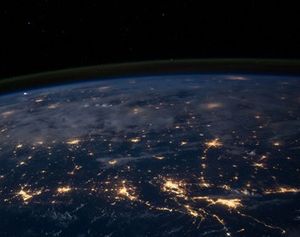
18frank-articleLargeOur galaxy, the Milky Way, is home to almost 300 billion stars, and over the last decade, astronomers have made a startling discovery — almost all those stars have planets. The fact that nearly every pinprick of light you see in the night sky hosts a family of worlds raises a powerful but simple question: “Where is everybody?” Hundreds of billions of planets translate into a lot of chances for evolving intelligent, technologically sophisticated species. So why don’t we see evidence for E.T.s everywhere?

The physicist Enrico Fermi first formulated this question, now called theFermi paradox, in 1950. But in the intervening decades, humanity has recognized that our own climb up the ladder of technological sophistication comes with a heavy price. From climate change to resource depletion, our evolution into a globe-spanning industrial culture is forcing us through the narrow bottleneck of a sustainability crisis. In the wake of this realization, new and sobering answers to Fermi’s question now seem possible.

Maybe we’re not the only ones to hit a sustainability bottleneck. Maybe not everyone — maybe no one — makes it to the other side.

Since Fermi’s day, scientists have gained a new perspective on life in its planetary context. From the vantage point of this relatively new field, astrobiology, our current sustainability crisis may be neither politically contingent nor unique, but a natural consequence of laws governing how planets and life of any kind, anywhere, must interact.

More here.

Paris, 2015

Justin E. H. Smith in The Utopian:

Tumblr_inline_nibvvxE5QB1qe7zezMy, what a year it’s been, so far. I spent the first week of it happily writing an overdue article on philosophical debates about avian vocalization—birdsong—from Aristotle to Kant. I spent the second week engaged in near-constant polemics and editorializing about the place of free speech in a just society. My life has been entirely overtaken by debates about what is at stake in the wake of last week’s attacks. I have tried to pull out, to get back to a normal sleeping schedule, to return to beautiful things. But I can’t. It has simply been too severe a bouleversement. It is a true crisis. Life, and history, occasionally throw these our way.

In case you missed it: some days ago in Paris a pair of assassins targeted and murdered the cartoonists associated with a weekly satirical magazine that had offended them with its contributions to the low art of caricature. Two days later, an ally of the assassins murdered four more people. What was their offense? They were Jewish, and they were moreover guilty by association with the cartoonists. What was the nature of this association? They happily lived and paid taxes in the same country that had hosted Charlie Hebdo.

In the days that followed, two trends emerged. The state cynically co-opted the attacks, and used it to promote “national unity,” which in fact means increased Islamophobia and deprivation of basic rights to privacy and freedom of expression. Parallel to this a number of commentators sought effectively to excuse the attacks, or to downplay the atrocity of them.

More here.

King, Kennedy, and the Power of Words

Martin_Luther_King_Jr-e1332771446820Tim Wendel at The American Scholar:

Novelist Charles Baxter contends that the greatest influence on American writing and discourse in recent memory can be traced back to the phrase “Mistakes were made.” Of course, that’s from Watergate and the shadowy intrigue inside the Nixon White House. In his essay, “Burning Down the House,” Baxter compares that “quasi-confessional passive-voice-mode sentence” to what Robert E. Lee said after the battle of Gettysburg and the disastrous decision of Pickett’s Charge.

“All of this has been my fault,” the Confederate general said. “I asked more of the men than should have been asked of them.”

In Lee’s words, and those of King and Kennedy, we hear a refreshing candor and directness that we miss today. In 1968, people responded to what King and Kennedy told them. During that tumultuous 24-hour period in 1968, people cried aloud and chanted in Memphis. Words struck a chord in Indianapolis, too, and decades later former mayor (and now U.S. Senator) Richard Lugar told writer Thurston Clarke that Kennedy’s speech was “a turning point” for his city.

more here.

the sordid life of eduard limonov

Cover00Sophie Pinkham at Bookforum:

In Moscow, Limonov fell passionately in love with a beautiful young woman named Tanya. The new couple soon emigrated to New York; Tanya wanted to be a model, and Limonov wanted to be famous. They lived in a fleabag apartment until Tanya ran off with a French photographer, leaving Limonov to weep, drink, masturbate, and have sex with homeless men. (“I lay there smiling and thought about how I must have been the only Russian poet who had ever been smart enough to fuck a black man in a New York vacant lot,” the narrator remarks in It’s Me, Eddie, one of Limonov’s many “fictional memoirs.”) Eventually Limonov got a job as a rich man’s butler. He liked to take girls back to the mansion and do filthy things to them in the master’s bed; that was his version of class warfare. But his American friends were unwilling to entertain his fantasies about revolutionary terrorism, and in America, he had concluded, writers had it even worse than they did in the Soviet Union. He moved to Paris. French intellectuals were amused by his violently ironic posturing, his toasts to Stalin, and his mockery of Solzhenitsyn. He published two memoir-novels that made him a minor star.

When perestroika came, Limonov wasn’t pleased. The Soviet legend was the legend of his childhood, after all, and what replaced it was a miserable neoliberalism. Also, his fame in France had plateaued, and he was running out of material for his fictional memoirs. It was time for a new chapter, with higher stakes.

more here.

How Patient Suicide Affects Psychiatrists

Sulome Anderson in The Atlantic:

LeadIt’s hard to listen to a psychiatrist who sounds so broken. I expect a mental-health provider to seem healthy, detached. But even over the phone, the weariness in Dr. Brown’s voice is palpable.

“This is what we do when people die,” he says. “Even if they die an expected death, it seems to be human nature to go back over [it]. What should I have said that I didn't, or shouldn’t have said that I did? Could I have done more or did I do too much? This seems to be a part of the grieving process. I think it's especially intense in a situation where you have direct responsibility for helping the person get better.”

Brown lost a patient to suicide last year. She was a long-term client of his, the mother of a large, loving family. Right after a session with him, she went home and killed herself. Two months later, Brown’s son did the same thing.

He doesn’t want to talk about his son. It’s still too immediate and painful. But he does tell me how he felt after his patient died. “I went to the funeral,” he says quietly. “I stood for the entire service … it was completely packed with people just standing and so I was thinking, as I was listening to this service, that I was the only person in that room who had that particular relationship with that woman. Everybody else knew her in some different way. They were friends, they were family, they were relatives, maybe they knew her in the congregation and I was the only one who had been working with her, seeing her the day before, trying to prevent this. I felt unique and not in a very flattering way.”

Read the rest here.

A President and a King

Jelani Cobb in The New Yorker:

KingIn June of 2009, when an aura of idealism still attended Barack Obama’s Presidency, he delivered a speech at Cairo University that was intended to recalibrate American relations in the region. He had already offered a qualified overture in his Inaugural Address—“We will extend a hand if you are willing to unclench your fist”—and the Cairo speech elucidated a vision of American soft power and democratic progress. Some listeners also noted a bit of historical jujitsu. In making a case for nonviolence in the region, the President remarked:

For centuries, black people in America suffered the lash of the whip as slaves, and the humiliation of segregation. But it was not violence that won full and equal rights. It was a peaceful and determined insistence upon the ideals at the center of America’s founding. This same story can be told by people from South Africa to South Asia; from Eastern Europe to Indonesia. It’s a story with a simple truth: that violence is a dead end.

Obama elided a few examples to make his argument: the more than six hundred thousand Civil War deaths in the United States; the well-documented though lesser-known history of armed black self-defense in the early twentieth century, which, in the eyes of many, served to make the nonviolent movement a palatable alternative; the armed resistance to apartheid that, for a time, counted even Nelson Mandela among its numbers. But fidelity to the historical record was not the key point.

More here.

Tuesday Poem

Toltecs
.

Radio about a foot-and-a-half

wide swinging at his side.

Three boys abreast and one

has the radio playing loud rock

they talk to as they walk

past my house. Three boys

dressed in their style

of short jackets and caps pulled

down almost to their eyes.

They might as well be naked

boys in the hot sun singing

in a changing voice the songs

they like to hear. They might

as well be boys chipping rocks

into weapons or tools.

But they are only boys on the way

someplace. They have to be men

sometime and no time for idle

rambling to rock music unless

they take jobs in the outdoors

where they can still be boys

and dress to get dirty. They can

be boys underneath the culture

forever because some other man

will gladly take those boys

and chip them down into tools

or weapons or bake them into

the walls of his own idea

of empire.

by Eloise Klein Healy
from Artemis in Echo Park
Firebrand Books, Ithaca, N.Y
.

Random Chance’s Role in Cancer

George Johnson in The New York Times:

CancerUnlike Ebola, flu or polio, cancer is a disease that arises from within — a consequence of the mutations that inevitably occur when one of our 50 trillion cells divides and copies its DNA. Some of these genetic misprints are caused by outside agents, chemical or biological, especially in parts of the body — the skin, the lungs and the digestive tract — most exposed to the ravages of the world. But millions every second occur purely by chance — random, spontaneous glitches that may be the most pervasive carcinogen of all. It’s a truth that grates against our deepest nature. That was clear earlier this month when a paper in Science on the prominent role of “bad luck” and cancer caused an outbreak of despair, outrage and, ultimately, disbelief.

The most intemperate of this backlash — mini-screeds on Twitter and hit-and-run comments on the web — suggested that the authors, Cristian Tomasetti and Bert Vogelstein of Johns Hopkins University, must be apologists for chemical companies or the processed food industry. In fact, their study was underwritten by nonprofit cancer foundations and grants from the National Institutes of Health. In some people’s minds, those were just part of the plot. What psychologists call apophenia — the human tendency to see connections and patterns that are not really there — gives rise to conspiracy theories. It is also at work, though usually in a milder form, in our perceptions about cancer and our revulsion to randomness. It takes several mutations, in specific combinations, for a cell to erupt into a malignant tumor. The idea that random copying errors are prominent among them is thoroughly mainstream. What was new about the paper was its attempt to measure this biological bad luck and see how it compares with the two other corners of the cancer triangle: environment and heredity — mutations we inherit from our parents that can give cancer a head start.

More here.

Monday, January 19, 2015

Perceptions

Bill Hudson is perhaps best known for capturing this galvanizing image of Parker High School student Walter Gadsden being attacked by police dogs in Birmingham, Alabama on May 3, 1963;

Bill Hudson. Birmingham, Alabama, May 3, 1963.

“… Associated Press photographer Bill Hudson is perhaps best known for capturing this galvanizing image of Parker High School student Walter Gadsden being attacked by police dogs in Birmingham, Alabama on May 3, 1963; a three column-spanning version of the shocking photo ran above the fold in The New York Times the following day.”

Danny LyonDanny Lyon.

“When a group of young women in rural Georgia were placed under lock and key after protesting segregation at the local library, photos like the one above, which was snapped through the bars by new journalism pioneer Danny Lyon, helped secure their release.”

More here and here.

Sunday, January 18, 2015

WHAT DO YOU THINK ABOUT MACHINES THAT THINK?

The responses to Edge.org's Annual Question for 2015 have been published. Here is my answer:

Picture-794-1419259181The Values Of Artificial Intelligence

The rumors of the enslavement or death of the human species at the hands of an Artificial Intelligence are highly exaggerated because they assume that an AI will have a teleological autonomy akin to our own. I don't think anything less than a fully Darwinian process of evolution can give any creature that.

There are basically two ways in which we could produce an AI: the first is by trying to write a comprehensive set of programs which can perform specific tasks that human minds can perform, perhaps even faster and better than we can, without worrying about exactly how humans perform those tasks, and then bringing those modules together into an integrated intelligence. We have already started this project and succeeded in some areas. For example, computers can play chess better than humans. One can imagine that with some effort it may well be possible to program computers to also perform even more creative tasks such as writing beautiful (to us) music or poetry with some clever heuristics and built-in knowledge.

But here's the problem with this approach: we deploy our capabilities according to values and constraints programmed into us by billions of years of evolution (and some learned during our lifetimes as well) and we share some of these values with the earliest life-forms including, most importantly, the need to survive and reproduce. Without these values, we would not be here, and we would not have the very finely tuned (to our environment) emotions that allow us not only to survive but to cooperate with others in a purposive manner. The importance of this value-laden emotional side of our minds is made obvious by, among other things, the many examples of individuals who are perfectly “rational” but unable to function in society because of damage to the emotional centers of their brains. So what values and emotions will an AI have?

More here. And the rest of the responses are here.

Robert Pinsky looks back on “Cascando” by Samuel Beckett

Robert Pinsky in Slate:

150109_POEM_samuelbeckett.jpg.CROP.original-originalHere is a love poem, clear-eyed yet passionate, personal and impersonal in ways I admire: “Cascando” by Samuel Beckett.

The poem’s intensity and misgivings are epitomized by the invented word at the end of its first stanza. “Wordshed,” on the model of “bloodshed,” generates associations of violent conflict; from another associated word, “woodshed,” gush other associations: drudgery, storage, punishment, and (maybe anachronistically) the jazz musician’s verb for practicing one’s art, woodshedding. And opposite to that practice-time in art, the simple meaning of shedding words: falling silent.

The poem’s erratic, doubling progress follows those conflicted energies as it oscillates, I think frantically, between the two magnetic attractions of abundance and of silence. The traditional lover’s uncertainty or agony has, in this poem, a rhetorical counterpart in the struggle between embracing traditional eloquence and rejecting it. For instance, “the grapples clawing blindly the bed of want” is a line of iambic pentameter as regular as anything in Shakespeare. The reckless, hyperbolic eloquence of the images—those eye-sockets and the “black want splashing their faces”—collides with the flatly corrosive, meaning-dispersing, adverbial “all always is it better too soon than never.”

For me, that hovering, back-and-forth movement between passion and reservations, need and doubt, images and disavowals, creates a strong emotion. The feeling gathers force from the poem’s argument with itself.

More here.

Ocean Life Faces Mass Extinction, Broad Study Says

Carl Zimmer in the New York Times:

JP-OCEANS2-articleLargeA team of scientists, in a groundbreaking analysis of data from hundreds of sources, has concluded that humans are on the verge of causing unprecedented damage to the oceans and the animals living in them.

“We may be sitting on a precipice of a major extinction event,” said Douglas J. McCauley, an ecologist at the University of California, Santa Barbara, and an author of the new research, which was published on Thursday in the journal Science.

But there is still time to avert catastrophe, Dr. McCauley and his colleagues also found. Compared with the continents, the oceans are mostly intact, still wild enough to bounce back to ecological health.

“We’re lucky in many ways,” said Malin L. Pinsky, a marine biologist at Rutgers University and another author of the new report. “The impacts are accelerating, but they’re not so bad we can’t reverse them.”

Scientific assessments of the oceans’ health are dogged by uncertainty: It’s much harder for researchers to judge the well-being of a species living underwater, over thousands of miles, than to track the health of a species on land. And changes that scientists observe in particular ocean ecosystems may not reflect trends across the planet.

Dr. Pinsky, Dr. McCauley and their colleagues sought a clearer picture of the oceans’ health by pulling together data from an enormous range of sources, from discoveries in the fossil record to statistics on modern container shipping, fish catches and seabed mining.

More here.

The War with Radical Islam

Jeffrey D. Sachs in Project Syndicate:

Sachs2011_250French Prime Minister Manuel Valls was not speaking metaphorically when he said that France is at war with radical Islam. There is, indeed, a full-fledged war underway, and the heinous terrorist attacks in Paris were part of it. Yet, like most wars, this one is about more than religion, fanaticism, and ideology. It is also about geopolitics, and its ultimate solution lies in geopolitics as well.

Crimes like those in Paris, New York, London, and Madrid – attacks on countless cafes, malls, buses, trains, and nightclubs – affront our most basic human values, because they involve the deliberate murder of innocents and seek to spread fear throughout society. We are wont to declare them the work of lunatics and sociopaths, and we feel repulsed by the very idea that they may have an explanation beyond the insanity of their perpetrators.

Yet, in most cases, terrorism is not rooted in insanity. It is more often an act of war, albeit war by the weak rather than by organized states and their armies. Islamist terrorism is a reflection, indeed an extension, of today’s wars in the Middle East. And with the meddling of outside powers, those wars are becoming a single regional war – one that is continually morphing, expanding, and becoming increasingly violent.

From the jihadist perspective – the one that American or French Muslims, for example, may pick up in training camps in Afghanistan, Syria, and Yemen – daily life is ultra-violent.

More here. [Thanks to Syed Tasnim Raza.]

An Economics Lesson: Teaching for Disciplinary Understanding

S. Abu Rizvi in Education Week:

ScreenHunter_948 Jan. 18 17.06Fifteen years ago, my colleagues and I observed that most economics undergraduates we taught quickly lost a third to half of their knowledge. “A” students turned into “C” students in a matter of weeks, right after final exams. For those of us who wanted disciplinary understanding to be useful to students well after they left college, this and similar findings were sobering. They spurred us to revamp how and what we teach while keeping an eye on why: to prepare students to use their understanding of the disciplines in other times and places.

Let's begin where we want to end up, with an example of the successful and flexible use of disciplinary understanding. As we consider the activities of two professional economists, Atif Mian and Amir Sufi, we should keep in mind that the concepts they employ are taught in introductory economics classes.

Mian and Sufi's intervention arose from the Great Recession at the end of the last decade. Economic turmoil left many homeowners “underwater,” with homes worth less than what was owed on mortgages. Federal debt relief was a policy that was considered. But Timothy Geithner, the Secretary of Treasury at the time, claimed that the impact of relief on the economy would be tiny. By freeing overburdened homeowners to spend, even a large program of $700 billion “would have increased annual personal consumption by just 0.1 to 0.2 percent.” Mian and Sufi thought this figure was too low. They used the concept of the marginal propensity to consume (MPC), “a very well-researched question,” to show that relief this big would have had an impact six to thirteen times higher than Geithner claimed. His figure for the policy's economic impact was far too small. Their argument, made at the right time, could have carried the day against Geithner's proposal.

More here.