
Category: Recommended Reading
Balthus the Painter
Patachou (1918 – 2015)
Mom: The Designated Worrier
Judith Shulevitz in The New York Times:
As I was thinking about Mother's Day today and read the article below in the NYT, I remembered the following which validates the thesis presented: I once asked my mother that she had raised seven children, did she have a favorite? She promptly said, yes, of course. I was so shocked at this blatant admission and the first thought I had was I will kill myself if it is not me. Who, I demanded nervously. She wisely responded, 'Anyone of you who is vulnerable at the moment becomes my favorite and all my love and attention becomes focused on that child. So all of you have taken turns to be my favorite'.

I wish I could say that fathers and mothers worry in equal measure. But they don’t. Disregard what your two-career couple friends say about going 50-50. Sociological studies of heterosexual couples from all strata of society confirm that, by and large, mothers draft the to-do lists while fathers pick and choose among the items. And whether a woman loves or hates worry work, it can scatter her focus on what she does for pay and knock her partway or clean off a career path. This distracting grind of apprehension and organization may be one of the least movable obstacles to women’s equality in the workplace. IT’S surprising that household supervision resists gender reassignment to the degree that it does. In the United States today, more than half of all women work, and women are 40 percent of the sole or primary breadwinners in households with children under 18. The apportionment of the acts required to keep home and family together has also been evening out during the past 40 years (though, for housework, this is more because women have sloughed it off than because men have taken it on). Nonetheless, “one of the last things to go is women keeping track of the kind of nonroutine details of taking care of children — when they have to go to the doctor, when they need a permission slip for school, paying attention at that level,” says the social psychologist Francine Deutsch, author of “Halving It All: How Equally Shared Parenting Works.”
More here.
Saturday, May 9, 2015
‘The Wright Brothers,’ by David McCullough
Daniel Okrent in the New York Times:
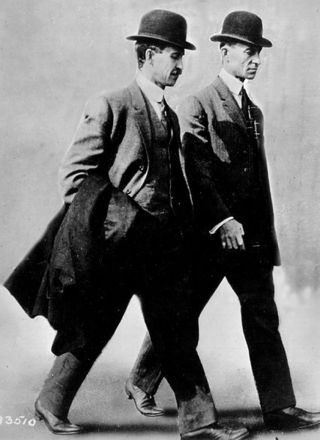
It does not begin promisingly. The first 30 or so pages consist of a somewhat desultory recounting of early years in the Wright household. But then 32-year-old Wilbur writes a letter to the Smithsonian, requesting any papers they have, or know of, regarding human flight. “I am an enthusiast,” he assures whoever might open the letter, “but not a crank in the sense that I have some pet theories as to the proper construction of a flying machine.”
Did he ever. There is no fortuity in the Wright brothers’ saga as related by McCullough, no unexpected events that changed their course. Except for Orville’s startling emergence from a horrible wreck during one of his flights, there’s not even any luck. Neither brother attended college, nor had been trained in physics or engineering, yet each step they took was not only correct but in many cases brilliant, and in nearly all cases original. That every one of those steps was also achieved through excruciating patience and obsessive attention to detail does not diminish the only word that can express what Wilbur, particularly, possessed: genius.
McCullough shows how endless calculation, application and recalculation led them to determine the proper shape of the wing, the means of manipulating its angle into the wind, how to compensate for the weight of the engine.
More here.
Analog Simulators Could Be Shortcut to Universal Quantum Computers
Peter Byrne in Scientific American:

Yet progress is arriving on two main fronts. First, researchers are developing unique quantum error-correction techniques that will help keep quantum processors up and running for the time needed to complete a calculation. Second, physicists are working with so-called analog quantum simulators—machines that can’t act like a general-purpose computer, but rather are designed to explore specific problems in quantum physics. A classical computer would have to run for thousands of years to compute the quantum equations of motion for just 100 atoms. A quantum simulator could do it in less than a second.
Quanta magazine spoke with Deutsch about recent progress in the field, his hopes for the near future, and his own work on scaling up binary quantum bits into base-16 digits.
QUANTA MAGAZINE: Why would a universal quantum machine be so uniquely powerful?
IVAN DEUTSCH: In a classical computer, information is stored in retrievable bits binary coded as 0 or 1. But in a quantum computer, elementary particles inhabit a probabilistic limbo called superposition where a “qubit” can be coded as 0 and 1.
Here is the magic: Each qubit can be entangled with the other qubits in the machine. The intertwining of quantum “states” exponentially increases the number of 0s and 1s that can be simultaneously processed by an array of qubits. Machines that can harness the power of quantum logic can deal with exponentially greater levels of complexity than the most powerful classical computer. Problems that would take a state-of-the-art classical computer the age of our universe to solve, can, in theory, be solved by a universal quantum computer in hours.
More here.
Chicago, Babylon
Zaheer Kazmi in The Brooklyn Rail:

In his musical homage to Illinois, the American songwriter, Sufjan Stevens, weaves together a collection of allusive, often dark and beautiful vignettes about the Prairie State subtly suffused with a spirit of Biblical mysticism. In the haunting song, “The Seer’s Tower,” evoking images of the Tower of Babel, Stevens intones ominously about the “tower above the earth […] built for Emmanuel.”
Seven miles above the earth,
There is Emmanuel of mothers.
With his sword, with his robe,
He comes dividing man from brothers.
Like God’s fateful decision to alienate the living from one another at Babel by creating intractable differences between them, the earthly arrival of the son of God, foretold in the prophecy of Emmanuel, also presaged division and conflict in the city of man. Once God is among us, a sacred unity is broken. Between the believers and the damned, the harbingers of divine truth leave only violence in their wake.
The play on the words, “Seer/Sear,” in the title of Stevens’s song conjures up prophetic visions and the violence they portend as much as the God’s eye view of the city from the top of the Chicago landmark.
More here.
What are those floaty things in your eye?
‘Hold Still,’ a Memoir by Sally Mann

Before reading “Hold Still,” my knowledge of Sally Mann was based entirely on her photographs of her family on their Virginia farm, her dreamlike Southern landscapes, and some memory of the controversies that have surrounded the question of whether her intimate portraits of her children, often nude, were exploitative. I’d assumed she was continuing to make new work and enjoying placid rural domesticity periodically interrupted by brief but abrasive trials in the court of public opinion.
Now her wonderfully weird and vivid memoir — generously illustrated with family snapshots, her own and other people’s photos, documents and letters — describes a life more dramatic than I had imagined. Perhaps that should be unsurprising, given how deeply her psyche and her oeuvre seem to have been marked by the South, its live oaks dripping Spanish moss, its terrible record on race and its multigenerational dynasties hiding gothic Faulknerian secrets.
more here.
Werner Herzog’s walking blues
David L. Ulin at the LA Times:
“Why is walking so full of woe?” Werner Herzog asks early in “Of Walking in Ice: Munich-Paris, 23 November – 14 December 1974” (University of Minnesota Press: 128 pp., $19.95 paper), a diary of sorts describing a 600-mile trek through winter that he undertook 40 years ago.
If this sounds quintessentially Herzog, quintessentially quixotic, so be it; in his films — most notably, perhaps, the hallucinatory “Fitzcarraldo” and “Aguirre, the Wrath of God” — he traces the price, and power, of obsession to both ennoble and dismantle us. Something similar is at work in this slender book, originally published in 1978 and newly restored to print.
The inspiration for the project is a phone call Herzog received in late 1974, informing him that a friend, the German film historian Lotte Eisner, was close to death in a Paris hospital. As an act of expiation, then, or maybe magic, Herzog decided to walk from Munich to Eisner’s bedside, as if, through such his relentless movement, he might keep her alive.
more here.
Biologists and philosophers debate altruism

In Does Altruism Exist? Culture, Genes, and the Welfare of Others, David Sloan Wilson sets out the evolutionary story. How we might have evolved to be self-sacrificing has long been a challenge for Darwinism — after all, those who give their lives to save their community do not pass on their genes. Even less extreme kindnesses such as sharing food with a sick friend could put someone at a disadvantage in the ruthless race to be the fittest.
Various theories have been put forward to solve this puzzle. Wilson, professor of biology and anthropology at the Binghamton University in New York State, has long been an advocate of one in particular called group selection. He claims that this view has now won out; a claim with which many biologists would disagree. But in this short and punchy book, he does an excellent job of explaining the relationship between the different theories and the now substantial evidence that we have indeed evolved to do each other good turns.
The essence of group selection is this: “although a high standard of morality gives but a slight or no advantage to each individual man and his children over other men of the same tribe . . . an increase in the number of well-endowed men and an advancement in the standard of morality will certainly give an immense advantage to one tribe over another. A tribe including many members who, from possessing a high degree of the spirit of patriotism, fidelity, obedience, courage, and sympathy were always ready to aid one another, and to sacrifice themselves for the common good, would be victorious over most other tribes, and this would be natural selection.”
more here.
An Interview with the Publisher of a Magazine Printed Using HIV-Positive Blood
Markus Lust in Vice:

VICE: What did you hope to achieve with the current issue of Vangardist? Julian Wiehl: We wanted to raise awareness for HIV—but also point out that people who carry the virus are still extremely stigmatized in our society. The problem is not that HIV never hit the headlines. The problem is that HIV doesn't make headlines any longer. Everybody seems to think we've heard enough about it. But the reaction to our print magazine shows that there's obviously still lots of work to do. Unfortunately, reporting on the topic in a matter-of-fact way is not enough
More here.
Saturday
Life is two things— what you get
and what you do with what you get
…………………. —Roshi Bob
Foxtrot
In five days Raul will die from falling
On a knife blade held in the fist of
An acquaintance.
His good friend Paulo will hold him
In his arms and cradle his
Shaved head,
While Raul's eyes express surprise
At the possibility—no, it is
The impending reality—yes, that life
Is quickly leaving his body.
And Raul's mind must race
To keep up with his soul's
Unscheduled departure.
But that will be five days hence. Right now,
Raul and Paulo and the rest of their crew
Are slogging through the crowded mall,
Adjusting loose waistbands, step step;
Shifting Sox headgear, three four;
Dragging trains of Nike laces
Among the threads of frayed pant legs,
As passers-by shift and pivot around them
One, two, onetwothree.
.
Gary Witt
from 10×3 plus, #7
When Mother Leaves the Room
Anne Enright in The New York Times:
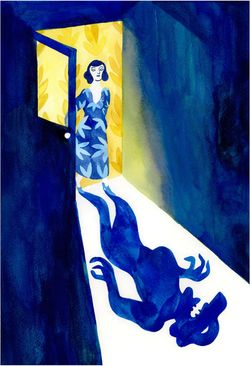
It’s a given that adulterous women make poor mothers; this is both sin and punishment for Emma Bovary and Anna Karenina, who lose not just their children, but their proper maternal instinct. First, and perhaps forgivably, they fall out of love with their husbands, but this leads them, somehow, to fall out of love with their own progeny. The perversion of the natural order becomes horribly perfect in Waugh’s “A Handful of Dust,” when Brenda Last blurts “Thank God” when she hears her son has died, and not, as she had supposed, her lover of the same name. When desire is in the air, motherhood becomes problematic. This despite the fact that sex causes motherhood. It is a fact worth stating sometimes that sex, in itself, cannot turn you into a whore, no matter what the nuns told you then or pornography tells you now, but it really can turn you into a mother. After which, of course, you are never allowed to have sex again.
More here.
Friday, May 8, 2015
Engineering students build a better barbecue smoker
Alvin Powell in the Harvard Gazette:

Along the way, they had to decode the arcane process of smoking meat, applying science to a traditional Southern art form with the aim of simplifying it for the novice and updating it for the 21st century. They had a real-world client in Williams-Sonoma, the company that sponsored their efforts; real-world competition in their experimental control, a high-end smoker called the “Big Green Egg”; and the real world itself to contend with, in the form of snowstorms and subzero temperatures for their Saturday smoking sessions.
“I was eating it last night as it came off the smoker, and it was fantastic,” said Patrick Connolly, Williams-Sonoma executive vice president and chief marketing officer, who was at an end-of-semester barbecue Monday where the culinary results were presented.
Connolly was among several dozen guests, students, faculty, and staff at the barbecue, held just outside Harvard’s Maxwell-Dworkin building. The barbecue followed an hour-long student presentation of the scientific results of the project in nearby Pierce Hall.
More here.
The Road to Jerusalem

Morgan Meis in The Smart Set:
The highway from Tel Aviv to Jerusalem, Highway 1, looks like any other highway in the world. This fact alone is disconcerting. The road to Jerusalem should be special. Somewhere deep down I suppose I wanted it to be a dirt road, a cobblestone road, anything but a normal highway. I even fantasized that the ascent from Tel Aviv to Jerusalem would not happen by means of a road at all. It would just happen. In reality, it is a highway. A highway filled with too many cars and bastard truck drivers probing the limits of vehicular stability and good sense.
About two thirds of the way up to Jerusalem, however, an interesting and unusual sight does present itself. It is the sight of abandoned vehicles along the side of the road. They aren’t normal vehicles, passenger cars or trucks. The vehicles are painted in the telltale green that only gets slapped on things owned by the military. You don’t get much time to inspect these military vehicles as you drive by on the highway. It is hard to guess their purpose, though it looks like they’ve been there for a while, remnants from something that happened in the first half of the 20th century.
My friend Ori, who was driving me from Ben-Gurion airport outside of Tel Aviv, explained that the vehicles were remnants of the military convoy that broke the Arab siege of Jerusalem during the War of Independence in 1948. The convoy was led by an American general, Mickey Marcus, Ori told me. “We call him the first Israeli general—aluf in Hebrew—since biblical days, since Joshua blowing his trumpet at the walls of Jericho.” The aluf, Ori said, was shot dead in the final days of the campaign. But the convoy made it through to Jerusalem.
For a week or so, while exploring Jerusalem old and new, the sight of those abandoned military vehicles along the road sat unbothered in the back of my brain. Then, I saw them again on a trip back down to Tel Aviv to visit friends. I began to understand what had nagged at me when I saw the vehicles the first time.
Half-destroyed military vehicles do not normally sit alongside a modern highway. These vehicles are monuments to the military struggles that attend the founding of the modern state of Israel. Such monuments might, in another country, come with an acknowledgment. No such luck in Israel.
More here.
What We Got Wrong In Our 2015 U.K. General Election Model
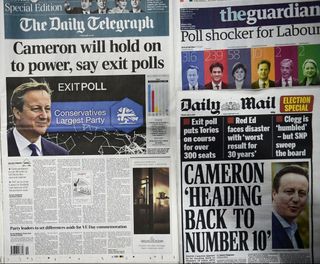
Polls for the UK election were all very off. Ben Lauderdale offers some possible reasons in FiveThirtyEight:
The only thing we can say on our behalf is that in comparative terms, our forecast was middle of the pack, as no one had a good pre-election forecast. Of course the national exit poll, while not as close to the target as in 2010, was far better than any pre-election forecast.
Steve Fisher at ElectionsEtc came closest to the seat result: his 95 percent prediction intervals nearly included the Conservative seat total, although they missed the Liberal Democrat interval substantially, just as ours did. Several other forecasts were further away than we were.
The most obvious problem for all forecasters was that the polling average had Labour and the Conservatives even on the night before the election. This was not just the average of the polls, it was the consensus. Nearly every pollster’s final poll placed the two parties within 1 percentage point of each other. Based on the polling average being level, we predicted Conservatives to win by 1.6 percentage points on the basis of the historical tendency of polls to overstate changes from the last election. This kind of adjustment is helpful for understanding how the 2010 result deviated from the national polls on election day, as well as the infamous 1992 U.K. polling disaster, when the polls had the two parties even before the election and the Tories won by 7.5 percentage points. The Conservative margin over Labour will be smaller than that when the 2015 totals are finalized, but not a lot smaller (currently it is 6.4 with all but one constituency declared). So our adjustment was in the right direction, but it was not nearly large enough. Part of the reason Fisher did better is that he applied a similar adjustment, but made it party-specific, leading to a larger swingback for the Tories than for other parties because of that 1992 result.
Before the election, we calculated expectations for three measures of performance — absolute seat error, individual seat error, and Brier score — based on the uncertainty in our forecast. (More about how those three errors are defined can be found in this article.) We have now calculated each of these quantities for our forecasts, given the final results. We did not do as well as we had expected to do by any of these measures. Our absolute seat error was 105 . We incorrectly predicted 63 individual seats (out of 632 in England, Wales and Scotland). Our Brier score was 96 (the best possible score would have been 0, and the worst 632). Not good.
More here.
The End of Labour

Richard Seymour in Jacobin (photo Ben Stanstall / AFP):
This is not 1992. In a way, it’s far worse than that. Imagine this: Labour has given the Conservatives their “Portillo moment,” with Ed Ballslosing his seat in Morley and Outwood, not from incumbency but from opposition.
The perspective gets even worse when you look at the figures. Overall, the Tory vote has barely shifted from 36.1% to (on present counts) 36.8%. That is, the Tories have a bit more than a third of the vote, and fractionally more than the total with which they failed to win a parliamentary majority in 2010. This is not, chiefly, a Tory surge. In previous elections, historically, a vote share of this scale would have left the Tories on the opposition benches.
But Labour’s vote also flatlined, currently about 30.6%, compared to 29% in 2010 — which was its worst share of the vote since 1918. In key marginals, like Nuneaton, it barely made a dent. In some relatively safe Tory seats where it should have had a swing, like North Swindon (a safe Tory area since 2010 boundary changes), the Tories actually gained.
National turnout looks like it was about 66%, which is fractionally above the turnout in 2010, and most of that increase will have been in Scotland and certain UKIP hot spots like Thanet South. So, Labour has mobilized almost no one who hadn’t previously voted Labour during its worst election defeat since 1918.
Both Labour and the Conservatives are in the middle of a long-term crisis, neither has done anything to reverse that, and the question in this election was: whose crisis is worse?
More here. Also see here in Vox.
orson welles at 100

Orson Welles would have been 100 this month. When he died in 1985, aged 70, the wonder was that he had lasted so long. His bulk was so immense, his productivity so prodigious in so many areas, his temperament so exorbitant, that he seemed to have been part of the landscape for ever. Never was ruined greatness so visible. The other great auteurs maudits of this century, Abel Gance and D.W. Griffith, disappeared into silence and oblivion. Eisenstein simply died young. Not Welles. Every time he trundled insincerely through some commercial for cheap liquor (he, the great bon viveur; he, for whom the very word commercial was an insult when applied to film), he sent a pang through the world’s heart.
Pity, for the man who made Citizen Kane, three other masterpieces including the peerless Chimes at Midnight, and at least two lesser but exquisite short films? Pity, for the man who revolutionised radio, whose theatre productions have never been rivalled for audacity and innovation, whose acting performances in the few good films he made for other directors (The Third Man, Compulsion) will never be forgotten? Yes, pity for what might have been: the very thing that haunted Welles himself. ‘Considering what I thought of myself at 14, I’m a mess,’ he admitted. ‘I started at the top,’ he famously said, ‘and worked my way downwards.’
more here.
is galadriel really so good?

Admittedly, I come to this as a notorious Orc-sympathizer, but I cannot bring myself to trust Galadriel, as well as the elves more generally. In my view, Galadriel has a rather ambiguous moral character. She is benevolent, to be sure, but her sense of good and evil rests on a dubious foundation, inasmuch as she perceives change itself as undesirable. For those beings who are not entirely satisfied with the status quo, Galadriel’s intentions may not be so noble, and her powers may well seem like forms of dark magic.
In my “Song of Saruman” essay, I suggested that the traitorous White Wizard was really an inverted Galadriel. When she refuses to take up the One Ring, she “passed the test,” whereas Saruman’s desire for power — even if it was for the power to do good — led him to become a Sauron-like villain. But lest we chalk up Galadriel’s noble choice to some inherent beatitude, thus denying how powerful the temptation really was and in turn robbing her of the truly heroic aspect of her refusal, we ought to remember that Galadriel is far more like Saruman, or even Sauron, than most Tolkien enthusiasts care to believe.
As we learn from her fascinating backstory, Galadriel came to Middle-earth as an unrepentant imperialist.
more here.