
[Thanks to John Ballard.]
Category: Recommended Reading
Intifada or not, something powerful is going on
Nigel Wilson in Al Jazeera:

The movement has even given traction to the idea that Palestinians could be on the verge of a new Intifada, or that one may have already begun.
More here.
Saturday Poem
This Neruda Earth
Sitting against a treetrunk in Dolores Park
amid the Chilean solidarity gathering.
my eyes beheld three tiny daisies
in the grass, their little pollen hearts
attacked by flies. Nearby, yellowjackets
were flying over a jungle of blades
of grass and brilliantly green-backed
horseflies were making merry on
a flute of dogshit. I had lowered
my eyes from the speeches, and even
the Peoples Tribune was stacked at
my side. So much movement
in nature. A butterfly alighted on
the front page and walked along
the headline as if reading it. The
flies went on eating the hearts out.
The horseflies were absolutely drunken
on the excrement. The yellowjackets
were strafing and landing and
taking off again. It was the guerrilla
war, it was mir, it was peace. So much
movement, so much space in an inch. This
Neruda earth.
by Jack Hirschman
from Poetry Like Bread
new translations of Bohumil Hrabal

In the Czech Republic, Hrabal is a mythic figure. The website for his favorite pub, U Zlatého tygra, has six tabs: Home, Beer/Cheese, Menu, Bohumil Hrabal, History, and Contacts. His 1994 meeting with ambassador Madeleine Albright and then presidents Havel and Clinton has been archived as both legend and link. The man and his work are preservations of Czech history, connecting old Prague, the “glory and downfall of the cultural boom of the ’60s” (to quote the Tygra’s website), and the city’s globalization under capitalism. Hrabal has come to represent a kind of nostalgia for a lost Czech time, somewhere back in the post-Soviet ’80s, or the pre-crackdown ’60s, or maybe even the democratic ’20s—anytime but now. In his intro to The Little Town Where Time Stood Still, Joshua Cohen identifies this nostalgia as Bohemian in general and Hrabalian in particular: “To feel born too late for a true life (whatever that is), and to feel that as a failure and that failure as ennobling, are very Czech emotions.” This complex blend of feeling—a yearning for the past that invigorates the presence of the present—courses through Hrabal’s best work, and is on full display in The Little Town Where Time Stood Still and Mr. Kafka and Other Tales from the Time of the Cult.
Originally translated in 1993 by the late James Naughton and newly reprinted by NYRB Classics, The Little Town Where Time Stood Still brings together two of Hrabal’s most iconic works. The first part, Cutting It Short (1976), takes the perspective of the author’s mother, Maryška, a restless, energetic woman constantly pushing the boundaries of acceptable behavior. Hers is the story of how these boundaries change with the passage of time, marked by the introduction of the wireless telephone to the little town of Nymburk.
more here.
‘Unfaithful Music & Disappearing Ink’ by elvis costello

Partway though Elvis Costello's baggy, often brilliant and wholly idiosyncratic memoir, “Unfaithful Music & Disappearing Ink,” there's a moment that echoes like a master metaphor. It's 1995 and our hero is about to accept “an Ivor Novello Award in the company of Van Morrison, Lonnie Donegan, and Don Black,” when a BBC exec sidles up to him and says, “Of course, you'd have had a lot more hits if you'd just taken out all the seventh and the minor chords.”
That this isn't the best line here is testament, I suppose, to how many good lines “Unfaithful Music & Disappearing Ink” contains. The implication is that Costello should have gone a more predictable route, given the programmers what they wanted — which is antithetical to the ethos of his career.
New wave rocker, country crooner, balladeer, collaborator and showman: Costello has been all of this and more in the course of what is now a 40-year run. Of all the first-generation punkers, he remains (with Patti Smith and possibly David Byrne) among the few who can claim the longevity and diversity of, say, Bob Dylan or Joni Mitchell, both of whom appear in this book. Like minds, perhaps, or water seeking its level. Either way, this is the company to which Costello belongs.
more here.
‘The Arab of the Future,’ by Riad Sattouf
Laila Lalami in The New York Times:
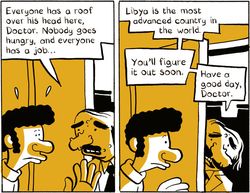
Abdel-Razak successfully defends his doctoral dissertation, and Clémentine, now his wife, gives birth to Riad. This should be a happy time for the young scholar, but instead he complains that he has received only a cum laude and that offers of employment arrive in the form of letters misspelling his name. Therein lies Abdel-Razak’s fatal flaw: He is unable to cope with the fact that his self-perception doesn’t match the way others perceive him. This, at least in part, explains why he leaps at the offer of a teaching post in Libya.
More here.
Friday, October 16, 2015
Is the world real, or is it just an illusion or hallucination?

Jessica L. Nielson, Sean Carroll, Fredrick Barrett, George Musser, Karl Friston, Rich Oglesby, and Brad Burge offer answers in Hopes and Fears. George Musser:
The holographic principle doesn’t mean the universe isn't real. It just means that the universe around us, existing within spacetime, is CONSTRUCTED out of more fundamental building blocks. “Real” is sometimes taken to mean “fundamental”, but that's a very limited sense of the term. Life isn't fundamental, since living things are made from particles, but that doesn’t make it any less real. It’s a higher-level phenomenon. So is spacetime, if the holographic principle is right. I talk about the holographic principle at length in my book, and I discuss the distinction between fundamental and higher-level phenomena in a recent blog post.
The closest we come in science to “real” or “objective” is intersubjective agreement. If a large number of people agree that something is real, we can assume that it is. In physics, we say that something is an objective feature of nature if all observers will agree on it – in other words, if that thing doesn’t depend on our arbitrary labels or the vagaries of a given vantage point (“frame-independent” or “gauge-invariant”, in the jargon). For instance, I'm not entitled to say that my kitchen has a left side and a right side, since the labels “left” and “right” depend on my vantage point; they are words that describe me more than the kitchen. This kind of reasoning is the heart of Einstein's theory of relativity and the theories it inspired.
Could we all be fooled? Yes, of course. But there's a practical argument for taking intersubjective agreement as the basis of reality. Even if everyone is being fooled, we still need to explain our impressions.
More here.
We Should Never Pay Down Our $17 Trillion Debt—Just Ask the IMF
Mike Konczal in The Nation:
In a 1937 radio address, the economist John Maynard Keynes said that “the boom, not the slump, is the right time for austerity at the Treasury.” The time to pay down debt isn’t when the economy is weak, since the necessary spending cuts and tax increases would exacerbate a recession, but instead when times are good.
But what if good times aren’t right for austerity either? What if we should just service our debt—i.e., pay the minimum—and chill? This piece of advice is coming from an institution that, for many on the left, is synonymous with austerity: the International Monetary Fund. The IMF’s retiring research chief, Olivier Blanchard, is an MIT-trained New Keynesian, and the research team he oversaw during the Great Recession pushed the discussion into brand-new territory. A recent paper by IMF economists Jonathan Ostry, Atish Ghosh, and Raphael Espinoza is titled “When Should Public Debt Be Reduced?”, and their surprising answer is, for a country like the United States, not in the near future.
As background, the national debt did increase as a result of the Great Recession. As the economy weakened, the government took in less in taxes and paid out more in support. These “automatic stabilizers” put a floor under demand and helped keep the Great Recession from turning into the next Great Depression.
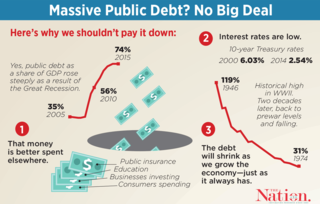
The government deficit increased throughout the worst of the recession, before falling and leveling off at a low rate. Now the deficit is just 2.4 percent of the GDP—lower than the average over the past 50 years. But the total amount of government debt has plateaued at a higher level. In 2007, the ratio of debt held by the public to GDP was about 35 percent; now it’s 74 percent.
To understand the IMF’s analysis, we must remember that the debt is what economists call a “sunk cost,” since the money has already been spent. We are left to consider the benefits and costs of this spending decision: Would our economy benefit most from throwing money at the debt, or investing it in something else?
More here.
Hillary vs. Bernie Will Decide the Future of the American Left

Elizabeth Bruenig in TNR:
The economic boom of the late '90s masked the disasterwelfare reform would eventually reveal itself to be for a time, and perhaps this is why Bill Clinton enjoys a reputation as a fantastic president with an almost lovable scoundrel side. But since the collapse of the dot-com bubble, his reckless gutting of welfare has plunged millions of families into deep poverty.
The point of welfare reform was, in Hillary’s words, to “transition from dependency to dignity”—that is, to transition desperately poor families from welfare to work within a definite period of time. Although Clinton has refused to comment on whether or not she still considers welfare reform a success, she has since stuck to the theme of keeping benefits means-tested, with the goal of limiting benefits to the most destitute. Thus her interest, one presumes, in preventing Donald Trump’s kids from attending college without paying tuition, as Norway’s Princess Märtha Louise didn’t when she attended one of Norway’s many state colleges. Quelle horreur.
Clinton’s approach is one way to think about benefits: as tightly limited programs of last resort for people in extreme circumstances. This is mostly the way we talk about benefits now, in the parlance of a “safety net” for the precariously balanced and fallen. In this vein of thought, it makes sense to limit benefits to the extremely needy and to impose terms even upon those benefits, so as to prevent dependency—since the point is, after all, eventually ending one’s use of benefits.
Then there is the other way of looking at benefits: the social-democratic way. In his 1990 book Three Worlds of Welfare Capitalism, Danish sociologist Gøsta Esping-Andersen described firstly the “‘liberal’ welfare state, in which means-tested assistance, modest universal transfers, or modest social-insurance plans predominate,” and “benefits cater mainly to a clientele of low-income, usually working-class, state dependents.” Then there is the social-democratic world, which consists of “a welfare state that would promote an equality of the highest standards, not an equality of minimal needs,” thus promising “that equality be furnished by guaranteeing workers full participation in the quality of rights enjoyed by the better-off.”
More here.
Why the Free Will Debate Never Ends
Julian Baggini in The Philosophers' Magazine:
Two hundred years later, when P F Strawson had his stab at the problem, the disagreements were as wide as ever, and unlike Hume, Strawson was under no illusion that he would resolve them. “This lecture is intended as a move towards reconciliation,” he said at the beginning of his classic 1962 essay “Freedom and Resentment,” “so it is likely to seem wrongheaded to everyone.”
There's a lot still be said for Hume's diagnosis of the problem, and his solution. Hume argued that there was no contradiction between accepting that human beings are fully part of nature, their actions subject to the same laws of cause and effect as anything else, and believing that we have free will. Free will is not some magical power to escape the necessity of nature but a capacity to make choices free from coercion.
More here.
The tantalizing links between gut microbes and the brain
Peter Andrey Smith in Nature:
“We try to be prepared for everything,” Knickmeyer says. “We know exactly what to do if kids make a break for the door.”
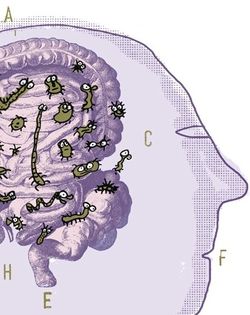
Knickmeyer is excited to see something else from the children — their faecal microbiota, the array of bacteria, viruses and other microbes that inhabit their guts. Her project (affectionately known as 'the poop study') is part of a small but growing effort by neuroscientists to see whether the microbes that colonize the gut in infancy can alter brain development.
The project comes at a crucial juncture. A growing body of data, mostly from animals raised in sterile, germ-free conditions, shows that microbes in the gut influence behaviour and can alter brain physiology and neurochemistry.
More here.
Henry David Thoreau’s moral myopia
Kathryn Schulz in The New Yorker:
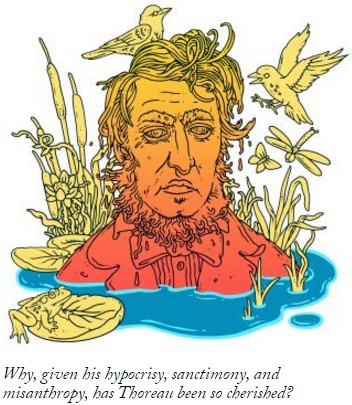
Two days later, a thirty-two-year-old Massachusetts native, en route from Concord to Cape Cod, got word of the disaster and detoured to Cohasset to see it for himself. When he arrived, fragments of the wreck were scattered across the strand. Those victims who had already washed ashore lay in rough wooden boxes on a nearby hillside. The living were trying to identify the dead—a difficult task, since some of the bodies were bloated from drowning, while others had struck repeatedly against the rocks. Out of sentiment or to save labor, the bodies of children were placed alongside their mothers in the same coffin.
The visitor from Concord, surveying all this, found himself unmoved. “On the whole,” he wrote, “it was not so impressive a scene as I might have expected. If I had found one body cast upon the beach in some lonely place, it would have affected me more. I sympathized rather with the winds and waves, as if to toss and mangle these poor human bodies was the order of the day. If this was the law of Nature, why waste any time in awe or pity?” This impassive witness also had stern words for those who, undone by the tragedy, could no longer enjoy strolling along the beach. Surely, he admonished, “its beauty was enhanced by wrecks like this, and it acquired thus a rarer and sublimer beauty still.”
Who was this cold-eyed man who saw in loss of life only aesthetic gain, who identified not with the drowned or the bereaved but with the storm? This was Henry David Thoreau, that great partisan of the pond, describing his visit to Cohasset in “Cape Cod.”
More here.
Neri Oxman: Design at the intersection of technology and biology
Frieze Projects Puts the Focus on Physical Space
Roslyn Sulcas in The New York Times:
Asad Raza
(American, 40)

The way I’ve furnished it is to use what was to hand. We are in the middle of the park, and I found a tree that was being cut down, from which we will create seating elements and a bookshelf. There are a lot of different things that might happen in the space. The children will learn about Pan and develop ideas with the artists; we are trying to make an oral portrait of this figure from the past. I hope it will be experiential and discursive, a space of imagination. We are interested in the home and the symbology of the domestic space, and what happens when you put the art object in different environments. For Frieze, we thought about the technology of privacy, and how this is changing the domestic environment. We put six bedrooms in the middle of the fair, which wasn’t easy because it’s hard to find space at Frieze! We are all architects — we met when we were studying at the Architectural Association in London — so we used our architectural knowledge to milk a long, narrow space out of the place where the tent is joined together, which usually you don’t see.
More here.
Palestinians Are Fighting for Their Lives; Israel Is Fighting for the Occupation
Amira Hass in Haaretz:

That we notice there’s a war on only when Jews are murdered does not cancel out the fact that Palestinians are being killed all the time, and that all the time we are doing everything in our power to make their lives unbearable. Most of the time it is a unilateral war, waged by us, to get them to say “yes” to the master, thank you very much for keeping us alive in our reservations. When something in the war’s one-sidedness is disturbed, and Jews are murdered, then we pay attention.
More here.
Friday Poem
Cirque D'Hiver
Across the floor flits the mechanical toy,
fit for a king of several centuries back.
A little circus horse with real white hair.
His eyes are glossy black.
He bears a little dancer on his back.
She stands upon her toes and turns and turns.
A slanting spray of artificial roses
is stitched across her skirt and tinsel bodice.
Above her head she poses
another spray of artificial roses.
His mane and tail are straight from Chirico.
He has a formal, melancholy soul.
He feels her pink toes dangle toward his back
along the little pole
that pierces both her body and her soul
and goes through his, and reappears below,
under his belly, as a big tin key.
He canters three steps, then he makes a bow,
canters again, bows on one knee,
canters, then clicks and stops, and looks at me.
The dancer, by this time, has turned her back.
He is the more intelligent by far.
Facing each other rather desperately—
his eye is like a star—
we stare and say, “Well, we have come this far.”
.
by Elizabeth Bishop
from The Complete Poems
publisher: Chatto & Windus, London, 1970
Thursday, October 15, 2015
A Feminism Where ‘Lean In’ Means Leaning On Others

Gary Gutting interviews Nancy Fraser in The NYT's The Stone:
Gary Gutting: You’ve recently written: “As a feminist, I’ve always assumed that by fighting to emancipate women I was building a better world — more egalitarian — just and free. But lately I’ve begun to worry that . . . our critique of sexism is now supplying the justification for new forms of inequality and exploitation.” Could you explain what you have in mind?
Nancy Fraser: My feminism emerged from the New Left and is still colored by the thought of that time. For me, feminism is not simply a matter of getting a smattering of individual women into positions of power and privilege within existing social hierarchies. It is rather about overcoming those hierarchies. This requires challenging the structural sources of gender domination in capitalist society — above all, the institutionalized separation of two supposedly distinct kinds of activity: on the one hand, so-called “productive” labor, historically associated with men and remunerated by wages; on the other hand, “caring” activities, often historically unpaid and still performed mainly by women. In my view, this gendered, hierarchical division between “production” and “reproduction” is a defining structure of capitalist society and a deep source of the gender asymmetries hard-wired in it. There can be no “emancipation of women” so long as this structure remains intact.
G.G.: Why can’t responding to feminist concerns be seen as just one major step in correcting the social and economic flaws of our capitalist society, not a fundamental transformation of the system?
N.F.: It certainly can be seen that way. But I am questioning whether today’s feminism is really advancing that process. As I see it, the mainstream feminism of our time has adopted an approach that cannot achieve justice even for women, let alone for anyone else. The trouble is, this feminism is focused on encouraging educated middle-class women to “lean in” and “crack the glass ceiling” – in other words, to climb the corporate ladder. By definition, then, its beneficiaries can only be women of the professional-managerial class. And absent structural changes in capitalist society, those women can only benefit by leaning on others — by offloading their own care work and housework onto low-waged, precarious workers, typically racialized and/or immigrant women.
More here.
How They Failed to Block the Iran Deal
Elizabeth Drew in The New York Review of Books:
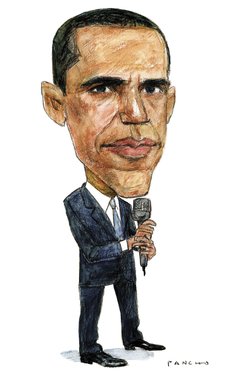
The president’s congressional victory on the nuclear agreement with Iran had many sources, not least of which were the nature and tactics of the opposition. It might have been more difficult to achieve if the Republicans as well as Israeli Prime Minister Benjamin Netanyahu and his allied American group, the American Israel Public Affairs Committee (AIPAC), had given any sense that they had thoughtfully considered the deal that six nations reached with Iran, or if they had offered any alternative. But the agreement with Iran collided with the current state of American politics.
Once the nuclear deal was presented to Congress in July, there was little question that it would fall into the deep crevasse that had developed between the two political parties. Ever since Barack Obama took office in 2009, the Republicans have opposed everything he wanted to do. In keeping with this strategy, within days of the deal’s being announced, numerous Republicans, without bothering to read the agreement or consider it seriously, jumped to oppose it.
The debate on the deal throughout was only ostensibly on its merits. The Republicans’ contempt for Obama—as a Democrat, as a black person, as, in the view of many of them, an illegitimate president—was clear to any close observer. For the first time in US history, the opposition party thumbed its nose at the president by inviting the head of another nation—Netanyahu—to address Congress to urge rejection of an international measure the president supported. When Secretary of State John Kerry, a former chairman of the Senate Foreign Relations Committee, appeared before it to testify on the agreement, he was greeted with overt contempt by its Republican members. The current chairman, Bob Corker of Tennessee, told him, “You’ve been fleeced.”
More here.
Did Astronomers Find Evidence of an Alien Civilization? (Probably Not. But Still Cool.)
Phil Plait in Slate:
The star is called KIC 8462852, and it’s one of more than a hundred thousand stars that was observed by NASA’s Kepler mission. Kepler stared at these stars, looking for dips in their brightness. These very slight dimmings can be due to many factors, but one is if the star has planets, and one (or more) of them orbits the star in such a way that it passes directly in front of the star as seen from Earth. If it does—what we call a transit—we see a tiny diminution of starlight, usually by less than a percent.
Thousands of exoplanets have been found this way. Usually the planet is on a short orbit, so the dip we see is periodic, repeating every few days, weeks, or months, depending on the size of the planet’s orbit.
KIC 8462852 is a star somewhat more massive, hotter, and brighter than the Sun. It’s about 1,500 light-years away, a decent distance, so it’s too faint to see with the naked eye. The Kepler data for the star are pretty bizarre: There are dips in the light, but they aren’t periodic. They can be very deep; one dropped the amount of starlight by 15 percent, and another by a whopping 22 percent!

Kepler data show huge dips in brightness, up to 22 percent in the star. The bottom axis is days after an arbitrary date, and the bottom two panels are close-ups of the top one, centered near 800 days (left) and 1,500 days (right). The average amount of starlight over time is set equal to 1 for ease of display. (Graphs by Boyajian et al.)
Straight away, we know we’re not dealing with a planet here. Even a Jupiter-sized planet only blocks roughly 1 percent of this kind of star’s light, and that’s about as big as a planet gets. It can’t be due to a star, either; we’d see it if it were. And the lack of a regular, repeating signal belies both of these as well. Whatever is blocking the star is big, though, up to half the width of the star itself!
Also, it turns out there are lots of these dips in the star’s light. Hundreds. And they don’t seem to be periodic at all. They have odd shapes to them, too. A planet blocking a star’s light will have a generally symmetric dip; the light fades a little, remains steady at that level, then goes back up later.
More here.
Mohsin Hamid — The reluctant novelist
Asad Rahim Khan in Herald:
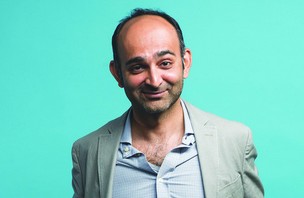
In a land of 140 million people, with less than 14 novelists of note between them – both in English and Urdu – Pakistan was unprepared for Moth Smoke in 2000; a decline-and-fall story with everything else in between: heat and hash, nuclear bombs and car chases, kite fights and wars of succession among Mughal princes.
In a way, the 29-year-old Mohsin Hamid could be compared to the 21-year-old Bret Easton Ellis, the boy wonder who blew the lid off the Reagan years with Less Than Zero. Like Hamid’s, Ellis’s maiden novel is a tale of beautiful young drug dealers that ends in tears. Unlike Hamid, Ellis could not write to save his life.
More here.