Why it’s time to dispel the myths about nuclear power

David Robert Grimes in The Guardian:

ScreenHunter_1863 Apr. 18 08.48This year marks the fifth anniversary of the Fukushima disaster, and the 30th anniversary of the Chernobyl incident. Together, these constitute the two greatest nuclear accidents the world has ever seen.

Even now, widespread confusion over these disasters still blights rational discussion on energy production; too often the debate becomes needlessly acrimonious, reliant on rhetoric in lieu of facts. Yet as climate change becomes an ever-encroaching factor, we need more than ever to have a reasoned discussion on nuclear power. To this end, it’s worth dispelling some persistent myths.

The events in the Ukrainian town of Pripyat on the morning of 26 April 1986 have permanently etched the name Chernobyl, and all its connotations, into the public mind. With a dark irony, it was a poorly conducted safety experiment that was the catalyst for the worst nuclear disaster in history. The full odious sequence of events that led to the accident would constitute an entire article. In essence, however, the mixture of flawed design, disabled redundancies and a tragic disregard for experimental protocol all feature heavily in the blueprint of the disaster. The net result of this errant test was a massive steam explosion, replete with enough kick to blow the 2,000 ton reactor casting clean through the roof of the reactor building.

Despite the sheer explosive force of the eruption, what ensued was not a nuclear blast.

More here.
The Promise and Peril of Bernie Sanders

Ali Minai in Barbarikon:

ScreenHunter_1862 Apr. 18 08.43I had originally intended to write a long article on the Bernie Sanders phenomenon unfolding before our eyes in the US elections, but an absolutely brilliant piece by Jamelle Bouie in Slate says almost everything I wanted to say. It is an absolute must read! for anyone interested in the near-future of American politics.

Sanders supporters should not be put off by the headline, “There is No Bernie Sanders Movement“. The article is much more about what the Sanders movementcan be than about what it is not. As Bouie notes, the most significant fact about the movement is the disproportionate youth of its supporters. As such, it has the potential to go from an insurgency against the Democratic establishment to becoming the future of the Democratic Party. I think that young Democratic leaders with ambition are realizing that, which explains why some of them have chosen to come out in support of Sanders. However, Sanders is less a savior than a harbinger – more John than Jesus. If the potential of his movement is to be realized fully, it will be at the hands of others – perhaps an Elizabeth Warren or Cory Booker – who will put in the blood, toil, sweat and tears to take it from vision to reality.

More here.

LSD Makes Your Brain More ‘Flexible,’ Less Anxious

Carrie Arnold in The Daily Beast:

LsdLast week, a pair of new studies revealed some of the first images of neural activity in people who had taken LSD. A far cry from the “This is your brain on drugs” ads of the 1980s, this new research shows that your brain on LSD actually involves a breakdown of the factors that normally keep neural circuits separate. The result? That stereotypical feeling of feeling “at one” with the world and part of something larger than yourself.

…Other research on psychedelic drugs given to dying cancer patients struggling with anxiety over their impending deaths has shown that this type of experience can be very helpful in relieving the sense of over-arching doom. Building on evidence from more than half a century ago, other studies are showing that these drugs may be helpful in relieving anxiety more broadly. For neuroscientists like Tagliazucchi, however, these drugs provide a novel way to simply understand how the brain goes about its everyday duties. “We think that what we experience normally is reality, but the truth is our brains are just constructing reality for us,” Tagliazucchi said.

More here.

In Gratitude – cancer, contrariness and Doris Lessing

Blake Morrison in The Guardian:

LessingWhen Jenny Diski was told she had an incurable cancer, her first reaction was embarrassment. That wouldn’t be the response of most people, but Diski rarely does as expected. “Contrary-minded” is her own phrase for it, and anyone who has read her over the years will know what she means. Who else would choose as the narrator for a novel a baby born without a brain (Like Mother, 1988)? Or feel a sudden compulsion to go to Antarctica and write a travel book that then turned into a memoir of her mother (Skating to Antarctica, 1997)? As a child she never did as she was told (borderline personality disorder, the experts called it), and as a writer she’s constantly surprising. Sometimes, for all her wit and knowingness, she surprises even herself. She was embarrassed because it felt so banal and predictable. With a disease “so known in all its cultural forms”, what could she say that hasn’t been said a million times? Her first response, in the consulting room with the “Onc Doc”, is to make a joke. Even that, she decides, is probably stereotypical behaviour, as is asking, in an apologetic, roundabout way, how long she can expect to live. Two to three years is the answer, but she wonders how much faith to invest in that: life expectancy for cancer patients is hard to predict, and what if the Onc Doc has added a year “for luck” or erred on the low side to avoid raising false hope?

In Gratitude works on many levels: as a memoir of an unusual adolescence; as an essay on family dysfunction; as an intimate mini-biography of a Nobel-prize-winning novelist; and as an unillusioned meditation on illness and death. At its heart, though, is the story of a difficult relationship between women, both, as it happens, outstanding writers. However prolific she has been in the past – 18 titles by my count – it’s the story Diski most needed to tell.

More here.

Sunday Poem

‘so rare a thing is absolute congeniality in every attitude
and habit even among dear friends’ —Petrarch

Ascent of Ben Bulben

—i.m. George Watson

There are two ways of climbing to the summit
of Ben Bulben: one behind Drumcliff churchyard,
east at the creamery and up the hill.
There you pass elegant retirement houses
on ever-narrowing woodbine-scented roads,
until you have to leave the car and walk,
straight up the formidable, striated front.

This is a hard way. If you make it,
look back down at all that you have left:
the sea stretching from the Rosses to the foot
of Knocknarea – seeing maybe the last thing
that Diarmuid saw before his death:
the unexcavated cairn of the fierce queen
who scorns the dangerous currents at Strandhill.

The other way is easier: you ask Jimmy Waters
whose business visits to the local farms
have taught him every yard and forest-track
where the mountain-stream disappears under
the ground. He’ll tell you which warnings to ignore:
the gates you can open, and what bogs
above Glencar you can still take in your stride.

And the Yeatses: which way for them? Did they stand
and clap their hands to send the swans wheeling
in broken rings, over the sea and across
to the other mountain, to wonder at the gist
of what they mean? Or did they watch the races
being set up on the yellow strand,
where men still break stones on the road below?

.
by Bernard O'Donoghue
publisher: Poetry International Web, 2011
.

Saturday, April 16, 2016

“Now the Writing Starts”

Adonis

Jonathan Guyer interviews Adonis in The NY Review of Books Daily:

In your new book, Violence et Islam, you wrote that ISIS represents the end of Islam. Will there be a new beginning?

You know, we have to remain believers. How so? If people, if humanity, comes to an end, then the world ends. As long as there are individuals—what I am saying now is that I am not alone. There are many individuals, in Egypt and other countries, who say what I am saying. This is why we have to remain confident that the human will reach a stage where he will find better solutions. But when and how will be determined in time. But I can say that the Arabs will never advance as long as they think and operate in this old, jihadist, religious context. It is not possible. This is what is extinct, what has ended. ISIS is the last shout. Like a candle about to go out, it ends with strength.

The renaissance needs time. Our society, during the fifteen centuries since the foundation of the first Islamic state, has not been able to establish a society of citizens. With a citizen’s duties come rights. Until now, Arab societies are formed of individuals who carry out the same duties but have different rights: the Christian does not have the same rights as the Muslim, for instance. Fifteen centuries. How can we solve fifteen centuries in a week or two, a month or two? But I trust that the time will come, but outside this context.

Does change require a new engagement with the West? I read your poem, “Desire Moving Through Maps of Matter” (1987), about the Eiffel Tower floating in the Mediterranean Sea, and a conversation you wrote between Abu Nawas and Victor Hugo. The bridge between Arabs and the West—

The East and the West are economic and military concepts, and were created by colonialism. We can say geographically that there are East and West. Economics and colonialism took advantage of that.

But in art there is no East and West. You see it in the paintings of Paul Klee and how he was inspired by Tunisia and Eastern Arabia. You see it in the paintings of Delacroix and how he was inspired by Morocco. When you read Rimbaud, you see that the best thing about Rimbaud is that he is not a Westerner; although he was born in the West, he was completely against the West. When you read Abu Nawas, or Abu Al-Ma’arri, you do not say that they are Easterners or Westerners. The creative ones are from one world, regardless of what country they come from or where they went.

More here.

Why Elizabethan England was obsessed with Islam

Jeremy Seal in The Telegraph:

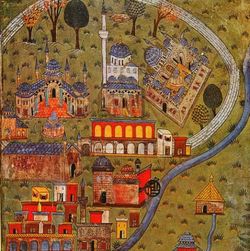
Constantinople_2-large_trans++qVzuuqpFlyLIwiB6NTmJwQv4qavVNcwcxNdFYK5RcKcOn a May morning in 1570 a papal bull, nailed to the door of the Bishop of London’s palace, sealed Protestant England’s break with Catholic Europe. But the excommunication of Elizabeth I had another consequence, one that posterity has been slow to acknowledge, and which this timely book is among the first to treat in substantial detail: the isolated English queen’s pursuit of ties with the sultans and shahs of Islamic Turkey, Morocco and Persia.

There is no question that Jerry Brotton’s exploration of “a much longer connection between England and the Islamic world” than is generally appreciated has currency. His canvas takes in places with “tragic resonance” for our age, among them Raqqa, Aleppo and Fallujah. But resisting the temptation to draw parallels between then and now, Brotton crafts a purely 16th-century narrative set on two geographical fronts. We follow pioneer embassies to Constantinople, Marrakesh and Qazvin (the former Persian capital) alongside the growing hold the Islamic world exerted on the English from the time of Henry VIII, a fascination that would find powerful expression in Elizabethan cuisine, fashion and theatre.

More here.

Stephen Hawking and Yuri Milner launch $100m star voyage

Tim Radford in The Guardian:

ScreenHunter_1861 Apr. 16 16.23In an unprecedented boost for interstellar travel, the Silicon Valley philanthropist Yuri Milner and the world’s most famous cosmologist Stephen Hawking have announced $100m (£70m) for research into a 20-year voyage to the nearest stars, at one fifth of the speed of light.

Breakthrough Starshot – the third Breakthrough initiative in the past four years – will test the knowhow and technologies necessary to send a featherweight robot spacecraft to the Alpha Centauri star system, at a distance of 4.37 light years: that is, 40,000,000,000,000 kilometres or 25 trillion miles.

A 100 billion-watt laser-powered light beam would accelerate a “nanocraft” – something weighing little more than a sheet of paper and driven by a sail not much bigger than a child’s kite, fashioned from fabric only a few hundred atoms in thickness – to the three nearest stars at 60,000km a second.

More here.

Crisis in Brazil

Download (1)

Perry Anderson in the LRB:

The BRIC countries are in trouble. For a season the dynamos of international growth while the West was mired in the worst financial crisis and recession since the Depression, they are now the leading source of anxiety in the headquarters of the IMF and the World Bank. China, above all, because of its weight in the global economy: slowing output and a himalaya of debt. Russia: under siege, oil prices falling and sanctions biting. India: holding up best, but unsettling statistical revisions. South Africa: in free fall. Political tensions are rising in each: Xi and Putin battening down unrest with force, Modi thrashed at the polls, Zuma disgraced within his own party. Nowhere, however, have economic and political crises fused so explosively as in Brazil, whose streets have in the past year seen more protesters than the rest of the world combined.

Picked by Lula to succeed him, Dilma Rousseff, the former guerrilla who had become his chief of staff, won the presidency in 2010 with a majority nearly as sweeping as his own. Four years later, she was re-elected, this time with a much smaller margin of victory, a 3 per cent lead over her opponent, Aécio Neves, the governor of Minas Gerais, in a result marked by greater regional polarisation than ever before, the industrialised south and south-east swinging heavily against her, and the north-east delivering an even larger landslide for her – 72 per cent – than in 2010. But overall it was a clear-cut win, comparable in size to that of Mitterrand over Giscard, and a good deal larger, not to mention cleaner, than that of Kennedy over Nixon. In January 2015 Dilma – from this point we’ll drop the surname, as Brazilians do – began her second presidency.

Within three months, huge demonstrations packed the streets of the country’s major cities, at least two million strong, demanding her ouster. In Congress, Neves’s Brazilian Social Democracy Party (PSDB) and its allies, emboldened by polls showing Dilma’s popularity had fallen to single figures, moved to impeach her. On May Day, she was unable even to give the traditional televised address to the nation: when her speech on International Women’s Day in March had been broadcast people banged saucepans and blew car horns, a form of protest that became known as panelaço. Overnight, the Workers’ Party (PT), which had long enjoyed by far the highest level of approval in Brazil, became the most unpopular party in the country. In private, Lula lamented: ‘We won the election. The following day we lost it.’ Many militants wondered if the party would survive at all.

How had it come to this?

More here.

Storytelling Tips from Cyber Illusionist Marco Tempest

From Adobe Voice & Slate Blog:

Cyber illusionist Marco Tempest uses technology to “invent the impossible.” His unique blend of science, tech, and magic creates one-of-a-kind experiences—most recently, a dancing swarm of twenty-four drones. The power of his illusions comes from the way they tease our imaginations into believing that we are seeing something just beyond what we think we know can be real. As Marco puts it, “Magic makes possible today what science will make tomorrow.”

His interest in technology has inspired several hit talks at TED, and his creative approach is instructive for both aspiring magicians and those of us whose daily lives are firmly grounded in reality. His work reveals the power of persuasion and the value of keeping your imagination open to any inspiration.

More here.

Basic Income And Social Democracy

PhilippeVanParijs

Philippe van Parijs in Social Europe:

The idea of an unconditional basic income is in fashion. From Finland to Switzerland, from San Francisco to Seoul, people talk about it as they have never done. Twice before, basic income was the object of a real public debate, albeit briefly and limited to one country at a time. In both episodes, the centre left played a central role.

The first debate took place in England in the aftermath of World War I. The Quaker and engineer Dennis Milner managed to get his “state bonus” proposal discussed at the 1920 Labour Party conference. It was rejected, but prominent members of the party kept defending it in the following years under the label “social dividend”. Among them were the Oxford economist and political theorist George Cole and the future Nobel laureate James Meade.

The second debate took place in the United States in the late 1960s and early 1970s. Another future Nobel laureate, James Tobin, advocated the introduction of a “demogrant”, along with Harvard economist and best-selling author John Kenneth Galbraith, also on the left of the Democratic Party. Persuaded by them, Senator George McGovern included the proposal in his programme during his campaign for the nomination as Democratic presidential candidate, but dropped it in the last months before the 1972 election which he lost to Richard Nixon.

The current, far longer and increasingly global debate originated in Europe in the 1980s. Interest in basic income arose more or less simultaneously in several countries and prompted the creation of a network (BIEN) that now has national branches in all continents. This time, however, the social democratic left is not exactly at the forefront, far less than the greens, for example, or than some components of the liberal right and the far left .

More here. Also see here for a response by Francine Mestrum.

‘Is that Kafka?’ by Reiner Stach

Is-that-kafkaEvan James at The Quarterly Conversation:

The first volume of Reiner Stach’s monumental, three-volume biography of Kafka was published in Germany about fourteen years ago. The second came six years later, in 2008.Is that Kafka?, which isn’t one of the three volumes,appeared in 2012, the same year that a decades-long legal battle finally made a trove of papers belonging to Max Brod, Kafka’s friend and literary executor, available to the public. Presumably this fortuitous ruling allowed Stach to write, at last, the final volume of his big, widely praised biography—funnily enough, the volume that addresses the first part of Kafka’s life. That book, Kafka—The Early Years, was published in 2014. (An English translation is forthcoming.)Even if Is that Kafka? was a kind of stopgap that kept Stach contemplating Franz while he awaited the release of key documents, it’s also an unconventional work of biography-by-collage in its own right. Its subtitle, 99 Finds, points to the raw material of the project: surprising discoveries made in the course of an epic research process.

Underlying all of this biographical work is a desire to complicate received ideas about the author. In his introduction, Stach describes the enduring image of Kafka in characteristically clear-eyed terms: even though “decades of international, interdisciplinary research” have given scholars a more nuanced picture of Kafka and his times, he has persisted in the popular imagination as ” “the quintessential archetype of the writer as a sort of alien: unworldly, neurotic, introverted, sick—an uncanny man bringing forth uncanny things.” Stach’s aim is to “destabilize” these images by introducing “counter-images” in which he emphasizes the unexpected and the overlooked to help “quietly divorce us from clichés.” Implied here is the conviction that clichés about an author’s life obstruct appreciation of their work. Why else bother to challenge them?

more here.

Elias Khoury’s ‘Broken Mirrors’

026a5258-1324-41f7-bfcd-0108510f6934Nathaniel Popkin at Public Books:

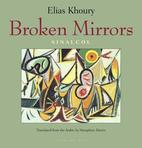
Lebanese author Elias Khoury’s latest novel to be translated into English, Broken Mirrors, is about identity and memory, destruction and displacement, exile and its internal ruptures. The book opens with the exiled Karim Shammas having just returned to a still-dangerous Beirut in 1990, as the Lebanese civil war that began in 1975 works its way to an explosive end. Karim suffers from a “homesickness for Beirut [that] had left him incapable of thought” and lands him in his home city without his knowing exactly why he is there. The deep, inexplicable longing that overtakes him in middle age is accompanied by paralyzing despair over endemic violence, endless war, and pervasive corruption. “The war will never end because it’s inside us,” says a woman, Salma, to Karim, reflecting not only the accumulated anguish of war, but the deeply fractured nature of Lebanon, Christian and Muslim, born from French and English imperial maneuvering and Maronite demands for a state independent of Syria at the fall of the Ottoman Empire.

Khoury, who was until recently a Global Distinguished Professor of the Middle Eastern and Arabic Studies at New York University and the editor of a top Lebanese literary magazine, Al-Mulhaq, is a stunning literary voice of Beirut’s despair and resilience. He isn’t alone in this project. Beirut, its sweep of sea and mountains perched on the edge of East and West, open and cosmopolitan, yet fundamentally unstable, has engendered an urban literature of resilience and memory, of voices trapped in the rubble. It’s worth mentioning here the work of the young Lebanese writer Rabee Jaber, whose striking novel The Mehlis Report was published in English in 2013 (Jaber’s Confessions was brought out by New Directions in March).

more here.

‘The Lady With the Borzoi: Blanche Knopf, Literary Tastemaker Extraordinaire’

Liesl Schillinger in The New York Times:

Laura-Claridge-author-Ettlinger-500-pxIf you’ve ever struggled with the task of composing a guest list for the ultimate fantasy dinner party, Laura Claridge’s biography of Blanche Knopf (née Wolf) will show you whom to put at the head of your table. That dream guest is, of course, Claridge’s subject: the petite, intense and, as Robert Gottlieb once put it, “fierce and exigent” co-founder of the great literary publishing house Alfred A. Knopf. She was an intuitive and visionary champion of contemporary authors, a voracious bookworm, a tireless hobnobber, a snappy dresser and a lifelong dog-lover (of tiny, fluffy ones, not of the imposing, austere borzoi she chose to grace the Knopf colophon, a breed she regarded as “cowardly, stupid, disloyal, and full of self-pity”). To round out the notional gathering, you might wheedle the illustrious publisher into bringing along some of her devoted friends, from Thomas Mann, H.L. Mencken, Albert Camus and Muriel Spark to Langston Hughes, John Hersey and Willa Cather. Or you could invite one of her many musical boyfriends, a group that included (but was not limited to) Jascha Heifetz, Leopold Stokowski and Arthur Rubinstein. An added perk: You wouldn’t need to worry about entertainment. Her pals Paul Robeson and George Gershwin could be counted on to drop by and provide the music, while Blanche herself (and chums Helen Hayes and Anita Loos) could dance the Charleston, the Lindy Hop and the Black Bottom. In 1925, at one of her dinner parties, Blanche performed a spirited medley of all three while sporting a top hat and cane, prompting her husband and business partner, Alfred, to “applaud vigorously; even as the guests seemed unsure what to think.” This, Blanche’s biographer makes plain, was a rare instance of spousal approval.

The typical tenor of the couple’s rapport, Claridge establishes early on, was acrimonious. Indeed, the Knopf conference room seems to have resembled the living room in “Who’s Afraid of Virginia Woolf?” (published by Knopf in 1962), with Blanche intentionally “nettling” Alfred, provoking him to shout, and Alfred “swooping down on her just as she thought there was an all-clear.”

Picture: Laura Claridge has written books ranging from feminist theory to biography and popular culture, most recently the story of an American icon, Emily Post: Daughter of the Gilded Age, Mistress of American Manners (Random House), for which she received a National Endowment for the Humanities grant.

More here.

Bringing Native Women’s Struggles to Life on Stage

Frances Madeson in Ms. Magazine:

ScreenHunter_1860 Apr. 16 13.05Typing the word “survivance” into the Ms. Blog’s search bar yields no results. So perhaps there is no better way to introduce this term here, as theorized in Native American circles of academe, than via Mary Kathryn Nagle’s play Sliver of a Full Moon. Sliver is a dramatization of the legislative struggle to reauthorize the Violence Against Women Act (VAWA) in 2013, and includes powerful testimony by three Native women lucky to be alive to tell their own stories.

“Survivance” is Anishinaabe writer and scholar Gerald Vizenor’s portmanteau of survival and resistance, or survival and endurance, and offers a way to understand both Nagle’s work, and the reasons the formerly abused women have chosen to participate in her play: creating dramatic art as “a renunciation of dominance, tragedy, victimry.”

In this instance, victimry is structured by law. It arose in the wake of Oliphant v. Suquamish Indian Tribe, a 1978 Supreme Court decision that stripped Indian Nations of the ability to exercise their inherent criminal jurisdiction over non-Indians who come onto tribal lands and commit crimes. About 67 percent of the crimes committed against Native women on tribal lands are by non-Native men—so it’s been open season on Native women for almost 40 years.

More here.

Why Mona Lisa Smiles

Vishwas R. Gaitonde in the Prague Review:

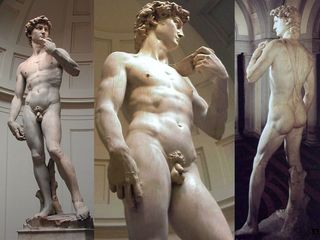
Michelangelo-davidIn Renaissance Italy, one of the perennial debates was whether sculpture was superior to painting, or the other way round. Many said two dimensional paintings couldn’t hold up against sculpture, which was three dimensional. Michelangelo, an archrival of Leonardo and who regarded himself as a sculptor first and a painter second, used the medium to depict movement; an excellent example was his statue, David. David’s head is slightly turned so that the point he faces is different from the point in front of his body. As a result, the body seems to be in motion. This is heightened by distributing the body weight unevenly between the two legs. The positioning of the face and upper body half-way through a motion was called contrapposto.

Donald Sassoon, a professor of Comparative European History and an authority on the Mona Lisa, describes the process Leonardo went through before he created Mona Lisa. Leonardo firmly believed that contrapposto was not the sole property of sculptors, that it could be employed in two-dimensional forms as well. The trick was to capture a moment in sequence rather than paint a static pose as though one was painting still life. When the face of the person pointed to a different direction from that which the torso was facing, the body would appear to be in movement. Leonardo perfected contrapposto in painting with the Mona Lisa.

More here.

Friday, April 15, 2016

Lessons from the Leading Game Theorist: An interview with Robert Axelrod

Eric Michael Johnson in Evonomics:

ScreenHunter_1859 Apr. 15 20.33Why do we choose to cooperate and how can we promote greater cooperation in world affairs? These are the questions that Robert Axelrod has pursued for more than 40 years. His career has been an interdisciplinary exploration that has encompassed mathematics, political science, and evolutionary biology. Now, his signature achievements in the areas of economic game theory and complex systems have earned him the highest scientific honor that the United States can bestow: the National Medal of Science.

I first encountered Axelrod’s work during my graduate studies working with great apes. His suggestion that cooperation could evolve as an adaptive strategy was an inspiration for me in a field still dominated by the view that selfish interests were the primary driver of evolution. After several years of watching bonobos – one of our closest evolutionary relatives – as they peacefully shared their resources with groupmates and avoided violence at all costs, I was eager for an alternative explanation. Axelrod’s publications with the celebrated evolutionary biologist William Hamilton had put the study of cooperation on a new foundation. What’s more, his application of this work to economics and political science offered the potential for an evolutionary framework that could help reduce violence and encourage mutual aid between nations and peoples.

More here.