
Category: Recommended Reading
ON THE JOURNALS OF FAMOUS WRITERS

Few literary artifacts remain as consistently enigmatic as the author’s journal. It seems to me that the more we read of them, the more elusive their provenance becomes. The very names we employ—the aforementioned “journal,” the stuffy “diary,” the tepid “notebook”—are failures of imagination, if not outright misreadings. Staid synopses and ossified lives these are not. Rather, what we find within their pages are wild, shapeless, violent things; elegant confessions and intricate codes; portraits of anguish; topographies of mind. Prayers, experiments, lists, rivalries, and rages are all at home here, interbred, inextricable from one another. A piece of petty gossip sits astride a transcendent realization. A proclamation of self-loathing becomes a paean to literary art. News of publication shares the page with the most banal errands imaginable. That juxtaposition, in which the profound and the prosaic rub elbows, creates the space for something like a revelation of character, one that finds the writer enmeshed in the sordidness of life, either striving to ennoble it or wading in its depths like warm mud. It is hardly surprising, then, that this is a portrait enriched by trivia, vulgarity, ennui, and triumph, by messiness, by the glitter and churn of raw thought. Far from the intimidating polish of more august work, the author’s journal reveals the human substance beneath the cultural effigy, mediumistic insofar as it is both supremely meditative and utterly marginal. For fans of literary biography—or anyone interested in the unrehearsed inner-workings of genius—this is an addicting pleasure indeed.
more here.
‘Dying Gaul’ Is a World Masterpiece About Death
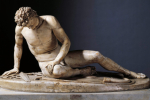
You knew this sculpture before you saw it. The pose is almost as well known in the mind as that of another sculpture from the ancient world — also on hand, no less — of a boy removing a thorn from his foot. But there's a piercing difference. We engage with the boy with sweetness, this softness, youth, incipient-innocence-on-the-verge experience. Dying Gaulspeaks to us in a tenor of tremulous enmeshed cosmic pathos.
Dying Gaul was part of a large sculptural grouping of an epic monument to commemorate decisive Hellenistic victories over the invading Gauls from nearby Galatia, in what is modern-day Turkey. The work was made between 100 and 200 B.C.E. and is a Roman copy of a lost bronze Greek original made about a century before by the great Hellenistic sculptor Epigonos (yes, artists had names then, too). The lost (probably melted down) bronze original was unceremoniously taken from Turkey by the Emperor Nero to Rome where it was used to decorate his gigantic gold, jewel-encrusted Golden House. Copy or not, time and distance collapse when you stand before it — a mysterious abyss opens between us and the sculpture, and recognition rushes in. We are seeing layers of beauty, strength, inwardness, isolation, vulnerability, and the sensuous antecedents of Michelangelo’s beautiful David — all the way to the even-older wisdom of Homer.
more here.
Donald Trump’s appeal should be a call to arms
Daniel Sarewitz in Nature:

As Nobel-prizewinning physicist Leon Lederman put it in 1992: “What’s good for American science … is good for America.” Maybe not. Although Trump supporters are by no means a homogeneous lot, a clever analysis in The New York Times in March showed that they can most reliably be characterized by two attributes. First, they identify their ancestral heritage as American, rather than any particular ethnic or religious stock. And second, they live in regions of the country that have not only failed to benefit economically from innovation, but have been harmed by it. Mainstream media analysis of the Trump phenomenon almost never links it to the science and technology policies pursued by the nation since the Second World War. Yet technological revolutions arising from these policies have contributed to more than 40 years of wealth inequality, disappearing middle-class jobs and eviscerated manufacturing communities in the places where support for Trump is strongest. Indeed, economic theory throws aside these millions of people as the inevitable losers in the ‘creative destruction’ that science catalyses, as if ruined cities and livelihoods are just side effects of the strong medicine of science-based innovation. These people are the cost of the prevailing myth of progress, and, given their core identity as ‘Americans’, it is no wonder they are susceptible to Trump’s jingoistic populism.
More here.
Friday Poem
Questions of Travel
There are too many waterfalls here; the crowded streams
hurry too rapidly down to the sea,
and the pressure of so many clouds on the mountaintops
makes them spill over the sides in soft slow-motion,
turning to waterfalls under our very eyes.
– For if those streaks, those mile-long, shiny, tearstains,
aren't waterfalls yet,
in a quick age or so, as ages go here,
they probably will be.
But if the streams and clouds keep travelling, travelling,
the mountains look like the hulls of capsized ships,
slime-hung and barnacled.
Think of the long trip home.
Should we have stayed at home and thought of here?
Where should we be today?
Is it right to be watching strangers in a play
in this strangest of theatres?
What childishness is it that while there's a breath of life
in our bodies, we are determined to rush
to see the sun the other way around?
The tiniest green hummingbird in the world?
To stare at some inexplicable old stonework,
inexplicable and impenetrable,
at any view,
instantly seen and always, always delightful?
Oh, must we dream our dreams
and have them, too?
And have we room
for one more folded sunset, still quite warm?
Thursday, August 4, 2016
Data2go.nyc

An interesting data tool from Measure of America capturing the Human Development Indices of New York neighborhoods:
DATA2GO.NYC brings together for the first time federal, state, and city data on a broad range of issues critical to the well-being of all New Yorkers. The website includes over 300 indicators for New York City’s 59 community districts—and 150 of these indicators are also available by census tract. Many of these indicators were previously unavailable to the public.
DATA2GO.NYC was created to provide reliable, up-to-date information on neighborhood assets and challenges. It is a tool people who are dedicated to a city in which “everyone counts” can use to craft effective solutions, target policies and services, advocate for change, and hold elected officials accountable for human progress. DATA2GO.NYC has funding for five years of data updates and the addition of new indicators based on user demand.
The data come predominantly from public entities, including the US Census Bureau and the US Bureau of Labor Statistics, the New York State Departments of Health and of Agriculture and Markets, and New York City agencies responsible for promoting the well-being of New Yorkers in many areas: children’s services, corrections, education, environmental protection, health, homelessness, sanitation, the police and fire departments, and more. DATA2GO.NYC also includes a first-ever dataset on philanthropic giving from the Foundation Center.
More here.
Common Property
Elizabeth Anderson in Boston Review:
Uniquely among the world’s rich countries, the United States lacks a comprehensive, universal social insurance system. This is largely due to ideological opposition by Republican Party elites. It took nearly seventy years for Democrats to achieve the expanded, still-less-than-universal coverage provided by the Affordable Care Act—against unanimous Republican opposition. Republicans have continued to sabotage the ACA, successfully blocking the extension of Medicaid coverage in nineteen states. The GOP’s primary plan for Medicare is to shift costs to the elderly. It has resisted full funding of Social Security Disability Insurance and insists that the only acceptable plan for ensuring the financial stability of Social Security is to cut benefits. Meanwhile, thirty-three states, nearly all GOP-led, have cut workers’ compensation programs since 2003, often drastically.
What accounts for this extreme hostility to social insurance? Social Security and Medicare are popular programs, even among the GOP’s base. Republican leaders, however, tend to think of social insurance as a socialist or communist scheme designed to undermine private property and free markets. Their arguments can be traced to Austrian economist Friedrich Hayek, whose 1944 book The Road to Serfdom warned that the emerging social democratic regimes of Europe were stepping onto a slippery slope to totalitarianism. Adapted into an illustrated booklet distributed widely by General Motors in the mid-1940s, The Road to Serfdom has fueled American opposition for decades now. Ronald Reagan, probably inspired by Hayek, made a recording opposing Medicare for the American Medical Association in 1961, predicting that it would lead to the state dictating to people what jobs they must perform and where they must live and work.
The ironies here are rich. Conservative criticisms of social insurance reflect profound misapprehensions of its relation to private property. Social insurance, in both theory and practice, arose in defense of private property and against communist and socialist threats. Exploring these origins is essential now because they contain important lessons that will help us strengthen social insurance to meet the challenges of post-industrial capitalism.
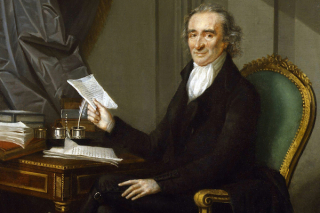
Thomas Paine, the great American revolutionary, proposed the world’s first realistic plan to abolish poverty. What he devised were universal social insurance and stakeholder grants, outlined in the 1797 pamphlet Agrarian Justice. (The relation of this work to later programs is not lost on the Social Security Administration, which reproduces the text on its website.)
More here.
Which Europe Now?
Mervyn King in the NY Review of Books:
Two questions that should have been at the forefront were largely absent from the campaign. First, what will the EU look like in the future? Second, what is the place of Britain in Europe? It is helpful to distinguish three distinct entities: Europe, the EU, and the eurozone.
No referendum can alter the fact that Britain is and will continue to be in Europe. Not even politicians can change geography, even if they rewrite history. Cheap travel has meant that opportunities formerly available only to the privileged few who embarked on the Grand Tour are now open to all of us—young and old, left and right. We experience the pleasure and privilege of discovering the many countries of Europe and revel in their differences, their cultures and cuisines, their languages and landscapes. We are lucky indeed to live in Europe where so much variety can be experienced within such short travel times. So the referendum was not about whether Britain is in Europe. It is and always will be, and we take pride in that fact.
The same cannot be said of the eurozone. The monetary union is now facing serious problems. As I explain in my book The End of Alchemy, the failure of some member countries to maintain competitiveness during the first decade or so of its existence means that the eurozone is now confronted with the choice of pursuing one, or some combination, of four ways forward. First, continue with high unemployment in the periphery countries in the south until wages and prices have fallen by enough to restore the loss in competitiveness. Second, create a period of high inflation in Germany and other surplus countries, while restraining wages and prices in the periphery. Third, accept the need indefinitely for explicit transfers from the north to the south to finance the trade deficits that would emerge if those latter countries returned to full employment. Fourth, break up the eurozone.
More here.
Alonso to Ferdinand – W.H. AUDEN
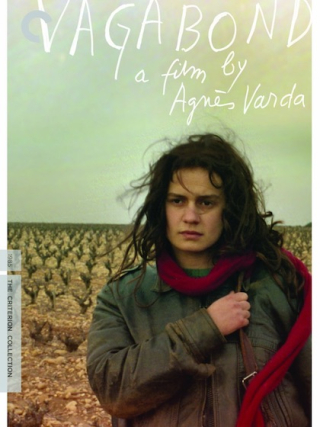
agnès varda’s vagabond — a film that leaves no trace
Richard Skinner in 3:AM Magazine:
If you tell the story of Citizen Kane, it’s not much of a story. An old rich mogul man is dead. He said a word we don’t understand. We don’t discover so much, just some pieces of his life and finally it is just a sled. Is that a story? It is not much. What makes Citizen Kane so interesting is the way [Welles] told us about the man—intriguing us about what people think about him.
— Agnès Varda
If Agnès Varda’s 1985 movie Vagabond is like any other movie, then it would be Citizen Kane. When you’ve seen both, you see that Varda almost certainly used the structure of Orson Welles’ 1941 movie as a blueprint for her own. Both start with a death, both are an investigation into a life, both end inconclusively.
Vagabond is about a young woman, Mona, played by Sandrine Bonnaire, who has perished from the cold, and the attempts by numerous people who crossed her path to assign meaning to her chosen way of living. There are 18 ‘visions’ of Mona presented by those who came across her. The film is a series of gazes, of one-way exchanges from different people—dropouts, hippies, a prostitute, an itinerant worker, a maid (the ‘punctum’ moment when the maid addresses the camera directly)—but each of these ‘witnesses’ is not seeing Mona, but a reflection of their own regrets, secrets, longings. As the film makes transparently clear, Mona refuses to be co-opted into any image they may have of her. She defies identification and empties the mirror of any meaning. Her peripatetic and solitary existence (‘I move’) is a deliberate choice and functions metonymically for her unfixability. Mona is the blank centre of the film and she leaves no trace of her existence.
In Cléo from 5 to 7 (1962), Agnès Varda made frequent use of tracking shots to follow Cléo along Parisian streets; there is a lot of the same kind of camerawork in Vagabond. But while the narcissistic Cléo is nearly always in the center of the frame, Mona can barely stay in the picture. As she walks along beaches, streets, fields—confirming the viewer’s sense of her restlessness and rootlessness—she either walks into the frame of an already-in-motion tracking shot, or falls behind, or walks out of frame as the camera keeps moving. It’s as though she is on the periphery of her own movie. Varda says, “The whole film is one long tracking shot … we cut it up into separate pieces and in between them are the ‘adventures’.” There are 14 of these highly formal tracking shots and they all frame Mona at some kind of juncture. They are Mona’s ‘signature’.
More here.
Rethinking religion in a political scientific wilderness
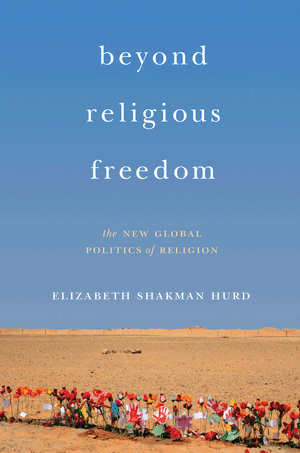
Ruth Marshall in The Immanent Frame:
Beyond Religious Freedom: The New Global Politics of Religionmakes an extremely important and timely contribution to a conversation that the discipline of political science should be but still isn’t really having. The continued lack of serious, analytically sophisticated attention to religion and religious phenomena by scholars of international relations and comparative politics is all the more baffling given the place of religion in political life around the world today. Religious affiliation has become thecentral category for a geo-political remapping of the world since 9/11. The results have been depressingly vapid analyses that underscore, once again, the ideological force of Samuel Huntington’s self-fulfilling prophecy, and the bankruptcy of dominant approaches in our discipline that continue to treat religion in the most reductionist, identarian, instrumentalist, and frankly, unthinking fashion. In this regard, Shakman Hurd’s book constitutes a truly novel and vital contribution and I cannot recommend this book highly enough to my co-disciplinarians, whether interested in religion or not. I underscore this point, since many scholars who frequent The Immanent Frame are not mainstream political scientists and are thus unaware of the bleak nature of the wilderness into which rare and prophetic voices like Shakman Hurd’s are crying.
In her approach to the intellectual and political stakes of the current global doxa on religious freedom, her central focus and angle of attack is a deconstruction of the problematic ways in which the category “religion” is deployed in academic, governmental and policy discourses and practices, and the ways these should prompt us to think more critically about the contradictions of liberalism, in particular, the ambivalence of liberalism’s understanding of religion and the connection between its discourses of tolerance, pluralism, rights, freedom and new forms of global governance. This choice of focus is crucial, since political scientists, (unlike scholars of religion or anthropologists) appear completely unaware of the problematic ways in which the category of “religion” is used in the literature. The unreflective use of a highly Christian, indeed Protestant, understanding of religion as belief, inner conviction, and a matter of personal choice which can be entered into and exited freely, has come to dominate the academic and policy field, enabling “scholars, practitioners and pundits to leap straight into the business of quantifying religion’s effects, adapting religion’s insights to international problem-solving efforts, and incorporating religion’s official representatives into international political decision making, public policy, and institutions.”
More here.
As Los Angeles Changes, Ed Ruscha Stays the Same

Over the last couple of decades, Ed Ruscha’s work has come to symbolize Los Angeles and the West, but lately, it seems, Ruscha the artist has too. At 78, he is still very much a handsome man, with placid blue eyes and rugged features. He speaks deliberately and slowly, with a slight drawl—he says “Los Angeles” instead of “L.A.,” and “Cali-for-knee-ah,” not “Califor-nyah.” It’s a way of speaking that is reminiscent of the late ’50s and early ’60s, when cowboys first roamed through Marlboro ads and Marilyn Monroe dressed down in Levi’s rolled at the cuff. To those who admire him now, Ruscha is a little bit like a Kennedy, a type of man that we lost in the 21st century—old-fashioned but masculine, well-mannered but tough. He possesses a laid-back cool that has helped to define—along with others such as the late Chris Burden and John Baldessari—what we understand as the Los Angeles artist.
Opening this month at the de Young Museum in San Francisco, “Ed Ruscha and the Great American West” emphasizes Ruscha’s deep commitment to place, and acknowledges the pioneer he was for heading west, not east, when he first set out to be an artist. “I felt California had something to offer me,” said Ruscha earlier this week over Skype, explaining his decision at the age of 18, in 1956, to attend the Chouinard Art Institute (now known as California Institute of the Arts or CalArts). “New York was the center of the art world,” Ruscha conceded. “People dreamed about New York. When I visited, it was every bit of what I thought it would be like. But I didn’t have the urge to move there. It seemed to be too cold and complicated and expensive. It would have been difficult to get across town with a piece of lumber.” Instead, the palm trees and sunsets and sprawl were more alluring. “California,” he said, “was like a new swanky place for me to go.”
more here.
FOUCAULT AND THE FICTOCRITICS
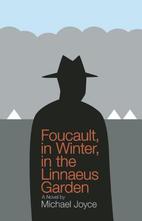
For at least three decades, starting in the 1970s, Michel Foucault was a phenomenon nearly comparable to the Beatles, or his predecessor on the academic scene, Claude Lévi-Strauss. In a history of the leather jacket in the New York Times Magazine, Foucault appears like a god alongside Marlon Brando and the Ramones as a marker for the mid-1970s, when he was becoming a worldwide celebrity. I first encountered Foucault in collections of structuralist essays in the stacks of a small Southern college library around that time. Only one other person at the school read those books; a bald French professor named Simpson. His name was always ahead of mine on the checkout card. Unbeknownst to me, Foucault was in New York at the time, as a visiting scholar for the French department at SUNY Buffalo. While he was there he visited the town of Attica, and the prison there. He gave a lecture on Manet at the museum on a Thursday night. He lived in an old hotel half a mile from where I would eventually live. A friend of mine saw him give a lecture at the university. He was dressed in a black velvet suit. The talk was entirely in French. My friend didn’t understand a single word, but he described it as a turning point in his life. There were shockwaves emanating from Foucault. This was before he became an institution and declined into something like an ancient part of Las Vegas; the inevitable result of thousands of dissertations, essays, and books appropriating his voice. Is it possible today to write anything about Foucault that isn’t already empty?
This is the big question the sometimes poet, hypertext novelist, and theorist Michael Joyce’s epistolary novel confronts. The letters are addressed to a ghost-like woman named Gabrielle, and to the historical figures of Foucault’s lover Jean, his mother, and a colleague and mentor.
more here.
A Literary Chameleon
Jesse McCarthy in Harvard Magazine:
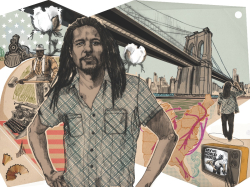
He has gained a reputation as a literary chameleon, deftly blurring the lines between literary and genre fiction, and using his uncanny abilities to inhabit and reinvent conventional frames in order to explore the themes of race, technology, history, and popular culture that continually resurface in his work. In a country where reading habits and reading publics are still more segregated than we often care to admit, his books enjoy a rare crossover appeal. His first novel, The Intuitionist, is a detective story that regularly turns up in college courses; the zombie thriller Zone One drew praise from literary critics and genre fiction fans alike; Sag Harbor, about black privileged kids coming of age in the 1980s, was a surprise bestseller. Beyond the books, Whitehead swims effortlessly in the hyper-connected moment: he maintains an active presence on Twitter, where his sly and dyspeptic observations on the curious and the mundane have gained him a devoted following. A sampling includes sagacious tips for the aspiring writer—“Epigraphs are always better than what follows. Pick crappy epigraphs so you don’t look bad”—and riffs on Ezra Pound: “The apparition of these faces in the crowd / Petals on a wet, black bough / Probably hasn’t been gentrified though.”
More here.
Health Secrets of the Amish
Moises Velasquez-Manoff in The New York Times:

Now a study released on Wednesday in The New England Journal of Medicine advances the research. The authors did something new and important: They found a suitable comparison group for the Amish in another farming community, the Hutterites. The two groups share genetic ancestry. Both descend from German-speaking stock. But unlike the Amish, the Hutterites, who live in the upper Midwest, are as allergic as your average American. Why doesn’t farming protect the Hutterites?
More here.
Wednesday, August 3, 2016
What Babies Know About Physics and Foreign Languages
Alison Gopnik in the New York Times:

In the last 30 years, the United States has completed its transformation to an information economy. Knowledge is as important in the 21st century as capital was in the 19th, or land in the 18th. In the same 30 years, scientists have discovered that even very young children learn more than we once thought possible. Put those together and our preoccupation with making children learn is no surprise.
The trouble is that most people think learning is the sort of thing we do in school, and that parents should act like teachers — they should direct special lessons at children to produce particular kinds of knowledge or skill, with the help of how-to books and “parenting” apps. Studies prove that high-quality preschool helps children thrive. But policy makers and educators are still under pressure to justify their investments in early childhood education. They’ve reacted by replacing pretend corners and playground time with “school readiness” tests.
But in fact, schools are a very recent invention.
More here.
Are We the Only Animals That Understand Ignorance?
Ed Yong in The Atlantic:

And yet, according to two psychologists, it’s a skill that only humans have. “We think monkeys can’t do that,” says Alia Martin from Victoria University of Wellington.
This claim is the latest volley in a long debate about how our fellow primates understand each other. Of particular interest is the question: Do they have a “theory of mind”—an understanding that others have their own mental states, their own beliefs and desires, their own ways of viewing the world?
More here.
Enter the mind of Bruce Lee
John Blake at CNN:
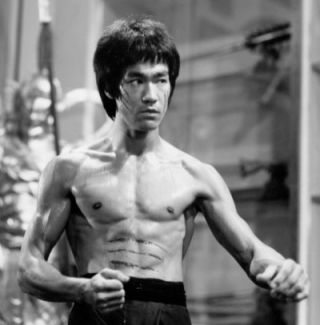
“Neither,” Lee said. “I think of myself as a human being.”
Forty-three years after his sudden death in July of 1973, more people are starting to think of Lee as something else: A profound thinker whose mind was as supple as his body.
That may seem like an odd claim. Lee was a fighter, not a philosopher, according to popular perception. He left behind some of the most exhilarating fights scenes ever captured on film in movies such as “Enter the Dragon” and “The “Chinese Connection.”
But his legacy also includes a revolutionary book on the martial arts and Eastern philosophy, and seven volumes of writings on everything from Taoism, quantum physics, psychotherapy and the power of positive thinking.
John Little, who examined Lee's papers after the actor's death, says he was stunned when he first entered Lee's library. He had at least 1,700 heavily annotated books. That's when he realized that Lee sharpened his mind as much as his body.
More here.
Noam Chomsky on Donald Trump
What’s It Like to See Ideas as Shapes?

Jackson sees his thoughts as shapes. Every person he meets, every sentence he reads, and every decision he makes are presented as data points on a kind of continuously moving mental scatter plot, creating figures he compares to constellations. If he were to make a decision about whether to take a new job, for instance, those points might represent salary, location, and cost of living. The lines between them would change depending on how attractive they were to Jackson, creating a unique configuration for each option.
For many people, decision-making is a murky, difficult process. Think it through, go with your gut, follow your heart—there’s a reason the English language features so many ways to talk about groping around in the cellar of the conscience to find the light switch of intuition. But for Jackson, intuition is anything but blind. When he makes a choice, his gut feelings are visually laid out in front of him. He can choose among his options the way others might choose the reddest, glossiest apple from a bowl.
In 2014, Jackson, who now lives in Seattle, designed and released an app with the aim of helping others make decisions. Called ChoiceMap, it helps users weigh the factors in a given decision, using an algorithm to spit out a “perfection score” for each option. Cold hard numbers; no more groping in the darkness. The app, which was rebuilt and re-released in May, helps users view decisions through a mathematical prism. It also serves as a reminder of the distance between people’s perceptions that can never be fully crossed—and as a testament to just how delicate and strange communication is in the first place.
more here.