Subrahmanyan Chandrasekhar: A study in fortitude and rigor

Ashutosh Jogalekar in The Curious Wavefunction:
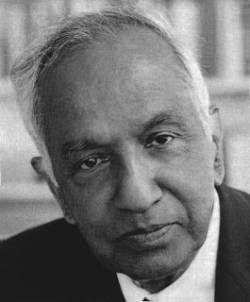
Chandra“Chandra”, as he was fondly known to friends and colleagues, was one of the twentieth century's most important astrophysicists. In addition he was probably its most rigorous and mathematical, applying hard and baroque mathematics to problems ranging from hydrodynamics to collapsing stars. His Nobel Prize came in 1983, and it should have come earlier. Chandra's life provides a good example of quiet rebellion against a traditional scientific establishment, and it's for this reason that it deserves wide study.

By all accounts Chandra was marked to be a great scientist from his birth. Born in the city of Lahore (now in Pakistan) to a respected civil servant, he quickly outpaced his fellow students in his study of advanced mathematics and physics. In the 1920s when he was attending college in the progressive city of Madras (now Chennai) he met the renowned physicist Arnold Sommerfeld when Sommerfeld was visiting Madras, and was both shocked and fascinated to hear Sommerfeld tell him that quantum theory had rendered outdated much of the physics he had learnt. That however was a deficiency that Chandra could remedy. As the famous story goes, at the mere age of nineteen, on a long voyage from India to England to attend graduate school at the University of Cambridge, he did the calculation that was to enshrine his name in history. That analysis which used tools from relativity and quantum theory that were far beyond the grasp of any other nineteen year old physics student, finally led to the establishment of the so-called 'Chandrasekhar limit', a limit for the mass a white dwarf can sustain before it collapses under the weight of its own gravity.

A few years later Chandra had a famous showdown with Arthur Eddington, the doyen of English astronomers and one of the most famous scientists in the world.

More here.
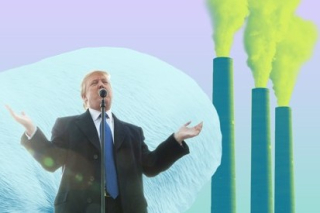
Donald Trump Is the First Demagogue of the Anthropocene

Robinson Meyer in The Atlantic:

ScreenHunter_2336 Oct. 30 17.17Lately I’ve been thinking back to something that John Kerry told The Atlantic’s editor in chief, Jeffrey Goldberg, earlier this year. Asked about the importance of the Middle East to the United States, Kerry answered entirely about the Islamic State.

“Imagine what would happen if we don’t stand and fight [ISIS],” he said:

If we didn’t do that, you could have allies and friends of ours fall. You could have a massive migration into Europe that destroys Europe, leads to the pure destruction of Europe, ends the European project, and everyone runs for cover and you’ve got the 1930s all over again, with nationalism and fascism and other things breaking out. Of course we have an interest in this, a huge interest in this.

The 1930s all over again—Kerry was laying out a prediction in April, but it sounds a little more like description now. Even if America’s current dunderheaded demagogue loses the presidential election, the European project already falters in the United Kingdom, and Russia rumbles with revanchism. Fueled now (as then) by an ailing global economy, far-right nationalism seems ascendant worldwide. It’s hard not to think of the 1930s as the catastrophe which presaged our contemporary tragicomedy.

I write and report on climate change, not a pursuit that usually encourages optimism, but watching all this unfold with the atmosphere in mind has been particularly bleak. For the past few months in particular, I’ve been thinking: Wow, this is all happening way earlier than I thought it would.

More here.

Distant Brains: ways for people to communicate using only their minds. But at what cost?

Alena Graedon in Guernica:

Distant_brains-final_TOP-minScientists have been experimenting with brain-to-brain communication for some time; recent results, which have been remarkable, represent the culmination of a decade or so of research. In the past few years, brain-machine interfaces have been used on monkeys, rodents, and people, and in at least one case, on a human-rat dyad. By training his eyes on a flashing light, a volunteer could get a rat’s tail to move. Some of the most noteworthy innovations have come from a team led by Miguel Nicolelis at Duke. Members of the Nicolelis lab began by connecting pairs of rat brains. After the animals had been implanted with microelectrodes, the neural activity of a rat in a Brazilian lab could be transmitted via Internet to one in Durham, North Carolina. The second rat, upon receiving a brain signal from the first, would perform a task—pressing a lever that rewarded them both with water. These results, when presented three years ago, were seen by many as revolutionary.

But now the Nicolelis team has moved on, connecting several animals at once to establish larger “Brainets.” And their findings—published in a pair of Scientific Reports studies last summer—are even headier. They managed, for example, to get three monkeys to collaborate mentally to move a virtual arm through 3D space. Maybe still more impressive and unsettling, the researchers created a network of four interconnected rat brains, which was able to solve “a number of useful computational problems, such as discrete classification, image processing, storage and retrieval of tactile information, and even weather forecasting.”

More here.

masculinity isn’t in crisis, human beings are

Steven Poole in New Statesman:

ManWhat a terrible time it is to be a man. Emasculated by desk jobs and postmodern gender politics, they can’t even exercise eternally manly virtues – correcting other people’s grasp of trivial facts, say, or punching them in the face. And as everyone knows, men are incapable of maintaining proper friendships, so they have no one to talk to about their problems, even if they were able to acknowledge their emotions, which of course they can’t. No wonder they commit nearly all the world’s crime. And no wonder that the single biggest killer of men under 45 in this country is suicide. Men these days are angry and sad and voting for Trump and Brexit. And it’s everyone’s problem. It’s Mangeddon. It’s the Androcalypse. Why does our culture hate men so much? Who will stand up for the downtrodden male of the species?

One answer, of course, is the “men’s rights” movement, from which corner one hears mainly the distant yowl of entitled misogyny. But in a slew of new books, readers will find a variety of more competent thinkers addressing the current supposed crisis of masculinity, and what should be done about it. The first question to ask is: what is masculinity anyway? The artist (and transvestite) Grayson Perry attempts a definition in The Descent of Man, a book that draws on his “Great White Male” guest edit of the NS in 2014. Perry describes masculinity as “a deeply woven component of the male psyche”, but also simply as “how men behave at present”. Jack Urwin, in the bloggy, teenager-friendly tones of Man Up, writes ecumenically: “As far as I’m concerned anyone who identifies as a man, is a man; and because masculinity is a social construct and thus rooted mostly in identity rather than biology, masculine behaviour is exhibited by all men.” Masculinity “is simply a reflection of how the majority of men act”.

More here.

Sunday Poem

Here and There

I sit and meditate—my dog licks her paws
on the red-brown sofa
so many things somehow
it all is reduced to numbers letters figures
without faces or names only jagged lines
across the miles half-shadows
going into shadow-shadow then destruction the infinite light

here and there cannot be overcome
it is the first drop of ink
.

by Juan Felipe Herrera
from Academy of American Poets, 2015
.

Saturday, October 29, 2016

Edward Albee’s Beautiful Venom

Shahryar Fazli in the Los Angeles Review of Books:

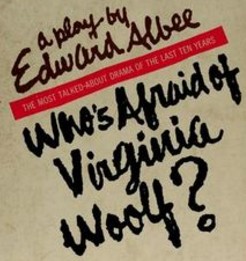
ScreenHunter_2335 Oct. 29 23.51When I was frist exposed to Edward Albee’s Who’s Afraid of Virginia Woolf? as a college student, I knew that something at some point had gone seriously wrong in the United States. George and Martha’s “fun and games” — indeed, their very existence — meant that, sometime in the early 1960s, the social consensus must have broken down more violently than I had initially thought. This is the only play to have been selected by the Pulitzer jury as the year’s best, only to have the prize stripped away by the advisory board (the trustees of Columbia University), on the basis of the text’s profanity. This was the annus mirabilis of 1963, “Between the end of the Chatterley ban / And the Beatles’ first LP,” as Philip Larkin argued, which was the year sexual intercourse began. Our threshold for impiety has risen dramatically since then, but Woolf retains its power to disturb. If anything, the modern viewer, no longer shocked by the play’s sexual candor, may be all the more sensitive to the other bugs circulating within.

I came to the play through Mike Nichols’s 1966 movie version, and then — forgive the pun — wolfed down most of the Albee inventory. His work transformed my view of what theater’s ambition should be: it should disturb us, change us, drain us. In Woolf’s climactic scene, as George prepares to “kill” his and Martha’s fictional son, he responds to Honey’s admission that she peels labels (she’s been drunkenly peeling the label off a brandy bottle for a while), by saying, “We all peel labels, sweetie; and when you get through the skin, all three layers, through the muscle, slosh aside the organs […] and get down to bone … you know what you do then?” Honey doesn’t. “When you get down to the bone, you haven’t got all the way, yet. There’s something inside the bone … the marrow … and that’s what you gotta get at.” The stage directions call for a “strange smile at Martha.” As a novelist, I find it difficult to write dialogue without George’s soliloquy in my ears. It summarizes what Albee brought to theater. Every one of George and Martha’s lines, or those of Agnes, Julia, and Claire in the equally brilliant A Delicate Balance (1966), goes straight for the marrow, each exchange flaying the antagonist, layer by layer. This, I realized, was the essence of dramatic dialogue.

More here.

World on track to lose two-thirds of wild animals by 2020, major report warns

Damian Carrington in The Guardian:

ScreenHunter_2334 Oct. 29 23.45The number of wild animals living on Earth is set to fall by two-thirds by 2020, according to a new report, part of a mass extinction that is destroying the natural world upon which humanity depends.

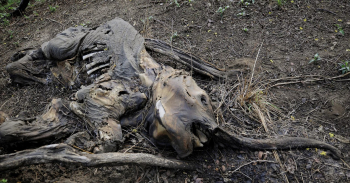
The analysis, the most comprehensive to date, indicates that animal populations plummeted by 58% between 1970 and 2012, with losses on track to reach 67% by 2020. Researchers from WWF and the Zoological Society of London compiled the report from scientific data and found that the destruction of wild habitats, hunting and pollution were to blame.

The creatures being lost range from mountains to forests to rivers and the seas and include well-known endangered species such as elephants and gorillas and lesser known creatures such as vultures and salamanders.

The collapse of wildlife is, with climate change, the most striking sign of the Anthropocene, a proposed new geological era in which humans dominate the planet. “We are no longer a small world on a big planet. We are now a big world on a small planet, where we have reached a saturation point,” said Prof Johan Rockström, executive director of the Stockholm Resilience Centre, in a foreword for the report.

More here. [Thanks to Sughra Raza.]

This Bird Can Remain Airborne For 10 Months Straight

Merrit Kennedy at NPR:

ScreenHunter_2333 Oct. 29 23.40Scientists have long suspected that the common swift remains airborne for extraordinary amounts of time during its annual migration.

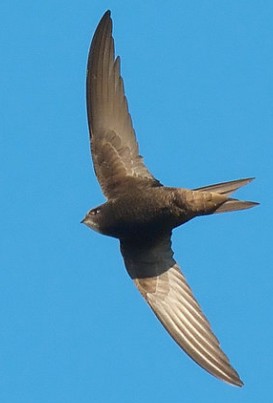
Now, a team of scientists in Sweden has proved that these birds fly for tremendously long periods of time. They affixed data loggers onto a total of 19 of the master fliers in 2013 and 2014, and recaptured the birds months or years later. Researchers found that the birds can spend almost their entire 10-month nonbreeding period on the wing.

The data loggers gathered information on acceleration and flight activity, and those installed in 2014 also included light trackers for geolocation.

The results were astonishing. For example, according to research published in Current Biology, one of the birds stopped for just four nights in February in 2014 — and the next year it stopped for only two hours. Other birds stopped for longer periods of time. But “even when swifts settle to roost,” the researchers say, “the amount of time not flying is very small.”

The birds are known to travel from Europe to sub-Saharan Africa — but they apparently don't touch down there, as National Geographic reports. Researchers say they have never found roosting sites in sub-Saharan Africa.

More here.

The quest to keep behavioral economics in policy after Obama’s presidency

David V. Johnson in The New Republic:

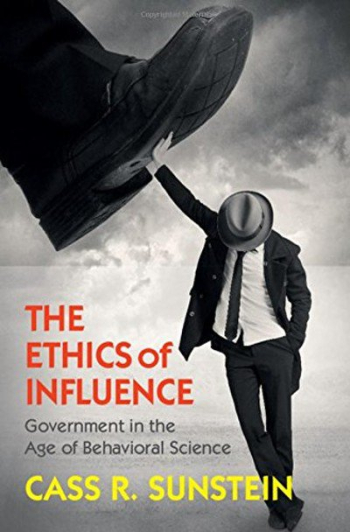
6e0ee10846f7abab8acc448ce462dc91735d940eThe first line of Cass Sunstein’s latest book, The Ethics of Influence, announces: “We live in an age of psychology and behavioral economics—the behavioral sciences.” For Sunstein, a Harvard law professor and former Obama administration official, this is as momentous a statement as saying we live in an age of antibiotics, steam engines, or the Internet. But just saying that nudges are here to stay does not make it so. In fact, if their future were not in doubt, why the need for yet another book on the topic—and so soon after his Father’s Day-gift-ready book on Star Wars—arguing that theyshould be here to stay? Like the president he served, Sunstein is now focused on cementing his legacy.

Sunstein’s work on behavioral economics found its ideal patron in President Obama, and not simply because the two men knew each other from their days teaching at the University of Chicago. For a presidency born in economic catastrophe and plagued by an anemic recovery, gross inequality, and a hostile Congress, there was always the question of how to use executive action to salvage something positive in the face of a hopeless political situation. Enter nudges, a means of influencing people’s decisions without the need for coercion or mandates; crucially, a nudge can secure policy success without requiring Congressional approval. This is not exactly what the candidate of hope and change had in mind by “hope and change,” but it would have to do.

In 2015, President Obama issued an executive order committing the U.S. to “using behavioral science insights to better serve the American People”— a directive that Sunstein proudly republishes as Appendix C of his latest book.

More here.

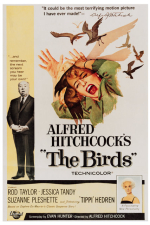
Creep or Craftsman? Alfred Hitchcock Was Both

30SHONE-Hitchcock-blog427Tom Shone at The New York Times:

These are good times for Alfred Hitchcock. The refurbishment of the director’s reputation, which began in 1966 when François Truffaut published his landmark book of interviews, “Hitchcock/Truffaut,” reached its conclusion in 2012 when the film critics polled by Sight and Sound voted “Vertigo” the greatest film of all time, kicking Orson Welles’s “Citizen Kane” from a top spot it had enjoyed for decades. Wellesians bit their knuckles, and the rest of us scratched our heads. “Vertigo” is not Hitchcock’s best, but rather, with its lush morbidity, somnolent pace, poor box office and relative scarcity of jokes, the Hitchcock film for those who most wish he were French. Flops make film critics feel useful — they are the film-crit equivalent of the deserving poor. What else can you do with a gleaming hit maker except overpraise his misses?

It’s just one poll, but beneath it, broader tectonic shifts can be detected. If a director who was repeatedly slighted by the academy during his lifetime is today the most acclaimed and certainly the most watched director of classical Hollywood, it may well be because modern Hollywood has largely rebuilt itself in his image. Back in 1976, when Hitch’s last film, “Family Plot,” was dragging itself from theater to theater in search of an audience, his virtues — string-of-pearl set-piece construction, perpetual-motion plots, coupled with a healthy disrespect for American landmarks — seemed as cobwebbed as Norman Bates’s ma. “Jaws” had come out the year before. “Young Spielberg,” Hitchcock said after seeing Steven Spielberg’s perversely gleeful frightener, “is the first one of us who doesn’t see the proscenium arch.”

more here.

Cynthia Ozick: Or, Immortality

Horn_rotatingDara Horn at the Jewish Review of Books:

Why does Cynthia Ozick, at 88 an undisputed giant of American letters, still seem obsessed with fame?

Like nearly everyone else who appreciates Cynthia Ozick’s brand of genius—and I don’t mean “brand” in the 21st-century sense, but rather the brand plucked from the fire, searing one’s lips into prophecy (the distinction between the two neatly encapsulates Ozick’s chief artistic fascinations)—I’m not the type of person who is a fan of anything at all. As something close to Ozick’s ideal reader, I am skeptical of the entire concept of fandom, religiously suspicious of the kind of artistic seduction that would make one uncritical of anything created by someone who isn’t God. But I am nevertheless a fan of Ozick’s, in the truly fanatical sense. I have read every word she’s ever published, taught her fiction and essays at various universities, reviewed her books for numerous publications (occasionally even the same book twice), written her fan letters and then swooned over the succinct handwritten replies in which she graciously gave me a sentence more than the time of day, and even based my own work as a novelist on her concept of American Jewish literature as a liturgical or midrashic enterprise (a stance she has since rejected, though too late for me). As a young reader I was astonished by what she apparently invented: fiction in English that dealt profoundly not with Judaism as an “identity,” but with the actual content of Jewish thought, at a time when almost no one, and certainly no one that talented, was quite bothering to try.

more here.

Henry James for Every Day of the Year

022640854X.01.LZZZZZZZMichael Gorra at The Millions:

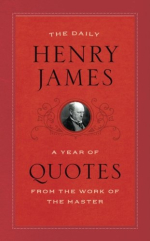
The little charmer published this month as The Daily Henry James first appeared as The Henry James Yearbook in 1911, bound in a deep burgundy cloth and with a typeface that matched that of the great New York Edition of James’s works, an edition that had finished its run only two years before. It offers a quotation for each day of the year, many of them apposite to the season though none of them obvious, taken from the full range of James’s production, the criticism and travel writing as well as the novels and tales.

The book was put out by the Gorham Press, a Boston publisher that, as a Harvard website delicately puts it, produced its things “at their authors’ expense.” We’d probably call it a vanity press, but in James’s day such books were usually described as having been privately printed, a category that included not only the work of his own father but even such classics as The Education of Henry Adams. Not that the Henry James Yearbook stayed private. H.L. Mencken noticed it in The Smart Set, reviewing it alongsideJoseph Conrad’s Under Western Eyes, and in 1912 the English firm of J.M. Dent brought out a trade edition, using sheets imported from Boston.

And then the book more or less vanished. A few older works of criticism list it in their bibliographies, and a small press in Pennsylvania reissued it in 1970. But no scholar has ever paid it much attention, and for decades it survived in the only way that forgotten books do survive: undisturbed in the stacks.

more here.

Can Happiness Make You Healthier?

Elizabeth Gudrais in Harvard Magazine:

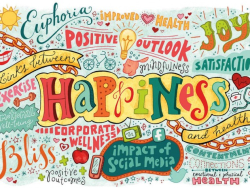
HappyStudies that probe the link between happiness and health outcomes are still relatively rare in scientific work, but the new Lee Kum Sheung Center for Health and Happiness at the Harvard T.H. Chan School of Public Health aims to change that as it pursues a new approach to health maintenance: focusing on specific factors that promote the attainment and maintenance of high levels of well-being.

…The researchers also hope to solidify evidence that emotional health influences physical health, and not just the other way around. This notion was challenged last year, when The Lancet published a study finding no connection. But critics (including Kubzansky, who coauthored a letter of response in the same journal) took issue with the study’s methodology, noting that in adjusting for self-rated health (which is partly defined by emotional well-being), the study’s authors essentially adjusted for the very factor they were trying to investigate as a predictor. The debate exemplifies the tension underlying research in this area: the public seems to find the subject enormously compelling, but some segments of the scientific community remain skeptical. Kubzansky and her colleagues aim to amass enough evidence of biological connections between emotional and physical health that eventually the link will be taken for granted, much as exercise is generally regarded as beneficial. Yet even if that link is established, how can it be applied? If some people are innately happier than others, are the latter doomed to ill health?

More here.

Frantumaglia: A Writer’s Journey by Elena Ferrante

Lisa Appegnanasi in The Guardian:

BookLike some bloodhound on the trail of Berlusconi or a mafia magnate, the Italian journalist Claudio Gatti recently unearthed financial documents suggesting that the pseudonymous novelist Elena Ferrante, author of the acclaimed Neapolitan novels, was really a translator with little link to Naples except through her husband. To many of her readers, the outing felt like a violation, and not only of authorial privacy. It also gave off a sweaty odour of macho politics. Rumours had long travelled the Italian circuit suggesting that no woman could be both so brilliant and so popular a writer: ergo Elena must be a man. Now, by linking his “real” Elena to a well-known Neapolitan writer-husband, Gatti had reinforced that rumour. The finger-pointing revelations have been denied. But the fact that they have preceded the publication of a new book of reflections, letters and interviews, by just a few weeks, shadows one’s reading of it: your eyes linger a little over the passages that state or assume a childhood in Naples, that ponder truth and lies. Such is the polluting power of journalistic innuendo – as our tabloids have long known.

Ferrante’s insistence on staying out of the stranglehold of celebrity culture has been to avoid this scrutiny. The reduction of a book to its author and spurious autobiography is one of the recurring themes in her interviews, never conducted in person. “Lacking a true vocation for ‘public interest’, the media,” she writes, “would be inclined, carelessly, to restore a private quality to an object that originated precisely to give a less circumscribed meaning to individual experience. Even Tolstoy is an insignificant shadow if he takes a stroll with Anna Karenina.” And Shakespeare’s plays will remain great whether we know for certain or not that he sported a beard and travelled to Italy.

More here.

Friday, October 28, 2016

He was turned down 18 times. Then Paul Beatty won the Booker

Charlotte Higgins in The Guardian:

ScreenHunter_2332 Oct. 28 19.48Paul Beatty may be the first American to win the Man Booker prize, after a rule change three years ago that made authors of any nationality eligible for the £50,000 award, so long as they were writing in English and published in the UK. But he very nearly wasn’t published in Britain at all. Beatty calls his fourth novel “a hard sell” for UK publishers. His rumbustious, lyrically poetic novel was turned down, his agent confirms, by no fewer than 18 publishers. And then, finally, a small independent called Oneworld – founded by a husband-and-wife team in 1986 – took it up. The company is celebrating the unusual achievement of a second consecutive Man Booker win, because it also published Marlon James’s A History of Seven Killings.

“It’s weird for me,” says Beatty, who is 54. The morning after the night before, the New York-based, Los Angeles-born writer is slightly dazed, somewhat short of sleep and good-naturedly overcoming his reluctance to talk about his work. “I think it’s a good book. I was like, ‘Why? What’s all that about?’ I would be uncomfortable guessing [why I couldn’t get a publishing deal]. I would hurt myself. It would be like, ‘Really? Still?’ I guess they thought the book wouldn’t sell.” He won’t be drawn, but the implication is that he suspects publishers may have found the material too harsh, too unconventional, too unfamiliar – and, conceivably, beneath all that, in some undefinable way too black. It is certainly a book in which one gasps frequently – amid deeply uncomfortable laughter and, at times, tears. Nothing is sacred in The Sellout, in which the book’s narrator (surname Me) decides to reinstate segregated schools and reluctantly takes on a slave in his home district of Dickens, Los Angeles. All things, no matter how piously regarded, up to and including the US civil rights movement, are there to be punctured by Beatty’s fierce and fizzing wit.

More here.