The Road to Oxiana: the greatest travel book of the 20th century

Robert McCrum in The Guardian:

AfghanAccording to Robert Byron’s Oxford contemporary Evelyn Waugh – never the most reliable witness – the future author of The Road to Oxiana used to delight in shouting “Down with abroad”. Typical in striking a pose, Byron was an aggressive Oxford aesthete of the “Brideshead generation”, a homosexual wanderer whose precocious career as a travel writer and art historian can be traced through a succession of prewar gems. (Robert Byron by James Knox, published by John Murray in 2003, remains the principal biographical source.) Byron wrote The Station, aged 22, after a visit to Mount Athos on a mule, Fortnum & Mason saddlebags bursting with a soda siphon and chicken in aspic. This was followed by The Byzantine Achievement (1929) and The Birth of Western Painting (1930). In 1933, the publication of First Russia, Then Tibet confirmed Byron’s reputation as a traveller and connoisseur. In the same year, accompanied by his friend Christopher Sykes, but tormented by his unrequited love for Desmond Parsons, Byron set out on a journey to Persia and Afghanistan, by way of Jerusalem, Damascus and Baghdad, in search of the origins of Islamic architecture. After many vicissitudes, The Road to Oxiana (the remote northern borderland of Afghanistan) became the record of his 11-month journey, a fabulous and intoxicating weave of surreal vignettes, journal entries and odd playlets. In these gorgeous pages, poetry, gossip and scholarship become braided into an exotic tapestry that dazzles as much today as it did on publication. As many critics have noted, unlike his contemporaries, such as Peter Fleming and Norman Douglas, Byron has not dated.

An enthusiastic literary critical response ranged from Graham Greene, who admired Byron’s demotic, conversational brilliance, to the rivalrous Evelyn Waugh, who had to concede the book’s high spirits, via the Sunday Times, which linked Byron to his namesake (no relation) and declared him “the last and finest fruit of the insolent humanism of the 18th century”. Today, widely considered to be Byron’s masterpiece, The Road to Oxiana stands as perhaps the greatest travel book of the 20th century.

More here.

Beyond Trump vs Clinton: A scientist’s guide to the US election

Lauren Morello in Nature:

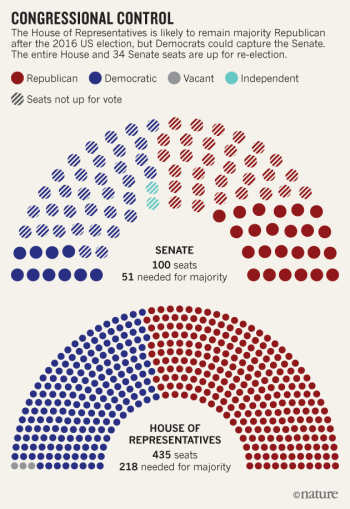
Nature-us-election-31-oct-2016-NEW1The presidential race between Hillary Clinton and Donald Trump is dominating the discussion about the upcoming US election, but it’s not the only contest to watch on 8 November. Choices that voters make will influence other levels of government — and some of these decisions will steer the course of science and science policy.

Will Congress change hands?

Winning the White House is only half the battle for the next president. The political balance of the two houses of Congress — the US House of Representatives and the Senate — can determine whether a president’s policies become law or die on the vine. The Republican Party currently controls both houses. But on 8 November, all 435 seats in the House of Representatives are up for grabs, as are 34 of the 100 seats in the Senate. Although the House seems likely to remain in Republican hands, a Democratic take-over of the Senate is possible. That would benefit Clinton — a Democrat — if she prevails over Trump: the latest polls suggest she has a narrow lead. A Democratic Senate would be more likely to back her funding and policy priorities, such as increasing science spending and fighting climate change, and to approve her nominees for government posts at NASA, the National Science Foundation (NSF) and other agencies key to science. And if the Senate ends up split with 50 Democrats and 50 Republicans, the vice-president — who is also president of the Senate — would break the tie, handing control to the party that wins the White House.

Individual House and Senate races — and retirements — are set to change the political landscape for US science agencies in subtler ways.

More here.

Tuesday, November 1, 2016

The media’s extermination of Bernie Sanders, and real reform

Thomas Frank in Harper's Magazine:

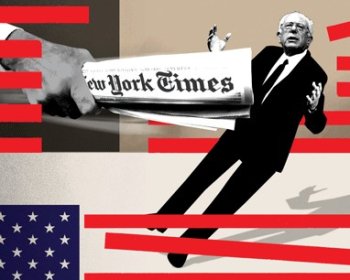
ScreenHunter_2340 Nov. 01 18.10All politicians love to complain about the press. They complain for good reasons and bad. They cry over frivolous slights and legitimate inquiries alike. They moan about bias. They talk to friendlies only. They manipulate reporters and squirm their way out of questions. And this all makes perfect sense, because politicians and the press are, or used to be, natural enemies.

Conservative politicians have built their hostility toward the press into a full-blown theory of liberal media bias, a pseudosociology that is today the obsessive pursuit of certain nonprofit foundations, the subject matter of an annual crop of books, and the beating heart of a successful cable-news network. Donald Trump, the current leader of the right’s war against the media, hates this traditional foe so much that he banned a number of news outlets from attending his campaign events and has proposed measures to encourage more libel lawsuits. He does this even though he owes his prominence almost entirely to his career as a TV celebrity and to the news media’s morbid fascination with his glowering mug.

His Democratic opponent hates the press, too. Hillary Clinton may not have a general theory of right-wing media bias to fall back on, but she knows that she has been the subject of lurid journalistic speculation for decades.

More here. [Thanks to Eric Chaffee.]

Hesperine for David Berger

by Kazim Ali

Begin with the dining room custodian at the university who smashed the stained glass window because we are actually going to change history

Imagine then in the suburbs of Cleveland a sculpture of steel rings broken in halves but opening up away from the bullet-written history of the burning helicopter toward the open sky

Seems possible because there is a bridge between relativity and quantum mechanics that no physicist has yet ascertained

Imagining neither a conditional future if the past was different nor forging ahead from the broken but something newer that bridged that loss

For example what if a painter who left the canvas entirely and instead looked at all the extant surfaces in the already man-made and man-frayed world

History then as fragile as stained glass and yet writes new narratives that shape every movement forward

Both ways of understanding the behavior of matter cannot both be true yet somehow they still behave as true on the lived-in planet

David Berger at 27 deciding to move across the world to Israel to train and compete in the Olympics, 1972 Munich

Continue reading the poem here.

Israel Proves the Desalination Era Is Here

Rowan Jacobsen in Scientific American:

4C28277C-621D-415F-BE5BC1CA30CC5FA7Ten miles south of Tel Aviv, I stand on a catwalk over two concrete reservoirs the size of football fields and watch water pour into them from a massive pipe emerging from the sand. The pipe is so large I could walk through it standing upright, were it not full of Mediterranean seawater pumped from an intake a mile offshore.

“Now, that’s a pump!” Edo Bar-Zeev shouts to me over the din of the motors, grinning with undisguised awe at the scene before us. The reservoirs beneath us contain several feet of sand through which the seawater filters before making its way to a vast metal hangar, where it is transformed into enough drinking water to supply 1.5 million people.

We are standing above the new Sorek desalination plant, the largest reverse-osmosis desal facility in the world, and we are staring at Israel’s salvation. Just a few years ago, in the depths of its worst drought in at least 900 years, Israel was running out of water. Now it has a surplus. That remarkable turnaround was accomplished through national campaigns to conserve and reuse Israel’s meager water resources, but the biggest impact came from a new wave of desalination plants.

More here.

Truth After Trump

Justin E. H. Smith in the Chronicle of Higher Education:

Photo_78978_landscape_650x433In his essay “On Bullshit,” precirculated for years as samizdat and published by Princeton University Press in 2005, the philosopher Harry G. Frankfurt identifies and analyzes a previously neglected species of untruth. It is of the same genre of lying, but unlike its better-known relative it does not seek simply to pass off a falsehood as true. Instead, the bullshitter is the person who no longer considers truth as the anchor of discourse, who speaks without regard for the truth, and who, finally, is unconcerned about whether his interlocutor knows he is speaking untruths or not. “When an honest man speaks,” Frankfurt explains, “he says only what he believes to be true.” For the liar, it is “indispensable that he considers his statements to be false.” But the bullshitter’s eye, Frankfurt argues, “is not on the facts at all, as the eyes of the honest man and of the liar are, except insofar as they may be pertinent to his interest in getting away with what he says. He does not care whether the things he says describe reality correctly. He just picks them out, or makes them up, to suit his purpose.”

One need not have heard of Frankfurt, or have grasped his precise technical meaning of bullshit, to associate it with the Republican nominee for president. But is a Frankfurtian analysis sufficient to understand this election?

More here.

Raising the spirit of American radicalism

Beck_FearLoveB32.4_63cmyk-838x386Jessa Crispin at The Baffler:

It was not, at one time, considered so remarkable that a candidate for the United States presidency talked to the dead. That the candidate was a former prostitute and an advocate for free love was more worrying. What’s more, her vice-presidential pick was a former slave; that was likely the surest sign that Victoria Woodhull was not going to be the next American president.

It was the election of 1872, and Woodhull stood as the nominee for the newly organized Equal Rights Party, with Frederick Douglass as her VP. (There’s no real evidence to show that Douglass agreed to this arrangement, and he certainly did not campaign with her.) Women might not have had the right to vote, but they could run for office, and Woodhull felt that the presidency was her destiny.

In the end, the first woman to seek the White House received no electoral college votes, and her party made the ballot in only twenty-two states. Her enemies pounced on her utopian call for sexual freedom for both men and women, and stirred up the fear of miscegenation that white voters felt, with only minimal prompting, at the sight of a white woman consorting with a black man. Meanwhile, Woodhull’s history of working as a clairvoyant and her vocal support of Spiritualism were not much of a hindrance to her campaign. Go figure.

more here.

Jonathan Swift: The Reluctant Rebel

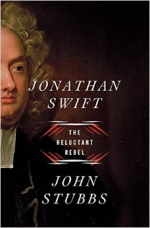
51TTYueNZzL._SY344_BO1,204,203,200_Freya Johnston at Literary Review:

‘Would we have liked to live with him?’ asked Thackeray, contemplating Swift, a question he immediately ducked by supplying a long list of other writers with whom we might prefer to spend our time. Samuel Johnson, similarly recoiling from the evidence of Swift’s character as manifested in his works, thought him ‘a man of rigorous temper’, whose ‘vigilance of minute attention’ must have made him unbearable. Even his best friends, on whose testimony Johnson relied, depicted him as cold, frugal, petulant and severe.

None of this would have surprised the man himself. In his autobiographical ‘Verses on the Death of Dr Swift’ (1731), he imagined widespread indifference to his demise and posthumous distortions of his name. The poem gives neither his vilest enemies nor his closest friends much credit for the sincerity or persistence of their feelings. Instead, it is the public Swift who endures, the man who unmasked cheats and frauds, who stood up for the financial and constitutional independence of Ireland, and who left his money

To build a House for Fools and Mad:
And shew’d by one satiric Touch,
No Nation wanted it so much:
That Kingdom he hath left his Debtor,
I wish it soon may have a Better.

more here.

Black Stories Matter

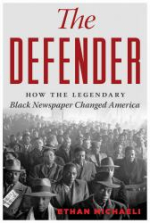
Criticism_freedman_defender_webSamuel G. Freedman at VQR:

During the summer of 2013, shortly after George Zimmerman was acquitted of the fatal shooting of an unarmed black teenager named Trayvon Martin, word leaked out that a juror was already shopping around a prospective book about the case. One particular Twitter user, Genie Lauren, was so outraged that she logged on to condemn the literary agent who was representing the juror. As Lauren later explained, “I didn’t think it was right that someone would make money off of this tragedy.” Almost immediately, thousands of other people began tweeting at the agent, a protest petition circulated online, and the book project was dropped.

By some readings of recent history, this episode marked the emergence of Black Twitter, a term that refers to the concentrated, effective, and proudly parochial use of the social-media platform by African Americans. In the years since the Zimmerman trial, Black Twitter has been an information-sharing and opinion-shaping phenomenon for everything from the BET Awards to the Michael Brown killing in Ferguson, Missouri. Black Twitter, of course, gave birth to the hashtag that became a slogan that became a movement: #BlackLivesMatter.

more here.

Maps are as much about art – and lies – as science

Stephen Bayley in The Spectator:

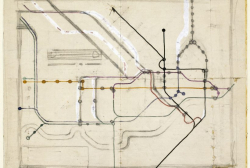
LIKE-Harry-Beck-tube-map-sketch-Victoria-Albert-Museum-©-TfL-820x550In Australia, I have been told, the female pubic area is sometimes known as a ‘mapatasi’ because its triangular shape resembles a map of Tasmania. And since we are discussing cartography and the nether regions, it is wonderful to find in the British Library’s new exhibition, Maps and the 20th Century, that Countess Mountbatten wore knickers made out of second world war airmen’s silk escape maps. Maps certainly colonise our imaginations in many different ways. The allies in Iraq had a ‘road map’ rather than a strategy. So much of personal value can be lost in the creases and folds of our own ‘mental maps’. And couples who often travel in cars will know the shrieking horrors of the map row, more complicated nowadays since satnav offers a third and often contrary route selection. If you visit the British Library you might use the Tube or go by road. So you will probably consult the Underground map or an A-Z. Here are two examples of maps as illusions, or, at least, persuasive abstractions.

Harry Beck was the London Transport engineering draftsman who created the modern Tube map. With great art he decided to use only verticals, horizontals and diagonals while, for clarity, he greatly enlarged the city’s central area. The result is an all-time, trumpets-of-Jericho classic of graphic design, admired and copied everywhere. But if you see a technical plan of the Tube lines as they actually are, it resembles a bowl of spaghetti spilt on the floor. The disparity between tangled ‘reality’ and Beck’s superlative, reductive modernist capriccio is shocking. It is not a faithful reproduction of underlying facts, but a lie that works. Therein is a central truth: the human mapping instinct is as much art as it is science.

More here.

By the year 2040, embryo selection could replace sex as the way most of us make babies

Jamie Metzl in KurzweilAI:

ImagesHuman reproduction is about to undergo a radical shift. Embryo selection, in connection with in-vitro fertilization (IVF), will help our species eliminate many genetic diseases, extend healthy lifespans, and enhance people’s overall well-being. Within 20 years, I predict that it will supplant sex as the way large numbers of us conceive of our children. But while the embryo selection revolution will do a lot of good, it will also raise thorny ethical questions about diversity, equality and what it means to be human–questions we are woefully unprepared to address. IVF for humans has been around since 1978, the year Louise Brown, the first so-called “test-tube baby,” was born in the UK. Since then, nearly six million infants around the world have been conceived via IVF, with the procedure growing in popularity each year. Starting in the 1990s, doctors began using preimplantation genetic screening (PGS) to extract cells from early-stage embryos and screen them for simple genetic diseases.

At present, over a thousand such diseases, including cystic fibrosis, Huntington’s disease, Tay-Sachs, sickle-cell anemia, and Duchenne muscular dystrophy, can be screened during PGS and the list is growing constantly. With this information, parents using IVF and PGS can select embryos not carrying those diseases if they choose to do so. Some jurisdictions, including the US, Mexico, Italy, and Thailand, also allow parents to select the gender of their future children.

More here.

Monday, October 31, 2016

Azra Raza honored at the annual DIL Gala

ScreenHunter_2341 Nov. 02 16.58Congratulations to my sister Azra!

From the event invitation:

We would like to extend to you a warm invitation to Developments in Literacy’s 2016 Gala. The event will be held on Friday, October 28th, 2016 at Cipriani on 42nd in New York, honoring our Chief Guest, Dr. Azra Raza. We are honored that Dr. Raza has chosen to support DIL’s mission in educating and empowering underprivileged children in Pakistan.

Developments in Literacy (DIL) is a section 501(c)(3) non-profit organization that was launched in 1998. DIL has educated more than 23,000 students at 124 schools situated in some of the most underserved regions of Pakistan. DIL provides high quality teacher training; innovative, low cost teaching resources and maintains strong relationships with school communities. DIL has been awarded a prestigious 4-star rating for 6 years in a row by Charity Navigator. DIL’s work was recently highlighted in USAID’s Frontline Magazine, calling the Mobile Learning Project a “game changer” in educating teachers in inaccessible, remote areas of the country through videos delivered on their mobile phones.

Previous honorees include Christiane Amanpour, Ted Turner, Nicholas Kristof, Mira Nair, Nandita Das, Maleeha Lodhi and Shahzia Sikander. Below is Azra’s acceptance speech.

by Azra Raza

Thank you Shaila, thank you DIL. I am deeply, deeply honored.

When my daughter Sheherzad was 5, she came home after the first week of kindergarten and announced to us, “I am just wasting my time. I can’t read. I can’t write. And they won’t let me talk.” Well, we told her, this pretty much summarizes the state of most girls all over the world. They can’t read, they can’t write and they are not allowed to speak.

I am a scientist, but we called my mother a Rocket Scientist. Her life epitomized the prevailing ethos and traditions of a sharifzadi being raised in the Aligarh of 1930s where high culture was defined by an attitude of extreme gentleness…particularly, in the men, overt hyper-masculinity was tantamount to hyper-vulgarity. Sadly, it was also a time when older women in the family had to smuggle a female tutor to enter the zanan-khana secretly to teach the young girls how to read and write. Basically, my very gentle and civilized grandfather’s attitude was why should the girls be taught to read and write? So they can shake hands with the English men?

After the death of the family patriarch, as the British tightened their hold over the natives, my mother’s family suddenly found themselves bereft of their possessions and with no practical skills to survive. For my mother, this traumatic experience underscored the importance of education as the only means of individual empowerment and thus ignited an intense desire in her to educate not only her own children, especially the girls, but to fight hard for the education of all the children in her community.

I remember one evening last year when I was telling some friends about my mother and how she taught everyone around her to read and write. So much so that our driver who was from the North West Frontier Provinces not only became literate, started reading the Urdu newspapers religiously but then became so obsessed with the written word that he ended up writing his autobiography. When I told this story, one of my unnamed and very famous writer friends responded, “Azra, what else would a driver write but an AUTO-biography? And now I have the name of his next book: BUS!!” [Editor’s note: “bus” means “enough” in Urdu, and “dil” means “heart”.]

Read more »

Perceptions

Anicka_Petri_lo-res_0-540x358

Anicka Yi. 6,070,430K of Digital Spit. 2015

“… The artist’s sculptural installation examines how “flavors”—visual, olfactory, gustatory, auditory—can form sense memories and spur longing, though their cultural and economic value is subject to global consumerism and a politics of taste. For the exhibition, the artist will create a large, illuminated pond containing synthetic and biological matter such as hair gel and the cellulose “leather” that grows from the bacterial cultures in kombucha tea. The gallery is scented with menthol—which for Yi recalls the dish Mint Pond, a plate of molecular gastronomy she once consumed at el Bulli, the famous but now defunct restaurant. The installation also features an intermittent soundtrack playing over speakers, as the exhibition plays on ideas of good and bad taste throughout.”

More here, here, and here.

How To Deal With Our Emotions

by Max Sirak

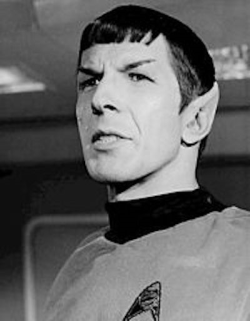
You are not a Vulcan. Leonard_Nimoy_Spock_1967

You are a human. You have a mind capable of logic and rational thought. You also possess a body that feels. Emotions are as principle to you and your being as your eyes, your hands, your feet, or your skin.

And, try as we might or think as we do – that life would be better, easier if we didn't have all these gooey feelings gumming up our insides – we do. So, since emotions seem to be a fundamental aspect of us, I thought now might be a good time to learn a bit more about them.

Our Emotional Education

Our emotional development starts three weeks after mommy and daddy make us.

This is when our brains start to form. Then, at about three months in utero, we start processing information. This is the genesis of our emotional lives. Long before we have our own lungs to breathe, our own mouths to eat, or our own eyes to see – we have our emotions.

Emotions are the names we give to the ways we feel. Inputs from the outside world are collected, filtered through our senses, and processed through our brains. The physiological changes we experience during this bio-computing – we name happy, sad, angry, etc.

Our propensity to identify with, or frequently experience, any particular emotion is partly atavistic, based on our genetic make-up. Some of us are more predisposed to feeling certain ways than others. It's a feature of our design. The foundations of which were laid long before we ever said hello to this sweet, sweet world.

Read more »

Sunday, October 30, 2016

The New Book of Snobs by DJ Taylor

Bee Wilson in The Guardian:

ScreenHunter_2338 Oct. 30 17.44I’m afraid we’ve become terrible salt snobs,” joked the late food writer Alan Davidson when he and his wife Jane had me round for lunch one day in the early 2000s. On the table were a panoply of special salts, from pink Himalayan to damp, grey fleur de sel from France. Announcing himself as a salt snob was a form of gentle self-mockery, something Alan was good at. He knew how absurd it was to have all these salts, when he could have made do with a cheap tub of Saxa. But it was also a modest kind of boastfulness. Alan wanted me to notice how superior his salt collection was, which I duly did.

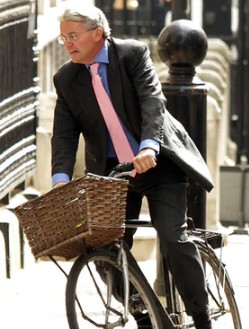
The concept of snobbery is deeply complex, as the literary critic and biographer DJ Taylor cleverly explores in his “definitive guide” to snobs. Snobbery is a form of social superiority, but it can also be a moral failing. Snobs may laud it over others, but we, in turn, despise and punish them for it. Taylor starts his book withthe “Plebgate” affair of 2012, in which the government chief whip Andrew Mitchell was forced to resign his official post, and later pay substantial damages, after it emerged that he had rebuked a police officer who asked him not to cycle through the gates of 10 Downing Street with the words: “Best you learn your fucking place … You’re fucking plebs.” As Taylor notes, Mitchell’s sin was not to swear, but his use of the word “plebs”, which, in ancient Rome, simply meant the common people.

More here.

How to Solve the Hardest Logic Puzzle Ever

Brian Gallagher in Nautilus:

ScreenHunter_2337 Oct. 30 17.38While a doctoral student at Princeton University in 1957, studying under a founder of theoretical computer science, Raymond Smullyan would occasionally visit New York City. On one of these visits, he met a “very charming lady musician” and, on their first date, Smullyan, an incorrigible flirt, proceeded very logically—and sneakily.

“Would you please do me a favor?” he asked her. “I am to make a statement. If the statement is true, would you give me your autograph?”

Content to play along, she replied, “I don’t see why not.”

“If the statement is false,” he went on, “you don’t give me your autograph.”

“Alright …”

His statement was: “You’ll give me neither your autograph nor a kiss.”

It takes a moment, but the cleverness of Smullyan’s ploy eventually becomes clear.

A truthful statement gets him her autograph, as they agreed. But Smullyan’s statement, supposing it’s true, leads to contradiction: It rules out giving an autograph. That makes Smullyan’s statement false. And if Smullyan’s statement is false, then the charming lady musician will give him either an autograph or a kiss. Now you see the trap: She has already agreed not to reward a false statement with an autograph.

With logic, Smullyan turned a false statement into a kiss. (And into a beautiful romance: The two would eventually marry.)

More here.

Subrahmanyan Chandrasekhar: A study in fortitude and rigor

Ashutosh Jogalekar in The Curious Wavefunction:

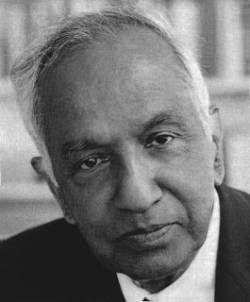
Chandra“Chandra”, as he was fondly known to friends and colleagues, was one of the twentieth century's most important astrophysicists. In addition he was probably its most rigorous and mathematical, applying hard and baroque mathematics to problems ranging from hydrodynamics to collapsing stars. His Nobel Prize came in 1983, and it should have come earlier. Chandra's life provides a good example of quiet rebellion against a traditional scientific establishment, and it's for this reason that it deserves wide study.

By all accounts Chandra was marked to be a great scientist from his birth. Born in the city of Lahore (now in Pakistan) to a respected civil servant, he quickly outpaced his fellow students in his study of advanced mathematics and physics. In the 1920s when he was attending college in the progressive city of Madras (now Chennai) he met the renowned physicist Arnold Sommerfeld when Sommerfeld was visiting Madras, and was both shocked and fascinated to hear Sommerfeld tell him that quantum theory had rendered outdated much of the physics he had learnt. That however was a deficiency that Chandra could remedy. As the famous story goes, at the mere age of nineteen, on a long voyage from India to England to attend graduate school at the University of Cambridge, he did the calculation that was to enshrine his name in history. That analysis which used tools from relativity and quantum theory that were far beyond the grasp of any other nineteen year old physics student, finally led to the establishment of the so-called 'Chandrasekhar limit', a limit for the mass a white dwarf can sustain before it collapses under the weight of its own gravity.

A few years later Chandra had a famous showdown with Arthur Eddington, the doyen of English astronomers and one of the most famous scientists in the world.

More here.

Donald Trump Is the First Demagogue of the Anthropocene

Robinson Meyer in The Atlantic:

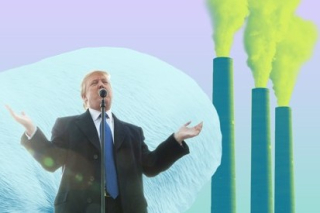
ScreenHunter_2336 Oct. 30 17.17Lately I’ve been thinking back to something that John Kerry told The Atlantic’s editor in chief, Jeffrey Goldberg, earlier this year. Asked about the importance of the Middle East to the United States, Kerry answered entirely about the Islamic State.

“Imagine what would happen if we don’t stand and fight [ISIS],” he said:

If we didn’t do that, you could have allies and friends of ours fall. You could have a massive migration into Europe that destroys Europe, leads to the pure destruction of Europe, ends the European project, and everyone runs for cover and you’ve got the 1930s all over again, with nationalism and fascism and other things breaking out. Of course we have an interest in this, a huge interest in this.

The 1930s all over again—Kerry was laying out a prediction in April, but it sounds a little more like description now. Even if America’s current dunderheaded demagogue loses the presidential election, the European project already falters in the United Kingdom, and Russia rumbles with revanchism. Fueled now (as then) by an ailing global economy, far-right nationalism seems ascendant worldwide. It’s hard not to think of the 1930s as the catastrophe which presaged our contemporary tragicomedy.

I write and report on climate change, not a pursuit that usually encourages optimism, but watching all this unfold with the atmosphere in mind has been particularly bleak. For the past few months in particular, I’ve been thinking: Wow, this is all happening way earlier than I thought it would.

More here.