On the nature of truth

9781107424425

Richard Marshall interviews Volker Halbach in 3:AM Magazine:

3:AM: From the beginning you have been investigating the nature of truth. One of the big distinctions that you’ve been working with is approaches to truth that are axiomatic and approaches that are semantic. So can we begin by asking you to sketch what the distinction is, and what is at stake?

VH: The axiomatic approach is very simple: We stipulate axioms for the truth predicate that look plausible and that avoid the paradoxes. Truth is taken to be a primitive notion. The axiomatic approach differs from traditional definitional approaches such as the correspondence or coherence theory of truth that it is not assumed from the outset that truth is definable.

Semantic theories of truth provide methods for defining semantics or models for a language with a truth predicate. The semantic definition of a model is usually carried out in set theory for a language that is essentially weaker. Semantic theories cannot provide models for the language in which the model is defined. In philosophical logic this is a standard approach that has been applied to many other notions: Toy languages with symbols for necessity, knowledge, or the like are given a suitable semantics. In semantic theories of truth the same strategy is applied to the truth predicate. Kripke’s theory and the revision semantics of truth by Gupta and Herzberger belong into this category, but also Tarski’s extremely successful model-theoretic account of truth that is the starting point for all later accounts.

More here.

With Snowflakes and Unicorns, Marina Ratner and Maryam Mirzakhani Explored a Universe in Motion

Amie Wilkinson in The New York Times:

MirzaThe mathematics section of the National Academy of Sciences lists 104 members. Just four are women. As recently as June, that number was six. Marina Ratner and Maryam Mirzakhani could not have been more different, in personality and in background. Dr. Ratner was a Soviet Union-born Jew who ended up at the University of California, Berkeley, by way of Israel. She had a heart attack at 78 at her home in early July. Success came relatively late in her career, in her 50s, when she produced her most famous results, known as Ratner’s Theorems. They turned out to be surprisingly and broadly applicable, with many elegant uses. In the early 1990s, when I was a graduate student at Berkeley, a professor tried to persuade Dr. Ratner to be my thesis adviser. She wouldn’t consider it: She believed that, years earlier, she had failed her first and only doctoral student and didn’t want another

Dr. Mirzakhani was a young superstar from Iran who worked nearby at Stanford University. Just 40 when she died of cancer in July, she was the first woman to receive the prestigious Fields Medal. I first heard about Dr. Mirzakhani when, as a graduate student, she proved a new formula describing the curves on certain abstract surfaces, an insight that turned out to have profound consequences — offering, for example, a new proof of a famous conjecture in physics about quantum gravity. I was inspired by both women and their patient assaults on deeply difficult problems. Their work was closely related and is connected to some of the oldest questions in mathematics.

…Dr. Ratner and Dr. Mirzakhani studied shapes that are preserved under more sophisticated types of motions, and in higher dimensional spaces. In Dr. Ratner’s case, that motion was of a shearing type, similar to a strong wind high in the atmosphere. Dr. Mirzakhani, with my colleague Alex Eskin, focused on shearing, stretching and compressing. These mathematicians proved that the only possible preserved shapes in this case are, unlike the snowflake, very regular and smooth, like the surface of a ball. The consequences are far-reaching: Dr. Ratner’s results yielded a tool that researchers have turned to a wide variety of uses, like illumining properties in sequences of numbers and describing the essential building blocks in algebraic geometry. The work of Dr. Mirzakhani and Dr. Eskin has similarly been called the “magic wand theorem” for its multitude of uses, including an application to something called the wind-tree model.

More here.

Monday, August 7, 2017

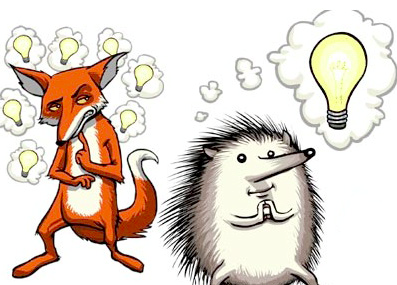
How to thrive as a fox in a world full of hedgehogs

by Ashutosh Jogalekar

DownloadThe Nobel Prize winning animal behaviorist Konrad Lorenz once said about philosophers and scientists, “Philosophers are people who know less and less about more and more until they know nothing about everything. Scientists are people who know more and more about less and less until they know everything about nothing.” Lorenz had good reason to say this since he worked in both science and philosophy. Along with two others, he remains the only zoologist to win the Nobel Prize for Physiology or Medicine. His major work was in investigating aggression in animals, work that was found to be strikingly applicable to human behavior. But Lorenz’s quote can also said to be an indictment of both philosophy and science. Philosophers are the ultimate generalists, scientists are the ultimate specialists.

Specialization in science has been a logical outgrowth of its great progress over the last five centuries. At the beginning, most people who called themselves natural philosophers – the word scientist was only coined in the 19th century – were generalists and amateurs. The Royal Society which was established in 1660 was a bastion of generalist amateurs. It gathered together a motley crew of brilliant tinkerers like Robert Boyle, Christopher Wren, Henry Cavendish and Isaac Newton. These men would not recognize the hyperspecialized scientists of today; between them they were lawyers, architects, writers and philosophers. Today we would call them polymaths.

These polymaths helped lay the foundations of modern science. Their discoveries in mathematics, physics, chemistry, botany and physiology were unmatched. They cracked open the structure of cells, figured out the constitution of air and discovered the universal laws governing motion. Many of them were supported by substantial hereditary wealth, and most of them did all this on the side, while they were still working their day jobs and spending time with their families. The reasons these gentlemen (sadly, there were no ladies then) of the Royal Society could achieve significant scientific feats were many fold. Firstly, the fundamental laws of science still lay undiscovered, so the so-called “low hanging fruit” of science was ripe and plenty. Secondly, doing science was cheap then; all Newton needed to figure out the composition of light was a prism.

But thirdly and most importantly, these men saw science as a seamless whole. They did not distinguish much between physics, chemistry and biology, and even when they did they did so for the sake of convenience. In fact their generalist view of the world was so widespread that they didn’t even have a problem reconciling science and religion. For Newton, the universe was a great puzzle built by God, to be deciphered by the hand of man, and the rest of them held similar views.

Read more »

Ah, the Past …

by Elise Hempel

52d4703df3ad999fd2a45d6a80e7db5b--old-medicine-bottles-antique-glass-bottlesFor many years I've loved to go antiquing, heading out with my partner on a Saturday afternoon to discover some quaint and hidden new antique shop, browsing through old pottery and glass, vintage knick-knacks and rusty railroad lamps, escaping the computer and TV for a while, the routine of daily life. Even better if the shop is slightly dim, with a certain mustiness to the air, if soft classical music surrounds me as I drift and imagine past the locked glass cases and open shelves. Even better if there's dust on those shelves.

I'm also a long-time enthusiast of antique glass bottles, having collected them and sold them on ebay, having bid in many online auctions and attended bottle shows in various states, having done much reading about them. I'm especially interested in the richly colored, glowing Midwestern pattern-molded bottles of the early 19th Century (the height of glass-making in America), as well as the gracefully curved and wonderfully off-kilter freeblown New England chestnut bottles from the late 1700s and early 1800s. So, if I were to wish for a real return to the past, I suppose I'd want back what I imagine was a national appreciation of skill and craftsmanship, quality and beauty – a time in the world of glass-making "before progress," before the automatic bottle machine started giving uniformity to bottles in the early 1900s, before even the use of glass molds to create the standardized bodies of bottles, a time when the glassblower's breath, out of necessity, regularly created delicate, individual objects of art.

I would not, of course, wish for much else still untouched by progress between the years 1815 and 1830 (the specific time of the Midwestern bottles I love) – slavery, a lack of women's rights, lack of electricity, etc., etc., etc. And one can only imagine the working conditions of a glass factory back then: the long hours and work week; the heat of the furnaces and the danger of molten glass; the dirtiness of the sand, soda ash, and limestone needed to make the glass; the shards of continuously broken bottles.

Read more »

Losing Orchid

by Christopher Bacas

ImageOn a cloudy November afternoon, the runaway dog headed south through a Victorian Brooklyn neighborhood. Shuttling down sidewalks, a black spindle unwinding in lengthwise turns. Legs, wisps of yarn, whipping down, then up into the skein. Scuff and click of paws un-synced to their motion; lightning flashes before the charge splits air. Overhead, massive houses linked eaves.

The run zigzagged through irregular blocks; cells in a massive, supine body. Cell walls: bulging chain link or ornate iron fences, mottled from scraping and accretion of paint, hedges, brick walls or ivied slat fences; permeable at angles and in raw gaps. She could thread these breaches at whistling speed. Her sleek coat catching, leaving tiny clumps of fur.

Driveways ran deep into their nuclei, connecting a garage or backyard. In the maw of each: garbage cans, white, green or clear membranes flapping cilia-like, bikes with rubber-sheathed DNA chains twisted around signs, silent toys clumped along cement culverts.

She forded each capillary street, barely slowing, angling through traffic. Her rump banged a fender and she fishtailed away from the blow, then straightened, accelerating. Across the flat, her momentum made the ground seem to bend from view, as if earth were a hinged disc and with each kick she plunged further down. Behind her, sidewalks, streets, whole neighborhoods tilted away under the unraveling, invisible tether of her shucked harness and leash.

On a dead end street, a guardrail topped with fencing protected the steep descent to an abandoned rail line. At the corner, the fence post leaned away from its mooring. She slowed. Her body wiggled, slotted the gap and careened down the hill. Dust eddies swirled behind her. Between tree roots, soft dirt glinted with shards of plate glass and broken bottle necks.

Read more »

Triggers, Trauma, and Implicit Memory

(Audio version available here!)

Last month I got a job as a ghostwriter.

Ghostwriting is a lot like being a doula. Only for books not babies. It's a long term, semi-intimate relationship based on delivering something new. I'm there to make the process as smooth and easy as possible.

The author I'm working with is a behavioral and family therapist with a specialty in children's play therapy. She has over 30 years of experience in her field and came to the point in her career when it was time to put the pen to paper (or fingers to keys, as it were) to share what she's learned. But she wanted help. So she hired me.

One of her stories is intense. It involves a repressed memory of an early childhood kidnapping flooding back into consciousness and overwhelming the woman 20 years later. Like I said, intense.

Read more »

Sunday, August 6, 2017

The Partition of Pakistan and India, 70 years on: Salman Rushdie, Kamila Shamsie, Pankaj Mishra, Mohsin Hamid and other writers reflect

From The Guardian:

2908Salman Rushdie:

The country [India] is rapidly being pulled in the direction decreed by the proponents of “Hindutva”, Hindu nationalism, and away from the secular ideals of the founding fathers. To criticise this movement, in the age of the political Twitter troll, is to be branded “sickular,” or, even worse, a “sickular libtard”. Meanwhile, in the land of the sacred cow, people are being lynched for the “crime” of allegedly possessing or eating beef. History textbooks are being rewritten as Hindutva propaganda. The government’s control over a largely acquiescent news media (there are a couple of honourable exceptions) would be envied by the president of the United States, if he happened to concern himself with such faraway matters. The “world’s largest democracy” feels more authoritarian and less democratic than it should.

But the Modi government is popular. It’s very popular. This is the greatest difference between the India of Indira’s Emergency and the India of today. Back then, Mrs Gandhi called an election, wrongly believing she would win, and by doing so would legitimise the excesses of the Emergency years. But she was voted down resoundingly and driven from office. There is no sign that the Indian electorate will turn against the present government any time soon. Midnight’s grandchildren seem content with what’s happening. And that’s the pessimistic conclusion to volume two of the Indian story.

More here.

Resentful white people propelled Trump to the White House — and he is rewarding their loyalty

Trump

John Sides in The Washington Post's Monkey Cage:

A sense of victimhood among whites was ascendant even before Trump’s candidacy. As sociologist Arlie Hochschild documented in her extensive conversations with rural whites in Louisiana, there was a pervasive sense that the beneficiaries of affirmative action, immigrants and refugees were “stealing their place in line,” cutting ahead “at the expense of white men and their wives.” In Hochschild’s phrase, these people felt like “strangers in their own land.”

This sentiment showed up in polls as well. In 2011-2012, 38 percent of Republicans thought that there was at least a moderate amount of discrimination against whites, according to American National Election Study surveys. That figure jumped to 47 percent in the ANES study in January 2016. Similarly, an October 2015 Public Religion Research Institute poll found that nearly two-thirds of Republicans thought that “discrimination against whites has become as big of a problem as discrimination against blacks and other minorities.”

These views were crucial to Trump’s rise. In March 2016, the political scientist Michael Tesler and I showedthe importance of “white identity” during the Republican primary. Trump did particularly well among whites who strongly identified as white, who thought whites suffered from discrimination, who thought whites were losing out on jobs to minorities, and who thought it was important for whites to work together to change laws that were unfair to whites.

Indeed, in further analysis that we’ve done, a strong sense of white identity has emerged as one of the most potent — if not the most potent — predictors of support for Trump in the primary. Support for Trump depended far less on personal economic anxiety — “I’m afraid of losing my job” — than on a distinctly racialized anxiety: “I think minorities are taking jobs from people like me.”

More here.

How “Shareholder Value” is Killing Innovation

Download (2)

William Lazonick over at INET:

Conventional wisdom holds that the primary function of the stock market is to raise cash that companies use to invest in productive capabilities. The conventional wisdom is wrong. Academic research on corporate finance shows that, compared with other sources of funds, stock markets in advanced countries have in fact been insignificant suppliers of capital to corporations. What, then, is their function? If we are to understand employment opportunity, income distribution, and productivity growth, we need an accurate analysis of the role of the stock market in the corporate economy.

The insignificance of the stock market as a source of real investment capital exposes as fallacious the fundamental assumptions of the prevailing ideology that, for the sake of economic efficiency, a business corporation should be run to “maximize shareholder value” (MSV). As a rule, public shareholders do not invest in a corporation’s productive capabilities; they simply buy shares outstanding on the market, hoping to extract value that they have played no role in helping to create. And in practice, MSV advocates modes of corporate resource allocation that undermine innovative enterprise and result in unstable employment, inequitable incomes, and sagging productivity.

The most obvious manifestations of the corporate misbehavior that MSV incentivizes are the lavish, stock-based incomes of top corporate executives and the massive distributions of corporate cash to shareholders in the form of stock buybacks, coming on top of already-ample dividends. Indeed, with stock-based pay incentivizing senior executives to do stock buybacks—i.e., having a company repurchase its own shares to give manipulative boosts to its stock price—over the past three decades the stock market has had a negative cash function. On the whole, U.S. business corporations fund the stock market, not vice versa.

More here.

Botanical Inquiry

Daniel Shipp in lensculture:

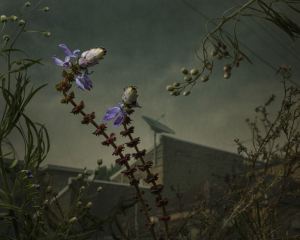
Lens“Botanical Inquiry” is a series of photographic dioramas that shuffle nature, geography, and physics into familiar but fictional environments.

In these compositions, the physical characteristics of the unremarkable plants I have collected become storytelling elements which, when staged against the backdrop of common urban environments, explore the quietly menacing effect that humans have on the natural world. From a subjective and ambiguous point of view, we witness the plants’ ability to adapt and survive. By manipulating the optical and staging properties of photography with an analogue “machine” that I have constructed, I have produced these studio-based images “in camera” rather than using Photoshop compositing. They rely exclusively on the singular perspective of the camera to render their mechanics invisible.

Picture: Southern Remedial Exclusion

More here.

Elena Ferrante: The Mad Adventures of Serious Ladies

G D Dess in LARB:

Elena-ferrante-novelsChildren are regularly treated brusquely, beaten, and/or suffer from benign, and not-so-benign, neglect in Ferrante’s novels. In the essay “What an Ugly Child She Is,” Ferrante responds to a Swedish publisher’s refusal to publish The Days of Abandonment because of the “morally reprehensible” way in which the protagonist treats her children. In that novel, Olga is chiefly guilty of neglect and indifference, abruptness and aloofness in her treatment of them; she does not harm them physically, although she is a bit rough in removing the makeup from her daughter who has, to her disgust, made herself up to look like her.

In defense of her portrayal of Olga’s behavior, Ferrante references Flaubert’s Madame Bovary, and the scene in which Emma Bovary, upon being pestered for attention by her young daughter, Berthe, angrily shoves the girl with her elbow, causing the child to fall against a chest of drawers and cut herself. The wound begins to bleed. She lies to the maid, telling her: “The baby fell down and hurt herself playing.” The wound is superficial. Emma stops worrying about what she had done, forgives herself for her abusive behavior, and chides herself for being “upset over so small a matter.” And then, still sitting by her daughter’s side as she recuperates, adding insult to injury, she thinks: “It’s a strange thing […] what an ugly child she is.”

Ferrante comments that only a man could write such a sentence. She claims (“angrily, bitterly”) that men “are able to have their female characters say what women truly think and say and live but do not dare write.” She says her attempt has been, “over the years, to take that sentence out of French and place it somewhere on a page of my own.” She does create a scene similar to Flaubert’s in The Lost Daughter. Leda, the narrator, tells us that when her daughter was young, she gave her a doll that had belonged to her since infancy. Leda expected her daughter to love the doll. But her daughter strips the doll of her clothes and scribbles over her with markers. When Leda discovers her sitting on the doll one afternoon, she loses her temper, “gives her a nasty shove,” and throws the doll over the balcony. It is run over and destroyed by the passing traffic. Leda’s only (ominous) comment about this incident: “How many things are done and said to children behind the closed doors of houses.”

More here.

Sunday Poem

Summer was always a liar
.

June

At the far outpost
of the Empire of Light, the
bugle sounds retreat.

………. pale moon in a black sky,
………. intense, solitary. aloof.
………. moon-lovers, silver with longing,
………. stand hushed in the driveway
………. before going in

now the sun scatters the old gold
of late summer about the garden
how lovely here seems
with all its busyness and beauty,
yet, the ghost of a moon hang
in the blue morning sky

………. As in an hour glass not long before
……….
it wants turning, the grains of sand
……….
seem to move faster, faster, so
……….
quicken the days of August.
……….
Summer was always a liar with
……….
its June promises of forever.

you think back to childhood
when the days of summer seemed
endless, and time long enough

the school bell rang
and you woke with a jolt
into the mortality of arithmetic

Nils Peterson
from The Sandhill Review
.

Saturday, August 5, 2017

Is linguistics a science?

Arika Okrent in Aeon:

ScreenHunter_2783 Aug. 05 23.24Science is a messy business, but just like everything with loose ends and ragged edges, we tend to understand it by resorting to ideal types. On the one hand, there’s the archetype of the scientific method: a means of accounting for observations, generating precise, testable predictions, and yielding new discoveries about the natural consequences of natural laws. On the other, there’s our ever-replenishing font of story archetypes: the accidental event that results in a sudden clarifying insight; the hero who pursues the truth in the face of resistance or even danger; the surprising fact that challenges the dominant theory and brings it toppling to the ground.

The interplay of these archetypes has produced a spirited, long-running controversy about the nature and origins of language. Recently, it’s been flung back into public awareness following the publication of Tom Wolfe’s book The Kingdom of Speech (2016).

In Wolfe’s breathless re-telling, the dominant scientific theory is Noam Chomsky’s concept of a ‘universal grammar’ – the idea that all languages share a deep underlying structure that’s almost certainly baked into our biology by evolution. The crucial hypothesis is that its core, essential feature is recursion, the capacity to embed phrases within phrases ad infinitum, and so express complex relations between ideas (such as ‘Tom says that Dan claims that Noam believes that…’). And the challenging fact is the discovery of an Amazonian language, Pirahã, that does not have recursion. The scientific debate plays out as a classic David-and-Goliath story, with Chomsky as a famous, ivory-tower intellectual whose grand armchair proclamations are challenged by a rugged, lowly field linguist and former Christian missionary named Daniel Everett.

More here.

How the Bible Belt lost God and found Trump

Flynt

Gary Silverman in the FT:

I went down to Alabama a few weeks ago and had a religious experience. A man of God welcomed me into his home, poured us both cups of English tea and talked about what has been happening to Jesus Christ in the land of Donald Trump.

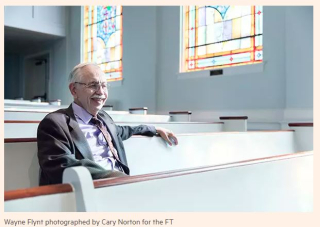
My host was Wayne Flynt, an Alabaman who has made the people of the southern US his life’s work. A 76-year-old emeritus professor of history at Auburn University, he has written empathetically about his region in books such as Poor But Proud. A Baptist minister, he still teaches Sunday school at his church and delivered the eulogy at last year’s funeral of his friend Harper Lee, author of To Kill a Mockingbird.

I took my place in the book-lined study of Flynt’s redwood house in Auburn, Alabama, to hear his thoughts on the local economy, but the conversation turned to a central mystery of US politics. Trump would not be president without the strong support of the folks Flynt has chronicled — white residents of the Bible Belt, raised in the do-it-yourself religious traditions that distinguish the US from Europe. I wondered how a thrice-married former casino owner — who had been recorded bragging about grabbing women by the genitals — had won over the faithful.

Flynt’s answer is that his people are changing. The words of Jesus, as recorded in the Gospels, are less central to their thinking and behaviour, he says. Church is less compelling. Marriage is less important. Reading from a severely abridged Bible, their political concerns have narrowed down to abortion and issues involving homosexuality. Their faith, he says, has been put in a president who embodies an unholy trinity of materialism, hedonism and narcissism. Trump’s victory, in this sense, is less an expression of the old-time religion than evidence of a move away from it.

More here.

Is the world really better than ever?

2362

Oliver Burkeman in The Guardian:

By the end of last year, anyone who had been paying even passing attention to the news headlines was highly likely to conclude that everything was terrible, and that the only attitude that made sense was one of profound pessimism – tempered, perhaps, by cynical humour, on the principle that if the world is going to hell in a handbasket, one may as well try to enjoy the ride. Naturally, Brexit and the election of Donald Trump loomed largest for many. But you didn’t need to be a remainer or a critic of Trump’s to feel depressed by the carnage in Syria; by the deaths of thousands of migrants in the Mediterranean; by North Korean missile tests, the spread of the zika virus, or terror attacks in Nice, Belgium, Florida, Pakistan and elsewhere – nor by the spectre of catastrophic climate change, lurking behind everything else. (And all that’s before even considering the string of deaths of beloved celebrities that seemed like a calculated attempt, on 2016’s part, to rub salt in the wound: in the space of a few months, David Bowie, Leonard Cohen, Prince, Muhammad Ali, Carrie Fisher and George Michael, to name only a handful, were all gone.) And few of the headlines so far in 2017 – Grenfell tower, the Manchester and London attacks, Brexit chaos, and 24/7 Trump – provide any reason to take a sunnier view.

Yet one group of increasingly prominent commentators has seemed uniquely immune to the gloom. In December, in an article headlined “Never forget that we live in the best of times”, the Times columnist Philip Collins provided an end-of-year summary of reasons to be cheerful: during 2016, he noted, the proportion of the world’s population living in extreme poverty had fallen below 10% for the first time; global carbon emissions from fossil fuels had failed to rise for the third year running; the death penalty had been ruled illegal in more than half of all countries – and giant pandas had been removed from the endangered species list.

More here.