The Enduring, Gloriously Déclassé Style of Barbara Windsor

Barbarawindsor-e1502378497911Laura Bannister at The Paris Review:

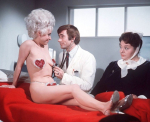
In 1969, the English actress Barbara (Babs) Windsor costarred in her fourth motion picture in the Carry On franchise, a succession of low-budget, campy comedies that dominated national cinemas for two decades. For Carry On Again Doctor, she assumed the role of a walking trope named Goldie Locks: a comely but rattlebrained blonde who’d fallen while modeling for a baby-food commercial, and thus required a checkup. In a now cult scene, a stern hospital matron peels back a blanket to reveal Windsor’s milky, bruised flesh, privates obscured only by heart-shaped nipple pasties and a matching glitter G-string. A male doctor gawps and splutters and spins around at the sight of her. The matron shoots him a censorious glance. Windsor, or Goldie Locks—all alabaster skin and towering, curly beehive—asks, “What’s wrong?” with Gorblimey cockney intonation. A clichéd comedy of errors ensues.

Since its inception in the late fifties, Carry On was an easy, if surprising, cash cow for its founders: deliberately slapstick, smutty and formulaic in plot, expert in recycling themes and motifs to engineer maximum audience delight. It internalized a then-lowbrow English attitude to sex; scripts were carnivalesque, replete with all the bawdy innuendo, double entendre, and wheezy wisecracks of a seaside postcard. (A writer for the Telegraph would later opine that Carry On adopted “innocent smut that plays Grandma’s footsteps with its subject, furtively creeping up on it, then freezing and corpsing when it comes face to face.”)

more here.

tough broads

4827f666-7c05-11e7-a055-7c0a669496014Elaine Showalter at the TLS:

When a female politician’s worst crime is to be unlikeable and uncompassionate, how much ration­ality and coldness is acceptable for women intel­lectuals and artists? Just how tough is tough enough? Deborah Nelson, a professor of English at the University of Chicago, con­siders the politics, psychology and philosophy of toughness in her study of six modern women: Simone Weil, Hannah Arendt, Mary McCarthy, Susan Sontag, Diane Arbus and Joan Didion. Nelson originally titled her book “Tough Broads”; it would be more idiomatic to call them “Tough Cookies”. But neither of these admiring monikers for the fast-talking dames in 1930s screwball comedy would suit the austere, aloof, serious, resolutely (if self-deludingly) unglamorous heroines of her book, and they would surely have been insulted to be linked with Katharine Hepburn, or even labelled as women at all.

These writers, intellectuals and artists insisted on the aesthetic, political and moral obligation to face the painful reality of the twentieth century head-on. Their toughness was a premeditated “lifelong project . . . worked out with a great deal of self-consciousness”. But they all faced anger and hostility for their insistence on confronting suffering and pain without emotion. Their tone of unemotional clarity on the most traumatic events of their time made them respected and feared; but crossing the fine line between detachment and heartlessness also made them seem “out of step with their times”. On some subjects – the Holocaust, the Eichmann trials, civil rights, Vietnam, 9/11 – their detached refusal of empathy and solidarity shocked even their close friends and allies.

more here.

A Childhood of Laughter and Forgetting

UnnamedJana Prikryl at n+1:

One day in Czechoslovakia, not long after I was born, during the gray decade that was the ’70s, my 6-year-old brother came home from school and shared what he’d learned: “Lenin was a kind person. He liked children.” Those words have acquired the force of a proverb in our family: we assure each other that Lenin liked children whenever one of us lets fly with a statement that seems dangerously optimistic. The following may fall into that category: Czechoslovakia before 1989, when the Communist regime fell, was not a bad place to be a child. For my parents, who spent a large part of their adulthoods in the country, it wasn’t all free health care and underground rock ‘n’ roll. As everyone knows by now, most people had to keep their opinions to themselves, do without traveling abroad, wait in line for bananas, accept overt and subtle limitations in their lives. As soon as kids started going to school, they too slipped under the arm of the state—witness my brother’s first-grade indoctrination. In general, though, a political system that thwarted the better instincts and ambitions of adults seems, perversely, to have been mostly congenial and comfortable for children.

I was 5 years old and my brother was 12 when my family fled the country. Instead of driving to the Dalmatian Coast with our camping gear in the trunk as we did for a few weeks every other summer, we made our way to Zagreb. My parents had heard that Czechs bound for Yugoslavia sometimes disappeared and resurfaced in more attractive countries like Italy, Germany, and France, and without quite knowing how, they hoped to do the same.

more here.

During an Eclipse, Darkness Falls and Wonder Rises

Dennis Overbye in The New York Times:

Some people scream. Some people cry. Some do both.

The regular movements of the heavens are the oldest and deepest intimations of order in the universe. So it is hard, no matter how enlightened you consider yourself to be, not to feel a primordial lurch in your gut when the sun suddenly disappears from the sky. On Aug. 21, the Great American Eclipse, as it has been branded by astronomers and trip promoters, will begin off the coast of Oregon and barrel across the country for an hour and a half before exiting off the coast of Charleston, S.C. A total solar eclipse happens about twice a year somewhere on the globe, but this is the first time since 1918 that the continental United States has had an exclusive on the spectacle, one of the true rare treasures of nature. Here’s our chance to see the shy corona, a pale sheath of energy the color of moonlight, wisping its tendrils into interplanetary space, and to stand in what feels like the Eye of Sauron as the winds rise, distant darkness spreads over the hills, and an eerie coolness invades the day. About 100 million people live within a day’s drive of the path of totality, a band about 70 miles wide. The State of Oregon is treating the eclipse as a rehearsal for a future civil defense disaster, like an earthquake or a tsunami. If the forecasts are correct, many of us are likely to be viewing the eclipse from a traffic jam.

More here.

Tuesday Poem

In Broken Images
.

He is quick, thinking in clear images;
I am slow, thinking in broken images.

He becomes dull, trusting to his clear images;
I become sharp, mistrusting my broken images.

Trusting his images, he assumes their relevance;
Mistrusting my images, I question their relevance.

Assuming their relevance, he assumes the fact;
Questioning their relevance, I question the fact.

When the fact fails him, he questions his senses;
When the fact fails me, I approve my senses.

He continues quick and dull in his clear images;
I continue slow and sharp in my broken images.

He in a new confusion of his understanding;
I in a new understanding of my confusion.

.
by Robert Graves
from To Read a Poem
Harcourt Brace, 1982
.

Monday, August 14, 2017

Sunday, August 13, 2017

Annie Dillard’s Classic Essay: “Total Eclipse”

“Seeing a partial eclipse bears the same relation to seeing a total eclipse as kissing a man does to marrying him.” —Annie Dillard

Ever since it was first published in 1982, readers—including this one—have thrilled to “Total Eclipse,” Annie Dillard’s masterpiece of literary nonfiction, which describes her personal experience of a solar eclipse in Washington State. It first appeared in Dillard’s landmark collection, Teaching a Stone to Talk, and was recently republished in The Abundance, a new anthology of her work. The Atlantic is pleased to offer the essay in full, here, until the day after the ‘Great American Eclipse’ on August 21. Ross Andersen

Annie Dillard in The Atlantic:

ScreenHunter_2789 Aug. 14 09.56It had been like dying, that sliding down the mountain pass. It had been like the death of someone, irrational, that sliding down the mountain pass and into the region of dread. It was like slipping into fever, or falling down that hole in sleep from which you wake yourself whimpering. We had crossed the mountains that day, and now we were in a strange place—a hotel in central Washington, in a town near Yakima. The eclipse we had traveled here to see would occur early in the next morning.

I lay in bed. My husband, Gary, was reading beside me. I lay in bed and looked at the painting on the hotel room wall. It was a print of a detailed and lifelike painting of a smiling clown’s head, made out of vegetables. It was a painting of the sort which you do not intend to look at, and which, alas, you never forget. Some tasteless fate presses it upon you; it becomes part of the complex interior junk you carry with you wherever you go. Two years have passed since the total eclipse of which I write. During those years I have forgotten, I assume, a great many things I wanted to remember—but I have not forgotten that clown painting or its lunatic setting in the old hotel. The clown was bald. Actually, he wore a clown’s tight rubber wig, painted white; this stretched over the top of his skull, which was a cabbage. His hair was bunches of baby carrots. Inset in his white clown makeup, and in his cabbage skull, were his small and laughing human eyes. The clown’s glance was like the glance of Rembrandt in some of the self-portraits: lively, knowing, deep, and loving. The crinkled shadows around his eyes were string beans. His eyebrows were parsley. Each of his ears was a broad bean. His thin, joyful lips were red chili peppers; between his lips were wet rows of human teeth and a suggestion of a real tongue. The clown print was framed in gilt and glassed.

To put ourselves in the path of the total eclipse, that day we had driven five hours inland from the Washington coast, where we lived. When we tried to cross the Cascades range, an avalanche had blocked the pass.

More here.

Should We “Stop Equating ‘Science’ With Truth”?

Heather Heying in Quillette:

BiologyActually: no.

In the modern world, there are ever fewer reasons to maintain the distinct roles of men and women, which evolved over millions of years. But to imagine that we are not living with that inheritance is to reject not just science, but all forms of logic and reason.

The message that liberates women is not: men and women are the same, and anyone who tells you different is oppressing you. The message that liberates women is: men and women are different. (And in fact, everyone who is intellectually honest knows this—see Geoffrey Miller’s excellent point regarding the central inconsistency in the arguments being presented by the control-left.) And not only are men and women different at a population level, but our distinct strengths and interests allow for greater possibility of emergence in collaboration, in problem-solving, and in progress, than if we work in echo chambers that look and think exactly like ourselves. Shutting down dissent is a classic authoritarian move, and will not result in less oppression. You will send the dissenters underground, and they will seek truth without you.

Evolutionary biology has been through this, over and over and over again. There are straw men. No, the co-option of science by those with a political agenda does not put the lie to the science that was co-opted. Social Darwinism is not Darwinism. You can put that one to rest. There are pseudo-scientific arguments from the left. Gould and Lewontin, back in 1979, argued, from a Marxist political motivation, that biologists are unduly biased in favor of adaptive explanations, which managed to confuse enough people for long enough that evolutionary biology largely stalled out. And, perhaps most alarming, there are concerns that what is true might be ugly.

More here.

Pakistani novelist Mohammed Hanif: The partition goes on

Tomorrow is the 70th anniversary of Pakistan and (the day after that) India's independence. Mohammed Hanif writes in Al Jazeera:

Flag-Pins-India-PakistanTwenty years ago I visited India for the first time. We were doing the same thing back then, celebrating 50 years of independence, or mourning 50 years of partition to a steady beating of breasts: why can't we live like friendly neighbours?

Like many Pakistanis I saw my first Indians in London and was surprised that they were a bit like us. Most Indians and Pakistanis have the same reaction when they meet. It seems as if they are brought up to believe that a community of ferals lives across the border.

My first Indian friend and colleague, Zubair Ahmed, came up with this rather clever idea that we should travel to each other's country, then come back and put together a series of programmes comparing our reactions. Originally we wanted to go and live with each other's families but in retrospect, wisely, we decided not to take this newfound brotherhood too far.

We applied for our visas after explaining our plan to the respective high commissioners. They loved the idea and it was followed by a lovely Lucknow-style stand-off where two gentlemen at a platform keep telling each other "No sir, you first" and then the train departs without either of them. For two months we went back and forth. Have they given Zubair the visa? But have they given Hanif the visa? Their logic was impeccable, if one of us didn't get a visa, how would there be a programme?

More here.

Freud the philosopher

Freud

David Livingstone Smith in Aeon:

Most people think of Sigmund Freud as a psychologist or a psychiatrist. But he was neither. He was trained as a neuroscientist and went on to create a new discipline that he called ‘psychoanalysis’. But Freud should also be thought of as a philosopher – and a deeply insightful and prescient one at that. As the philosopher of science Clark Glymour observed in 1991:

Freud’s writings contain a philosophy of mind, and indeed a philosophy of mind that addresses many of the issues about the mental that nowadays concern philosophers and ought to concern psychologists. Freud’s thinking about the issues in the philosophy of mind is better than much of what goes on in contemporary philosophy, and it is sometimes as good as the best …

In fact, it’s impossible to really understand Freudian theory without coming to grips with its philosophical undercurrents. This might sound strange, given the many derogatory remarks about philosophy that are scattered through Freud’s writings and correspondence. But these remarks are easy to misinterpret. Freud’s verbal barbs were not directed at philosophy per se. They were directed at the kind of philosophy that was dominant during his lifetime – philosophy of the speculative, armchair variety that remains aloof from scientific investigations of the material world, often described as ‘metaphysics’, a subject that he characterised as ‘a nuisance, an abuse of thinking’, adding: ‘I know well to what extent this way of thinking estranges me from German cultural life.’

To come to grips with the philosophical thrust of Freud’s thinking, it is crucial to place it in its historical context. Born in 1856 in a village in what is now the Czech Republic, Freud enrolled in the University of Vienna just at the time when the sciences of the mind were gaining momentum. Although he initially planned to study law with the intention of pursuing a career in politics, and also toyed with the idea of doing a joint PhD in zoology and philosophy, he eventually found his way to neurology. In entering this field at just that moment, the young Freud launched himself into an incredibly exhilarating and dynamic intellectual milieu. For neuroscientific researchers, the daunting scientific challenge of figuring out how the brain works (without the benefit of the sophisticated technologies available today) was compounded by the equally formidable philosophical challenge of explaining the relationship between the electrochemical impulses coursing through a massively complex network of neurons and the experiential fabric of our subjective mental lives – our thoughts, values, perceptions, and choices.

More here.

The Lost Cause Rides Again

Lead_960

Ta-Nehisi Coates in The Atlantic:

The terms of the white South’s defeat were gentle. Having inaugurated a war which killed more Americans than all other American wars combined, the Confederacy’s leaders were back in the country’s political leadership within a decade. Within two, they had effectively retaken control of the South.

Knowing this, we do not have to wait to point out that comparisons between Confederate and The Man in the High Castle are fatuous. Nazi Germany was also defeated. But while its surviving leadership was put on trial before the world, not one author of the Confederacy was convicted of treason. Nazi Foreign Minister Joachim von Ribbentrop was hanged at Nuremberg. Confederate General John B. Gordon became a senator. Germany has spent the decades since World War II in national penance for Nazi crimes. America spent the decades after the Civil War transforming Confederate crimes into virtues. It is illegal to fly the Nazi flag in Germany. The Confederate flag is enmeshed in the state flag of Mississippi.

The symbols point to something Confederate’s creators don’t seem to understand—the war is over for them, not for us. At this very hour, black people all across the South are still fighting the battle which they joined during Reconstruction—securing equal access to the ballot—and resisting a president whose resemblance to Andrew Johnson is uncanny. Confederate is the kind of provocative thought experiment that can be engaged in when someone else’s lived reality really is fantasy to you, when your grandmother is not in danger of losing her vote, when the terrorist attack on Charleston evokes honest sympathy, but inspires no direct fear.

More here.

Vacancy. No Nazis Allowed.

April Glaser in Slate:

AbbThis weekend, alt-righters and white supremacists will descend upon Charlottesville, Virginia, as they have throughout 2017. But they may find themselves without a place to party. That’s thanks to Airbnb, which this week removed users who were using the service to book venues as part of their Unite the Right rally, as Gizmodo first reported. The company learned from some of its users that Unite the Right attendees were organizing logistics on the neo-Nazi website the Daily Storm, which brands itself as “The World’s Most Genocidal Republican Website” and has a poster for the event on its front page that urges visitors to join the rally “to end Jewish influence in America.” Once Airbnb confirmed that some rally-goers had used the platform to book listings for events associated with the anti-Semitic rally, the home-share site decided to boot those users’ accounts.

This wasn’t just an easy and correct call for Airbnb. It was also an example of how a platform company can actually make judgments about what is and is not an acceptable behavior, rather than simply waving away controversies by claiming it offers a mere tool for its users. That’s something that many deep-pocketed Silicon Valley firms can’t seem to figure out—and an area in which, until recently, Airbnb struggled, too.

In this case, the problem that Airbnb had on its hands was clear-cut. “We’ve taken over all of the large AirBnbs in a particular area,” wrote a user named SCnazi on a Daily Storm message board. “So far, we’re close to filling our 7th house. We have 80-90 people, and are a mix of various AltRight groups.” SCnazi continued: “We've set up ‘Nazi Uber’ and the ‘Hate Van’ to help in moving our people around as needed, esp. between our off-site locations and Charlottesville.” Airbnb said it booted a number of rally attendees because they “would be pursuing behavior on the platform that would be antithetical” to the community policy,” which requires “those who are members of the Airbnb community accept people regardless of their race, religion, national origin, ethnicity, disability, sex, gender identity, sexual orientation, or age.”

More here.

Sunday Poem

Unexpected Meeting

We are very polite to each other,
insist it's nice meeting after all these years.

Our tigers drink milk.
Our hawks walk on the ground.
Our sharks drown in water.
Our wolves yawn in front of the open cage.
Our serpents have shaken off lightning,
monkeys—inspiration, peacocks—feathers.
The bats—long ago now—have flown out of our hair.

We fall silent in mid-phrase,
smiling beyond salvation.
Our people
have nothing to say.
.

by Wislawa Szymborska
from The Vintage Book of Contemporary World Poetry
Vintage Books, 1996
.

Saturday, August 12, 2017

Amitava Kumar on his beloved form of the modern love-story

Amitava Kumar in Daily O:

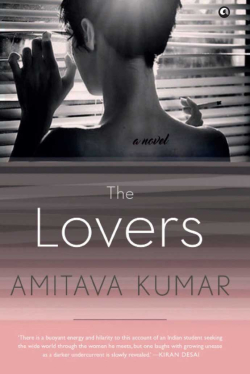
Amitava_the-lovers_a_080717064151Let’s talk about favourite lines. That is, let’s talk about what one loves.

Here is a favourite line of mine from a short-story by Junot Diaz: "The half-life of love is forever."

It tells me that nothing dies. Or that it lasts forever even after it is lost to time. (Gulzar’s song from Ijazzat "Mera kuchh samaan" is a paean to that idea. Here is a bad translation: "My few things are still with you / Those wet monsoon days / That single night wrapped in my letter / Erase that night / Please return some of my things…")

The line of Diaz’s that I have quoted above occurs at the end of the last story in his collection This Is How You Lose Her.

My second favourite line comes early in the book. Actually, it is the first line of the collection’s first story: "I’m not a bad guy."

I like that line so much because it tells me that modern love stories, at least those told by men, are seeded in guilt. We live in an unequal society — how could it be otherwise?

More here.

Why we fell for clean eating

Bee Wilson in The Guardian:

2094For as long as people have eaten food, there have been diets and quack cures. But previously, these existed, like conspiracy theories, on the fringes of food culture. “Clean eating” was different, because it established itself as a challenge to mainstream ways of eating, and its wild popularity over the past five years has enabled it to move far beyond the fringes. Powered by social media, it has been more absolutist in its claims and more popular in its reach than any previous school of modern nutrition advice.

At its simplest, clean eating is about ingesting nothing but “whole” or “unprocessed” foods (whatever is meant by these deeply ambiguous terms). Some versions of clean eating have been vegan, while others espouse various meats (preferably wild) and something mysteriously called “bone broth” (stock, to you and me). At first, clean eating sounded modest and even homespun: rather than counting calories, you would eat as many nutritious home-cooked substances as possible.

But it quickly became clear that “clean eating” was more than a diet; it was a belief system, which propagated the idea that the way most people eat is not simply fattening, but impure. Seemingly out of nowhere, a whole universe of coconut oil, dubious promises and spiralised courgettes has emerged.

More here.

Why Donald Trump Needs Muslim Women

Rafia Zakaria in The Nation:

ScreenHunter_2788 Aug. 13 11.46On an April morning 10 years ago, I set out to speak at the Indiana General Assembly. I was a graduate student then, green and greedy for any sort of opportunity that would lift me above all of the other sharp and competitive students in the political-science department at Indiana University. The invitation fit that bill grandly, even though I’d been given only some vague guidelines regarding the topic of my speech. I learned soon enough when I was greeted warmly by the very nice state representative who had asked me to come. “Just speak for a few minutes about your work on honor killings,” she whispered with a smile. The venue was not the Assembly itself, but a luncheon for the Women’s Caucus of the Indiana House of Representatives.

I did speak about honor killings that afternoon, after I received a tour of the Statehouse, stood beneath the hushed and high rotunda, and had my picture taken with my host, the two of us standing by the flag behind the podium. I spoke about the work my small organization of expat Pakistani-American women was doing on the issue, of the cruelty of the crime and the helplessness of the victims. It was the first time I had spoken on the issue for a mainly white and exclusively American audience—and a largely conservative one. There was raucous applause when I was done. A resolution officially commending my work on honor killings in South Asia was passed. I received it in the mail and had it framed.

Ten years later, I can barely look at it. A miserable mix of remorse, guilt, and shame follows when I force myself to do so or to recount the moment it commemorates.

More here.