The Breach: North Korea’s Nuclear Strategy

DRK

Over at the Breach, Lindsay Beyerstein interviews Ankit Panda:

Lindsay: What kind of nuclear strategy is North Korea entertaining at this point?

Ankit: So this is the question of the hour. It's been something that I've been talking about with Vipin Narang who is a nuclear strategy expert up in Massachusetts Institute of Technology. I actually recently had him on my own podcast to kind of talk this stuff in like really wonky detail. I'll try not to get into too much detail right now

Lindsay: It's wonderful everybody should go download that episode of The Diplomat, it's really good.

Ankit: Oh thank you. Thank you, Lindsay. But like to just very quickly wrap up what I think is going on in North Korea's nuclear strategy is that, they're essentially looking to use a first strike nuclear strategy. But they're planning to use a first strike within the theater. So the theater you can broadly think of everything kind of 2,000 to 3,000 miles out from North Korea. So, basically, what the North Koreans have been saying … they're actually pretty explicit about it this. This isn't something that kind of tell us in poetry and we have to kind of spend hours decoding. They have very explicitly released statements through their foreign ministry – actually, their deputy foreign minister had a great statement in April where he kind of laid this out. Basically, this is what they say: if North Korea ever gets the sense that The United States and South Korea are mobilizing to preemptively attack North Korea, or preemptively take out Kim Jong-un, or preemptively kind of take out North Korea nuclear launch sites, they will launch everything they have except their intercontinental range systems, right? So they will launch their short range systems, their medium range systems, their intermediate range systems first, with nuclear war heads and conventional explosive range warheads. They will launch them at pretty much every US asset in the region, right? So this includes the Port Of Pusan, Iwakuni air force base in Japan, Guam. And to kind of tell you that I'm not crazy and kind of envisioning this, when they release images of their recent nuclear tests — it's really interesting they kind of dangle these maps, right? So if you look at Kim Jongun's desk, for example, in February — or sorry in March — when they tested these four extended range scud missiles, there was this map on Kim Jun-un's desk. And I think this was the map that showed these missiles going to Iwakuni, right…

More here.

detroit: the film

Detroit_movie_posterStuart Klawans at The Nation:

What happened, exactly? Detroit gives you a highly credible reconstruction—not that the filmmakers will stop at mere plausibility. They’re content with nothing less than full immersion, playing out the incident at such length that the movie might more accurately have been titled Algiers. By means of excruciating exhaustiveness, they hit the first of their sweet spots: proving to their own satisfaction, and presumably yours, that their opening statement was correct. The white cops in the Algiers were unrelentingly racist and violent, and the black Detroiters devoid of options other than enduring their victimhood, collaborating with the cops, or rebelling.

Bigelow and Boal envision the purity of victimhood in the figures of Larry Reed (Algee Smith) and Fred Temple (Jacob Latimore), members of an aspiring vocal group who are holed up at the Algiers. They’re portrayed as achingly dewy and innocent—especially Larry, who might play at being a ladies’ man but mostly wants to lift his sweet tenor toward heaven. The self-torture of collaboration is represented by Melvin Dismukes (John Boyega), a security guard who believes the best way to help his people is to align himself with the inescapable white authorities and demonstrate his rectitude to them at all times. Bigelow and Boal make him out to be the type of guy who would iron his boxer shorts. You know from the start that he’ll end up betrayed and disillusioned, just as any experienced moviegoer will understand that Larry and Fred will never get back to the stage of the Fox Theatre.

more here.

The head of Medusa, in myth and in memory

Medusa_by_CarvaggioCaroline Alexander at Lapham's Quarterly:

The Gorgon is evoked in a variety of literature and above all in art. Images of the Gorgon head, or Gorgoneion, appear from the seventh century BC onward on painted vases, as architectural features, and on coins. In mythology, the Gorgons were three sisters, Stheno, Euryale, and Medusa. Along with other monstrous offspring that included Echidna (Viper) and Ophis (Serpent), the Gorgons were the result of an incestuous union between children of Pontos (Sea) and Gaia (Earth). The source for this genealogy is the Greek poet Hesiod, whose Theogony, written in the seventh century BC, is the basis of much mythological knowledge. For reasons Hesiod does not explore, the first two Gorgons were divine, while Medusa was wholly mortal. Other early poets add further details: the Gorgons lived in the far west, toward the edge of night, on a rocky island beyond the streams of all-encircling Ocean. Little is given in the way of physical description except to note that they wore snakes wrapped about their waists, and that the face of Medusa turned men to stone.

It is the story of Medusa’s head, however, that rivets attention. Central to this story is the hero Perseus, a prince of Argos, an actual city of great antiquity that once commanded much of the Peloponnese; his association with other named cities of the Argolid, such as Mycenae and Tiryns, has led some to believe there may have been a historical king behind the myth. In mythology, Perseus is the son of beautiful Danaë, whose own father locked her away in a bronze chamber in order to outwit a prophecy that any son she bore would kill him. Zeus, however, assuming the form of a shower of golden light, infiltrated the chamber and impregnated her. When Danaë gave birth to Perseus, her father put mother and child into a chest and set them adrift upon the sea. An island fisherman of noble blood rescued them, and they remained with their savior on the island. When Perseus came of age, he was invited to a birthday celebration at the court of the local king, who happened to be the fisherman’s brother. Asked what gift he would bring for the occasion, Perseus replied, rashly and inexplicably, “the Gorgon’s head.” When the king held him to his answer, Perseus’ adventures began.

more here.

Picasso and Tragedy

Clar05_3916_02T.J. Clark at the LRB:

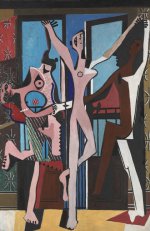
In the ten years preceding Guernica Picasso had been, to put it baldly, the artist of monstrosity. His paintings had set forth a view of the human as constantly haunted, and maybe defined, by a monstrous, captivating otherness – most markedly, perhaps, in the Punch and Judy show of sex. ‘Au fond, il n’y a que l’amour,’ he said. This was as close, I reckon, as Picasso ever came to a philosophy of life, and by ‘love’ he certainly meant primarily the sexual kind, the carnal, the whole pantomime of desire. In his art monstrosity was capable of attaining to beauty, or monumentality, or a kind of strange pathos. But do any of these inflections lead to Guernica? Are not the monstrous and the tragic two separate things? To paint Guernica, in other words, wasn’t Picasso obliged to change key as an artist and sing a tune he’d never before tried; and more than that, to suppress in himself the fascination with horror that had shaped so much of his previous work? (The belonging together of ecstasy and antipathy, or fixation and bewilderment – elation, absurdity, self-loss, panic, disbelief – is basic to Picasso’s understanding of sex, and therefore of human life au fond. And the very word ‘fascination’ speaks to the normality of the intertwining: its Latin root, fascinus, means simply ‘erect penis’.) But isn’t Guernica great precisely to the extent that it manages, for once, to show us women (and animals) in pain and fear without eliciting that stunned, half-repelled, half-attracted ‘fascination’?

Many have thought so. But the story is more complicated. I doubt that an artist of Picasso’s sort ever raises his or her account of humanity to a higher power simply by purging, or repressing, what had been dangerous or horrible in an earlier vision. There must be a way from monstrosity to tragedy. The one must be capable of being folded into the other, lending it aspects of the previous vision’s power.

more here.

EMERGING FEMINISMS, The Myth of the Master

Sophie Alka in The Feminist Wire:

Alka-Sophie_-bio_imageWhether as a lover, mother, daughter, sister, or in religious life, there is a social narrative happening that is telling us that, as women, we can contribute, thrive most in the service of intellect, invention, transcendence, and genius – but as it is embodied in others, not in ourselves. This is our best hope of coming near to inhabiting these spheres, for they are inherently masculine, and therefore preclude us.

This may seem like a dated theme to be needling, yet there are parallels in contemporary popular culture which beg thought. This narrative, “the myth of the master” as Germaine Greer calls it, has its roots in the Enlightenment, and before: the renaissance man, the maverick genius in his ivory tower, the Master, who looks for inspiration and satiety to the feminine Muse. It has passed through many incarnations over the centuries from its origins in the classical Greek concept of the Muses. The Master/Muse narrative is, for example, immanent in the cults of devotion to the “Virgin Queen” Elizabeth I who was cast by figures such as Raleigh as Muse to the nascent colonial and industrial ambitions of the English. This nationalistic discourse of Queen/country as Muse later reappeared in the language of Victorian Britannia. In this way, the notion of Master/ Muse fueled imperialism’s justification for slavery and frontier violence against First Nations people and lands. The concept of Muse was also employed to describe these lands as “virgin territory” or “terra nullius” – a blank canvas for European colonialists to project the identities and vanities of their utopias upon; as well as embodied in the Other – those who violence was perpetrated against. In this context, the Muse was objectified as a source of raw materials convertible to wealth, the fulfillment of romanticized ideals, and sexual gratification. Another example of this objectification via the Muse was occurring in the salons and studios of 17th to early 20th century Western artists, with the Muse embodied as the Master’s mistress: a source of raw inspiration (rarely remunerated), sexual gratification, and the embodiment of romanticized virtues. So many of our Western cultural icons live out this trope, both historically as creators, and in the literary characters they created, creatures of persistent patriarchy. As the saying goes, look behind every great man, and you shall find a great woman. But why always behind?

Greer writes that “the artistic ego is to most women repulsive for themselves, and compelling in men” (35). Seeing and recognizing single-minded creative and spiritual impulse in another is captivating, especially when one has been unknowingly taught that such light in oneself is not valued by society to the same degree. In her opening to Middlemarch (one of Western literature’s great explorations of the Master/Muse trope) George Eliot quotes the early seventeenth century play The Maid’s Tragedy: “Since I can do no good because a woman, reach constantly at something that is near it” (1).

More here.

When Dinosaurs Ruled the Earth, Mammals Took to the Skies

Carl Zimmer in The New York Times:

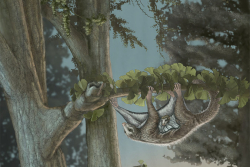
MammalThe Mesozoic Era, from 252 million years ago to 66 million years ago, is often called the Age of Dinosaurs. To generations of paleontologists, early mammals from the period were just tiny nocturnal insect-eaters, trapped in the shadows of leviathans. In recent years, scientists have significantly revised the story. Mammals already had evolved into a staggering range of forms, fossil evidence shows, foreshadowing the diversity of mammals today. In a study published on Wednesday, a team of paleontologists added some particularly fascinating new creatures to the Mesozoic Menagerie. These mammals did not lurk in the shadows of dinosaurs. Instead, they glided far overhead, avoiding predatory dinosaurs on the ground — essentially flying squirrels of the Jurassic Period, from an extinct branch of mammals that probably still laid eggs.

The fossils “are most primitive-known mammal forerunners that took to air,” said Zhe-Xi Luo, a paleontologist at the University of Chicago who led the research. The first Mesozoic mammal fossils came to light in the early 1800s, but for generations, paleontologists struggled to find more than teeth and bits of bone. In the late 1990s, they hit the jackpot. At a site in northeastern China, hillside after hillside turned out to contain stunning mammal fossils, most dating back about 160 million years. Researchers were suddenly able to examine entire skeletons, some still bearing impressions of skin and hair.

More here.

Thursday Poem

Prayer

I want a god
as my accomplice
who spends nights
in houses
of ill repute
and gets up late
on Saturdays

a god
who whistles
through the streets
and trembles
before the lips
of his lover

a god
who waits in line
at the entrance
of movie houses
and likes to drink
café au lait

a god
who spits
blood from
tuberculosis and
doesn’t even have
enough for bus fare

a god
knocked
unconscious
by the billy club
of a policeman
at a demonstration

a god
who pisses
out of fear
before the flaring
electrodes
of torture

a god
who hurts
to the last
bone and
bites the air
in pain

a jobless god
a striking god
a hungry god
a fugitive god
an exiled god
an enraged god

a god
who longs
from jail
for a change
in the order
of things

I want a
more godlike
god

by Francisco X. Alarcón,
from
Body in Flames/Cuerpo En Llamas
trans. Francisco Aragón;
Chronicle Books, San Francisco: 1990
.

Wednesday, August 9, 2017

The creation of India and Pakistan in 1947 led to horrific sectarian violence and made millions refugees overnight. Seventy years on, five survivors remember

From The Guardian:

2978Moni Mohsin

In the early 90s, I went from Lahore to Delhi to attend a wedding in the family of some Hindu friends. At one of its many events, I bumped into a friend from Lahore who was also visiting the city. We were chatting in Punjabi when we noticed a well-dressed, middle-aged man lurking nearby, apparently eavesdropping on our conversation. Noticing our discomfiture, he apologised.

“When you mentioned Lahore, I couldn’t tear myself away,” he said. “You see, we are Hindus, but my family was Lahori. We had a house in Model Town and I attended Aitchison college. We left at partition. I have never gone back. When my wife passed away, 17 years ago, I thought that even though I had no children or siblings I would get by. But now I feel the creeping loneliness of old age and what I think of most is the happiness of my childhood. I have a yearning to return to Lahore. I want to see it once before I die.”

Everywhere I went in Delhi I heard similar stories, but that is not surprising. At partition, Delhi received a huge influx of Hindu and Sikh refugees from Punjab. Some moved on to other parts of India, but most stayed and put down roots. In the 90s, many of those elderly migrants were alive; whenever I bumped into them and they heard I was from Lahore, they crowded round, asking me to speak in “real Lahori Punjabi”. Others asked after childhood haunts they hadn’t seen for almost 50 years – Anarkali Bazaar, Shalimar Gardens, Mayo School of Arts, Model Town. “Our home was on Queen’s Road. It had a semicircular driveway and black, wrought-iron balconies. Is it still there?” “Do the fireflies still dance on the canal on summer nights?” “Do you ever go to Faletti’s hotel? And its famous cabarets?” When I told the late writer and historian Khushwant Singh– a Delhi wallah who was once a Lahori – of my encounters in Delhi, he smiled and said: “You should see them at the cinema. Whenever Lahore gets mentioned, they all burst into tears together.”

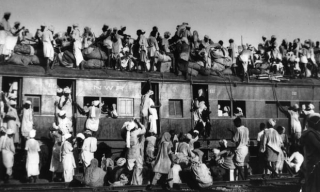
Seventy years ago, on 14 August 1947, as 200 years of British rule came to an end, India was divided into two independent states, Muslim-majority Pakistan and Hindu-majority India. It was one of the most painful births in modern history.

More here.

The Most Common Error in Media Coverage of the Google Memo

Conor Friedersdorf in The Atlantic:

Lead_960 (1)This week, headlines across a diverse array of media outlets proclaimed that at least one Google employee was so antagonistic to women that he circulated a 10-page “anti-diversity screed.”

That is how Gizmodo characterized the now infamous internal memo when publishing it Saturday. Similar language was used in headlines at Fox News, CNN, ABC News, the BBC, NBC News, Time, Slate, Engadget, The Huffington Post, PBS, Fast Company, and beyond (including a fleeting appearance in a headline here at The Atlantic).

But love or hate the memo, which makes a number of substantive claims, some of which I regard as wrongheaded (and which would’ve benefitted greatly from an editor with more emotional intelligence than the author to help him avoid alienating his audience, even if he was determined to raise all of the same arguments), the many characterizations of the memo as “anti-diversity” are inaccurate.

Using that shorthand is highly misleading.

As many who read past the headlines would later observe, its author, who was later fired, began, “I value diversity and inclusion, am not denying that sexism exists, and don’t endorse using stereotypes. When addressing the gap in representation in the population, we need to look at population level differences in distributions. If we can’t have an honest discussion about this, then we can never truly solve the problem.”

The balance of his memo argues that he is not against pursuing greater gender diversity at Google; he says it is against the current means Google is using to pursue that end and the way the company conceives of tradeoffs between the good of diversity and other goods.

More here.

Editing human embryos with CRISPR is moving ahead – now’s the time to work out the ethics

Jessica Berg in Phys.org:

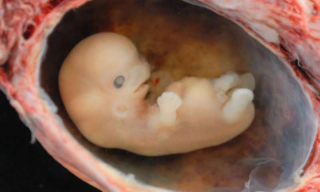
1-editinghumanThe announcement by researchers in Portland, Oregon that they've successfully modified the genetic material of a human embryo took some people by surprise.

With headlines referring to "groundbreaking" research and "designer babies," you might wonder what the scientists actually accomplished. This was a big step forward, but hardly unexpected. As this kind of work proceeds, it continues to raise questions about ethical issues and how we should we react.

For a number of years now we have had the ability to alter genetic material in a cell, using a technique called CRISPR.

The DNA that makes up our genome comprises long sequences of base pairs, each base indicated by one of four letters. These letters form a genetic alphabet, and the "words" or "sentences" created from a particular order of letters are the genes that determine our characteristics.

Sometimes words can be "misspelled" or sentences slightly garbled, resulting in a disease or disorder. Genetic engineering is designed to correct those mistakes. CRISPR is a tool that enables scientists to target a specific area of a gene, working like the search-and-replace function in Microsoft Word, to remove a section and insert the "correct" sequence.

In the last decade, CRISPR has been the primary tool for those seeking to modify genes – human and otherwise. Among other things, it has been used in experiments to make mosquitoes resistant to malaria, genetically modify plants to be resistant to disease, explore the possibility of engineered pets and livestock, and potentially treat some human diseases (including HIV, hemophilia and leukemia).

More here.

How America Lost Its Mind

Kurt Anderson in The Atlantic:

Lead_960When did America become untethered from reality?

I first noticed our national lurch toward fantasy in 2004, after President George W. Bush’s political mastermind, Karl Rove, came up with the remarkable phrase reality-based community. People in “the reality-based community,” he told a reporter, “believe that solutions emerge from your judicious study of discernible reality … That’s not the way the world really works anymore.” A year later, The Colbert Report went on the air. In the first few minutes of the first episode, Stephen Colbert, playing his right-wing-populist commentator character, performed a feature called “The Word.” His first selection: truthiness. “Now, I’m sure some of the ‘word police,’ the ‘wordinistas’ over at Webster’s, are gonna say, ‘Hey, that’s not a word!’ Well, anybody who knows me knows that I’m no fan of dictionaries or reference books. They’re elitist. Constantly telling us what is or isn’t true. Or what did or didn’t happen. Who’s Britannica to tell me the Panama Canal was finished in 1914? If I wanna say it happened in 1941, that’s my right. I don’t trust books—they’re all fact, no heart … Face it, folks, we are a divided nation … divided between those who think with their head and those who know with their heart … Because that’s where the truth comes from, ladies and gentlemen—the gut.”

Whoa, yes, I thought: exactly. America had changed since I was young, when truthiness and reality-based community wouldn’t have made any sense as jokes. For all the fun, and all the many salutary effects of the 1960s—the main decade of my childhood—I saw that those years had also been the big-bang moment for truthiness. And if the ’60s amounted to a national nervous breakdown, we are probably mistaken to consider ourselves over it.

More here.

Rachel Cusk Gut-Renovates the Novel

Judith Thurman in The New Yorker:

CuskIn Rachel Cusk’s most recent novels, “Outline” and “Transit,” a British writer named Faye encounters a series of friends and strangers as she goes about her daily life. She is recently divorced, and while her new flat is being renovated her two sons are living with their father. There is something catlike about Faye—an elusiveness that makes people want to detain her, and a curiosity about their pungent secrets. They tell her their histories, and she listens intently. As these soliloquies unspool, a common thread emerges. The speakers suffer from feeling unseen, and in the absence of a reflection they are not real to themselves. Faye shares their dilemma. “It was as if I had lost some special capacity to filter my own perceptions,” she says. But she lends herself as a filter to her confidants, and from the murk of their griefs and sorrows, most of which have to do with love, she extracts something clear—a sense of both her own outline and theirs. Critics have hailed these books, which are the first volumes of a trilogy, as a “reinvention” of the novel, and they are certainly a point of departure for it, one at which fiction merges with oral history. Each witness has suffered and survived a version of the same experience, but uniquely, and the events that are retold don’t build toward a revelation. The structure of the text, a mosaic of fragments, mirrors the unstable nature of memory. It is worth noting that “Outline” was published in 2014, a year before Svetlana Alexievich won the Nobel Prize in Literature. (“Transit” was published two years later.) Alexievich interviews women and men who have lived through cataclysms—the Second World War, Chernobyl, the Soviet gulags—and she distills their testimony into what the Swedish Academy cited as a “history of emotions.” Cusk has been chastised for ignoring politics and social inequities, and the central catastrophe in her fiction is family life. But her imaginary oral histories are exquisitely attuned to the ways in which humans victimize one another.

Late in “Transit,” Faye listens to a palaver about clothes and sex by a friend named Amanda, who works in fashion and has “a youthful appearance on which the patina of age was clumsily applied.” “No one ever tells you the truth about what you look like,” Amanda says of her profession, to which Faye responds, “Perhaps none of us could ever know what was true and what wasn’t.” At the end of their conversation, which is mostly about Amanda’s affair with her contractor, she stands up to leave the café, “darting frequent glances at me,” Faye observes. “It was as if she was trying to intercept my vision of her before I could read anything into what I saw.”

More here.

Why a sustainable future means shopping like our grandparents

Georgina Wilson Powell in Prospect Magazine:

Wednesday Poem

Love Poem
.
My clumsiest dear, whose hands shipwreck vases,
At whose quick touch all glasses chip and ring,
Whose palms are bulls in china, burs in linen,
And have no cunning with any soft thing
Except all ill-at-ease fidgeting people:
The refugee uncertain at the door
You make at home; deftly you steady
The drunk clambering on his undulant floor.
Unpredictable dear, the taxi drivers' terror,
Shrinking from far headlights pale as a dime
Yet leaping before apoplectic streetcars—
Misfit in any space. And never on time.
A wrench in clocks and the solar system. Only
With words and people and love you move at ease;
In traffic of wit expertly maneuver
And keep us, all devotion, at your knees.
Forgetting your coffee spreading on our flannel,
Your lipstick grinning on our coat,
So gaily in love's unbreakable heaven
Our souls on glory of spilt bourbon float.
Be with me, darling, early and late. Smash glasses—
I will study wry music for your sake.
For should your hands drop white and empty
All the toys of the world would break.
John Frederick Nims

Reading:
https://www.youtube.com/watch?v=PhGG4SP-3No

Tuesday, August 8, 2017

WRITERS, PROTECT YOUR INNER LIFE

Lan Samantha Chang in Literary Hub:

Inner-lifeWhile chatting with a dear non-writer friend of mine, I mentioned that I had been thinking a lot about the significance of the inner life. My friend, a medical doctor married to an Ivy League professor and the proud mother of two perfect children, looked puzzled. “What do you mean by an ‘inner life?’” she asked. “When we say a person has a ‘rich inner life,’ isn’t that a way of saying that they look like a mess from the outside?” To her, describing someone as having a rich inner life is a backhanded complement similar to the dodge in Mao’s China where, when trying to describe a young woman who was not physically attractive, people would say, “She is very patriotic.”

My friend’s question illustrates the considerable pressure on people in this society to have a strong and well-defended outer life. In New York, this might include real estate and private schools. In Iowa, this might include regular family dinners made from personally gathered, wild edibles. This pressure began way back with our country’s founders, many of whom believed in the existence of the elect—in the idea that some of us are predestined to salvation. This idea can be logically extended to mean that some of us are not. Because we have no way, when we’re alive, of knowing which of us is predestined, it is important to behave as if.

I’m not trying to blame anyone for wanting or having nice real estate, good-looking children, or a glossy pet. I’m only pointing out that people live in anxiety or even fear about whether their outer lives are enough. It’s easy to believe that if we look good enough, perhaps it might be true that our lives are meaningful or even blessed. Everywhere we go, we can see evidence of this. Walking along the Seine, one sees dozens of people from all over the world standing with their backs to the view, smiling hopefully up at their iPhones. Millions of selfie sticks are purchased out of hope and fear.

More here.

No One Should Have Sole Authority to Launch a Nuclear Attack

From the editors of Scientific American:

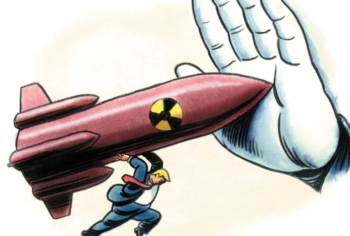
ScreenHunter_2786 Aug. 09 00.48In just five minutes an American president could put all of humanity in jeopardy. Most nuclear security experts believe that's how long it would take for as many as 400 land-based nuclear weapons in the U.S. arsenal to be loosed on enemy targets after an initial “go” order. Ten minutes later a battalion of underwater nukes could join them.

That unbridled power is a frightening prospect no matter who is president. Donald Trump, the current occupant of the Oval Office, highlights this point. He said he aspires to be “unpredictable” in how he might use nuclear weapons. There is no way to recall these missiles when they have launched, and there is no self-destruct switch. The act would likely set off a lethal cascade of retaliatory attacks, which is why strategists call this scenario mutually assured destruction.

With the exception of the president, every link in the U.S. nuclear decision chain has protections against poor judgments, deliberate misuse or accidental deployment. The “two-person rule,” in place since World War II, requires that the actual order to launch be sent to two separate people. Each one has to decode and authenticate the message before taking action. In addition, anyone with nuclear weapons duties, in any branch of service, must routinely pass a Pentagon-mandated evaluation called the Personnel Reliability Program—a battery of tests that assess several areas, including mental fitness, financial history, and physical and emotional well-being.

There is no comparable restraint on the president. He or she can decide to trigger a thermonuclear Armageddon without consulting anyone at all and never has to demonstrate mental fitness. This must change.

More here.

Our Broken Economy, in One Simple Chart

David Leonhardt in the New York Times:

Inequality-top-chart-th-Artboard_1The message is straightforward. Only a few decades ago, the middle class and the poor weren’t just receiving healthy raises. Their take-home pay was rising even more rapidly, in percentage terms, than the pay of the rich.

The post-inflation, after-tax raises that were typical for the middle class during the pre-1980 period — about 2 percent a year — translate into rapid gains in living standards. At that rate, a household’s income almost doubles every 34 years. (The economists used 34-year windows to stay consistent with their original chart, which covered 1980 through 2014.)

In recent decades, by contrast, only very affluent families — those in roughly the top 1/40th of the income distribution — have received such large raises. Yes, the upper-middle class has done better than the middle class or the poor, but the huge gaps are between the super-rich and everyone else.

The basic problem is that most families used to receive something approaching their fair share of economic growth, and they don’t anymore.

More here.

The limits of tolerance

Header_essay-182587828_master

Paul Russell in Aeon:

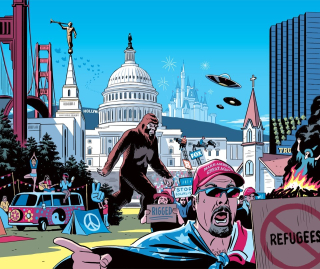
Throughout the Western world, the political ‘Left’ is in disarray. It is fragmented, rudderless and lacks a coherent plan to stem the tide of ‘populism’, nationalism and xenophobia. Identity politics and questions of religion have done much to fuel both the Right’s xenophobic tendencies, and the Left’s fragmentation. The ‘Old Left’ embraced a simple Manichean worldview of good versus evil: the enemy was easily identified (the rich and powerful, who oppressed the poor and the weak), and its agenda was simple and clear (redistribution of wealth and greater economic equality).

In contrast, the ‘New Left’ has introduced multiple new agendas – and enemies. The ‘Old Left’, it is said, was insensitive about issues affecting a range of marginalised groups, who identify themselves along lines of race, gender and sexual orientation. The three-legged stool of the Old Left – ‘liberty, equality and fraternity’ – was never very secure, but when fraternity was replaced by the demands of group identity, little stability remained.

Among other things, the core Old-Left liberal value of religious tolerance has now come into confrontation with the identity politics of the New Left. Indeed, one central strand of New Left thinking regards all talk of (liberal) ‘religious tolerance’ as mere camouflage concealing deep and systematic disrespect and unequal treatment of religious minorities. From this perspective, what needs priority is not so much the right of individuals to choose their religion as they see fit and without interference, but the rights of religious groups to secure and preserve their standing and identity in a society that would otherwise marginalise them.

How should the Left understand and practise religious tolerance in the face of the emphasis that various groups now place on the value of their religious identities? This is a question that has, of course, become tangled up with overlapping issues, such as racism, anti-immigrant sentiment, and various forms of nationalist xenophobia. But we should keep these issues separate and focus on the difficult enough question of the relationship between religious toleration and identity politics. Much of the (New) Left analysis, which concentrates on the language and agendas of identity politics, has paid too little attention to a very significant distinction that falls within the various identities that have been proposed as a basis for rectifying various forms of social injustice and unequal treatment: the distinction between ideological and non-ideological identity commitments.

More here.