EIGHT WAYS OF LOOKING AT SAMUEL BECKETT

Screen-Shot-2017-12-31-at-12.01.42-AMJ.M. Coetzee at Literary Hub:

As Hugh Kenner explained to us long ago in his essay “The Cartesian Centaur,” Samuel Beckett is a philosophical dualist. Specifically, Beckett writes as if he believes that we are made up of, that we are, a body plus a mind. Even more specifically, he writes as if he believes that the connection between mind and body is mysterious, or at least unexplained. At the same time Beckett—that is to say, Beckett’s mind—finds the dualistic account of the self ludicrous. This split attitude is the source of much of his comedy.

According to this standard account, Beckett believes that our constitution is dual, and that our dual constitution is the fons et origo of our unease in the world. He also believes there is nothing we can do to change our constitution, least of all by philosophical introspection. This plight renders us absurd.

But what is it exactly that is absurd: the fact that we are two different kinds of entity, body and mind, linked together; or the belief that we are two different kinds of entity linked together?

more here.

What the Stoics did for us

Massimo Pigliucci in New Humanist:

Piggliucci-webLet me then introduce you to three fundamental ideas of Stoicism – one theoretical, the other two practical – to explain why I’ve become what I call a secular Stoic. To begin with, the Stoics – a school of philosophers who flourished in the Greek and Roman worlds for several hundred years from the third century BCE – thought that, in order to figure out how to live our lives (what they called ethics), we need to study two other topics: physics and logic. “Physics” meant an understanding of the world, as best as human beings can grasp it, which is done by way of all the natural sciences as well as by metaphysics. The reason that physics is considered so important is that attempting to live while adopting grossly incorrect notions about how the world works is a recipe for disaster. “Logic” meant not only formal reasoning, but also what we would today call cognitive science: if we don’t know how to use our mind correctly, including an awareness of its pitfalls, then we are not going to be in a position to live a good life.

The ancient Stoics explained the idea by way of a metaphor introduced by Chrysippus of Soli, the second head of the Stoa, as the Stoic school was known. It was named after the stoa poikile, the painted porch in Athens, a public place where Stoics would gather to discuss philosophy with whoever was interested. According to the metaphor, a life worth living is like a fenced garden: the fence itself is logic, as it guards the inside from weeds and other noxious things; the nurturing soil is the physics, since it informs us on how to navigate the world to the best of our ­abilities; and the fruits are the ethics, resulting in a eudaimonic (happy or flourishing) life, the sort of life that one looks back to on her death bed and thinks, “Yup, that was pretty well done.” This means that Stoic theory embraces the humanist emphasis on an ethical life, but also directly justifies our interests in both metaphysics and natural sciences (“physics”) as well as philosophy and social science (“logic”). They all come together in a satisfyingly coherent package.

The first practical notion I’m going to discuss is that of the three disciplines and their related four virtues. Epictetus, a slave who became one of the most influential teachers of antiquity, thought that there are three areas of ­application of Stoic philosophy – what are now known as the three disciplines: desire, action and assent.

18 Years Into the New Millennium, Finding My Younger Self

Robert Goldfarb in The New York Times:

Merlin_131047685_43d6f6d2-ca41-48dc-8bfa-1fa6910fb278-master768That I have lived as many years in the new millennium — 18 — as I did in the time from birth to finishing high school seems inconceivable to me. I’m 88, and between 1930 and 1948 went from newborn to adult, from toddler to leader of an infantry squad. Those first 18 years were a journey into manhood, while the millennium seems merely its epilogue.

I’m certainly not the same man at 88 I was when the millennium began. But changes in me — stiffness, skin that invites angry bruises, occasional memory lapses — are insignificant compared to the growth spurt at 17 that shot me from 5-foot-8 to 6-foot-2. I hope I’ve gained additional wisdom during the millennium, but feel I’m essentially the same man I was 18 years ago. That contrast came into sharp focus recently when I renewed my driver’s license. A motor vehicle clerk, glancing from me to the photograph taken seven years earlier, said I hadn’t changed enough to require a new picture. So little physical change in seven years! Only my mother would have recognized me in photographs taken seven years apart during my first 18 years of life. Aging has put me on a conveyor propelling me through days as though there were only two in a month, the first and the last. Daily rituals like shaving, brushing my teeth, dressing have me puzzling, didn’t I just do this? I sometimes think of time as slices of a pie. Summers were endless when I was 6, just as one-sixth of a pie is a generous portion. Even with a scalpel and hands steadier than mine, cutting a pie into 88 slices is beyond most of us. That thought alone reminds me that the slice of life remaining to me is very small.

More here.

Tuesday Poem

The Heart of Herakles

Lying under the stars,
In the summer night,
Late, while the autumn
Constellations climb the sky,
As the Cluster of Hercules
Falls down the west
I put the telescope by
And watch Deneb
My body is asleep. Only
My eyes and brain are awake.
The stars stand around me
Like gold eyes. I can no longer
Tell where I begin and leave off.
The faint breeze in the dark pines,
And the invisible grass,
The tipping earth, the swarming stars
Have an eye that sees itself.

by Kenneth Rexroth

Monday, January 1, 2018

Gender Trouble 2017, Comedy Edition

by Katrin Trüstedt

"Next time Feminism will not be a tragedy, but a comedy"

—Carla Lonzi

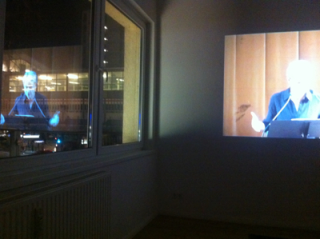
IMG_7031Kottbusser Tor, Berlin. On the second floor of one of the large buildings surrounding this place you can currently find yourself in an exhibition by Ariane Müller and Verena Kathrein on comedy and feminism, entitled "Then I would like to make a happy end for once." This seems like an apt title for the end of this year. It has been a particularly intense year in many respects. Among other things, it has been particularly intense in terms of gender relations. There has been wide-spread outing of sexual harassment and sexual violence of all kinds and degrees. There have been various forms of criticism of this outing. There has been backlash. And there have been discussions about the nature and the future of gender relations.

The danger at this point, it seems to me, is that of reaffirming and hypostatizing the very gender categories that have been at the heart of the problem in the first place. The suggestion, for instance, that men, per se, are predators, that it is the very nature of male behavior to be sexually transgressive and aggressive; and that woman are, per se, victims, and dependent – such suggestions are in danger of reproducing the very problem they are addressing.

Acts of sexual harassment including many of those that have been outed in the past couple of months seem to show, on the contrary, that something like masculinity is not a given, but in need of constant performative reestablishment. To come back to something like a "primal scene" of the current developments – the Weinstein case, and in particular one piece of "evidence" that is out there, namely the audio from a wire tap – it seems like the masculinity in question here is in rather desperate need of violent performance with elaborate arrangements. Trying to bully Ambra Battilana Gutierrez into joining him in his hotel room by repeating what a powerful man he is, appears on tape as a pathetic attempt to performatively produce manliness as power. Not only does the repeated claim suggest the lack of what this performance is intent to prove ("I am a powerful man"). It also exposes the very need of this position to be performed, enacted, and reaffirmed by its other. Needing the woman to feed back to him what a powerful, powerful man he really is, he also needs to emphasize how powerless she is by contrast in this situation ("you don't want to ruin your friendship with me for five minutes").

Read more »

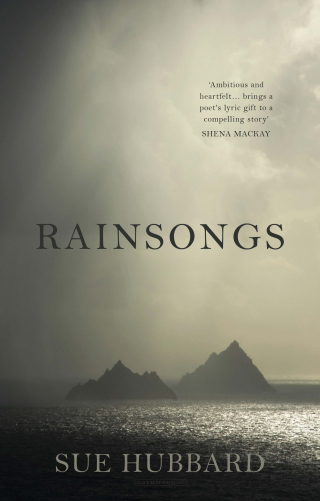
Review of Sue Hubbard’s New Novel RAINSONGS

by Maniza Naqvi

71g8LGHvB2LSue Hubbard's lovingly mapped novel Rainsongs is a gentle gem of quietly shimmering intellect. I read it twice to savor its sense of place. It is rooted in the abstractions of land and memory, the magical thinking of a bereaved woman.

Hubbard's expressive talent is in full display through her descriptions of the south western Irish landscape of Kerry, so that the reader feels a sense of belonging and a resonance with its emotional and social fabric. I read this book the week before the year changed, curled up in bed, tucked in against the winters bone-chilling cold outside, deeply aware that I was savoring a rarity, seeing through words a remote land. Seeing it through the eyes of the main character, Martha Cassidy who, herself not Irish, has returned after a period of decades of absence.

In the end of December 2007 Martha Cassidy is a woman in mourning who returns to her late husband's cottage in search of solace from grief. Rainsongs approaches the peril and remoteness of relief through the certitude of both storm and calm and its attendant pain on the journey towards consolation. Martha is a beautiful, mature-minded, self-assured woman in her fifties, focused on her own inner journey. Yet she is neither weak nor in need of comforting or saving. And perhaps because of her demeanor, is orbited by men who knew her husband and, as in the case of the young poet-musician, Colm Nolan, is the same age as her son.

Driving rain and wind are the song and silence of the inner drama where Rainsongs will take you. That place within yourself of sorrows, solitudes and solaces, the spaces you have been through, the ones you are passing through, the ones you surely will go through. That place is lit up momentarily like a revelation, then gone and, in the novel, searched out metaphorically through the beam of a lighthouse – beckoning, saving, warning – on Skellig island as it sweeps across the darkened sea and landscape on Bolus Head and shines into the room in the cottage where Martha sleeps. Periodically, as if a monitor for a heartbeat.

Read more »

Is Wine a Living Thing?

by Dwight Furrow

Wine in barrelsThe claim that wine is a living organism is something I hear often from people in the wine world impressed with the capacity of wine to evolve. Writer and sommelier Courtney Cochran writes:

Wine, with its clear ties to the lifecycle of plants, its ability to evolve and change (to grow) and its delicate fragility in the face of danger (TCA, oxygen, light), fairly screams "alive." In today's overly sanitized, automated world, could our wine be more alive – perhaps even more ‘human' – than us?

Wine grapes react in a very sensitive way to the conditions under which they are grown. They are a product of an ecosystem as well as a reflection of that ecosystem with the characteristics of the vineyard, community, winemaker and weather living on in the wine—a storehouse of the past, a series of "memories" that are transmitted to the consumer in the flavors and textures of the wine.

Even after the grapes are harvested and fermented, wine as it ages responds to stimuli, adapts to its environment, and like a child, requires guidance and nurturing to reach its potential, expressing its aesthetic worth through its own "evolutionary" path, influenced but not wholly directed by the winemaker. People in the culture of wine think of it as "living" because wine not only persists but changes and in some cases improves with age. There is a trajectory of maturation that is in some respects similar to the development of living organisms.

The claim that wine is a living thing has also received philosophical endorsement. In philosopher Nichola Perullo's introduction to his edited, online anthology "WineWorld: Tasting, Making, Drinking, Being", he advocates treating wine as a living thing in order to reform tasting practices and gain a deeper understanding of the aesthetics of wine production, especially in light of the fact that wine is ultimately assimilated to our own living tissue. If we take this view on board, wine is best understood not as a commodity but as something with emotional resonance and authenticity, an object we can engage with as emotional beings, not just through analytical tasting.

But is wine really a living thing or is this discourse just making use of a particularly resonant and vibrant metaphor?

Read more »

The Female Anatomy of Letters: A Five-part Essay

by Shadab Zeest Hashmi

IMG_1250Writing lives in the gut, like the good bacteria and the bad; it carries on an endless flirtation, an infuriating, nagging conversation with the gut’s long-married partner, the psyche. From time to time, it may traverse its underground-cityscape of anxiety, nostalgia, compulsion, its contradictory pull between instinct and fact-checking, its love-hate habits— to ascend through the pathway of the spirit and become actualized. It may show up on the page ripe and bright as a field of mustard, or as a well-fitting dress, an ammunition depot, a seam of eternity, a sufi’s orchard, or, as too often in my case: a colossal, squandered energy.

This piece of writing, I promise you, is neither about the gut-brain axis, nor is it about writing. It is the first of a short series of essays on my views as a feminist. I have always believed and stated repeatedly in interviews that it is enough to deal with this subject in poetry, that so much of my poetry–nearly all of it—assembles the many facets of feminism important to me, that talking about womanhood requires a language that does not exist. The topic is like handling a slab of granite: a paradox of sheer heft and delicacy, better conveyed through poetry— reduced, ignored, exoticized and caricatured as it has been through the ages. We must mold the language first and create our own terms. I changed my mind, however, after mulling over a few significant discussions, the first of which began as a direct question about the women’s movement from a noted Pakistani poet, the feminist legend Kishwar Naheed at my poetry session at Lahore Literary Festival, the second at SOAS, London, with my activist-academic friend Dr. Maria Rashid, and the most recent one with Rafia Zakaria whose writings on the subject I find truly impressive; I have now begun to see the value of articulating, in prose, how I see gender dynamics and how I have fared as a woman of multiple identities.

Read more »

Sunday, December 31, 2017

Margaret Atwood and Andrew O’Hagan on Trump, the Internet, and Our Dark Future

From Literary Hub:

John Freeman: The question I think all speculative fiction, and I think some of us who are politically active, want to know: Is now the time to be very, very worried?

Margaret Atwood: When was the time not to be very, very worried? Should we be more worried than ever before?

Andrew O’Hagan: Yes. Definitely.

JF: Maybe we should start when you both began as writers. Margaret, you in the early 1960s; Andy, you were, this was the early 1990s… What were the structural concerns that occupied you at the time, and how do they differ to some degree from what you see in front of you now as writers?

AO: Well, there was a basic reality that one could conjure with, certainly when I started. The situation now makes you feel slightly nostalgic for the Cold War, when the oppositions were pretty simple and almost charming, in fact quite delightful.

You know, one of the things that happened during the Cold War was that the CIA and the shape of the Council for Cultural Freedom decided the best way to tackle Russian ideology was to put money behind a literary magazine, Encounter, which it funded for some time thinking that, you know, somehow having an effect on the kinds of poets that would be published, and the way that F.R. Leavis would be handled as a critic, and the way that certain novelists would be discussed would be a decisive step forward in the war with Russia to rule humanity. And that makes me almost tickled pink to think that that was the level we operated on once upon a time, because now, of course, what’s happening is so deeply sinister, and it’s happening in the very basic units of veracity, of actuality, of what we can believe to be true.

Although there always was techniques and propaganda, of course, and lies—we always knew that—they were never operating at the level of everybody’s everyday life, I think, in the way that they are now. Everybody who opens a laptop and sits down for a mug of coffee in the morning is immediately confronted, I think, by a miasma of confected life and trying to separate out in order to have an opinion about what’s happening with the environmental crisis, or what’s happening in the election, or whether you can trust even the most basic reports.

Well, writers now, I think, are facing that every day, that you have got to see yourself, whether you want to or not, as having a responsibility, especially when it comes to nonfiction. You’ve got a responsibility to tackle that miasma and, if you like, the government institutional lying which is now an everyday reality for us.

More here.

To Live Your Best Life, Do Mathematics

1920wide_MSP-0007

Kevin Hartnett in Quanta Magazine:

QUANTA MAGAZINE: The title of your talk was “Mathematics for Human Flourishing.” Flourishing is a big idea — what do you have in mind by it?

FRANCIS SU: When I think of human flourishing, I’m thinking of something close to Aristotle’s definition, which is activity in accordance with virtue. For instance, each of the basic desires that I mentioned in my talk is a mark of flourishing. If you have a playful mind or a playful spirit, or you’re seeking truth, or pursuing beauty, or fighting for justice, or loving another human being — these are activities that line up with certain virtues. Maybe a more modern way of thinking about it is living up to your potential, in some sense, though I wouldn’t just limit it to that. If I am loving somebody well, that’s living up to a certain potential that I have to be able to love somebody well.

And how does mathematics promote human flourishing?

It builds skills that allow people to do things they might otherwise not have been able to do or experience. If I learn mathematics and I become a better thinker, I develop perseverance, because I know what it’s like to wrestle with a hard problem, and I develop hopefulness that I will actually solve these problems. And some people experience a kind of transcendent wonder that they’re seeing something true about the universe. That’s a source of joy and flourishing.

Math helps us do these things. And when we talk about teaching mathematics, sometimes we forget these larger virtues that we are seeking to cultivate in our students. Teaching mathematics shouldn’t be about sending everybody to a Ph.D. program. That’s a very narrow view of what it means to do mathematics. It shouldn’t mean just teaching people a bunch of facts. That’s also a very narrow view of what mathematics is. What we’re really doing is training habits of mind, and those habits of mind allow people to flourish no matter what profession they go into.

More here.

Would Twitter Ruin Bee Democracy?

13967_043ea4eb48d314b91e95fb5052d3d8f0

Lixing Sun in Nautilus:

Did the ancient Athenians invent democracy? Or did bugs have it way earlier than the Greeks? Cornell entomologist Tom Seeley knows which option he’s voting for.

Honeybees regularly split from their mother colony. Seeley wondered, with tens of thousands of bees in a swarm, how do they reach agreement? His answer: simple-majority democracy.

In his 2010 book Honeybee Democracy, Seeley described how bees intending to strike out on their own first send scouts in all directions to collect information. On their return, these early scouts buzz and twirl to recruit more scouts. Some gain fans whereas others lose them. Newly deciding scouts go out to look for themselves. After the majority of scouts (which number in the hundreds) have converged on one opinion, the entire swarm takes off for its promised land.

Bees are not alone in using simple-majority rule—Tibetan macaques do it too. In 2014, my colleagues and I were studying how a group of 12 adult macaques coordinated their collective movements. We noticed that once three or more of them ganged up together, the entire group would often follow suit. The success rate in getting the group into action increased with the number of initiators—those who started the process. When the initiators numbered seven or more, exceeding a simple majority, the success rate reached its maximum: 100 percent.

Democracy in collective decision-making has also been observed in African buffaloes, red deer, baboons, and pigeons. Even single-celled bacteria make collective decisions based on a democratic process known as quorum sensing. Their genes control some aspect of their behavior, like how mobile or virulent they should become, based on how many of their bacterial comrades are already engaging in that behavior. Similar democratic processes are also used by cockroaches and other swarming insects.

More here.

World’s richest 500 see their wealth increase by $1tn this year

3000

Rupert Neate in The Guardian:

The world’s super-rich hold the greatest concentration of wealth since the US Gilded Age at the turn of the 20th century, when families like the Carnegies, Rockefellers and Vanderbilts controlled vast fortunes. There are now 1,542 dollar billionaires across the world, after 145 multimillionaires saw their wealth tick over into nine-zero fortunes last year, according to the UBS / PwC Billionaires report.

Josef Stadler, the lead author of the report and UBS’s head of global ultra-high net worth, said his billionaire clients were concerned that growing inequality between rich and poor could lead to a “strike back”.

A report by Credit Suisse found that the world’s richest 1% people have seen their share of the globe’s total wealth increase from 42.5% at the height of the 2008 financial crisis to 50.1% in 2017, or $140tn.

“The share of the top 1% has been on an upward path ever since [the financial crisis], passing the 2000 level in 2013 and achieving new peaks every year thereafter,” the Credit Suisse global wealth report said. The bank said “global wealth inequality has certainly been high and rising in the post-crisis period”.

The increase in wealth among the already very rich led to the creation of 2.3 million new dollar millionaires over the past year, taking the total to 36 million. “The number of millionaires, which fell in 2008, recovered fast after the financial crisis, and is now nearly three times the 2000 figure,” Credit Suisse said.

These millionaires – who account for 0.7% of the world’s adult population – control 46% of total global wealth that now stands at $280tn. At the other end of the spectrum, the world’s 3.5 billion poorest adults each have assets of less than $10,000 (£7,600). Collectively these people, who account for 70% of the world’s working age population, account for just 2.7% of global wealth.

More here.

the Shadow of White Supremacy

Lydialyle Gibson in Harvard Magazine:

Resendstevenson005_smThe audience could sense where the story was going almost as soon as Bryan Stevenson began telling it. Two black children in the barely desegregated South, hurtling with giddy, unguarded elation toward their first swim in a pool that until recently had been available only to whites. A swim they’d been dreaming of for years. As Stevenson, J.D.-M.P.A.’85, LL.D. ’15, kept talking, an electricity of unease began to intensify among the listeners packed into First Parish Church last week—as many people as the pews would hold—who’d come to hear him deliver Harvard’s 2017 Tanner Lecture on Human Values, hosted by the Mahindra Humanities Center. A civil-rights lawyer who for three decades has defended death-row inmates and fought for criminal-justice reform from a warehouse-turned-office in downtown Montgomery, Alabama, Stevenson is a MacArthur “genius” grant recipient, a New York University law professor, and founder and executive director of the nonprofit Equal Justice Initiative.

…At the other end of the pool was a cluster of white children, whose parents were lounging nearby. At first, Stevenson and his sister didn’t really notice them. But then suddenly, the parents were screaming at their children to get out of the water, snatching them up by the arms, hustling them away crying. A little white boy was the last one left amid the commotion, and as Stevenson and his sister looked on in horror and confusion, the boy’s father waded into the pool to grab him. “And then I did this thing that I knew I wasn’t supposed to do,” Stevenson recalled. “I asked that man a question, even though I didn’t know him. I turned to him, and I asked him, ‘What’s wrong?’ And I will never forget, the man looked at me and he said, ‘You’re wrong, n—–.’”

It wasn’t the first time Stevenson had been called that, but in that moment, he was unprepared to hear it, and the slur cut right through him. After the white families withdrew, he and his sister ran to their mother to tell her what had happened, afraid they’d be in trouble. They weren’t, but she was angry. She told her children to get back in the pool. They didn’t want to. She insisted. “Don’t let those people run you from the pool,” Stevenson remembers her saying. The next day, the family continued on to Disney World. “I know we had fun,” Stevenson said of the week in Florida, but he is fuzzy on the details. Instead, “What I remember most vividly about that trip was getting back into the pool, standing in a corner, holding my sister’s hand and desperately trying not to cry.”

In the years since, he’s wondered, do the white kids remember the day they were pulled out of the pool? Does that father remember what he said? Do any of them tell the story, as Stevenson and his sister still do? “And my fear is that they don’t remember,” he said. “My fear is that they haven’t been talking about it the rest of their lives. My fear is that it just evaporated. It was one more moment in a life of segregation with no consequences, no legacy, no shadow.”

More here.

Saturday, December 30, 2017

What holds a society together in the absence of common ideas?

Shadi Hamid in The Atlantic:

ScreenHunter_2917 Dec. 31 00.37Dystopian novels are a difficult genre: They need to be imaginative, edging on the far-fetched, while being just plausible enough to terrify. Omar El Akkad’s American War, which interprets the American South by way of the Middle East, challenges Americans to imagine what it might be like to die for, but also kill, their fellow citizens.

The Second Civil War begins in 2074. Climate change has changed the continent, submerging the banks of Louisiana and the near entirety of Florida, save for an island enclave or two, one of which eventually houses the notorious Sugarloaf Detention Facility for Northern prisoners of war.

In the early 2070s, the federal government, by then based in Columbus, moved to outlaw fossil fuels. Southerners resented this and other impositions from the richer, prosperous Northern states. Fervor for secession began to build. The nature of Southern “culture” was rich, but also somewhat vague and constructed, like all cultural identities are. It was enough, though, to moor a movement that would lead to the deaths of millions. A Southern suicide bomber assassinated the president in 2073, plunging the country into violence.

There are little details that stand out: the stubbornness of symbols; how the simple revving of an engine still running on old fuel, while ultimately meaningless, becomes an act of rebellion, an expression of self-affirmation but a completely futile one in the face of so much killing.

More here. [Thanks to Omar Ali.]