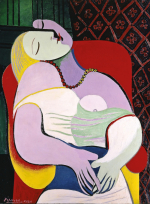
Picasso’s year of erotic torment

2018_12_picasso_2Michael Prodger at The New Statesman:

As 1931 turned into 1932, Picasso was 50 years old, famous, rich and admired. His main home was a swish apartment in Paris but he also owned an 18th-century manor house at Boisgeloup in Normandy; he shuttled between the two in a chauffeur-driven Hispano-Suiza; he was married to the Russian ballerina Olga Khokhlova, with whom he had a son, Paulo, and he had a mistress too, Marie-Thérèse Walter, then 22 but whom he had met when she was just 17. Both the Museum of Modern Art in New York and the Venice Biennale wanted to stage a retrospective of his work but he had plumped for the Galeries George Petit in Paris and the show was to open in June. To cap it all, an early work, La Coiffure of 1905, sold for a record 56,000 francs in February.

So Picasso in 1932 had a rich, full life. But then, when didn’t he? Such was his emotional and artistic fecundity (he is said to have produced some 50,000 individual artworks during his career) that an enterprising curator could make an exhibition from pretty much any year of his career. Those at Tate Modern have gone for 1932 and tagged it his annus mirabilis.

more here.

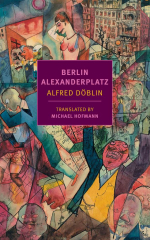
Berlin Alexanderplatz

Doblin_cvr_new_COLORS_1024x1024J. W. McCormack at The Baffler:

LOOK, ANY HONEST ESTIMATION of the new translation, by Michael Hofmann, of Alfred Döblin’s Berlin Alexanderplatz from NYRB Classics is bound to begin with duteous piety, lauding it, since it is a one-and-done masterpiece that’s basically impossible to oversell, as (why not) the single biggest event in publishing in a lifetime, a crucial refurbishment of something English-language readers have been missing out on for a century, and a long-missing piece of Modernism’s ponderous jigsaw. All of which is the case of course. But when we’re talking about a dense, all-but-untranslatable Weimar-era novel, whose only point of reference for Anglophone audiences until now has been Rainer Werner Fassbinder’s meticulous fifteen-hour adaptation from 1980 (one heck of a tease) it feels important to attempt a slight rescue from its own forbidding reputation, because Alexanderplatz is less a book than a living thing, and one that joyously resists the dust heap of bourgeois literary scholarship with its every line.

Berlin Alexanderplatz’s most famous feature is also the cause of the quandary that’s vexed translators all these years, as it is written in a highly site-specific argot—that of the low-rent and seedy districts surrounding 1920s Alexanderplatz—and the narrative is itself festooned with interludes from noisome modernity and ancient myth. An incomplete list of these includes transcriptions of newspapers, Bible passages, train schedules, travel supplements, radio broadcasts, scientific breakthroughs, references to Orestes, ominous political rumblings, advertisements, weather reports, popular melodies, screeds by revolutionary agitators, angelic interlocutors, and dreams.

more here.

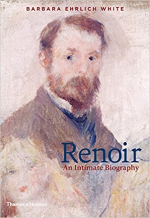
Renoir: An Intimate Biography

510Xg44u4gL._SX341_BO1 204 203 200_Tom Stammers at Literary Review:

Pierre-Auguste Renoir lived long enough to see himself canonised. In 1911, he was the first Impressionist artist to be accorded a full monograph study, penned by Julius Meier-Graefe. In 1915 he was filmed at home in Cagnes-sur-Mer by Sacha Guitry for the series The Great Ones Among Us, in which the 74-year-old artist appears heroically applying paint to canvas, in defiance of his rheumatoid arthritis. In 1919, shortly before his death, the frail Renoir was carried on a chair to see his portrait of Madame Charpentier installed in the Louvre, an honour never before bestowed on a living artist. The evocative, doting 1958 biography written by his son, film director Jean Renoir, further burnished his reputation for kindness, wisdom and valour in adversity. Sixty years on, Barbara Ehrlich White now seeks to go beyond the legend by offering an intimate picture of the beloved Impressionist’s life, drawing on a vastly extended corpus of more than three thousand letters. In contrast to the outward simplicity and modesty noted by contemporaries, Renoir emerges from her study as a man who was painfully ambivalent in his attitude towards modern France and his own commercial success.

In his first canvas of daily life, The Inn of Mother Anthony, Marlottefrom 1866, Renoir depicted a group of his friends around a table, chatting over the newspapers, a caricature of Henri Murger looming on the wall behind them.

more here.

Monday, March 26, 2018

The Owl of Minerva and the Fallacy Fallacy

by Scott F. Aikin and Robert B. Talisse

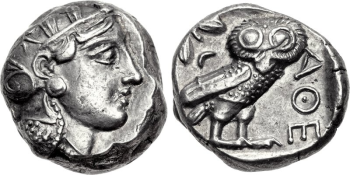
87000462-3The Owl of Minerva flies only at dusk. That's a metaphorical way of saying that wisdom is something that arises only at the end of inquiry, always in hindsight. You have to make the errors to learn from them, for sure. But there's more to the Owl of Minerva insight – our learning from the errors creates new capacities for error. And so, the process of learning from our mistakes is an endless task. That's what we call the Owl of Minerva Problem (we've written more about it HERE and HERE).

The fallacy fallacy is a good way to appreciate the Owl of Minerva Problem. The fallacy fallacy occurs when one starts seeing fallacies everywhere. In the same way that the college sophomore taking Abnormal Psychology becomes convinced that everyone in her dorm suffers from some disassociative disorder, students of informal logic frequently become convinced that fallacies are everywhere. That's fine, in a way. There are lots of fallacies and bad reasoning. That's because reasoning well is hard, and humans are regularly pretty bad at it. But once one starts seeing fallacies everywhere, one is tempted to think those who say so many things on the basis of fallacious reasons are thereby wrong about the things they say. But that inference, too, is a fallacy! Here's the basic scheme:

S is committed to p

S gives argument A for p

A is a fallacy

Therefore, p is false

The conclusion does not follow. Just because people have terrible reasons for some conclusion, it doesn't mean that the conclusion is false. Your uncle may believe something on the basis of wishful thinking, but that doesn't make it a false belief. So if he believes that the sun will rise tomorrow because he just can't go on in the dark, he's got a dumb reason, but his conclusion's still right. That's why we evaluate reasons as reasons independently of evaluating the conclusion. That's the whole point of critical thinking – keeping those questions separate.

This point about the fallacy fallacy is important because it provides a case where training in informal logic and fallacy detection actually creates a new kind of error. Nobody could commit the fallacy fallacy if there were no vocabulary of fallacies to begin with. The metalanguage of logic, which is supposed to help make us better reasoners, ends up making possible a particular kind of argumentative pathology. From the project of fallacy correction arises a new fallacy. Now, if that ain't ironic, we don't know what is.

Read more »

A-Tisket, A-Tasket, an Apollonian Gasket

bScreen Shot 2018-03-25 at 2.35.33 PMy Jonathan Kujawa

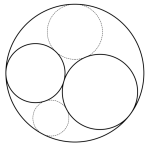
Apollonius of Perga (262-190 BC) was a well known and prolific geometer in ancient Greece. He is mainly known for his surviving work on the conic sections. Indeed, he gave us the definition of the ellipse, parabola, and hyperbola we use today. In some circles, Apollonius's most famous theorem is the fact that if you have three circles which are mutually tangent, then there always exactly two ways to add a fourth circle which is tangent to all three. That is, you can always fit exactly one new circle tangent to the original three within each interstice made by the existing circles. In the picture to the right if you start with the three black circles, then you can complete the picture to four tangent circles by adding either of the gray circles.

One thing I've learned in math is: anything worth doing once, is worth doing many times. Once you add the two new circles you've now created six new gaps. This, in turn, can be filled with circles, creating yet more gaps. And so on. You can keep adding circles forever:

Screen Shot 2018-03-25 at 2.47.40 PM

Image from [1].

The fractally looking result is an Apollonian Gasket. There is a delightful Gasket maker available here. You get fun pictures like this one:

Screen Shot 2018-03-25 at 7.35.03 PM

As we did above, it is common when drawing Gaskets to start with two circles inside of a third, but this is only for convenience and isn't needed for Apollonius's result. Indeed, if you start with three circles which are tangent to each other and none contains the others, then one of the two new circles you add will encircle the others, so you'll end up with the outside circle, anyway.

When looking at pictures like these, it is natural to ask how much of the big circle is filled by the smaller circles. At each stage there will always be little slivers of empty space. But perhaps eventually every gap is filled with a circle. If you know about fractals, you'll know the answer to this question is not so obvious.

Read more »

The Superlative form of Love

by Shadab Zeest Hashmi

And there was evening– you were born (raging like a lioness). A monsoon evening– the window wide and the world awash.

IMG_5201With this, the window in the story of my first hours on earth, my mother conjures a desire for perspective and possibility. I will grow up seeing the veins of history mapped onto this window, equations of math and myth, the teeth of logic, tufts of wisdom, pillars of language roofed by silence— every hue between identification and imagination. This “seeing” will begin from the most luxurious vantage point possible: my mother’s arms.

And it is evening, here in California, evening of a melon-sherbet sky and birds with pencil nibs for beaks. In the ultrasound image, my baby is an amphibious enigma— a riddle wafting in unfathomable love, thumb in mouth, curled like a golden promise, a dreamscape reminding me of a flock of starlings forming a dancing cloud— I shudder at his vulnerability, recall a verse from the Quran:

“Do they not see the birds above with wings outspread or folded in? None holds them (aloft) except Ar Rahman, the Most Merciful One. Indeed He is, of all things, Seeing.”

The word Ar Rahman comes from Raham or "womb," the superlative form of merciful love—the most exalted of the ninety-nine beautiful names of God.

Driving back from the clinic in the fading light, I feel vulnerable and empowered at the same time. Hand on my belly, I imagine the warmth of the womb waters. As my husband opens the door, Yaseen, my two-year old shrieks in delight, arms thrown wide; the sight quickens my heartbeat and baby Yousuf, weeks away from being born, feels my burst of joy and starts kicking in response: Love was never spoken with more eloquence. And I, the poet in the house, had nothing to do with it.

Snapshots of a Karachi Spring

by Claire Chambers

As I step, bleary-eyed, out of my PIA aeroplane from Manchester, UK, I notice a door sign warning of the danger PIA Aeroplaneof falling personnel. Partly amused, partly disconcerted, I head for the luggage carousel at Karachi's Jinnah International Airport.

In the car on our way to my hotel, we follow a man in a shalwar kameez the colour of lapis lazuli, one leg hitched over the tailgate of a Toyota Hilux, caressing the shaft of his gun. Our security guard occasionally uses his walkie-talkie to give a number and a crisp 'Roger' to a disembodied voice at the other end, which responds with another number and a 'Roger'. There must be some logic to it, but amidst my jet-lag pea-souper I can't see what.

A wall darkly proclaims: PREPARE ANY STRENGTH YOU CAN MUSTER AGAINST THEM. Countercultural Karachi Wall Artstencils sunnily protest this authoritarianism with such slogans as 'I Am Karachi — United for Peace'. Banksy-style balloons brighten one Maersk Sealand container, and a lotus painted using truck-art techniques adorns a grim underpass. American sociologist Anita Weiss has regularly spent time in Pakistan since the 1970s. She is currently researching wall art, and calls the I Am Karachi group a 'guerrilla art movement', especially when it comes to the challenge they are sending out to sectarianism.

On the main road we see Land Cruisers rather than the Pajero jeeps I remember from 1990s Pakistan. Men hang off buses, and my eyes are assailed by a dizzying array of hoardings. KK Rehabilitation Centre. Handi Inn. Baithak Peshwari. On dusty slip roads, I notice a family eating their dinner under bedraggled trees on the pavement near the glittering Park Towers. Four men on the pavement are smiling, perspiring and conspiring. Yameen Chicken. Mutton and Beef Centre. WalkEaze. A school advertises its 'salient features' in businesslike bullet points. A beggar pleads at our car window on his bachche's behalf, exposing the lack of government capacity to deal with the country's grinding poverty.

Read more »

Liquid Kitsch: Wine, Beauty and the Obsession with Smooth

by Dwight Furrow

ScreenHunter_3018 Mar. 26 09.14It is natural to invoke beauty as the aesthetic ideal that winemakers strive to achieve and wine lovers seek to discover. Throughout much of the history of aesthetics beauty has named the highest form of aesthetic order. As Elaine Scarry writes, beauty is:

Sacred, lifesaving, having as precedent only those things which are themselves unprecedented, beauty has a fourth feature: it invites deliberation….Beauty almost without any effort of our own acquaints us with the mental event of conviction, and so pleasurable a mental state is this that ever afterwards one is willing to labour, struggle, wrestle with the world to locate enduring sources of conviction – to locate what is true. (Scarry, On Beauty and Being Just, 26-31)

For wine lovers scouring the globe for a glimpse of vinous perfection, Scarry's account of what beauty does surely rings true. However, although we toss the word beauty around quite freely, in the aesthetics of art it has fallen on hard times since early in the 20th Century. With the display of Duchamp's upside down urinal in a New York art studio in 1917 and the mass atrocities of WW1 and the Holocaust haunting artistic production throughout the rest of the century, the idea of beauty no longer seemed to capture what the art world was selling. The problem was that by the 20th Century beauty had been assimilated to what was "pretty", "charming", and easily accessible and had thus lost its power to enthrall or represent the more difficult aspects of human existence. Thus, the art world dumped beauty and embraced the sublime. Art became abstract, difficult, and for most of the public, inaccessible.

There are interesting parallels and cross-currents to this story about art that are beginning to unfold in the wine world today. In the past, prior to the 1980's, great wines were tough when first bottled taking years to develop in the cellar at which time they often developed aromas such as cigar box, old shoes and barnyard. Vintage variation was enormous especially in the storied vineyards of central France where unpredictable weather from the Atlantic Ocean inhibited the consistent ripening of grapes. In some years even great vineyards could produce only thin, weedy wines with harsh acidity and aggressive, under-ripe tannins prompting the addition of sugar to make the wine palatable. Furthermore, the presence of bacteria and the unpredictability of fermentations produced off flavors in the wine that contributed to a wine's character but also to a sense of adventure when opening a bottle. That was the good stuff. Vin ordinaire performed a plausible rendition of battery acid.

Read more »

Sunday, March 25, 2018

How Genetics Is Changing Our Understanding of ‘Race’

David Reich in the New York Times:

25reich-superJumboIn 1942, the anthropologist Ashley Montagu published “Man’s Most Dangerous Myth: The Fallacy of Race,” an influential book that argued that race is a social concept with no genetic basis. A classic example often cited is the inconsistent definition of “black.” In the United States, historically, a person is “black” if he has any sub-Saharan African ancestry; in Brazil, a person is not “black” if he is known to have any European ancestry. If “black” refers to different people in different contexts, how can there be any genetic basis to it?

Beginning in 1972, genetic findings began to be incorporated into this argument. That year, the geneticist Richard Lewontin published an important study of variation in protein types in blood. He grouped the human populations he analyzed into seven “races” — West Eurasians, Africans, East Asians, South Asians, Native Americans, Oceanians and Australians — and found that around 85 percent of variation in the protein types could be accounted for by variation within populations and “races,” and only 15 percent by variation across them. To the extent that there was variation among humans, he concluded, most of it was because of “differences between individuals.”

In this way, a consensus was established that among human populations there are no differences large enough to support the concept of “biological race.” Instead, it was argued, race is a “social construct,” a way of categorizing people that changes over time and across countries.

It is true that race is a social construct. It is also true, as Dr. Lewontin wrote, that human populations “are remarkably similar to each other” from a genetic point of view.

But over the years this consensus has morphed, seemingly without questioning, into an orthodoxy. The orthodoxy maintains that the average genetic differences among people grouped according to today’s racial terms are so trivial when it comes to any meaningful biological traits that those differences can be ignored.

More here.

Stephen Hawking’s “Final Theory” is not groundbreaking

Sabine Hossenfelder in Back Reaction:

ScreenHunter_3017 Mar. 25 22.00Yesterday, the media buzzed with the revelation that Stephen Hawking had completed a paper two weeks before his death. This paper supposedly contains some breathtaking insight.

The headlines refer to a paper titled “A Smooth Exit from Eternal Inflation” in collaboration with Thomas Hertog. The paper was originally uploaded to the arXiv in July last year, but it was updated two weeks ago. It is under review with “a leading journal” which I suspect but do not know is Physical Review D. Thomas Hertog gave a talk about this at the conference which I attended last summer. You can watch the video of Hertog’s talk here.

According to The Independent the paper contains “a theory explaining how we might detect parallel universes and a prediction for the end of the world.” Furthermore, we learn, “Hawking also theorised in his final work that scientists could find alternate universes using probes on space ships, allowing humans to form an even better understanding of our own universe, what else is out there and our place in the cosmos.”

In the Sunday Times you can read that the paper “shows how we might find other universes” and in The Telegraph you find a quote by Carlos Frenk, professor of cosmology at Durham University who said: “The intriguing idea in Hawking’s paper is that [the multiverse] left its imprint on the background radiation permeating our universe and we could measure it with a detector on a spaceship.”

Since the paper doesn’t say anything about detecting parallel universes, I was originally confused whether the headlines were referring to another paper. But no, Thomas Hertog confirmed to me that the paper in question is indeed the paper that is on the arXiv. There is no other paper.

So what does the paper say?

More here.

The Unfinished Quest for the Meaning of Quantum Physics

Peter Woit in Not Even Wrong:

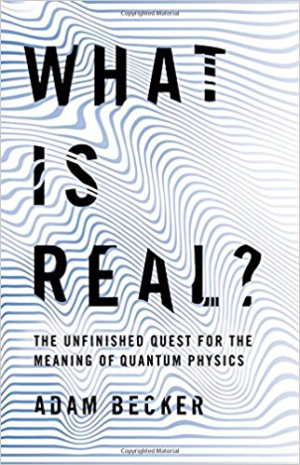
51TFzNEPIxL._SX320_BO1 204 203 200_ (1)There’s a new popular book out this week about the interpretation of quantum mechanics, Adam Becker’s What is Real?: The Unfinished Quest for the Meaning of Quantum Physics. Ever since my high school days, the topic of quantum mechanics and what it really means has been a source of deep fascination to me, and usually I’m a sucker for any book such as this one. It’s well-written and contains some stories I had never encountered before in the wealth of other things I’ve read over the years.

Unfortunately though, the author has decided to take a point of view on this topic that I think is quite problematic. To get an idea of the problem, here’s some of the promotional text for the book (yes, I know that this kind of text sometimes is exaggerated for effect):

A mishmash of solipsism and poor reasoning, [the] Copenhagen [interpretation] claims that questions about the fundamental nature of reality are meaningless. Albert Einstein and others were skeptical of Copenhagen when it was first developed. But buoyed by political expediency, personal attacks, and the research priorities of the military industrial complex, the Copenhagen interpretation has enjoyed undue acceptance for nearly a century.

The text then goes to describe Bohm, Everett and Bell as the “quantum rebels” trying to fight the good cause against Copenhagen.

Part of the problem with this good vs. evil story is that, as the book itself explains, it’s not at all clear what the “Copenhagen interpretation” actually is, other than a generic name for the point of view the generation of theorists such as Bohr, Heisenberg, Pauli, Wigner and von Neumann developed as they struggled to reconcile quantum and classical mechanics. They weren’t solipsists with poor reasoning skills, but trying to come to terms with the extremely non-trivial and difficult problem of how the classical physics formalism we use to describe observations emerges out of the more fundamental quantum mechanical formalism.

More here.

Emma Gonzalez Is Responsible for the Loudest Silence in the History of US Social Protest

Ari Berman in Mother Jones:

ScreenHunter_3016 Mar. 25 21.46“Six minutes and about 20 seconds. In a little over six minutes, 17 of our friends were taken from us.” That’s how Emma Gonzalez, a senior at Marjory Stoneman Douglas High School and one of the organizers of the March for Our Lives, began her remarkable speech on Saturday afternoon at the rally in Washington, DC.

After reading the names of her classmates who were killed in the mass shooting, Gonzalez stood at the podium in silence for six minutes, fighting back tears. It was an incredible, chilling moment. All of the major cable networks carried it live. “Loudest silence in the history of US social protest,” my colleague David Corn tweeted.

“Never again,” many in the crowd of 500,000 chanted in response. After her timer went off, Gonzalez said, “since the time when I came out here, it has been six minutes and twenty seconds. The shooter has ceased shooting and will soon abandon his rifle, blend in with the students as they escape, and walk free for an hour before arrest,” she said. “Fight for your lives before it’s someone else’s job.” And then she left the stage.

More here.

Companion Species

Catherine Pond in Avidly:

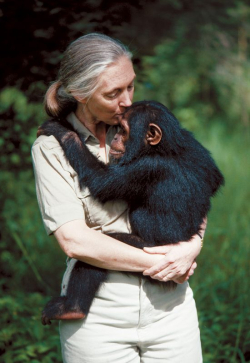
JaneBret Morgen’s Jane opens on a shot of Gombe. Culled from 140 hours of footage shot by Goodall’s ex-husband, photographer Hugo van Lawick, the movie captures Jane in her mid-twenties, lithe and excitable, her movements set to a lush Phillip Glass soundtrack. Morgen’s film suggests a dual love story: that of Jane as she falls in love with Hugo, and that of Jane as she falls in love with the chimps around Lake Tanganyika. The love affair with Hugo ends after they have a child together: he wants to be on the Serengeti; Jane can’t tear herself away from Gombe. But her love for the chimps endures. Though it seems obvious to us now, the movie highlights the novelty of Jane’s experiences: she is the first, ever, to live among the chimpanzees and record their behavior. After witnessing their great empathy, their ability to nurture and sympathize with each other, and their communal lifestyle, Jane believes the chimpanzees not only to be human, but to be better than human — not our companion species, but our superior species. Humans, she reasons, have war, and bloodshed, and an endless need to inflict pain and conflict on themselves.

Goodall is primarily concerned, in the early years captured by the movie, with a community of chimps centered around alpha male David Greybeard. The lone female of the group, Flo, captures Jane’s interest as well. For a while, Jane observes, interacts, and records the individual personalities of these spectacular primates. In the second half of the footage, though, tragedy strikes: Flo dies, leaving her children and the male chimpanzees bereft. And Jane witnesses something that undoes her prior understanding of the species: the male chimps devolve into violence.

By the end of their warring, one-third of the male chimps in the community lie dead in the river, limbs sprawled, as Goodall looks on with eyes the color of milk: glossy, tear-filled, she turns away from the camera. Her disappointment is far greater than if she had never assumed the goodness of the chimps in the first place: it is, in fact, not disappointment at all, but deep grief. I do not know what it was, for Jane, that restored her faith in the chimpanzees. I do not know how, after that blow, she regained her respect for them, but she did. Her love, though challenged, did not waver, despite witnessing for the first time the violence they were capable of, how in this way, too, they were like the humans she’d sought to avoid.

…In an excerpt from the 2015 New York Times article ‘Jane Goodall is Still Wild at Heart,’ author Paul Tullis describes Goodall’s realization in the early 90s that “there would be no…habitat” for her chimps “if poverty continued to force a growing human population to chop down trees for farmland and firewood. [It] convinced her that the chimps’ lot could not improve until that of the people living near them did.” Thus began “an abrupt career shift, from scientist to conservationist.” Suddenly, Jane’s work bridged an interesting gap.

More here.

Trust Your Own Heart, Write Your Own Story and Fight On

Amy Chozick in The New York Times:

DEAR MADAM PRESIDENT

An Open Letter to the Women Who Will Run the World
By Jennifer Palmieri
180 pp. Grand Central Publishing. $20.

BookNot long after Hillary Clinton’s unexpected defeat to Donald J. Trump, her campaign’s communications director, Jennifer Palmieri, shopped around a book idea. “I was advised that if I didn’t have something juicy to share about Hillary, there wouldn’t be interest in me,” she writes in “Dear Madam President: An Open Letter to the Women Who Will Run the World.” But, she adds, using Clinton’s frequent description of herself, “there aren’t any juicy things to share about Hillary because she’s a simple and serious person.”

In any other election year, an advice book from a high-ranking campaign official on the losing candidate’s side wouldn’t have much coin. But 2016 wasn’t like any other election year, and as it turns out Palmieri has plenty of wisdom — and even a little dish about Clinton — to dispense. In this slim volume, Palmieri neatly weaves her heartbreaking personal story of losing her sister to Alzheimer’s weeks after losing the election with lessons learned from her long career in Democratic politics and Mitch Albom-style wisdom (“When the unimaginable happens, imagine what else may be possible”). Palmieri had been President Obama’s White House communications director when she agreed to join the Clinton campaign. She (like most of us) thought Clinton would win and didn’t think her gender would be much of an obstacle, especially after Obama had broken racial barriers. Clinton warned Palmieri otherwise. Before the race started, Clinton “held forth for more than an hour” to recap each scandal, from the uproar in Arkansas when she resisted taking Bill Clinton’s name to the White House and her doomed 2008 presidential campaign. “She was as bewildered as anyone by the phenomenon of ‘Hillary Clinton,’” Palmieri writes.

More here.

Saturday, March 24, 2018

The Chinese Typewriter: A History

Jamie Fisher in the London Review of Books:

Fish04_4005_01Nominally a book that covers the rough century between the invention of the telegraph in the 1840s and that of computing in the 1950s, The Chinese Typewriter is secretly a history of translation and empire, written language and modernity, misguided struggle and brutal intellectual defeat. The Chinese typewriter is ‘one of the most important and illustrative domains of Chinese techno-linguistic innovation in the 19th and 20th centuries … one of the most significant and misunderstood inventions in the history of modern information technology’, and ‘a historical lens of remarkable clarity through which to examine the social construction of technology, the technological construction of the social, and the fraught relationship between Chinese writing and global modernity’. It was where empires met.

Long before it could be a technological reality, the Chinese typewriter was a famous non-object. In 1900, the San Francisco Examiner described a mythical Chinatown typewriter with a 12-foot keyboard and 5000 keys. The joke caught on, playing to Western conceptions of the Chinese language as incomprehensible, impractical and above all baroque: cartoons showed mandarins in flowing robes, clambering up and down staircases of keys or key-thumping in caverns. ‘After all,’ Thomas Mullaney writes, ‘if a Chinese typewriter is really the size of two ping-pong tables put together, need anything more be said about the deficiencies of the Chinese language?’ To many Western eyes, the characters were so exotic that they seemed to raise philosophical, rather than mechanical, questions. Technical concerns masqueraded as ‘irresolvable Zen kōans’: ‘What is Morse code without letters? What is a typewriter without keys?’ A Chinese typewriter was an oxymoron.

More here. [Thanks to Ali Minai.]