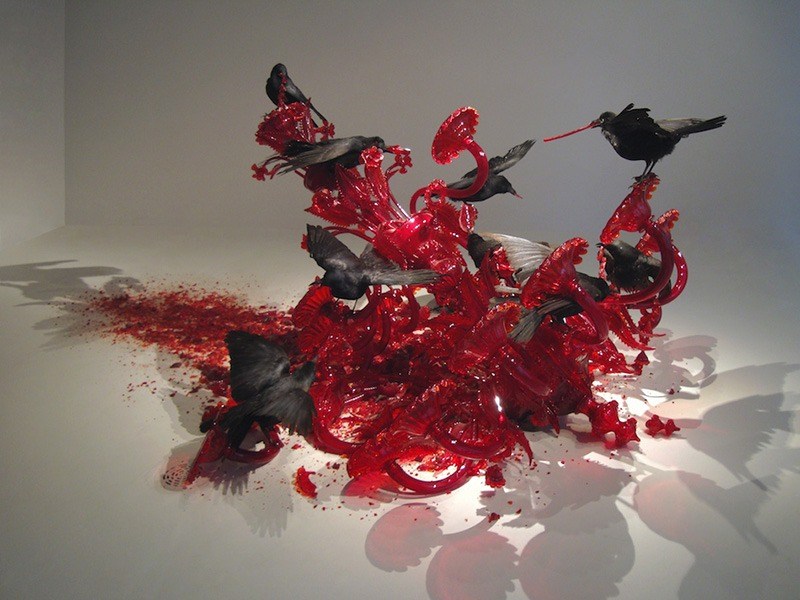
Javier Perez. Carroña, 2011.
Installation.

by Brooks Riley
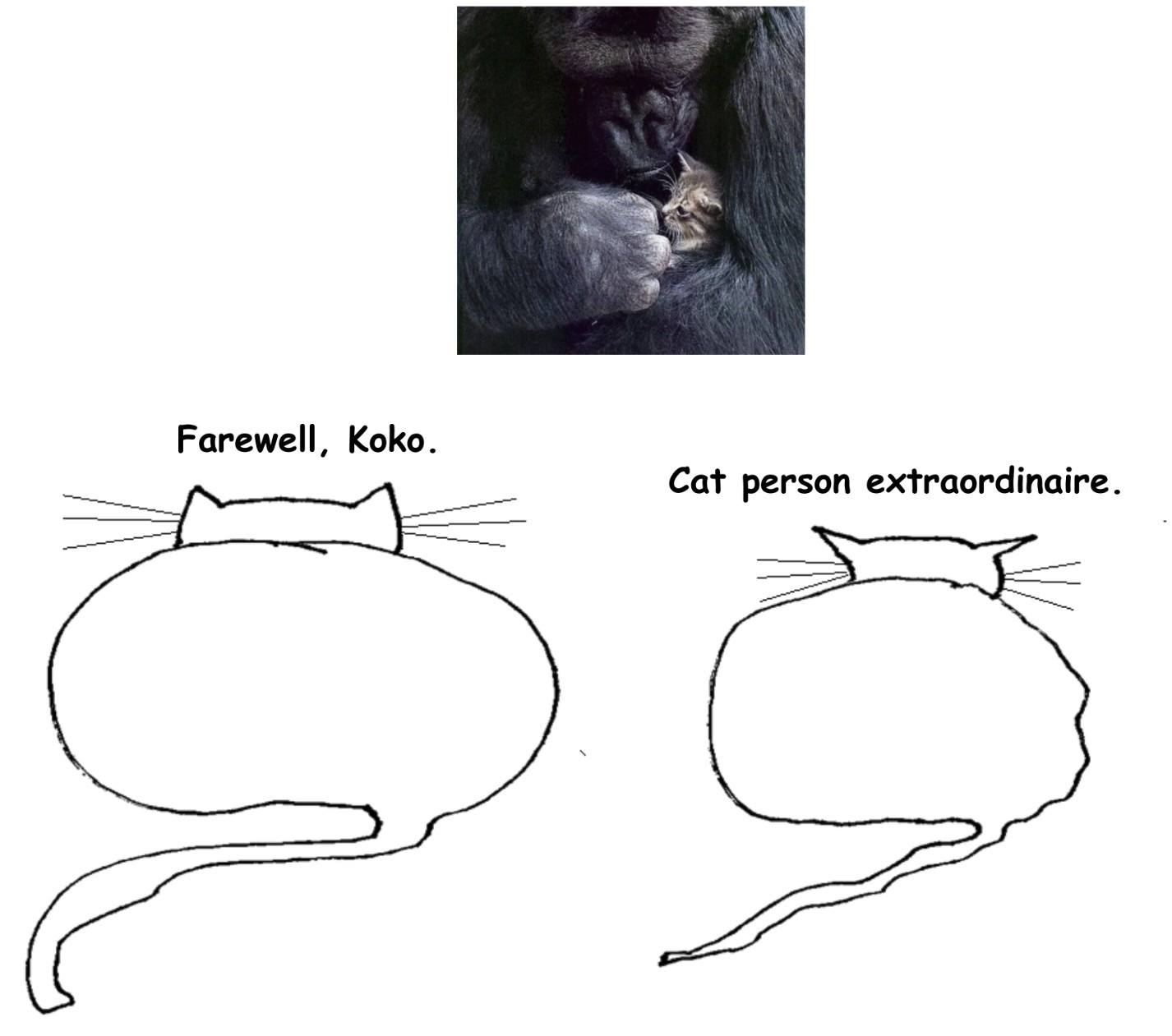
by Bill Benzon
We are now less than a year away from the scheduled release of Disney’s live-action remake of Dumbo, the studio’s fourth animated feature. It is in some ways dark and sinister–animals jaded from the daily grind of performing and being on display; cruel, exploitive, and drunken clowns; and the snobbish elephant matrons who ostracize Dumbo and his mother. But let’s set that aside–I’ve covered it all, and more, in my working paper on Dumbo. By the time the film had come out, 1941, there’d been a substantial history of cartoons centered on animals. If anything, cartoons were more likely to center on humans than animals. Why animals and why elephants? Read more »
by Maniza Naqvi
 Give me a break I mutter. I text—and I text. Incessantly I text. Send money. Now. Send money. More money. You don’t reply. You will. It is Spring and I am young. Everyone around me on the beach is around my age or younger. We are young.
I offer: Let’s chat. Then I wait. Stretching out leisurely I see stretching before me powdery pristine white sand, waves gently furling and unfurling, nibbling at the beach as far as my eyes can see—a cloudless blue sky mirroring a gentle ocean to my right. A gentle ocean—its blue so blue against the sky and the white that I cannot even give it a name—this blue—this blue of abundance. This blue of calm and peace. This blue of happiness. This combination of blue and white—this perfect sweet air, a fresh ocean breeze. And I am high, feeling the buzz—of this intoxicating time. The beach vibrates—undulates and shivers—trembles with life, the shells, clams and crabs– alive. On the distance horizon over the ocean I can make out cargo ships, probably Chinese and Dutch and trawlers, probably Japanese, netting the big fish. Our fish. Read more »
by Dave Maier
I’ve always been a big fan of logic puzzles, especially Japanese ones (heyawake, nurikabe, gokigen naname, hashiwokakero), but I recently ran across another kind of puzzle which has been driving me crazy. So I thought I would share it with you, so maybe you also may be driven crazy. You’re welcome!
I do this puzzle (called “Guess” in this version) on my iPad, and I got it as part of large collection called Puzzles, which means that if you search for it on the App Store, you’ll get a bazillion hits and never find this particular one. Luckily (or not), Guess is easily available under another name, Mastermind, the name of the board game it’s based on. I don’t remember ever playing this game, but the only difference, I take it, is that when it’s played by two humans, one player chooses the tokens while the other guesses, and one scores better or worse based on how long it takes to get the answer (or fails to do so). Guess doesn’t give points, but one naturally tries in any case to solve the puzzle in as few steps as possible — which involves figuring things out rather than simply guessing randomly. Read more »
Christie Wilcox in Scientific American:
 We, as emotional beings, place a high value on happiness and joy. Happiness is more than a feeling to us – it’s something we require and strive for. We’re so fixated on happiness that we define the pursuit of it as a right. We seek happiness not only for ourselves and our loved ones, but also for our planet and its creatures.
Sure, campaigns for Animal Liberation take this to the extreme. They believe that all animals “deserve to lead free, natural lives.” But extreme animal activists aren’t the only ones who think animal happiness is important. They’re not even the only ones that think animals have some level of right to be free. Many people are against zoos because they feel it’s wrong to keep animals in captivity. I’ve even heard arguments for hunting as an alternative to farming livestock, because at least the wild animals lived happily prior to their death, while the poor cows or chickens suffered because they are never allowed to be free. And let’s be honest: who didn’twatch Free Willy and feel, at least for a moment, that every animal we have ever put in a cage or a tank should be let go?
The core idea behind all of this is the belief that animals in nature are truly happier than animals in captivity, even than domesticated ones. But are they? I mean, really?
More here.
Erica Klarreich in Quanta:
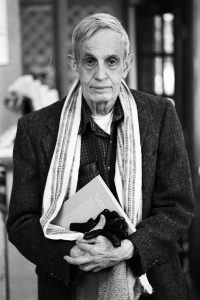 In 1950, John Nash — the mathematician later featured in the book and film “A Beautiful Mind” — wrote a two-page paper that transformed the theory of economics. His crucial, yet utterly simple, idea was that any competitive game has a notion of equilibrium: a collection of strategies, one for each player, such that no player can win more by unilaterally switching to a different strategy.
Nash’s equilibrium concept, which earned him a Nobel Prize in economics in 1994, offers a unified framework for understanding strategic behavior not only in economics but also in psychology, evolutionary biology and a host of other fields. Its influence on economic theory “is comparable to that of the discovery of the DNA double helix in the biological sciences,” wrote Roger Myerson of the University of Chicago, another economics Nobelist.
When players are at equilibrium, no one has a reason to stray. But how do players get to equilibrium in the first place? In contrast with, say, a ball rolling downhill and coming to rest in a valley, there is no obvious force guiding game players toward a Nash equilibrium.
“It has always been a thorn in the side of microeconomists,” said Tim Roughgarden, a theoretical computer scientist at Stanford University.
More here.
Rafia Zakaria in the Times Literary Supplement:
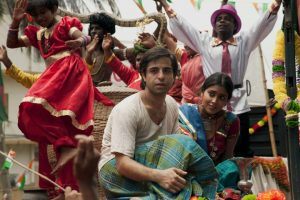 “What, then, shall that language be? One-half of the committee maintain that it should be the English. The other half strongly recommend the Arabic and Sanscrit. The whole question seems to me to be – which language is the best worth knowing?” So asked Lord Macaulay of the British Parliament on February 2, 1835. He went on, of course, to answer his own question; there was no way that the natives of the subcontinent over which they now ruled could be “educated by means of their mother-tongue”, in which “there are no books on any subject that deserve to be compared to our own”. And even if there had been, it did not matter, for English “was pre-eminent even among languages of the West”. English, it was decided, would be the language that would be taught to the natives. By 1837, English replaced Persian as the language of courtrooms and official business in Muslim India and took with it the cultural ascendancy of the Persian speakers.
This sordid story of tainted beginnings is aptly recounted in Muneeza Shamsie’s Hybrid Tapestries: The development of Pakistani literature in English, which traces the history of an often vexed but always intriguing literary lineage from the nineteenth century until today. It is a tricky tale to tell, not least because the moment of origin is also the moment of imposition and conquest. The development of Pakistani literature is directly linked to those deposed Muslims and their cherished Persian, which adds further flavours of resentment and betrayal to the mixture.
More here.
Skye C Cleary in Aeon:
 Philosophers love to hate Ayn Rand. It’s trendy to scoff at any mention of her. One philosopher told me that: ‘No one needs to be exposed to that monster.’ Many propose that she’s not a philosopher at all and should not be taken seriously. The problem is that people are taking her seriously. In some cases, very seriously.
A Russian-born writer who moved to the United States in 1926, Rand promoted a philosophy of egoism that she called Objectivism. Her philosophy, she wrote in the novel Atlas Shrugged (1957), is ‘the concept of man as a heroic being, with his own happiness as the moral purpose of his life, with productive achievement as his noblest activity, and reason as his only absolute’. With ideals of happiness, hard work and heroic individualism – beside a 1949 film starring Gary Cooper and Patricia Neal based on her novel The Fountainhead (1943) – it’s perhaps no wonder that she caught the attention and imagination of the US.
Founded three years after her death in 1982, the Ayn Rand Institute in California reports that her books have sold more than 30 million copies. By early 2018, the institute planned to have given away 4 million copies of Rand’s novels to North American schools. The institute has also actively donated to colleges, with the funding often tied to requirements to offer courses taught by professors who have ‘a positive interest in and [are] well-versed in Objectivism, the philosophy of Ayn Rand’ – with Atlas Shrugged as required reading.
Rand’s books are becoming increasingly popular. The Amazon Author Rank lists her alongside William Shakespeare and J D Salinger. While these rankings fluctuate and don’t reflect all sales, the company her name keeps is telling enough.
More here.
From The Economist:
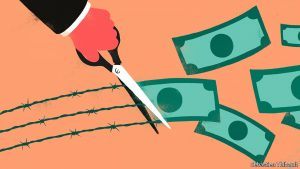 A HUNDRED-DOLLAR BILL is lying on the ground. An economist walks past it. A friend asks the economist: “Didn’t you see the money there?” The economist replies: “I thought I saw something, but I must have imagined it. If there had been $100 on the ground, someone would have picked it up.”
If something seems too good to be true, it probably is not actually true. But occasionally it is. Michael Clemens, an economist at the Centre for Global Development, an anti-poverty think-tank in Washington, DC, argues that there are “trillion-dollar bills on the sidewalk”. One seemingly simple policy could make the world twice as rich as it is: open borders.
Workers become far more productive when they move from a poor country to a rich one. Suddenly, they can join a labour market with ample capital, efficient firms and a predictable legal system. Those who used to scrape a living from the soil with a wooden hoe start driving tractors. Those who once made mud bricks by hand start working with cranes and mechanical diggers. Those who cut hair find richer clients who tip better.
“Labour is the world’s most valuable commodity—yet thanks to strict immigration regulation, most of it goes to waste,” argue Bryan Caplan and Vipul Naik in “A radical case for open borders”.
More here.
William Leith in The Sunday Times:
 In 1989, a trainee physician called Edward Bullmore treated a woman in her late fifties. Mrs P had swollen joints in her hands and knees. She had an autoimmune disease. Her own immune system had attacked her, flooding her joints with inflammation. This, in turn, had eaten away at Mrs P’s collagen and bone, noted Bullmore, who was 29, and whose real ambition was to become a psychiatrist.
He asked Mrs P some routine questions about her physical symptoms, and made a correct diagnosis of rheumatoid arthritis. Then he asked her a few questions he wasn’t supposed to ask. How was she feeling? How would she describe her mood? Well, said Mrs P, she was feeling very low – she was tired, listless and losing the will to live. She couldn’t sleep.
At this point, Bullmore made another diagnosis. “She’s depressed,” he told his boss at the hospital.
“Depressed?” said the consultant. “Well, you would be, wouldn’t you?”
Both of these doctors understood that Mrs P had an inflammatory disease. They knew that it had wrecked her joints. They understood the basic process that caused the joints to be wrecked. And they also knew that Mrs P was depressed.
More here.
Leuker and Van Den Bos in Nautilus:
 After the fall of the Berlin Wall, East German citizens were offered the chance to read the files kept on them by the Stasi, the much-feared Communist-era secret police service. To date, it is estimated that only 10 percent have taken the opportunity. In 2007, James Watson, the co-discoverer of the structure of DNA, asked that he not be given any information about his APOE gene, one allele of which is a known risk factor for Alzheimer’s disease. Most people tell pollsters that, given the choice, they would prefer not to know the date of their own death—or even the future dates of happy events. Each of these is an example of willful ignorance. Socrates may have made the case that the unexamined life is not worth living, and Hobbes may have argued that curiosity is mankind’s primary passion, but many of our oldest stories actually describe the dangers of knowing too much. From Adam and Eve and the tree of knowledge to Prometheus stealing the secret of fire, they teach us that real-life decisions need to strike a delicate balance between choosing to know, and choosing not to.
But what if a technology came along that shifted this balance unpredictably, complicating how we make decisions about when to remain ignorant? That technology is here: It’s called artificial intelligence. AI can find patterns and make inferences using relatively little data. Only a handful of Facebook likes are necessary to predict your personality, race, and gender, for example. Another computer algorithm claims it can distinguish between homosexual and heterosexual men with 81 percent accuracy, and homosexual and heterosexual women with 71 percent accuracy, based on their picture alone.1 An algorithm named COMPAS (Correctional Offender Management Profiling for Alternative Sanctions) can predict criminal recidivism from data like juvenile arrests, criminal records in the family, education, social isolation, and leisure activities with 65 percent accuracy.
More here.
Julian Baggini in The Guardian:
 Surprisingly, few of the world’s great philosophers have directly addressed this question. Instead, they have focused on a subtly different question: what does it mean to live well? In his Nicomachean Ethics, Aristotle emphasised the need to cultivate good character, finding the sweet spot between harmful extremes. For example, generosity lies between the extremes of meanness and profligacy, courage between cowardice and rashness. A remarkably similar vision is presented in the Chinese classics TheAnalects of Confucius and Mencius.
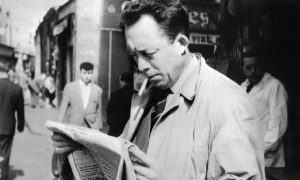
However, in the west, millennia of Christian dominance created the assumption that life needed some justification outside of itself. As religious belief waned, the question of whether life is worth living emerged as a central concern for the French existentialists of the 20th century. The gist of their answer was hardly inspiring: life is absurd so you’ve just got to get on with it and create your own meaning. If you’re up for the challenge, Jean-Paul Sartre’s Existentialism and Humanism and The Myth of Sisyphus by Albert Camus expand on this.
More recently, anglophone philosophers have offered more positive answers by pulling together threads in their tradition that have previously been separate. Two fine examples of this are Robert Nozick’s The Examined Life and Christopher Belshaw’s 10 Good Questions About Life and Death.
More here.
.where are you
…on the willow-hung swing
…in a goldfield of grass
where
…in the hemlock
…straddling the branch just below the top
…hands sticky with sap
where, where
…sitting on the well-house step
…with the lake at your back
…remembering a future
…of victory or collapse
where
…on the topside deck above the bridge
…holding the cable-rail fast
…exhilarated at how the bow’s pitch feels
…spearing a new wave’s gut
…as green water breaks over steel
…and you feel up your spine
…the meaning of
…………………….….….splash!
…among zucchini
…grubbing for ones green and fat
…or off in a high in a twelve-string cage
…hoping to harmonize with truth in that
where
…are you tumbling up a shaft
…like a 9-lived cat
Jim Culleny
6/18/18
Bill Casselman at the website of the American Mathematical Society:
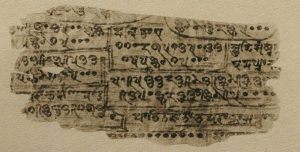 The Bakhshali manuscript is a mathematical document found in 1881 by a local farmer in the vicinity of the village of Bakhshali, near the city of Peshawar in what was then British India and is now Pakistan. It is written in ink on birch bark, a common medium for manuscripts in northwestern India throughout much of history. In the tough climate of India and neighbouring regions, such things deteriorate rapidly, and it is miraculous that this document has survived.
The Bakhshali manuscript is in a very damaged state, but is a valuable mathematical record nonetheless. It consists now of 70pages, but was probably once part of something much longer. Some of the pages we have are themselves broken up into fragments, and large parts are missing. Even the exact order of the pages has been a matter of conjecture, since the state in which it first came under careful examination is not necessarily the original order. The first edition of the manuscript was published by the Government of India in Calcutta in 1927, and its editor was G. R. Kaye. In 1995 a new edition was published, edited by Takao Hayashi as an extension of his PhD thesis at Brown University. He ordered the pages very differently from Kaye, and made a much more thorough translation.
The manuscript was donated to the Bodleian Library at Oxford University early in the twentieth century. Attempts to assess its age have generated much controversy–estimates have ranged, roughly, from 300 C.E. to 1200 C.E.
More here. [Thanks to Pramathanath Sastry.]
Ashley Strickland at CNN:
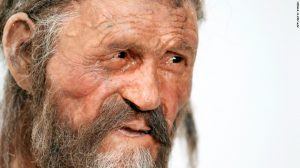 Although he’s older than the Giza pyramids and Stonehenge, the 5,300-year-old mummy of Otzi the Tyrolean Iceman continues to teach us things.
The latest study of the weapons he was found with, published in the journal PLOS ONE on Wednesday, reveals that Otzi was right-handed and had recently resharpened and reshaped some of his tools before his death. They were able to determine this by using high-powered microscopes to analyze the traces of wear on his tools.
The upper half of the Iceman’s body was accidentally discovered by a vacationing German couple hiking in the North Italian Alps in 1991. Otzi was found with a dagger, borer, flake, antler retoucher and arrowheads. But some of the stone was collected from different areas in Italy’s Trentino region, which would have been about 43.5 miles from where he was thought to live.
More here.
Charlotte Higgins in The Guardian:
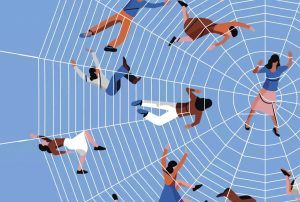 On 7 January this year, the alt-right insurgent Steve Bannon turned on his TV in Washington DC to watch the Golden Globes. The mood of the event was sombre. It was the immediate aftermath of multiple accusations of rape and sexual assault against film producer Harvey Weinstein, which he has denied. The women, whose outfits would normally have been elaborate and the subject of frantic scrutiny, wore plain and sober black. In the course of a passionate speech, Oprah Winfrey told the audience that “brutally powerful men” had “broken” something in the culture. These men had caused women to suffer: not only actors, but domestic workers, factory workers, agricultural workers, athletes, soldiers and academics. The fight against this broken culture, she said, transcended “geography, race, religion, politics and workplace”.
Bannon, Donald Trump’s former chief strategist, was one of 20 million Americans watching. In his view, the scene before him augured the beginning of a revolution “even more powerful than populism”, according to his biographer Joshua Green. “It’s deeper. It’s primal. It’s elemental. The long black dresses and all that – this is the Puritans. It’s anti-patriarchy,” Bannon declared. “If you rolled out a guillotine, they’d chop off every set of balls in the room … Women are gonna take charge of society. And they couldn’t juxtapose a better villain than Trump. He is the patriarch.” He concluded: “The anti-patriarchy movement is going to undo 10,000 years of recorded history.”
Until very recently, “patriarchy” was not something rightwing men were even supposed to believe in, let alone dilate upon with such apocalyptic relish. It was the sort of word that, if uttered without irony, marked out the speaker as a very particular type of person – an iron-spined feminist of the old school, or the kind of ossified leftist who complained bitterly about the evils of capitalism. Even feminist theorists had left it behind.
Nevertheless, “patriarchy” has, in the past year or so, bloomed in common parlance and popular culture.
More here.
Kevin Baker in Harper’s:
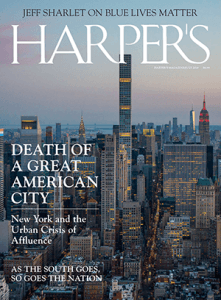 As New York enters the third decade of the twenty-first century, it is in imminent danger of becoming something it has never been before: unremarkable. It is approaching a state where it is no longer a significant cultural entity but the world’s largest gated community, with a few cupcake shops here and there. For the first time in its history, New York is, well, boring.
This is not some new phenomenon but a cancer that’s been metastasizing on the city for decades now. And what’s happening to New York now—what’s already happened to most of Manhattan, its core—is happening in every affluent American city. San Francisco is overrun by tech conjurers who are rapidly annihilating its remarkable diversity; they swarm in and out of the metropolis in specially chartered buses to work in Silicon Valley, using the city itself as a gigantic bed-and-breakfast. Boston, which used to be a city of a thousand nooks and crannies, back-alley restaurants and shops, dive bars and ice cream parlors hidden under its elevated, is now one long, monotonous wall of modern skyscraper. In Washington, an army of cranes has transformed the city in recent years, smoothing out all that was real and organic into a town of mausoleums for the Trump crowd to revel in.
More here.