 Lance Taylor over at INET:
Income distribution and employment are crucial macroeconomic indicators. Profits are key to distribution. Ther share in the value of output has risen steadily since around 1980. Households near the top of the size distribution of income receive business profits through various channels including interest, dividends, capital gains, proprietors’ incomes, and even labor compensation—which in US statistics includes profit-related items such as bonuses and stock options. Rising household inequality can be traced directly to higher profits fed by slower growth of real wages than of productivity (Taylor and Ömer, 2018).
The employment rate or the ratio of employment to the working age population, fluctuates around 60%. It hit a post-WWII high of 64% in 1990 at the peak of a business cycle, dropped to 55% in the wake of the Great Recession, and now is nearing 62%.
How do these developments hang together? Rising income inequality and oscillating employment are not the happiest macroeconomic combination. Causes include changing structural relationships including more “duality” between low wage/high employment industries and the rest.
In our paper, my co-author and I first trace these linkages in the data and then examine possible explanations. A key contrast is between business firms’ “monopoly” power to push up prices in markets for goods and services against consumers’ wages on the one hand, and their ability by various means to drive down wages against prices on the other. The latter strategy may well be more significant.
More here.
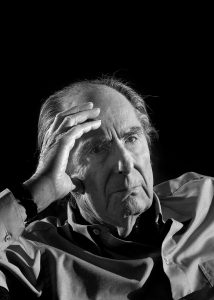 Philip Roth, the prolific, protean, and often blackly comic novelist who was a pre-eminent figure in 20th century literature, died on Tuesday night at a hospital in Manhattan. He was 85.
 Isaac Butler has a new podcast over at Slate on politics and Shakespeare. The first episode is on Julius Caesar:
 Sam Harris, one
 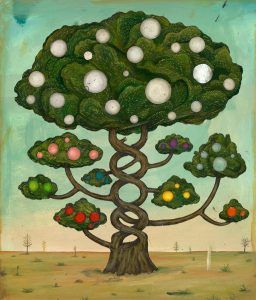 James Priest couldn’t make sense of it. He was examining the DNA of a desperately ill baby, searching for a genetic mutation that threatened to stop her heart. But the results looked as if they had come from two different infants.
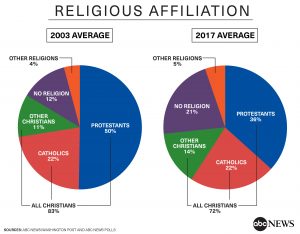 The nation’s religious makeup has shifted dramatically in the past 15 years, with a sharp drop in the number of Americans who say they’re members of a
  In 1920, the night before Easter Sunday, Otto Loewi woke up,
  Godard has a way of spinning every question into a cosmic tangent. A Brazilian journalist asked him about his approach to sound. A technical question. Godard replied that one his original titles for the film was An Attempt at Blue. “There are things that text and language cannot convey,” he added. “The voice is not the same as speech. And speech is not necessarily language. When it came to sound, the aim was to separate the sound from the image. We didn’t want it to be just an accompaniment. We wanted a true dialogue between the sound and the images.” Alluding to cinema’s original pioneers, he added, “I believe that the Lumière brothers, when they filmed the arrival of the train in the station, were thinking of all this.” Without a pause, he then jumped straight to French impressionism. “What the impressionists have brought into art is light. Then Cézanne brought colour, and colour has something to do with speech—even if we are talking about Heidegger here. The sound should not be too close to the images for me. The perfect screening should be in a café instead of on a TV screen.
 W
W Nothing, however, prepares one for the tender ferocity of Bacon’s isolated, entrapped figures. In the earliest of these, the large canvas of Figure in a Landscape(1945), a curled-up, almost human form appears to be submerged in a desert—we see his arm and part of his body, but the legs of his suit hang, empty, over a bench. This is masculinity destroyed. The sense of desperation is even stronger in Bacon’s paintings of animals, such as Dog (1952), in which the dog whirls like a dervish, absorbed in chasing its tail, while cars speed by on a palm-bordered freeway, or Study of a Baboon (1953), where the monkey flies and howls against the mesh of a fence. In their struggles, these animals are the fellows of Bacon’s “screaming popes”: in Study after Velazquez (1950), a businessman in a dark suit, jaws wrenched open in a silent yell, is trapped behind red bars that fall like a curtain of blood. The curators connect Bacon’s postwar angst with Giacometti’s elongated statues, isolated in space, and to the philosophy of existentialism. Yet Bacon’s vehement brushstrokes speak of energy and involvement, physical, not cerebral responses. In Study for Portrait II (after the Life Mask of William Blake) (1955), you feel the urgent vision behind the lidded eyes. He cares, passionately.
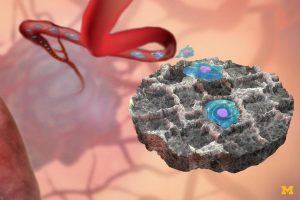 A small device implanted under the skin shows promise for improving breast cancer survival by catching cancer cells and slowing the development of metastatic tumors in other organs. These findings, based on experiments in mice and reported in the journal Cancer Research, suggest a path for identifying metastatic cancer early and intervening to improve outcomes. “This study shows that in the metastatic setting, early detection combined with a therapeutic intervention can improve outcomes. Early detection of a primary tumor is generally associated with improved outcomes. But that’s not necessarily been tested in metastatic cancer,” says study author Lonnie D. Shea, Ph.D., the William and Valerie Hall Department Chair of Biomedical Engineering at the University of Michigan.


 It’s with a certain pleasure that I can recall the exact moment I was seduced by the musical avant-garde. It was in the fourth grade, in a public elementary school somewhere in New Jersey. Our music teacher, Mrs. Jones, would visit the classroom several times a week, accompanied by an ancient record player and a stack of LPs. You could always tell when she was coming down the hall because the wheels of the cart had a particularly squeak-squeak-wheeze pattern. However, such a Cageian sensibility was not the occasion of my epiphany. I’m also not sure if fourth-graders are allowed to have epiphanies, or, which is likelier, if they are not having them on a daily basis.