The stories of being Muslim in today’s India are beginning to emerge in fiction

Annie Zaidi in Scroll.in:

There is nothing solid or pragmatic about happiness, grief, love. A successful business, however, has to be run along sensible lines, and a businessman must be able to count on his employees just as he can count on the food on his plate actually being there. It is at this junction of reason, driven by the evidence of one’s physical senses, and the other, intangible, unbelievable world that Tabish Khair places his new novel.

A slender, brisk narrative, it takes its title, Night Of Happiness, from “Shab-e-baraat”, a festival when some Muslim sects visit graveyards, light incense and consecrate halva in memory of ancestors and other departed family members. Naturally, a reference to the dead suggests a paranormal setting. This is, however, not so much a paranormal tale as it is a story about the struggle to retain one’s sense of reality, to remain centred, and about trust.

The narrator is an “import-export” businessman, Anil Mehrotra, who boasts a company several employees and an international clientele. His right hand man is Ahmed, a man who is both dignified and dependable, reticent and hard-working almost to an extreme. An unhurried, deeply self-respecting man, and therefore also commanding respect. He has unusual linguistic abilities, and is at ease with cultural differences. But he will no more bow to a mullah’s dictates than he will give up on his own faith.

More here.

Feynman at 100

Peter Woit in Not Even Wrong:

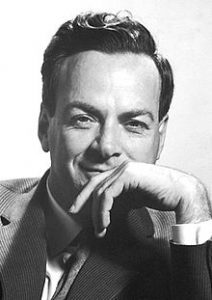
The past month has seen quite a few events and articles celebrating the 100th anniversary of Richard Feynman’s birth (see for example hereherehere and here). Feynman was one of the great figures of twentieth century physics, with a big intellectual influence on me and on many generations of particle theorists. In particular, his development of the path integral formulation of quantum mechanics and the Feynman diagram method for calculating and understanding what quantum field theories are telling us are at the center of how we have learned to think about fundamental physics and apply it to the real world.

When I first started studying physics, in the seventies, Feynman was a major figure to physicists, but not that well-known outside the subject. After the 1985 appearance of the book of anecdotes “Surely You’re Joking, Mr. Feynman!” and his 1986 role in the report on the Challenger disaster (followed by more anecdotes in the 1988 “What Do You Care What Other People Think?”) Feynman became a huge public figure. The Physics section of any book store that carried science books would often have nearly a whole shelf of books by and about him, with the only competition the shelf of books about Einstein (the Hawking shelf didn’t get going until a bit later).

I avidly read the Feynman anecdote books when they came out and was suitably entertained, but I also found them a bit disturbing.

More here.

US liberal Islamophobia is rising – and more insidious than rightwing bigotry

Khaled A Beydoun in The Guardian:

When will Muslims step up and reform Islam?” asked the self-identified “progressive and intersectional” college student, following a presentation of my book, American Islamophobia: Understanding the Roots and Rise of Fear, at New York University.

The student wore a Black Lives Matter T-shirt and a colorful assortment of pins and patches on his camouflage backpack calling for “equality now” and claiming that “The future is female”. The young man, by way of verbal admission and the myriad of political statements he proudly wore, was a political progressive. And indeed, a representative of a swelling population of leftists who embrace progressive principles yet see Islam as inimical to liberal values and in conflict with American identity.

The left is saturated with pundits and self-styled public intellectuals who disseminate discourses that Islam is monolithic; that Muslims must choose between liberal principles and their faith, and, echoing the college student I encountered at in March, a religion that is in need of “reform”.

A diverse and eclectic litany of prominent Islamophobes occupies the left. These liberal Islamophobes, like Bill Maher and Sam Harris, weaponize atheism as an ideology that not only discredits the spiritual dimensions of Islam but also demonizes it in line with longstanding orientalist, political terms.

More here.

The truth about midlife infidelity

Karin Jones in The Times:

It’s not possible to justify my liaisons with married men; I won’t even try. I’m not proud that, for a few years while living near London, I entered into casual relationships with married men. But I don’t regret it. What I learnt from these men warrants discussion, even though I’ve recently been publicly condemned for doing so in The New York Times.

I want to know the wife’s perspective. But what I have is the story told by their husbands. It’s an issue we might all want to talk about, say, annually, the way we get the yearly MOT to keep the family car from breaking down.

I was adrift when I separated from my husband of 23 years. We had only been living in the UK for just over a year, so I wasn’t close enough to the kind of people you commiserate with after you’ve torn down the walls that once sheltered you both physically and mentally. When I set up accounts on Tinder and OkCupid, I was too raw to want to date anyone looking for a relationship. Instead I looked for no-strings-attached company. A fair number of men who responded to my profile were married; sometimes headless or faceless or insouciantly grinning in their photos. But all of them came to me first. I simply responded. Sure, that makes me complicit, but I felt drawn to married men, perhaps because I instinctively needed what they were also seeking: affection and sex with someone uninterested in attachment. Just a few hours of levity.

I know this is dicey because you can’t always control your emotions when body chemicals mix, but I reasoned that because they had wives, children and mortgages, they wouldn’t go overboard with their affections. We were safe bets for each other.

More here.

Tuesday Poem

When One Has Lived A Long Time Alone

1.
When one has lived a long time alone
one refrains from swatting the fly
and lets him go, and one hesitates to strike
the mosquito, though more than willing go slap
the flesh under her, and one lifts the toad
from the pit too deep for him to hop out of
and carries him to the grass, without minding
the toxic urine he slicks his body with,
and one envelops, in a towel, the swift
who fell down the chimney and knocks herself
against the window glass and releases her outside
and watches her fly free, a life line flung at reality,
when one has lived a long time alone.

2.

When one has lived a long time alone,
one grabs the snake behind the head
and holds him until he stops trying to stick
the orange tongue, which splits at the end
into two black filaments and jumps out
like a fire-eater’s belches and has little
in common with the pimpled pink lump that shapes
sounds and sleeps inside the human mouth,
into one’s flesh, and clamps it between his jaws,
letting the gaudy tips show, as children do
when concentrating, and as very likely
one down oneself, without knowing it,
when one has lived a long time alone.
Read more »

This Man Memorized a 60,000-Word Poem Using Deep Encoding

Lois Parshley in Nautilus:

“Of man’s first disobedience, and the fruit of that forbidden tree,” John Basinger said aloud to himself, as he walked on a treadmill. “Of man’s first disobedience…” In 1992, at the age of 58, Basinger decided to memorize Paradise Lost, John Milton’s epic poem, as a form of mental activity while he was working out at the gym. An actor, he’d memorized shorter poems before, and he wanted to see how much of the epic he could remember. “As I finished each book,” he wrote, “I began to perform it and keep it alive in repertory while committing the next to memory.” The 12 books of Paradise Lost contain over 60,000 words; it took Basinger about 3,000 hours to learn them by rote. He did so by reciting the piece, line-by-line out loud, for about an hour a day for nine years. When he memorized all 12 books, in 2001, Basinger performed the masterpiece in a live recital that lasted three days. Since then, he’s performed smaller sections for various audiences, eventually attracting the attention of John Seamon, a psychologist at Wesleyan University, in Connecticut. In 2008, “He recited for an hour in the Wesleyan library,” says Seamon. “He’d given out copies of Milton’s book so we could follow along. At the end of the talk I introduced myself and said ‘I’d love to study your memory.’” Basinger agreed, and so Seamon devised a test.

Then 74, Basinger came into the lab to perform a series of cued recall tests. Scientists read two successive lines from each of the poem’s 12 books and then asked Basinger to recall the next 10 lines. The results, published in Memory in 2010, were surprising: Despite the amount of elapsed time since his memorization process, Basinger’s recall was, overall, word-perfect 88 percent of the time. When he was prompted with lines that opened one of the 12 books, his accuracy increased to 98 percent.

Seamon wondered how he might explain this performance, and realized deliberate practice theory could be useful. Although it was “formulated to account for elite performance in chess, music, and sports, it provides a reasonable basis for interpreting JB’s procedure for memorising Paradise Lost,” says Seamon. “He too, in daily short sessions, devoted thousands of hours of study over a period of years to achieve his mastery of Milton.” But Basinger didn’t just remember the words; it would be a mistake, says Seamon, to interpret Basinger’s performance as “simply a remarkable demonstration of brute force, rote memorisation.” In order to memorize the epic poem, he spent a lot of time repeatedly analyzing its meaning and structure. Acting researchers emphasize this strategy, Seamon notes: “Deep encoding requires actors to attend to the exact wording of lines, and it is the focus on exact wording to gain an understanding of the characters that yields verbatim memory, instead of merely the retention of gist.”

More here.

The Thing Inside Your Cells That Might Determine How Long You Live

JoAnna Klein in The New York Times:

Once there was a mutant worm in an experiment. It lived for 46 days. This was much longer than the oldest normal worm, which lived just 22. Researchers identified the mutated gene that had lengthened the worm’s life, which led to a breakthrough in the study of aging — it seemed to be controlled by metabolic processes. Later, as researchers studied these processes, all signs seemed to point to the nucleolus. Under a microscope, it’s hard to miss. Take just about any cell, find the nucleus, then look inside it for a dark, little blob. That’s the nucleolus. If the cell were an eyeball, you’d be looking at its pupil. You’ve got one in every nucleus of every cell in your body, too. All animals do. So do plants, and yeast — and anything with a cell with a nucleus. And they’ve become much more important in our understanding of how cells work. “We think the nucleolus plays an important role in regulating the life span of animals,” said Adam Antebi, a cellular biologist at the Max Planck Institute for Biology of Ageing in Germany. He’s an author of a new review published last week in Trends in Cell Biology that examines all the new ways that researchers have fallen in love with the nucleolus — especially its role in aging.
You may have forgotten this from biology class, but the nucleolus is the cell’s ribosome factory. Ribosomes are like micro-machines that make proteins that cells then use for purposes like building walls, forming hairs, making memories, communicating and starting, stopping and slowing down reactions that help a cell stay functioning. It uses about 80 percent of a cell’s energy for this work. But there’s more to the nucleolus than just making ribosomes. If building a cell were like building a building, and the DNA contained the blueprint, the nucleolus would be the construction manager or engineer. If building a cell were like building a building, and the DNA contained the blueprint, the nucleolus would be the construction manager or engineer. “It knows the supply chain, coordinates all the jobs of building, does quality control checks and makes sure things continue to work well,” said Dr. Antebi. How well it balances these tasks influences a cell’s health and life span. And in certain cells, its size has something to do with it.

More here.

Monday, May 28, 2018

Sam Harris’s error and how not to argue about cultural relativism

by Dave Maier

Photo credit: Damon Winter/The New York Times

So Sam Harris, Jordan Peterson, and a number of other brash rebels daring to challenge the stifling intellectual status quo, in which one is not allowed to criticize anyone from other cultures, because multiculturalism or Marxism or something, are part of, I am not making this up, the Intellectual Dark Web. Fine, whatever. It’s not that there’s no such thing as lefty orthodoxy, obviously, especially on campus, but these best-selling authors look pretty petty presenting themselves as somehow being silenced.

Anyway, that’s not what I want to talk about. In the New York Times piece telling us about all this, I ran across the following exchange:

After [Harris’s] talk, in which he disparaged the Taliban, a biologist who would go on to serve on President Barack Obama’s Commission for the Study of Bioethical Issues approached him. “I remember she said: ‘That’s just your opinion. How can you say that forcing women to wear burqas is wrong?’ But to me it’s just obvious that forcing women to live their lives inside bags is wrong. I gave her another example: What if we found a culture that was ritually blinding every third child? And she actually said, ‘It would depend on why they were doing it.’” His jaw, he said, “actually fell open.”

It’s not unprecedented, or even unusual, that Harris should commit a philosophy fail. But in detaching ourselves from error, we have to be careful about where we end up. It’s not even clear, for example, that his point in the context is threatened by his futile sally. So I’ll be defending him as much as diagnosing his (all too common) error. Maybe I should be on the IDW too. Help, I’m being silenced!

Okay, enough japery for now. What did Harris do wrong here, and why may his main point survive the stumble? Read more »

The Graduate Schools His Father

by Michael Liss

Celebrate with me. 

May is graduation month, and my children are among the graduates.  My son marched two weeks ago for his Masters, and, if you are reading this on Memorial Day, it might be at the very same time I watch my daughter receive her Bachelor of Music. Go get ‘em, kids.  

Perhaps your joy need not be vicarious—you have your own family skittering across the podium. One of the special pleasures of this time of year is that so many of your friends and relations are also submerged in a sea of caps and gowns, blurry pictures, hugs, and the dreaded Elgar Pomp and Circumstance Earworm. They announce themselves with each vibration from your iPhone, a kaleidoscope of happy, and occasionally goofy, images. Can we all stipulate that the whole outfit looks a bit silly?

Graduation also reminds you that time passes (way too fast). Your kids’ time, and your time. You’ve changed, just as has the five-year old who came bouncing out of her room, a huge grin on her face, ready for the first day of Kindergarten. You are a little older (just a little) and a little more “robust,” and your times in the Road Runners races are “moving” in the wrong direction.  

It doesn’t matter.  There are your children, not looking little at all, promising you a peculiar type of immortality. They are going to go do things, great things, going to change the world. They are the discoverers, the communicators, the creators. They will wash away any imperfections you’ve left and build things bigger and better. They really are the future.

You’ve celebrated with me. Now, indulge me. Read more »

The Disruption Ecosystem

by Sarah Firisen

30 years ago I moved from the UK to New York City and I gave up my car. I had mixed feelings about doing so at the time – I was only 21 and driving was still a novelty and an expression of independence. When I moved out of New York City to upstate 13 years later, I again became a car owner and regular driver. After my divorce, when I moved back to New York City, I once again gave up my car, this time happily. I would honestly be thrilled if I never had to get behind the wheel of a car again. I don’t enjoy driving, I’m not the most confident driver (I cannot reverse to save my life even after over 30 years of driving) and I generally would prefer to be driven. My transportation needs are now taken care of by a combination of public transport, ride sharing services and a boyfriend with a car who is very good about driving me around. And thanks to online shopping, the retail convenience of a car ownership has almost totally disappeared. As far as I’m concerned, this is a perfect state of affairs.

And it turns out, I’m not the only person who feels this way. While there is debate about just how strong a trend it is, and even exactly why it’s happening, there does seem to be a clear trend that millennials also don’t want to own cars.

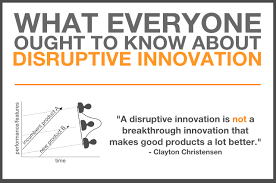
Ever since Professor Clayton Christensen of Harvard University first coined the phrase Disruptive Innovation almost 25 years ago, companies have talked a lot about trying to head off disruption from entrants into their industry, and some have even taken strong action, with mixed results.  But sometimes, no effort is enough, “Consider that 18 months after the introduction of the Google Maps Navigation app for smartphones in 2009, as much as 85% of the market capitalization of the top makers of stand-alone GPS devices had evaporated.” Read more »

Listen Up, Davos: If You Don’t Have Redistribution, Regulations And Strong Unions, You Get Trump. It’s That Simple.

by Evert Cilliers

The freer the market, the more people suffer.
Look what happened after Bill Clinton signed the two bills that deregulated Wall Street with the repeal of Glass-Steagall (the firewall between regular and speculative banking) and the removal of derivatives from all oversight: Wall Street tanked the world.

And who got bailed out? The crooks of Wall Street, not their victims.

Socialism for the rich, and capitalism for the rest of us (as MLK put it).

The free market means freedom for the rich, and oppression for everyone else.

1. Taxes

Consider taxes:

At the end of WW2, for every buck in taxes collected on individuals, Washington collected $1.50 on business profits. Today, for every buck collected on individuals, Washington gets 25 cents from business profits.

Remember that one. Sear it into your brain. Staple it on your cerebellum. Since Reagan, the tax burden has been neatly shifted from business to individual people, from GE (who never seems to pay ANY taxes in any given year) to you and me.

Then add this: the marginal tax rate on the richest individuals went from 91% after WW2 to 35% today, and is actually, for hedge fund billionaires, 15%, and for the second richest American, Warren Buffett, 17% (as he never tires from pointing out, “my secretary pays a higher tax rate than me”). Read more »

Sunday, May 27, 2018

The go-between: how fear of failure has helped me persuade men with guns to make peace in the midst of conflict

Ram Manikkalingam in The National:

Four years ago, I was in a hideout of the Basque separatist group Eta in southern France, surrounded by explosives, revolvers, grenades and rocket launchers. I was present as the chief of the commission to verify a ceasefire and begin the group’s disarmament. It followed more than three years of difficult discussions with Eta leaders, Basque politicians and Basque civil society. We convinced Eta’s leaders that clinging to weapons was going to help neither themselves nor the Basque people.

The Basque peace process was unilateral; Madrid made no concessions to Eta in exchange for disarmament. Our efforts concluded last year in Bayonne in the French Basque region, where I accepted and certified Eta’s disarmament in the presence of the mayor of Bayonne, the Archbishop of Bologna and the Bishop of the Methodist Church of Ireland. Eta informed us where their arms caches were located, information we passed on to the French authorities, who then removed the weapons.

Two weeks ago, Eta themselves announced their disbanding in a statement read out by the director of the Henri Dunant Centre in Geneva, our partner in the effort. So ended a process of more than a dozen years, quietly and without violence and fanfare.

It was just one example of the tireless work of the Dialogue Advisory Group (DAG), which I founded, to get men with guns to make peace in the midst of violent conflict.

Although we are funded by the governments of Germany, Finland, Ireland, Lichtenstein, The Netherlands and Norway, we neither solicit nor accept funds from states with direct interests in the conflicts we work on. Sometimes we approach governments and armed groups – usually they approach us. We then begin by convincing separatists and rebels that using violence as a means to achieve goals is untenable.

More here.

What Do We Mean When We Call Art ‘Necessary’?

Lauren Oyler in the New York Times:

About a year ago I met up for the first time with a woman I knew only online. Articulate and funny, she is a brilliant writer who studied literature in graduate school. So I was surprised that, when I mentioned a recent novel I liked, my new friend responded with head-shaking resignation. “I can’t see how anyone justifies talking about books anymore,” she said. Our nation was so overwhelmed with causes demanding attention and action, she suggested, that it had entered a state of constant emergency, whereby pursuits both personal and political must be pitted against one another to determine which are essential.

A turn toward socially conscious criticism, ushered in by the internet’s amplification of previously ignored perspectives, has meant that culture now tends to be evaluated as much for its politics as for its aesthetic successes (or failures). Certain works — usually those that highlight the experiences of marginalized groups, or express some message or moral about the dangers of prejudice — have been elevated in stature. It’s an overdue correction that brings with it an imposition: No longer just illuminating, instructive, provocative or a way to waste a few hours on a Saturday, these works have become “necessary.” The word is a discursive crutch for describing a work’s right-minded views, and praise that is so distinct from aesthetics it can be affixed to just about anything, from two-dimensional romantic comedies to a good portion of the forthcoming books stacked beside my desk. Necessary for what is always left to the imagination — the continuation of civilization, maybe.

More here.

John Preskill on Quantum Computing

From Y Combinator:

John Preskill is a theoretical physicist and the Richard P. Feynman Professor of Theoretical Physics at Caltech.

He once won a bet with Steven Hawking, which as he writes made him “briefly almost famous.” John and Kip Thorne bet that singularities could exist outside of black holes and after six years Hawking conceded that they were possible in very special, “nongeneric” conditions.

In this episode we cover what John’s been focusing on for years: quantum information, quantum computing, and quantum error correction.

What was the revelation that made scientists and physicists think that a quantum computer could exist?

John Preskill – The idea caught on about 10 years later when Peter Shore made the suggestion that we could solve problems which don’t seem to have anything to do with physics, which are really things about numbers like finding the prime factors of a big integer. That caused a lot of excitement in part, because the implications for cryptography are a big disturbing. But then physicists, good physicists– Started to consider, can we really build this thing?

Some concluded and argued fairly cogently that no, you couldn’t because of this difficulty that it’s so hard to isolate systems from the environment well enough for them to behave quantumly. It took a few years for that to sort out sort of at the theoretical level. In the mid ’90s we developed a theory called quantum error correction. It’s about how to encode the quantum state that you’d like to protect in such a clever way that even if there are some interactions with the environment that you can’t control, it still stays robust. At first, that was just kind of a theorist fantasy. It was a little too far ahead of the technology, but 20 years later, the technology is catching up. Now this idea of quantum error correction has become something you could do in the lab.

More here.

The Wizard and the Prophet: On Steven Pinker and Yuval Noah Harari

John Faithful Hamer in Quillette:

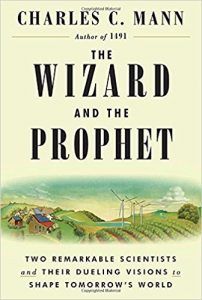
In The Wizard and the Prophet (2018), Charles C. Mann maintains that intellectual life in the 21st century is defined by a civil war between Wizards, who believe that technology will save us, and Prophets, who see various kinds of disaster on the horizon: “Prophets look at the world as finite, and people as constrained by their environment. Wizards see possibilities as inexhaustible, and humans as wily managers of the planet. One views growth and development as the lot and blessing of our species; others regard stability and preservation as our future and our goal. Wizards regard Earth as a toolbox, its contents freely available for use; Prophets think of the natural world as embodying an overarching order that should not casually be disturbed.” Steven Pinker, the author of Enlightenment Now: The Case for Reason, Science, Humanism, and Progress (2018), is a Wizard. Yuval Noah Harari, the author of Homo Deus: A Brief History of Tomorrow (2015), is a Prophet.

At its best, Enlightenment Now reads like one of those gratitude journals self-help authors tell us to keep: “Today I am thankful for . . . .” Pinker reminds us of what we in the chattering classes too often forget: namely, that modernity has for the most part been a major upgrade for humanity: “The story of human progress is truly heroic. It is glorious . . . We live longer, suffer less, learn more, get smarter, and enjoy more small pleasures and rich experiences. Fewer of us are killed, assaulted, enslaved, oppressed, or exploited by the others. From a few oases, the territories with peace and prosperity are growing, and could someday encompass the globe.”

More here.

Due Process

Lewis H. Lapham in Lapham’s Quarterly:

To pick up on almost any story in the news these days—political, financial, sexual, or environmental—is to be informed in the opening monologue that the rule of law is vanished from the face of the American earth. So sayeth President Donald J. Trump, eight or nine times a day to his 47 million followers on Twitter. So sayeth also the plurality of expert witnesses in the court of principled opinion (media pundit, Never Trumper, think-tank sage, hashtag inspector of souls) testifying to the sad loss of America’s democracy, a once upon a time “government of laws and not of men.” The funeral orations make a woeful noise unto the Lord, but it’s not clear the orators know what their words mean or how reliable are their powers of observation. The American earth groans under the weight of legal bureaucracy, the body politic so judiciously enwrapped and embalmed in rules, regulations, requirements, codes, and commandments that it bears comparison to the glorified mummy of a once upon a time great king in Egypt. Senior statesmen and tenured Harvard professors say the rule of law has been missing for three generations, ever since President Richard Nixon’s bagmen removed it from a safe at the Watergate. If so, who can be expected to know what it looks like if and when it shows up with the ambulance at the scene of a crime? Does it come dressed as a man or a woman? Blue eyes and sweet smile riding a white horse? Black uniform, steel helmet, armed with assault rifle? Or maybe the rule of law isn’t lost but misplaced. Left under a chair on Capitol Hill, in a display case at the Smithsonian, scouting locations for Clint Eastwood’s next movie.

…Ronald Reagan was elected president in 1980 to restore America to its rightful place “where someone can always get rich,” his attitude and agenda not unlike Donald Trump’s, and by 1984 everywhere in the society, money was seen to be the hero with a thousand faces, greed the creative frenzy from which all blessings flow. What was billed as the Reagan Revolution and the dawn of a new Morning in America united the many and various parties of the right (conservative, neoconservative, libertarian, reactionary, evangelical, the Ku Klux Klan, and the Koch brothers) under one flag of transcendent and absolute truth—money ennobles rich people, making them healthy, wealthy, and wise; money corrupts poor people, making them lazy, ignorant, and sick. The doctrine of enlightened selfishness rebranded as neoliberalism has remained in power in Washington for the past thirty years. The separation of values treasured by a capitalist economy from those cherished by a democratic society has resulted in the accumulation of more laws limiting the freedom of persons, fewer laws restraining the license of property, the letting fall into disrepair of nearly all the infrastructure (roads, schools, rivers) that provides the citizenry with the ways and means of its common enterprise.

More here.