
Adam Entous in The New Yorker:
 One afternoon in the spring of 2015, a senior State Department official named Frank Lowenstein paged through a government briefing book and noticed a map that he had never seen before. Lowenstein was the Obama Administration’s special envoy on Israeli-Palestinian negotiations, a position that exposed him to hundreds of maps of the West Bank. (One adorned his State Department office.)
Typically, those maps made Jewish settlements and outposts look tiny compared to the areas where the Palestinians lived. The new map in the briefing book was different. It showed large swaths of territory that were off limits to Palestinian development and filled in space between the settlements and the outposts. At that moment, Lowenstein told me, he saw “the forest for the trees”—not only were Palestinian population centers cut off from one another but there was virtually no way to squeeze a viable Palestinian state into the areas that remained. Lowenstein’s team did the math. When the settlement zones, the illegal outposts, and the other areas off limits to Palestinian development were consolidated, they covered almost sixty per cent of the West Bank.
More here.
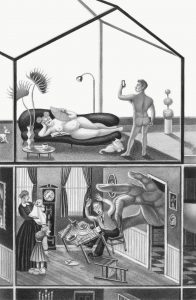 WHAT DO WE LOSE WHEN WE LOSE OUR PRIVACY?
 O
O Still, signs of considerable inner turbulence beneath the unruffled surface Powell presented to the world were there. He suffered from nearly permanent insomnia (‘In my early days I never slept a wink’), late on installing a camp bed by his desk so as not to keep his wife awake too. Prey not only to bouts of paralysing accidie, ‘the feeling that nothing’s worth doing’, but to spells of black depression – after an unsuccessful sortie to Hollywood in 1937, and in still more acute form, on returning to civilian life again after the war, when ‘every morning he wished he were dead’ – in his memoirs he implied a rather different explanation for having nothing to say when asked about his character, observing that ‘not everyone can stand the strain of gazing down too long into the personal crater, with its scene of Hieronymus Bosch activities taking place in the depths.’ Spurling, tacitly treating his depressions as discrete episodes, without much bearing on what he may have been like at some deeper level, does not recall this graphic image. Reluctance to venture much psychological surmise after Powell landed in London is visible in other ways. Reporting his claim never to have raised his voice again after leaving Eton, she later shows he was not so imperturbable: ‘rage and frustration’ at the tedium and inanity of life in the army ‘drove him to the kind of explosion he had witnessed as a child from his father’; he ‘lost control’ after Graham Greene’s obstruction of his book on Aubrey; he was hopelessly drunk with ‘unguarded anger, bitterness and shock’ on dismissal as literary editor at Punch; he severed his long-standing ties with the Daily Telegraph in ‘grief and rage’ at infantile barbs from the junior Waugh.
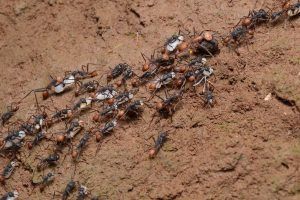 Army ant (Eciton) soldiers are bigger but do not have larger brains than other workers within the same colony that fulfill more complex tasks, according to a study published in the open access journal BMC Zoology. A collaborative team of researchers led by Drexel University in Philadelphia, US and German colleagues suggests that because the very specific and limited tasks soldiers fulfill place limited cognitive demands on them, investment in the development of brain tissue is also limited. Prof. Sean O’Donnell, lead author of the study said: “To compare different types of ant castes—soldiers and other workers—we took advantage of the dramatically distinct soldier class of workers in Eciton army ant colonies. Soldiers are morphologically distinct—they are bigger than their nest mates—but also behaviorally distinct: they have a simpler behavioral repertoire. Our findings support the idea that the simple behaviors of soldiers allow for reduced investment in brain development.”
 As stories of immigrant children separated from their parents after crossing the U.S.-Mexico border dominated headlines last month, one question came up repeatedly: Where are the children being held?
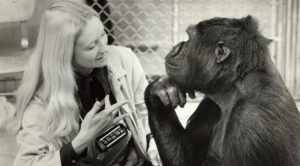 It’s a tantalising notion that the faculty of language may be attainable by other species. However, the case of Koko does not demonstrate this. Our report, by Ben Hoyle,
 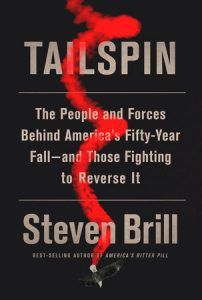 According to Gallup, in the first week of January 2004 more than half of surveyed Americans were satisfied with the direction of the country. Within a few weeks, however, that number had fallen below 50 percent. It has never recovered. Since the 2008 financial crisis, it has not cracked 40 percent. For well over a decade,
 ARE WE ON the cusp of a new age of African literature? If so, the key to new novels from African writers seems to be the fresh use of historical fiction to articulate a new future.
 Candy begins with exhilarating precision; the opening chapters are my favorite pages of any book ever written, with its exquisitely tuned language guiding us through an ecstatic parody of outrageous ego-driven meaninglessness, pulled off with the combination of subtle precision and insane audacity that you might find in a pilot successfully flying a plane under the Brooklyn Bridge. As it continues, the book’s writing gradually collapses, with an entropy that might well be described as obscene, into a tone of sloppy, lascivious wildness that syncs well with its plot. Along the way, it goes on extremely unnecessary tangents to satirize nearly everything imaginable to an audience of its time: psychotherapy, New York City, Hollywood screenwriting, Jewish mothers, quack doctors, New Age healing, progressive causes, pretension, naïveté, innocence, idealism, corruption, generosity, selfishness, spiritual searching, gurus, the male gaze, awareness of the male gaze, “daddy issues,” sexual repression, sexual liberation—as one review suggested, sex itself—and perhaps most of all, the reader who would buy such a book—a person they surely pictured on the banks of the Seine, scratching his head as to what the hell he was reading and whether it was turning him on or not.
 There can be few more compelling subjects for a biography than Charles de Gaulle, the modern symbol of French grandeur. During his remarkable political career, he twice rescued his country from disaster: first through his bold leadership of the Resistance after France’s defeat by the Nazis in 1940, and later by his skilful handling of the crisis provoked by the Algerian war of national liberation. As the founder of the Fifth Republic in 1958, he redesigned France’s political system along presidential lines, and his shadow has loomed heavily over all his successors (on his official photograph, Emmanuel Macron’s most prominent talisman is an open copy of de Gaulle’s War Memoirs). Once reviled by liberals and progressives for his authoritarianism, and by the extreme Right for his anti-fascism and anti-colonialism, de Gaulle is now celebrated by the entire French political class. Indeed, le grand Charles has become the nation’s most revered historical figure, with thousands of streets, schools and public squares across France bearing his name. His vision of Frenchness has reshaped his compatriots’ sense of their collective self, and of their country’s rightful place in the world. To understand de Gaulle, in sum, is to appreciate what it means to be French, both intellectually and emotionally.
 Eric Lundgren, the 33-year-old, fedora-wearing CEO of a major electronic waste recycling plant in Los Angeles, could be called both the Elon Musk and the Edward Snowden of e-waste. Elon Musk because in 2017 he built an electric car out of recycled batteries that broke the world record for electric vehicle range. Edward Snowden because he’s currently serving a prison sentence for copyright infringement, as a result of printing 28,000 Windows restore disks to be distributed with repaired computers. Lundgren’s court case and electronic creations have made him an icon for the Right to Repair Movement and e-waste reuse.
 At the time my wife and I were beginning to date, I owned a broken bed. The box spring had a biggish crack on one side, which caused you to feel like you were being gradually swallowed in the night—an effect seriously exacerbated by the presence of a second person. I had not bothered to buy pillows when I moved to Milwaukee, reasoning that old pants stuffed in a pillowcase could not possibly feel that different. I did, however, have a desk, which I had carried from the Salvation Army, a mile and a half, on my shoulders, in August. I should mention here that I have never been what anyone would consider macho. It simply hadn’t occurred to me that I was allowed to live any other way.
 In a recent Nature Sustainability
  On 3 May, at around 4.45pm, a short, trim Indian man walked quickly down London’s Old Compton Street, his head bowed as if trying not to be seen. From his seat by the window of a nearby noodle bar, Anuvab Pal recognised him instantly. “He is tiny, and his face had been all over every newspaper in