
by Tim Sommers
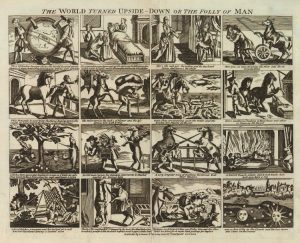
Do You Own Yourself?
In 1646, the Leveller leader, Richard Overton became the first person in the English-speaking world to assert that we own ourselves. “To every Individuall in nature, is given an individuall property by nature, not to be invaded or usurped by any,” he wrote, “for every one as he is himselfe, so he has a selfe propriety, else he could not be himself.”
We might question the claim that without owning ourselves we couldn’t be ourselves. After all, we don’t need ownership, or property law, to explain why my beliefs are mine or why my actions are mine.
But it’s easy to appreciate the political strategy behind Overton’s use of self-ownership – once you hear it.
The Levellars, so-named originally by opponents for supposedly having leveled hedges during the enclosure riots, were the egalitarians of the English Civil War preaching that sovereignty was founded on consent and that the franchise and property ownership should be extended to all men. Overton was responding to the argument that only men of property should be allowed to vote, when he wrote that all men are men of property, because all men have property in themselves.
Do they, though? It sounds plausible. But do you own yourself?
Actually, that’s an easy one. Ownership is a legal notion. In no legal system in the world do you own yourself. (About as close as you can come to a legal precedent, in American law, that might be interpreted as supporting self-ownership has to do with copyright: celebrities do, at least to some extent, own the use of their image for commercial purposes.)
But even if you don’t own yourself, maybe, you should. Read more »

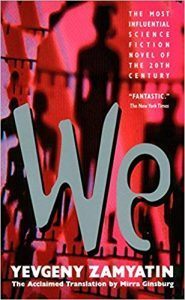 A number of scenes in Eugene Zamyatin’s dystopian novel
 It must be hard for
 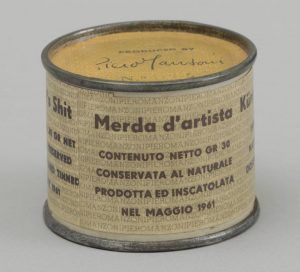 In 1961, Piero Manzoni created his most famous art work—ninety small, sealed tins, titled “Artist’s Shit.” Its creation was said to be prompted by Manzoni’s father, who owned a canning factory, telling his son, “Your work is shit.” Manzoni intended “Artist’s Shit” in part as a commentary on consumerism and the obsession we have with artists. As Manzoni put it, “If collectors really want something intimate, really personal to the artist, there’s the artist’s own shit.”
 As the EU struggles to rein in some member states that are backsliding on democratic standards, a critical vote in the European Parliament next week could be a decisive moment.
 On a late Friday afternoon in November last year,
  In a
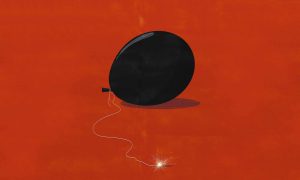
In a  It could all go wrong in an instant. In Yasmina Reza’s unsettling new novel, Elisabeth, the narrator, looks back on an evening in a Paris suburb that began in the most ordinary way — a casual evening party for family, friends and neighbors — and ended in catastrophe. The nature of the disaster unfolds across a brisk 200 pages, but it is foreshadowed from the very beginning, when Elisabeth observes her neighbor, Jean-Lino, rigid in an uncomfortable chair, surrounded by the detritus of the festivities, “all the leavings of the party arranged in an optimistic moment. Who can determine the starting point of events?”
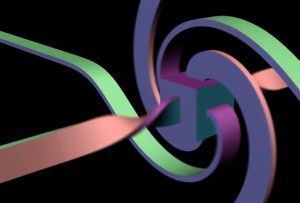 Imagine winding the hour hand of a clock back from 3 o’clock to noon. Mathematicians have long known how to describe this rotation as a simple multiplication: A number representing the initial position of the hour hand on the plane is multiplied by another constant number. But is a similar trick possible for describing rotations through space? Common sense says yes, but William Hamilton, one of the most prolific mathematicians of the 19th century, struggled for more than a decade to find the math for describing rotations in three dimensions. The unlikely solution led him to the third of just four number systems that abide by a close analog of standard arithmetic and helped spur the rise of modern algebra.
 On February 22, 2012, when the British photojournalist Paul Conroy survived the artillery barrage that
  The human mind wants to worry. This is not necessarily a bad thing — after all, if a bear is stalking you, worrying about it may well save your life. Although most of us don’t need to lose too much sleep over bears these days, modern life does present plenty of other reasons for concern: terrorism, climate change, the rise of A.I., encroachments on our privacy, even the apparent decline of international cooperation.
 The notion of mattering is intimately linked with the notion of attention. To say that something matters is to assert that attention is due it, the kind of attention that both recognises and reveals its reality. Something that matters has a nature that demands to be known, and the knowledge may yield other attitudes and behaviour due it. If I say that something doesn’t matter, I’m saying that it’s not worth paying attention to.
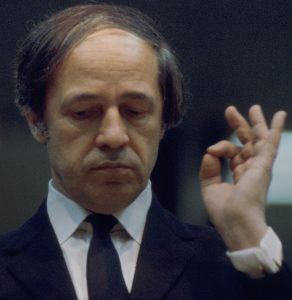 Can a melody provide us with pleasure? Plato certainly thought so, as do many today. But it’s incredibly difficult to discern just how this comes to pass. Is it something about the flow and shape of a tune that encourages you to predict its direction and follow along? Or is it that the lyrics of a certain song describe a scene that reminds you of a joyful time? Perhaps the melody is so familiar that you’ve simply come to identify with it.