
Eric Boodman in Stat News:

WASHINGTON — As deals struck by health care behemoths go, this was one of the stranger ones. On one side, you had a medical device giant, with a phalanx of PR professionals carefully guarding the company’s image. On the other, you had a consultant who didn’t sound much like a consultant:
“I am synthetic life form ‘Yoko K.,’ assembled in the US with components made in Japan,” one of her websites explained. “I am designed to assume the role of an ‘electronic musician.’ I am one of many secret agents sent to this time to plant magical thinking in people through the use of ‘pre-22nd century nostalgia Mars pop music.’”
In other words, Yoko K. Sen is an ambient electronic musician, born in Japan but transplanted to the United States, where she’s layered her breathy, machine-modulated vocals over ethereal blooms of synth at galleries, in concert halls, and on award-winning albums. In recent years, though, she’s created a new, more corporate niche for herself: revamping the soundscape in hospitals. Medtronic had hired her, late in 2017, for a related project, to help design the beeps patients would hear from their cardiac monitors at home.
We live in an era of constant redesigns, and health care — with its cheerless institutional bent and vomit-like color palette — has proven especially ripe for reimagining. Fashion icons have taken on the hospital gown. Architects have gone after the hospital room, and celebrity chefs have barged into the cafeteria. One bigwig San Francisco designer even tried to rebrand death. You name it, there’s probably someone out there working to give it a makeover. And sometimes, these aesthetic changes might just save lives. As the New York Times reported in 2014, when patients moved into homier hospital rooms as a test, they not only felt more comfortable but also requested less pain medication.
More here.

 Little Miracles 2:


 A number of scenes in Eugene Zamyatin’s dystopian novel
 It must be hard for
 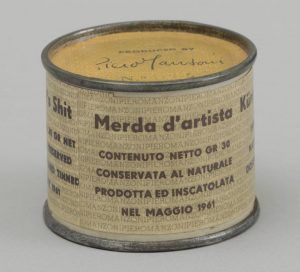 In 1961, Piero Manzoni created his most famous art work—ninety small, sealed tins, titled “Artist’s Shit.” Its creation was said to be prompted by Manzoni’s father, who owned a canning factory, telling his son, “Your work is shit.” Manzoni intended “Artist’s Shit” in part as a commentary on consumerism and the obsession we have with artists. As Manzoni put it, “If collectors really want something intimate, really personal to the artist, there’s the artist’s own shit.”
 As the EU struggles to rein in some member states that are backsliding on democratic standards, a critical vote in the European Parliament next week could be a decisive moment.
 On a late Friday afternoon in November last year,
  In a
In a  It could all go wrong in an instant. In Yasmina Reza’s unsettling new novel, Elisabeth, the narrator, looks back on an evening in a Paris suburb that began in the most ordinary way — a casual evening party for family, friends and neighbors — and ended in catastrophe. The nature of the disaster unfolds across a brisk 200 pages, but it is foreshadowed from the very beginning, when Elisabeth observes her neighbor, Jean-Lino, rigid in an uncomfortable chair, surrounded by the detritus of the festivities, “all the leavings of the party arranged in an optimistic moment. Who can determine the starting point of events?”