
Category: Recommended Reading
We Didn’t Know We Needed Mongolian Folk Rock Until We Heard It
James Lanka in Phantom Sway:
 I can’t understand the words. Heck, I can’t even identify all the instruments these guys are playing, but I am loving The HU.
Finding their video was just a happy accident thanks to whatever arcane divination is behind YouTube’s recommendation algorithm. For some serendipitous reason, it served up The HU’s video for Yuve Yuve Yu and I had to check it out.
Four guys looking like warriors from another age playing wildly ornate instruments against a rugged backdrop of Eurasian wilderness—the video is visually stunning. The music is at once alien and familiar. The hooks and the driving beat are pure rock and roll while the instrumentation and vocals are something that many in the west will find entirely new.
More here.
Friday, November 30, 2018
The Illegitimacy of the Ruling Class
Thea N. Riofrancos in In These Times:
 Despite Christine Blasey Ford’s stirring testimony, an FBI investigation, thousands of protesters (hundreds of whom were arrested), petitions and phone calls from constituents, an elevator confrontation and a record-high disapproval rating, on October 6 the U.S. Senate confirmed Brett Kavanaugh’s nomination to the Supreme Court by a margin of two.
That evening, Kavanaugh was granted a lifetime appointment to a deeply undemocratic institution. He was confirmed by a legislative body that counts some votes more than others, giving the loudest voice (per capita) to the most sparsely populated states. The Senate’s majority vote represented a minority of Americans (44 percent). And Kavanaugh was selected by a president who lost the popular vote, a pedigree he shares with three of his esteemed colleagues: Neil Gorsuch, John Roberts and Samuel Alito.
It was, in other words, an egregious case of the system working precisely as designed. The framers of the Constitution imagined the Supreme Court, the Senate and the Electoral College to function as checks on the “tyranny of the majority”—in other words, to ensure white male landowners had the final say. Two centuries later, the women’s suffrage and civil rights movements expanded the franchise far beyond what the founders intended. But, thanks to unprecedented electoral spending by corporations and the wealthy, as well as rampant voter suppression—both of which were granted a constitutional green light by recent Supreme Court decisions—the Republican-led government has become increasingly unmoored from the people it ostensibly represents.
More here.
The Insect Apocalypse Is Here
Brooke Jarvis in the New York Times:
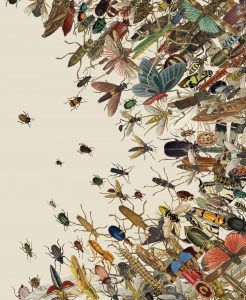 Sune Boye Riis was on a bike ride with his youngest son, enjoying the sun slanting over the fields and woodlands near their home north of Copenhagen, when it suddenly occurred to him that something about the experience was amiss. Specifically, something was missing.
It was summer. He was out in the country, moving fast. But strangely, he wasn’t eating any bugs.
For a moment, Riis was transported to his childhood on the Danish island of Lolland, in the Baltic Sea. Back then, summer bike rides meant closing his mouth to cruise through thick clouds of insects, but inevitably he swallowed some anyway. When his parents took him driving, he remembered, the car’s windshield was frequently so smeared with insect carcasses that you almost couldn’t see through it. But all that seemed distant now. He couldn’t recall the last time he needed to wash bugs from his windshield; he even wondered, vaguely, whether car manufacturers had invented some fancy new coating to keep off insects. But this absence, he now realized with some alarm, seemed to be all around him. Where had all those insects gone? And when? And why hadn’t he noticed?
More here. [Thanks to Brooks Riley.]
How monopolies have flourished—and undermined democracy
Ganesh Sitaraman in The New Republic:
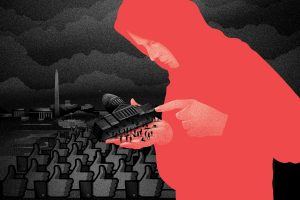 The last forty years have seen a transformation in American business. Three major airlines dominate the skies. About ten pharmaceutical companies make up the lion’s share of the industry. Three major companies constitute the seed and pesticide industry. And 70 percent of beer is sold to one of two conglomerates. Scholars have shown that this wave of consolidation has depressed wages, increased inequality, and arrested small business formation. The decline in competition is so plain that even centrist organizations like The Economist and the Brookings Institution have called for a reinvigoration of antitrust enforcement.
Antitrust law today is, however, very narrowly construed. The currently reigning paradigm originated in the 1970s with Robert Bork—the same Bork whom the Senate would later block from the Supreme Court. Bork’s book The Antitrust Paradox argued that the only goal of the antitrust laws was consumer welfare. This eagle-eyed focus was not only economically efficient, Bork and his followers pointed out, but easy for courts to administer, because consumer welfare could be measured in terms of prices: If prices are going down, the system is working. To abandon this standard, former FTC Commissioner Joshua Wright, a Republican, has said, “would be a monumental shift,” and “a dangerous one.”
More here.
Stephen Fry on Political Correctness and Clear Thinking
Iraq Dispatch: The Guardians of Culture
David Shook at The Believer:
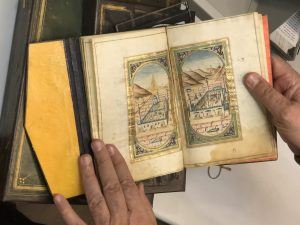 Much has been written about the courageous rebuilding of the Iraqi libraries destroyed by the Islamic State during its occupation of Mosul and other cities in the region. In adjacent Kurdish Iraq, the centuries-old struggle to build a repository of Kurdish culture and history has primarily and often necessarily continued with little visibility or fanfare, undertaken by willful idealists and brave individualists. Recently, I visited Zheen Archive Center, and met the people making that dream a reality. Here, two optimistic, broadminded brothers and an all-women team of crack manuscript preservationists are building a collection of books, manuscripts, and papers that have survived hundreds of years of language bans and the mass destruction of property that accompanied the countless murders of Saddam Hussein’s 1980s genocidal campaign, Anfal. Zheen—which means “life” in the Sorani dialect of Kurdish—houses the greatest collection of Kurdish cultural material of any other institution in the four contemporary nation-states that comprise the region of the Kurds, and probably the world. Remarkably, the Salih brothers formally founded Zheen in just 2004, and only acquired their present location, the nondescript four-story office building that houses its archives in northwest Sulaimani, in 2009.
more here.
The Power of Naming
Cecilia Sjöholm at Cabinet Magazine:
 No story captures the lonely act of naming as a truly human capacity better than Daniel Defoe’s novel Robinson Crusoe (1719), where it saves the shipwrecked Crusoe from disintegration. Here, the logic of naming acquires a new twist. Friday—not an animal, but an aboriginal from a nearby island—becomes the center of his universe, the saving grace of his dwindling powers of perception, the focal point in his attempts to restructure something that at least looks like a society. Friday is not particularly responsive. But Crusoe invents a whole new kind of mastery, one in which Friday, in fact, becomes wholly redundant. Crusoe does not need Friday to confirm his powers. He does not need such affirmation because he has invented the technology of naming. Friday is named after a day in the calendar, and not according to a higher principle. He is named according to a certain principle of contingency, an operation of chance that can be repeated, serially, in as many varieties and forms as one likes. The question is no longer if names come from God or not, but rather how we are to produce them in the most efficient manner possible.
more here.
The Frailty, Vanity and Duality of Saul Bellow
Leo Robson at The New Statesman:
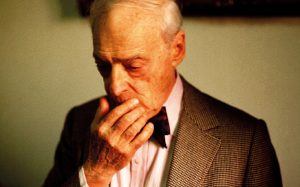 Is this a good moment – propitious, welcoming – for the appearance of a long, rich and unflaggingly detailed account of the later life of Saul Bellow? Ten years in the making, Zachary Leader’s biography was rubber-stamped at an earlier and distinctively different point in time. Then, the writer still reflected the glow of adulation – from the reviews of James Atlas’s single-volume biography Bellow(2000); his final novel Ravelstein (2000) and his Collected Stories (2001); from the 50th-anniversary tributes to The Adventures of Augie March in 2003 and the appearance, the same year, of the Library of America compendium, Novels 1944-1953; and from the obituaries and memorial essays that appeared on his death in 2005, aged 89. When, around that time, I starting getting interested in fiction, I was made to feel about Bellow’s writing more or less what Charlie Citrine, in Humboldt’s Gift (1975), recalls feeling about Leon Trotsky in the 1930s – that if I didn’t read him at once, I wouldn’t be worth conversing with.
more here.
Friday Poem
(Following Hurrican Katrina) Ethel Freeman’s body sat for days in her wheelchair
outside the New Orleans Convention Center. Her son Herbert, who had assured his
mother that help was on the way, was forced to leave her there once she died.
Ethel’s Sestina
Gon’ be obedient in this here chair,
gon’ bide my time, fanning against this sun.
I ask my boy, and all he says is Wait.
He wipes my brow with steam, says I should sleep.
I trust his every word. Herbert my son.
I believe him when he says help gon’ come.
Been so long since all these suffrin’ folks come
to this place. Now on the ground ’round my chair,
they sweat in my shade, keep asking my son
could that be a bus they see. It’s the sun
foolin’ them, shining much too loud for sleep,
making us hear engines, wheels. Not yet. Wait.
Lawd, some folks prayin’ for rain while they wait,
forgetting what rain can do. When it come,
it smashes living flat, wakes you from sleep,
eats streets, washes you clean out of the chair
you be sittin’ in. Best to praise this sun,
shinin’ its dry shine. Lawd have mercy, son,
is it coming? Such a strong man, my son.
Can’t help but believe when he tells us, Wait.
Wait some more. Wish some trees would block this sun.
We wait. Ain’t no white men or buses come,
but look—see that there? Get me out this chair,
help me stand on up. No time for sleepin’,
cause look what’s rumbling this way. If you sleep
you gon’ miss it. Look there, I tell my son.
He don’t hear. I’m ’bout to get out this chair,
but the ghost in my legs tells me to wait,
wait for the salvation that’s sho to come.
I see my savior’s face ’longside that sun.
Nobody sees me running toward the sun.
Lawd, they think I done gone and fell asleep.
They don’t hear Come.
First law of leadership: be human first, scientist second
Alisen Antes in Nature:
 “I was a human first, and then I learned to be a scientist. If I forget the human part, then that’s a problem.” This is what I heard when I interviewed 52 scientists recognized as exemplary by their peers for their scientific accomplishments and conduct. Related themes come up in my work with scientists who have been referred to a formal remediation programme after lapses in research integrity. I’m an organizational psychologist, specializing in the scientific workplace. What interests me are the decisions and behaviours that yield innovative, rigorous, ethical research. The past few months have drawn attention to unhealthy working environments, especially bullying in academia. We should also focus on a related, widespread problem: mentors who have excellent intentions but limited knowledge of how to create a healthy workplace. Many scientists whom I work with feel that they lack management and leadership skills. They want help with concrete tasks such as coordinating projects or facilitating meetings. But what comes up most emphatically is that conducting research requires them to establish and maintain positive relationships in the lab.
Many researchers in our remediation programme have had strained interactions with compliance officers and have struggled in their roles as supervisors. By contrast, exemplars resoundingly emphasize how they foster good team dynamics by being involved, approachable and aware of the workplace atmosphere. As one told me: “Rule number one in the lab is harmony. First and foremost, we have to get along, we have to respect each other, we have to trust each other, and that is the operating principle for everything else.” Yet, given the choice between working on a scientific paper or broaching a difficult conversation, many researchers pick the former — the task that feels most directly connected to research goals. Principal investigators might need to work consciously against the feeling that ‘nothing is getting done’ during personal interactions. Because, whether it is mentoring a struggling trainee or celebrating a hard-won achievement, investing in strong, respectful relationships is an investment in effective science.
So, what to do? All principal investigators should add relationship building to their to-do lists.
More here.
How free is free love? How polyamory lost its allure
Lara Feigel in The Guardian:
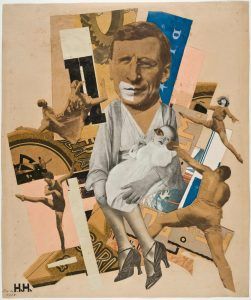 In 1919 the German Dada artist Raoul Hausmann dismissed marriage as “the projection of rape into law”. It’s a statement that relishes its own violence: he is limbering up to fight marriage to the death. A strange mixture of dandy, wild man, provocateur and social engineer, Hausmann believed that the socialist revolution the Dadaists sought couldn’t be attained without a corresponding sexual revolution. And he lived as he preached. He was married, but was also in a four-year relationship with fellow artist Hannah Höch. Hausmann and Höch form one of the couples in the Barbican’s Modern Couples exhibition, which shows the freewheeling experimentation of interwar art to be inseparable from even more extravagant experiments in sexuality and coupledom. The exhibition includes several of the partly whimsical, partly grim collages Höch made at this time. Bobbing her hair and smoking in public, Höch was a self-styled “new woman” who shared Hausmann’s carnivalesque contempt for bourgeois morality. Her Bourgeois Wedding Couple (Quarrel) photomontage from 1919 satirises the married pair as ungainly children. The bride teeters on the boots of a grown-up woman, but she has the body of a mannequin and the face of an overgrown baby whose tantrum is observed by her childlike spouse.
However, the alternative to bourgeois marriage wasn’t obviously promiscuity for Höch in the way it was for Hausmann. Years later, she described being “disappointed, crushed, destroyed” by the double standards of the Dadaist men, who wanted to free women while remaining obdurately patriarchal.
More here.
Thursday, November 29, 2018
Meditation Is a Powerful Mental Tool—and For Some People It Goes Terribly Wrong
Shayla Love in Vice:
 Last November, on the Monday before Thanksgiving, David* was sitting in traffic on his drive home from work. He was suddenly overwhelmed by the realization that everything he experienced was filtered through his brain, entirely subjective, and possibly a complete fabrication.
“Not a unique or deep thought to be sure, but I felt the world drop out from under me and experienced panic—and a certainty that, if I chose to, I could go insane at that very moment,” he tells me. He rolled down the window, turned on the radio, and carefully made his way home.
That night, he couldn’t fall asleep. He would get very tired, come close to nodding off, and then a jolt of energy would shock him awake. “I was very shaken, suffering chest tension and nausea,” he says. “This continued unabated for six days during which I estimate I slept for a total of six hours. On Sunday evening I went to the emergency room.”
David had a hunch about what had caused his panic attack: his meditation practice.
More here.
What can psychology tell us about music?
Elizabeth Hellmuth Margulis at the blog of the Oxford University Press:
 Music can intensify moments of elation and moments of despair. It can connect people and it can divide them. The prospect of psychologists turning their lens on music might give a person the heebie-jeebies, however, conjuring up an image of humorless people in white lab coats manipulating sequences of beeps and boops to make grand pronouncements about human musicality.
In truth, that’s historically rather how music psychology used to work. In the early 1900s, elaborate mechanical apparatus were devised that purported to determine a child’s musical potential by measuring their perceptual acuity on tasks such as loudness discrimination. Measuring musical aptitude with performance on an acoustic judgment task misses out on what might be even more essential factors—say, the degree to which music captivates a child’s attention or inspires them to move.
But contemporary work on music perception embraces a variety of disciplines and methodologies, from anthropology to musicology to neuroscience, to try to understand the relationship between music and the human mind. Researchers use motion capture systems to record people’s movements as they dance, analyzing the gestures’ relationship to the accompanying sound. They use eye tracking to measure changes in infants’ attentiveness as musical features or contexts vary. They place electrodes on the scalp to measure changes in electrical activity, or use neuroimaging to make inferences about the neural processes that underlie diverse types of musical experiences, from jazz improvisation to trance-like states to simply feeling a beat.
More here.
What an Obscure German Novel Taught Me About Dictators
Jens Kruse in Politico:
 I was born in Hamburg, Germany, in 1949, so I grew up playing cowboys and Indians with my cousins in the rubble fields of my native city. Family lore had it that my mother, who had survived the Hamburg firestorm of 1943, made me baby shirts from the sugar bags that came in American care packages. Her father had been sent to a concentration camp during the early days of the Nazi dictatorship because he collected dues for an illegal union; fortunately, he survived. Because of the housing shortage caused by the bombings, my parents and I, for the first 11 years of my life, lived in a one-room apartment. Suffice it to say my childhood was a daily reminder of the catastrophic consequences of the destruction of the Weimar democracy and the rise of Adolf Hitler.
The other constant of my early life was a presence of things American that went beyond the baby shirts with “SUGAR” stamped on them. Even though we lived in the British occupation zone, American movies played at the local movie theater where my mother worked, and Bill Haley & His Comets were my father’s favorite rock ’n’ roll band. My father had been a prisoner of war of the Americans, and while he almost never talked about the war itself, he talked frequently about those years from 1945 to 1947 in camps in Germany, Holland and France. The Americans, he said, treated and fed him well and taught him to drive a 2.5-ton truck. When my parents traveled to the U.S. for the first time for my wedding to a wonderful American woman—six years after I had visited the U.S. for the first time and three years after I had spent a year at Indiana University as an exchange student—he brought his decades-old POW driver’s license in hopes that my father-in-law would let him drive his car.
More here.
The Philosophy of Ludwig Wittgenstein
Who Built the Pyramids? Not slaves
Jonathan Shaw in Harvard Magazine:
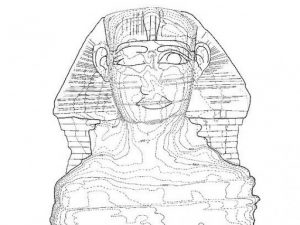 The pyramids and the Great Sphinx rise inexplicably from the desert at Giza, relics of a vanished culture. They dwarf the approaching sprawl of modern Cairo, a city of 16 million. The largest pyramid, built for the Pharaoh Khufu around 2530 B.C. and intended to last an eternity, was until early in the twentieth century the biggest building on the planet. To raise it, laborers moved into position six and a half million tons of stone—some in blocks as large as nine tons—with nothing but wood and rope. During the last 4,500 years, the pyramids have drawn every kind of admiration and interest, ranging in ancient times from religious worship to grave robbery, and, in the modern era, from New-Age claims for healing “pyramid power” to pseudoscientific searches by “fantastic archaeologists” seeking hidden chambers or signs of alien visitations to Earth. As feats of engineering or testaments to the decades-long labor of tens of thousands, they have awed even the most sober observers.
The question of who labored to build them, and why, has long been part of their fascination. Rooted firmly in the popular imagination is the idea that the pyramids were built by slaves serving a merciless pharaoh. This notion of a vast slave class in Egypt originated in Judeo-Christian tradition and has been popularized by Hollywood productions like Cecil B. De Mille’s The Ten Commandments, in which a captive people labor in the scorching sun beneath the whips of pharaoh’s overseers. But graffiti from inside the Giza monuments themselves have long suggested something very different.
More here.
Thursday Poem
Kookaburra
So big in life, head like a chopping block
Beak like a carving knife,
His hysterical voice cracked branches, his laugh
Stripped bark from the wood-borers.
But in the twilight something got him,
So close to the house I should have heard.
He was left like a taunt, a dead bird
By an empty chicken run.
Now his dusk-stained feathers rock
In their dead grass cradle,
His bitten body is the flame
From which these moths escape.
That beak is buried in the sucked-out skull
Where eyes were lost in another mouth. His small crate,
Ant-eaten already, has ribs open like rafters
To welcome flies, and his wings rest like two open fans beside him.
Stripped of what made him
He is only a fraction of his noise.
by Frieda Hughes
from Wooroloo
HarperCollins, 1998
Pärt mournful, Pärt majestic
Hannah Neimeier at The New Criterion:
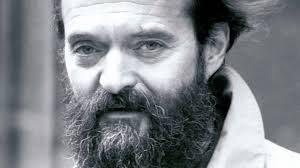 Arvo Pärt (b. 1935) is one of those fortunate composers who has created his own world in music—and is beloved for it in his lifetime. The Estonian, who for the last decade has been the world’s most performed living composer, started his career writing neoclassical pieces influenced by the Russian greats, chiefly Prokofiev and Shostakovich. Then he discovered Schoenberg’s twelve-tone scale, serialism, and other twentieth-century experimental techniques and soon became a prominent member of the avant-garde. But Soviet censors disapproved, and in the late 1960s their unofficial censorship removed Pärt’s music from concert programs and sent him into what he called a “period of contemplative silence.”
For years he composed nothing, instead studying medieval choral music intensely in an attempt to find the roots of Western music. These transformative periods of creativity and reflection have marked the rhythm of Pärt’s career, and in 1976 emerged from his longest silence yet with a focus on sacred music and an entirely new mode of composition: tintinnabuli.
more here.
Meghan O’Gieblyn’s Interior States
Joseph Hogan at The Point:
 But it wasn’t as if, by leaving church, I could escape. In the Midwest, everything is haunted by Jesus: the Rust Belt towns, the long gray freeways; county fairs in the summer with headlining Christian bands; breweries full of wholesome Christian hipsters in warm sweaters, Iron and Wine or Sufjan Stevens on the sound system. After belief, I didn’t want to drive through the suburbs and come upon some postwar church with hymnals full of David Haasand Marty Haugen songs. Even living near Lake Michigan became impossible. I’d drive to the lake after work and walk along the beach as the sun set, moodily brooding. The lake had its own extra-diegetic soundtrack, from the “Pure Michigan” campaign, which O’Gieblyn describes as evoking the kind of “autumnal sentimentalism” that “animates Starbucks ads and late-career Diane Keaton films.” She notes that you can easily imagine the voice over the ads—Middle America’s dad, Tim Allen—as belonging “to God himself.”
more here.