
George Dvorsky in Gizmodo:
 It’s a huge day for archaeologists and anyone interested in the history of America’s first settlers. Findings from three new genetics studies—all released today—are presenting a fascinating, yet complex, picture of the first people in North and South America, and how they spread and diversified across two continents.
Our understanding of how the Americas were first settled used to be simple. Today, it’s not.
North America’s first migrants, we’ve been told, spilled into the continent at the tail end of the last Ice Age some 15,000 years ago, either by trekking along the West Coast and/or through an interior land route. Eventually, this population found itself south of a massive ice sheet covering North America from coast to coast. From here, scientists assumed that, as populations moved southward, some groups split off, never to meet again. Gradually, this pattern of southward migration and dispersal resulted in the peopling of the Americas.
But as the new research released today suggests, it’s considerably more complicated than that. Humans, as we’re all too aware, aren’t so predictable.
More here.
 It’s fun to be in the exciting, chaotic, youthful days of the podcast, when anything goes and experimentation is the order of the day. So today’s show is something different: a solo effort, featuring just me talking without any guests to cramp my style. This won’t be the usual format, but I suspect it will happen from time to time. Feel free to chime in below on how often you think alternative formats should be part of the mix.
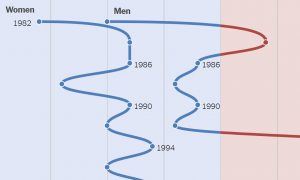 In the 2016 presidential election, 55 percent of white women voted for Republicans. And this year, the group backed Democrats and Republicans evenly.
 The fascination of what’s difficult,” wrote WB Yeats, “has dried the sap out of my veins … ” In the press coverage of this year’s Man Booker prize winner, Anna Burns’s
  The futurist philosopher Yuval Noah Harari worries about a lot. He worries that Silicon Valley is undermining democracy and ushering in a dystopian hellscape in which voting is obsolete. He worries that by creating powerful influence machines to control billions of minds, the big tech companies are destroying the idea of a sovereign individual with free will. He worries that because the technological revolution’s work requires so few laborers, Silicon Valley is creating a tiny ruling class and a teeming, furious “useless class.” But lately, Mr. Harari is anxious about something much more personal. If this is his harrowing warning, then why do Silicon Valley C.E.O.s love him so? “One possibility is that my message is not threatening to them, and so they embrace it?” a puzzled Mr. Harari said one afternoon in October. “For me, that’s more worrying. Maybe I’m missing something?”
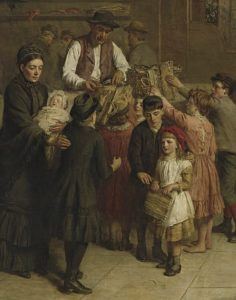 Following the sensational success of Thomas Piketty’s Capital in the Twenty-First Century, with no less than 2.5 million copies of the book sold worldwide, inequality is now widely perceived, to quote Bernie Sanders, as “the great moral issue of our time.” Clearly the shift is part of a wider transformation of American and European politics in the wake the 2008 crash that has turned the “1%” into an object of increasing attention. Marx’s Capital is now a bestseller in the “
 Because biology is the result of evolution and not human development, bringing engineering principles to it is guaranteed to fail. Or so goes the argument behind the “Grove fallacy,”
  Growing up, I never considered myself to be particularly nice, perhaps because I’m from a rural part of New Brunswick, one of Canada’s Maritime Provinces—the conspicuously “nicest” region in a self-consciously nice country. My parents are nice in a way that almost beggars belief—my mother’s tact is such that the strongest condemnation in her arsenal is “Well, I wouldn’t say I don’t like it, per se…” As for me, teenage eye-rolls gave way to undergraduate seriousness, which gave way to graduate-student irony. I thought of Atlantic Canadian nice as a convenient way to avoid telling the truth about the way things are—a disingenuous evasion of the nasty truth about the world. Even the word nice seems the moral equivalent of “uninteresting”—anodyne, tedious, otiose.
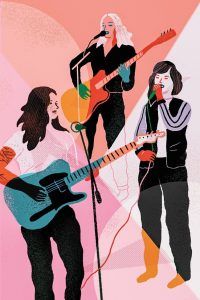 In 2016, the singer-songwriters Julien Baker, Lucy Dacus, and Phoebe Bridgers, who were all in their early twenties, were living parallel lives. They’d proved themselves to be careful and accomplished writers and performers, and had begun to attract attention from critics and labels alike. Each artist had crafted a distinct sound: Baker, a recovered opioid addict from Memphis, whose musical upbringing was in the Christian church, makes spare and swelling music that draws from the melodies and the ritualized melancholy of the emo world. Bridgers, a Los Angeles native who worshipped
 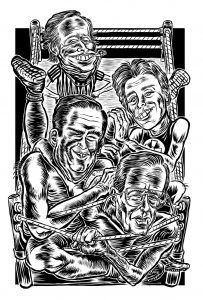 Who was the main enemy now? On the right, the answer increasingly was one another. In the 1980s, the conservative movement split into two warring factions—neoconservatives and paleo conservatives. The two sects fought over ideas, but also resources: comfortable think tank positions and administrative posts; grant money and the allegiance of the idle army of increasingly ideologically restive conservative activists who could scare up campaign contributions and votes.
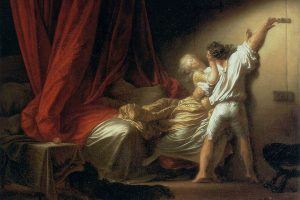 “Before the bedroom there was the room, before that almost nothing”, Perrot announces. She chooses to leapfrog over much medieval history and begin with a description of the king’s bedroom at Versailles under Louis XIV – an account for which she relies heavily on the memoirs of the duc de Saint-Simon, who spoke to the Sun King twice. Emmanuel Le Roy Ladurie is more thorough as an interpreter of the stultifying etiquette of the Versailles system, and Nancy Mitford much funnier; there is no fresh research or information in Perrot’s summary, which is at best indecisive as to the significance of the royal bedroom: “the king’s chamber guards its mysteries”. That said, we learn that Perrot intends to trace the origin of the desire for a “room of one’s own”, which mark of individualization is apparently less universal than it might appear. The Japanese had no notion of privacy, we are told, which might have come as news to the ukiyo-e artists of the seventeenth century; nonetheless, Perrot is broadly correct in her account of the evolution of private sleeping space as depending on the movement from curtained or boxed beds to separate chambers during the same period in Europe.
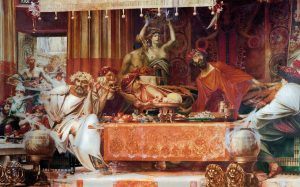 According to David Wootton, we are living in a world created by an intellectual revolution initiated by three thinkers in the 16th to 18th centuries. “My title is, Power, Pleasure and Profit, in that order, because power was conceptualised first, in the 16th century, by Niccolò Machiavelli; in the 17th century Hobbes radically revised the concepts of pleasure and happiness; and the way in which profit works in the economy was first adequately theorised in the 18th century by Adam Smith.” Before these thinkers, life had been based on the idea of a summum bonum – an all-encompassing goal of human life. Christianity identified it with salvation, Greco-Roman philosophy with a condition in which happiness and virtue were one and the same. For both, human life was complete when the supreme good was achieved.
 Of the many small humiliations heaped on a young oncologist in his final year of fellowship, perhaps this one carried the oddest bite: A 2-year-old black-and-white cat named Oscar was apparently better than most doctors at predicting when a terminally ill patient was about to die. The story appeared, astonishingly, in The New England Journal of Medicine in the summer of 2007. Adopted as a kitten by the medical staff, Oscar reigned over one floor of the Steere House nursing home in Rhode Island. When the cat would sniff the air, crane his neck and curl up next to a man or woman, it was a sure sign of impending demise. The doctors would call the families to come in for their last visit. Over the course of several years, the cat had curled up next to 50 patients. Every one of them died shortly thereafter. No one knows how the cat acquired his formidable death-sniffing skills. Perhaps Oscar’s nose learned to detect some unique whiff of death — chemicals released by dying cells, say. Perhaps there were other inscrutable signs. I didn’t quite believe it at first, but Oscar’s acumen was corroborated by other physicians who witnessed the prophetic cat in action. As the author of the article wrote: “No one dies on the third floor unless Oscar pays a visit and stays awhile.”
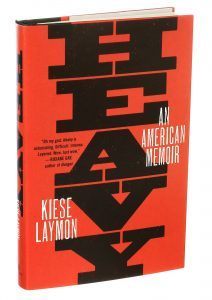 Kiese Laymon started his new memoir, “Heavy,” with every intention of writing what his mother would have wanted — something profoundly uplifting and profoundly dishonest, something that did “that old black work of pandering” to American myths and white people’s expectations. His mother, a professor of political science, taught him that you need to lie as a matter of course and, ultimately, to survive; honesty could get a black boy growing up in Jackson, Miss., not just hurt but killed. He wanted to do what she wanted. But then he didn’t.