
The Belly Dancer
Across the road the decorators have finished;
your flat has net curtains again
after all these weeks, and a ‘To Let’ sign.
I can only think of it as a tomb,
excavated, in the end, by
explorers in facemasks and protective spacesuits.
No papers, no bank account, no next of kin;
only a barricade against the landlord,
and the police at our doors, early, with questions.
What did we know? Not much: a Lebanese name,
a soft English voice; chats in the street
in your confiding phase; the dancing.
You sat behind me once at midnight Mass.
You were Orthodox, really; church
made you think of your mother, and cry.
From belly dancer to recluse, the years
and the stealthy ballooning of your outline,
kilo by kilo, abducted you.
Poor girl, I keep saying; poor girl –
no girl, but young enough to be my daughter.
I called at your building once, canvassing;
your face loomed in the hallway and, forgetting
whether or not we were social kissers,
I bounced my lips on it. It seemed we were not.
They’ve even replaced your window frames. I still
imagine a midden of flesh, and that smell
you read about in reports of earthquakes.
They say there was a heart beside your doorbell
upstairs. They say all sorts. They would –
who’s to argue? I don’t regret the kiss.
by Fleur Adcock
from Glass Wings
publisher: Bloodaxe, Newcastle, 2013
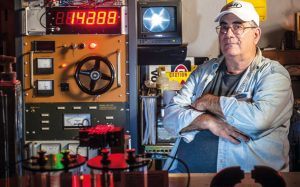 For his eighth birthday, Richard Hull’s mother bought him a Geiger counter. It was 1955 and the United States was testing nuclear weapons on its own soil. “They would always announce a test in the newspaper,” Hull remembers. “The material that went into the stratosphere drifted with the prevailing winds. The radioactive fallout particles came down with rain, as far north as New York and as far south as Georgia.” Hull lived then, as now, in Virginia, squarely in the path of the fallout that blew east from the bombs in the Nevada desert. “We would have days when we couldn’t have milk,” he remembers, “because of the strontium-90.” Hull wanted a Geiger counter not because he was afraid of radioactivity, but because he was enthralled by it. He pointed his new toy at anything that might make it tick, from wristwatches to rocks, and he collected fallout from the bombs. “I would take bird-bath water, or water that I gathered in pails from the downspouts of the house, and I would slowly evaporate that water on my mother’s stove, and that would leave the solids behind. And they were highly radioactive,” he says, with evident satisfaction.
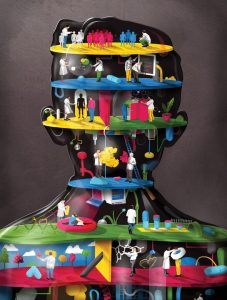 Doctors are not accustomed to making medication choices using genetics. What they have done, for decades, is to look at easily observed factors such as a patient’s age and weight and kidney or liver functions. They also considered what other medications a patient is taking and any personal preferences.
  Philosophers are supposed to ask Big Questions. The Big Questions is the title of a popular introduction to philosophy and of a long-running BBC programme in which people discuss their ethical and religious perspectives. But since we philosophers, following in the footsteps of Socrates, claim to practice critical thinking, it behooves us to ask whether Big Questions are a good idea.
 In his Critique of Pure Reason (1781) Kant claimed that in denying knowledge he was “making room for faith.” Inevitably, though, faith in God, the soul and the afterlife has declined dramatically since Kant’s time, especially among intellectuals. There are virtually no articles published in philosophy journals today that treat the existence of God or the immortality of the soul as live issues. Science does not explicitly teach us that there is no God and no heaven, any more than it teaches us that there are no fairies or vampires. But the default attitude of most professional philosophers today is that in such matters the absence of evidence amounts to evidence of absence.
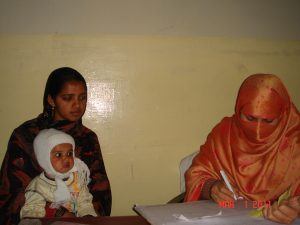 Mandra health center, outside Islamabad, on this spring morning, without the cacophony and confusion of health centers in the city, was the picture of serenity. An emaciated woman of indeterminate age sits coughing in the corridor, in a chair that bears the logo of the United States Agency for International Development, next to a little girl with dry shoulder length hair and yellow eyes, one bare foot resting upon the other. I make a provisional diagnosis—pulmonary tuberculosis for the woman, viral hepatitis for the girl, both diseases endemic in Pakistan.
 Academics have a privileged epistemic position in society. They deserve to be listened to, their claims believed, and their recommendations considered seriously. What they say about their subject of expertise is more likely to be true than what anyone else has to say about it.
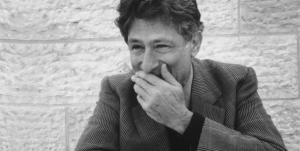 Edward Said’s
  When I was seven, my parents bought me and my brother an Atari 2600, the first mass game console. The game it came with was “Asteroids.” We played that game an awful lot. One night, we snuck down in the middle of the night only to discover my Dad already playing.
 Thomas Piketty, the French economist whose 2013 bestseller
 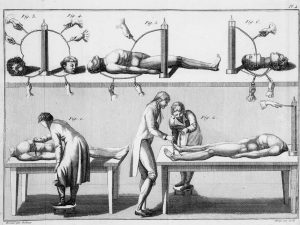 On 17 January 1803, a young man named George Forster was hanged for murder at Newgate prison in London. After his execution, as often happened, his body was carried ceremoniously across the city to the Royal College of Surgeons, where it would be publicly dissected. What actually happened was rather more shocking than simple dissection though. Forster was going to be electrified. The experiments were to be carried out by the Italian natural philosopher Giovanni Aldini, the nephew of Luigi Galvani, who discovered “animal electricity” in 1780, and for whom the field of galvanism is named. With Forster on the slab before him, Aldini and his assistants started to experiment. The Timesnewspaper reported: “On the first application of the process to the face, the jaw of the deceased criminal began to quiver, the adjoining muscles were horribly contorted, and one eye was actually opened. In the subsequent part of the process, the right hand was raised and clenched, and the legs and thighs were set in motion.”
 He scanned my medical history, and the answer was there in black and white: a body mass index of 24, blood pressure a shade lower than the normal range, total cholesterol below 120, and no chronic disorders or ailments to speak of. There was just one outlier in this picture of good health: I recently turned 67. Which is why, when I saw a new doctor for my annual checkup, he had a hard time believing I wasn’t taking an arsenal of drugs simply to remain upright. There is plenty of alarm about the unprecedented aging of humanity. Since 1950, the median age in developed countries has jumped from 28 to 40, and is expected to reach 44 by mid-century. The percentage of citizens age 65 and older is expanding accordingly, from less than 10 percent in 1950 in the United States, Western Europe, and Japan to a respective 20, 30, and 40 percent by 2050. The fear is that, as baby boomers like me march lockstep into “retirement age” (the first of us crested that hill in 2011), there will be fewer young workers to support us old folk, which will curb spending, strain the healthcare system, and drain Social Security and Medicare benefits.
 Can we, after all these months, find it within ourselves to manage a teeny-tiny, eensie-weensie, little itty-bitty smidgen of sympathy for Donald Trump? It doesn’t have to be much. Something about the size of the period at the end of this sentence would do. I mean, all the man did was run for president and accidentally win, and now it’s all over Twitter and everywhere else that he could end up in jail! C’mon folks, just look at the guy. It all started out so innocently back in the summer of 2015. He started out the only way he knew how: by running a reality TV show of a campaign. Remember that so-called “rally” in the lobby of Trump Tower when he announced? I mean, he and Melania coming down that escalator like a political Gloria Swanson descending the staircase of her mansion in “Sunset Boulevard.” He may as well have turned to the camera and said, “I’m ready for my close-up.” Even the crowd was mostly extras hired from an open casting call.
 I. GARY SNYDER SAID that we know our minds are wild because of the difficulty of making ourselves think what we think we ought to think.
 ‘I am glad,’ wrote the acclaimed American philosopher Susan Wolf, ‘that neither I nor those about whom I care most’ are ‘moral saints’. This declaration is one of the opening remarks of a landmark essay in which Wolf imagines what it would be like to be morally perfect. If you engage with Wolf’s thought experiment, and the conclusions she draws from it, then you will find that it offers liberation from the trap of moral perfection.
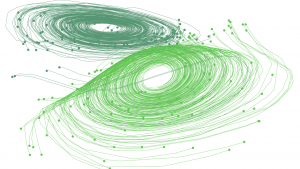 David Duvenaud was collaborating on a project involving medical data when he ran up against a major shortcoming in AI.