
Joshua Rapp Learn in Smithsonian:
 When Lake Xochimilco near Mexico City was Lake Texcoco, and the Aztecs founded their island capital city of Tenochtitlan in 1325, a large aquatic salamander thrived in the surrounding lake. The axolotl has deep roots in Aztec religion, as the god Xolotl, for whom the animal is named, was believed to have transformed into an axolotl—although it didn’t stop the Aztecs from enjoying a roasted axolotl from time to time. The custom of eating axolotl continues to this day, although the species has become critically endangered in the wild. Saving the salamander that Nature called “biology’s beloved amphibian” takes on a special significance given the animal’s remarkable traits. Axolotls are neotenic, meaning the amphibians generally do not fully mature like other species of salamander, instead retaining their gills and living out their lives under water as a kind of juvenile. On rare occasions, or when stimulated in the lab, an axolotl will go through metamorphosis and develop lungs to replace its gills.
Accompanying these unique traits is a remarkably complex genome, with 32 billion base pairs compared to about 3 billion base pairs in human DNA. The axolotl has the largest genome ever fully sequenced, first completed last year by a team of European scientists. The University of Kentucky, which heads axolotl research in the United States, today announced that researchers have added the sequencing of whole chromosomes to the European effort—“about a thousand-fold increase in the length of assembled pieces,” according to Jeremiah Smith, an associate biology professor at the University of Kentucky. Scientists hope to use this new data to harness some of the axolotl’s unique abilities.
More here.
 Every so often a book comes along and changes the way you see a classic of literature. The Diary of Virginia Woolf, published between 1977 and 1984, came out decades after Woolf’s death in 1941, and added a stunning lens through which to view her long and dynamic career. Her husband Leonard had carefully edited a volume initially in 1953, one that focused entirely on Woolf’s writing process and avoided personal details, but it was only when Woolf’s diaries were released in their totality that readers gained a precious glimpse inside a complicated mind at work.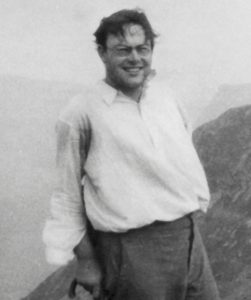

 Rationality has long been an important concept in the study of judgement and decision making. The highly
 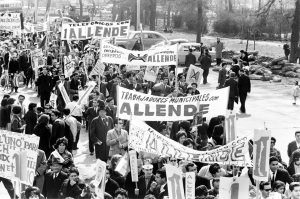 Discussions about the state of democracy are suddenly all the rage. And it’s not hard to see why: Bolsonaro in Brazil, Trump in the US, Erdoğan in Turkey, Orbán in Hungary — all point to a resurgent authoritarianism and a diminution of democratic forms. But we can’t understand the current retrenchment without understanding how mass democracy came about in the first place.
 Sally Wen Mao’s new book of poems, “
 I
I The beating heart of it all, Du Maurier’s estate Menabilly, remains a secret few have been allowed to penetrate. Nestled behind locked gates, a visitor would find it impossible to catch even a glimpse of its infamous facade from the roadside. Nearby is the town of Fowey. Another great love. Once referred to as Du Maurier’s ‘salvation’, it is the picture of gentle tranquillity. By a twinkling blue estuary lined with quaint white cottages, you can glance at her other famous home —Ferryside. The coves are full of families, the beaches always busy. Journey on for forty minutes more, and you might stumble across the infamous Jamaica Inn. Far from an isolated hub of menacing activity and excitement, it now stands on a busy motorway leading out of Cornwall — an impersonal, family stop on the way back from a typical summer road trip.
 2018 was a year overstuffed with culture. That’s just the way it is now, movies and TV and songs and memes and thoughtful features and endless, endless politics scrolling past our weary eyes at the speed of silicon and too-blue light. But in all the chaos there’s a moment where my hazy memories of frenetic consumption pause, for a piece of filmmaking that called on me to think hard and to remember. That movie was Spike Lee’s “BlacKkKlansman.” It’s currently raking in a modest haul of awards, but for me, it’s going to linger long past the last bottle of popped January 1st champagne, a remarkable slice of light to which I’ll return for years to come.
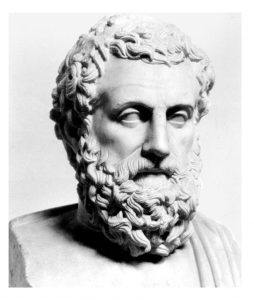 Three years ago, New Year’s came and I promised to eat only organic. I lasted two weeks. A year ago, I resolved to run before dawn and take a cold shower every morning. That lasted two days. This year, I don’t have a resolution. Instead I read Edith Hall’s “Aristotle’s Way: How Ancient Wisdom Can Change Your Life,” and concluded I probably didn’t have to undergo some painful — and therefore temporary — transformation to remake my life. I just had to put some sustained effort into being properly happy.
 1. My mother once saw the chaffinch (Fringilla coelebs; in Irish: “Rí Rua”) take a shit on Grafton Street and she scolded him. He just kept repeating his distinctive call “pink, pink, pink, trup,” over and over again, but you could kinda tell that he was mortified. Good bird, really; had trouble later with the auld drugs, and got very stout. Died way too young. In the eighties, those birds had a string of great hits.
 The Large Hadron Collider is the world’s largest particle accelerator. It’s a 16-mile-long underground ring, located at CERN in Geneva, in which protons collide at almost the speed of light.
 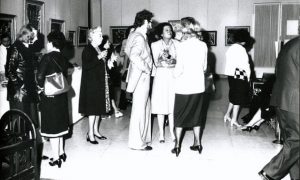 Michael Peppiatt’s memoir is subtitled Paris Among the Artists, but it could be called A Portrait of the Art Critic As an Older Man. Peppiatt, who is best known for his biography and memoirs of his friend
 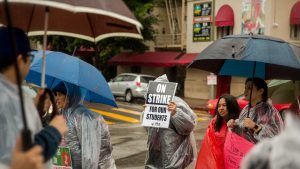 The word strike seems to be on everyone’s lips these days. Workers across the world have been striking to protest poor working conditions, to
  HOW LONG did an hour feel in 1971? Was it like three 2018 hours? Ten minutes? The music of the eighty-six-year-old French composer Éliane Radigue forces these questions because as much as it’s about synthesizers and magnetic tape and silence and held notes and resonance, it is also about time. Her work cannot be excerpted or sliced into representative swatches or versified. The movement from a piece’s beginning to its end is the motif itself; to lose even a little of that adventure is to lose the music. Œuvres électroniques (Electronic Works), a new fourteen-CD box set recently released by Ina GRM, collects pieces recorded between 1971 and 2007. The shortest of them is a little over seventeen minutes long; most of them run closer to an hour. These days, Radigue composes largely for acoustic stringed instruments, but she remains as focused an artist as electronic music has ever had, possibly because she never needed the equipment to hear her sound, only a series of tools with which to render it.
 As the argument has progressed, a de facto alliance between ostensibly progressive identitarians and Wall Street Democrats has come together around asserting, along with Paul Krugman and others, that “horizontal inequality”—i.e., inequality between statistically defined racial/ethnic groups—is a more important problem than “vertical inequality,” characterized as inequality between individuals and households. That distinction instructively makes class and class inequality disappear, which is consistent with the trajectory of American liberalism across the more than seven decades since the end of World War II. Moreover, in a sort of mission creep, opponents of what they decry as a “class-first” position increasingly have come to denounce any expressions of concern for economic inequality as in effect catering to white supremacy. This tendency, which Touré Reed has argued rests on a race-reductionism, has surfaced and spread within the newly revitalized Democratic Socialists of America (DSA), as even many among those who consider themselves socialists object to the organization’s selection of Medicare for All as its key political campaign on the ground that pursuit of decommodified health care for all is objectionable because doing so does not sufficiently center antiracist and anti-disparitarian agendas. I submit that there’s clearly a problem when anti-socialism is defined as socialism.