
Heini Lehtinen at Raven & Wood:

The Dialogue Advisory Group, which works in conflict areas such as the Democratic Republic of the Congo, Libya, Iraq and Basque Country, facilitates political dialogue to reduce violence. In an interview, Ram Manikkalingam illustrates the locations, spaces and the contexts of the peace dialogues in his own work, and reflects on the potential impact of the chosen locations and spaces on the negotiations.
Dialogue Advisory Group works on several conflicts in very different political, cultural and geographical settings around the world. What kinds of places and spaces are usually used for peace negotiations?
Generally, I would use the word ‘dialogues.’ We are starting conversations, not negotiations.
We differentiate ourselves from official facilitators, as it is easier for us to move and meet people discreetly. We work in places in-between governments, armed groups and international organisations. The dialogues can be organised in a fancy hotel, a bar, or a café, or in a discreet or secret place. It depends on the context in which we are meeting people.
For the first meeting, we like to meet people where they are based to make them comfortable and build trust. For example, in Libya, we went and met with armed groups in their homes and bases, when others would not travel there.
More here.
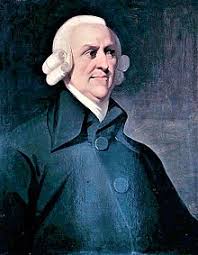 I just read Adam Smith’s The Wealth of Nations for the first time. Not every word. It’s over a thousand pages, and there are long “Digressions” (Smith’s term) on matters such as the history of the value of silver, or banking in Amsterdam, which I simply passed over. I was mainly interested in what Smith has to say about work, so I also merely skimmed some other sections that seemed to have little relevance to my research. Time and again, though, I found myself getting sucked into chapters unrelated to my concerns simply because the topics discussed are so interesting, and what Smith has to say is so thought-provoking. Reading the book is also made easier both by Smith’s admirably lucid writing and by the brief summaries of the main claims being made that he inserts throughout at the left-hand margin.


 About 75 percent of Americans
  Pinker does get a lot of press, though most-covered doesn’t always mean most-loved. While Enlightenment Now received ecstatic blurbs — Bill Gates called it his “favorite book of all time” — other assessments were less kind. A New York Times reviewer panned it as “disdainful and condescending — sympathetic to humanity in the abstract but impervious to the suffering of actual human beings.” The dismissive term
  Late last month, in between the firestorm over Congresswoman Ilhan Omar’s comments about AIPAC’s influence being “all about the Benjamins” and the firestorm over her comments about “allegiance to a foreign country,” the United Nations
  I approached
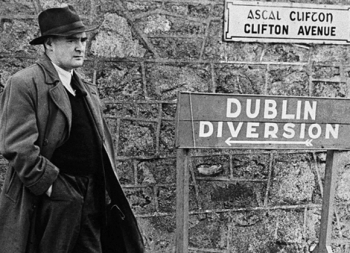 Thrumming discreetly in the deep regions of Addenbrooke’s Hospital here in Cambridge, the X-ray projectors continue to chase a dodgy little cancer from one of my facial cavities to the next, so I am still catching up with Christmas. One of my presents was The Collected Letters of Flann O’Brien, edited by Maebh Long, who must have wondered, towards the end of her task, what kind of nut-bag she had taken on. Justifiably regarded as an adornment to Irish literature, O’Brien was a funny novelist who was even funnier as a columnist, but there is nothing funny about hearing a grown mind fooling around with the word “nigger.” In his later years O’Brien, in his correspondence, did so habitually, although we perhaps need to see his bad habit in the oblique light cast by the further fact that he never gave up on the idea that St Augustine might have been black.
 Diamond Joe Esposito was once plain Joseph Carmine Esposito, an Italian-American mechanic’s son growing up in Chicago during the Second World War. In the paranoid 1950s, he was drafted into service and sent to West Germany, where he met and befriended Elvis Presley. After their discharge, the singer employed him as his road manager and they remained close until the end – at least, the premature, undignified end of Presley’s life on 16 August 1977. Esposito was among the first to see his still-young body sprawled on the floor of his bathroom, beside some vomit and a book about the Turin shroud. Ten years later, Esposito was in the service of another king – this time the king of pop, Michael Jackson, for whom he was overseeing the logistics of the Bad tour. Jackson was another kind of pop star altogether, and big on a scale that would surely have been unimaginable even for Presley. But his confounding descent from great American icon to lonely, seedy, delusional butt of lazy comedians’ jokes would follow – with considerably more darkness – the template established by the first rock ’n’ roll icon. Neverland substituted for Graceland, the powerful sedative propofol for sundry uppers and downers, yet the grand narratives rhymed. When Esposito encountered Jackson at the peak of his powers, did he think, “Here we go again”?
 Although widely held, the belief that merit rather than luck determines success or failure in the world is demonstrably false. This is not least because merit itself is, in large part, the result of luck. Talent and the capacity for determined effort, sometimes called ‘
 On a warm summer evening, a visitor to 1920s Göttingen, Germany, might have heard the hubbub of a party from an apartment on Friedländer Way. A glimpse through the window would reveal a gathering of scholars. The wine would be flowing and the air buzzing with conversations centered on mathematical problems of the day. The eavesdropper might eventually pick up a woman’s laugh cutting through the din: the hostess, Emmy Noether, a creative genius of mathematics.
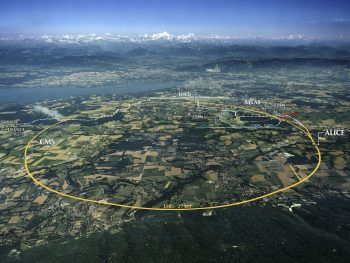 I’ve of course been following the recent public debate about whether to build a circular collider to succeed the LHC—notably including