
Moises Velasquez-Manoff in Nautilus:
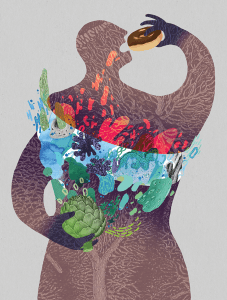 For the microbiologist Justin Sonnenburg, that career-defining moment—the discovery that changed the trajectory of his research, inspiring him to study how diet and native microbes shape our risk for disease—came from a village in the African hinterlands. A group of Italian microbiologists had compared the intestinal microbes of young villagers in Burkina Faso with those of children in Florence, Italy. The villagers, who subsisted on a diet of mostly millet and sorghum, harbored far more microbial diversity than the Florentines, who ate a variant of the refined, Western diet. Where the Florentine microbial community was adapted to protein, fats, and simple sugars, the Burkina Faso microbiome was oriented toward degrading the complex plant carbohydrates we call fiber.
Scientists suspect our intestinal community of microbes, the human microbiota, calibrates our immune and metabolic function, and that its corruption or depletion can increase the risk of chronic diseases, ranging from asthma to obesity. One might think that if we coevolved with our microbes, they’d be more or less the same in healthy humans everywhere. But that’s not what the scientists observed. “It was the most different human microbiota composition we’d ever seen,” Sonnenburg told me. To his mind it carried a profound message: The Western microbiome, the community of microbes scientists thought of as “normal” and “healthy,” the one they used as a baseline against which to compare “diseased” microbiomes, might be considerably different than the community that prevailed during most of human evolution. And so Sonnenburg wondered: If the Burkina Faso microbiome represented a kind of ancestral state for humans—the Neolithic in particular, or subsistence farming—and if the transition between that state and modern Florence represented a voyage from an agriculturalist’s existence to 21st-century urban living, then where along the way had the Florentines lost all those microbes?
More here.
 The discussion of Islam in world politics in recent years has tended to focus on how religion inspires or is used by a wide range of social movements, political parties, and militant groups. Less attention has been paid, however, to the question of how governments—particularly those in the Middle East—have incorporated Islam into their broader foreign policy conduct. Whether it is state support for transnational religious propagation, the promotion of religious interpretations that ensure regime survival, or competing visions of global religious leadership; these all embody what we term in this new report the “geopolitics of religious soft power.”
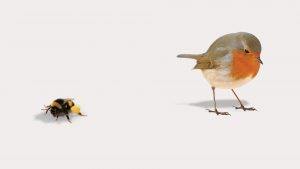 The share of Americans who say sex between unmarried adults is “not wrong at all” is at an all-time high. New cases of HIV are at an all-time low. Most women can—at last—get birth control for free, and the morning-after pill without a prescription.
 At the chilling climax of William S. Lind’s 2014 novel “Victoria,” knights wearing crusader’s crosses and singing Christian hymns brutally slay the politically correct faculty at Dartmouth College, the main character’s (and Mr. Lind’s) alma mater. “The work of slaughter went quickly,” the narrator says. “In less than five minutes of screams, shrieks and howls, it was all over. The floor ran deep with the bowels of cultural Marxism.”
 When I first read Marguerite Duras’s Moderato Cantabile for my high school AP French class, an alarm went off on me. That I was reading the words of someone who understood love in the same way I did. At that point in my life I hadn’t yet experienced love, but it didn’t matter. It was a foreshadowing of what was to come, of what I already knew to be true. The next year, in a college French class, I read Duras’s The Lover. From the first page (J’ai un visage détruit) I saw myself again. I felt recognized. But even as I was, in Kate Briggs’s words, underlining, typing the passage out, capturing it on my phone…even in its plenitude, even as it is right now filling me up, there is, I feel, something missing. What is missing is me: my action, my further activity…the audacious counteraction—of the active force that is me. Perhaps in reading these words, the ache that opened up in me was not from identification but from feeling that this writing wouldn’t be complete until I had acted my own force on it. The drive to translate—not for glory, not for recognition, not for money (obviously): to complete the text (in my eyes) by adding my own force to it. When I read a given book and feel the jolt Briggs describes as a matter of intensely felt identification, it’s not the text, it’s me in the text. In the words of Duras (in our translation of her), What moves me is myself.
 This is also a musical biography that makes clear why, after all, we should bother to read a book about Chopin. Far from being a salon miniaturist, he was a major artist, a true heir to Bach and Mozart (as well as Beethoven, though he wouldn’t have liked it said), a creator of new forms, new modes of expression, and new keyboard techniques and sonorities. Walker rightly indicates Scriabin and Fauré as direct musical descendants, and Debussy as heir to Chopin’s discoveries about the piano; and since Debussy drew a new language partly from these findings, Walker might well have claimed (though he doesn’t) that Chopin lies behind a good deal of modern music, too. How’s that for a salon miniaturist?
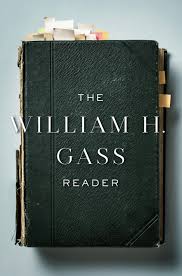 William H. Gass loved words. “A word is a wanderer,” he wrote in “Carrots, Noses, Snow, Rose, Roses.” “Except in the most general syntactical sense, it has no home.”
 “A geneticist, an oncologist, a roboticist, a novelist and an A.I. researcher walk into a bar.” That could be the setup for a very bad joke — or a tremendously fascinating conversation. Fortunately for us, it was the latter. On a blustery evening in late September, in a private room at a bar near Times Square, the magazine gathered five brilliant scientists and thinkers around a table for a three-hour dinner. In the (edited) transcript below — moderated by Mark Jannot, a story editor at the magazine and a former editor in chief of Popular Science — you can see what they had to say about the future of medicine, health care and humanity.
 A couple of years ago, while working on my novel Home Fire, which required me to look into certain aspects of the UK’s citizenship laws, I had a slightly painful conversation with one of my oldest friends. Like me, she had grown up in Karachi. But while I didn’t move to the UK until the age of 34, she came here at 18 to go to university, and has never left. She became a British citizen soon after graduating (her grandmother was British); later, she married an Englishman, and they had a son. Her son was born in London, has never lived anywhere but here. But the painful thing I had to tell her was this: unlike many children who are born and live in the UK, her son’s claim on UK citizenship was contingent rather than assured. He was a British citizen, yes, but he could be made unBritish.
 It is an understatement to say that the 42-year-old [Tino] Sehgal is obsessive about his work, from its concept to the lexicon used to describe it. His practice has more to do with theater and acting techniques (many of his players are professional actors) than it does with the tradition of performance art, the de facto description for any kind of live experimentation in the art world. And it’s not strictly conceptual art, either, if one goes by
  The executive summary of the paper is this. They claim that the optical signal does not fit with the hypothesis that the event is a neutron-star merger. Instead, they argue, it looks like a specific type of white-dwarf merger. A white-dwarf merger, however, would not result in a gravitational wave signal strong enough to be measurable by LIGO. So, they conclude, there must be something wrong with the LIGO event. (The VIRGO measurement of that event has a signal-to-noise ratio of merely two, so it doesn’t increase the significance all that much.)
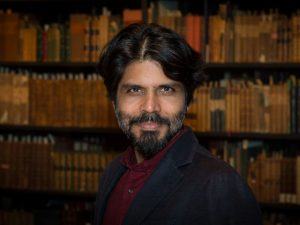 PANKAJ MISHRA: I know from experience that it is very easy for a brown-skinned Indian writer to be caricatured as a knee-jerk anti-American/anti-Westernist/Third-Worldist/angry postcolonial, and it is important then to point out that my understanding of modern imperialism and liberalism — like that of many people with my background — is actually grounded in an experience of Indian political realities.
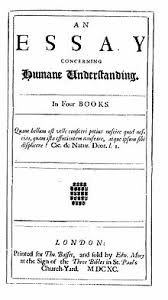 It is the mind of the writer that makes for the most brilliant essays. Reality—whether the material world of our senses or the intellectual world we apprehend—is of intrinsic interest. It exists, according to some thinkers, eternally in the mind of God, an object of divine contemplation. If our attention wanes it is only because we lack the godlike capacity to consider such objects—“the meanest flower that blows” or the cosmic fires overhead—with the attention they deserve. Had we the mind of a philosopher we might be able to observe the distant stars, their light, perhaps a photograph of what once was, and contemplate with love the fate of suns or our own mortality. But we scurry beneath sublimity, and when we glance up we blink.
 It was supposed to be the best day of Richard “Blue” Mitchell’s life, but June 30, 1958, turned out to be one of the worst. The trumpeter had been summoned to New York City from Miami for a recording session with Julian “Cannonball” Adderley, an old friend who was being hailed as the hottest alto sax player since Charlie Parker.
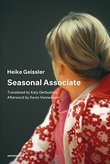 Heike Geissler, the German novelist and translator, ran out of money in the winter of 2010 and took a temporary job at an Amazon warehouse in Leipzig to support her two children. As she tells us in the opening pages of her book about that experience, she was not intending to write a book about that experience. But intention is one thing and canniness another; a real writer’s canniness never deserts her. “Though the work was physically and mentally exhausting,” her translator explains, Geissler “managed to take notes on Post-its” during her six weeks at the warehouse, and write more detailed impressions at night.
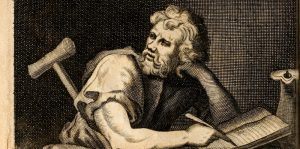 The chief constraint on personal freedom in ancient Greece and Rome was what Epictetus knew at first hand, the social practice and indignity of slavery. It was slavery, the condition of being literally owned and made to serve at another’s behest that gave ancient freedom its intensely positive value and emotional charge. Slaves’ bodily movements during their waking lives were strictly constrained by their masters’ wishes and by the menial functions they were required to perform. But slaves, like everyone else, had minds, and minds as well as bodies are subject to freedom and constraint. You can be externally free and internally a slave, controlled by psychological masters in the form of disabling desires and passions and cravings. Conversely, you could be outwardly obstructed or even in literal bondage but internally free from frustration and disharmony, so free in fact that you found yourself in charge of your own well-being, lacking little or nothing that you could not provide for yourself. The latter, in essence, is the freedom that Epictetus, the ancient Stoic philosopher, made the central theme of his teaching.