
From Black History.com:
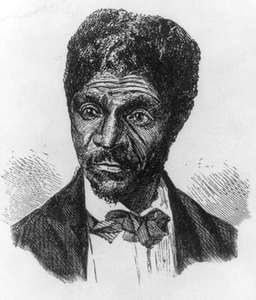 On March 6, 1857, the U.S. Supreme Court handed down its decision in Scott v. Sanford, delivering a resounding victory to southern supporters of slavery and arousing the ire of northern abolitionists. During the 1830s, the owner of a slave named Dred Scott had taken him from the slave state of Missouri to the Wisconsin territory and Illinois, where slavery was outlawed, according to the terms of the Missouri Compromise of 1820. Upon his return to Missouri, Scott sued for his freedom on the basis that his temporary removal to free soil had made him legally free. The case went to the Supreme Court, where Chief Justice Roger B. Taney and the majority eventually ruled that Scott was a slave and not a citizen, and thus had no legal rights to sue.
According to the Court, Congress had no constitutional power to deprive persons of their property rights when dealing with slaves in the territories. The verdict effectively declared the Missouri Compromise unconstitutional, ruling that all territories were open to slavery and could exclude it only when they became states. While much of the South rejoiced, seeing the verdict as a clear victory for the slave system, antislavery northerners were furious. One of the most prominent abolitionists, Frederick Douglass, was cautiously optimistic, however, wisely predicting that —This very attempt to blot out forever the hopes of an enslaved people may be one necessary link in the chain of events preparatory to the complete overthrow of the whole slave system.”
More here. (Note: Throughout February, we will publish at least one post dedicated to Black History Month)
 Dan Mallory, a book editor turned novelist, is tall, good-looking, and clever. His novel, “
 “We’re the United States’ only proverb laboratory. Our mission is to stress-test the nation’s proverbs. To provide rigorous backing for the good ones, and weed out the bad ones.”
 THIS SHOW’S TITLE comes from a letter that my grandmother wrote to me around ten years ago. I had just begun collecting stories from my family and had asked her to describe the house she lived in as a young girl in the Philippines. She drafted a long, detailed letter, filled with drawings. But she forgot to specify my apartment number on the address, so the letter was eventually returned to her. When she re-sent it, she added a note, lamenting, “All the while I thought you had received this.”
 In contrast to her opponents, Murdoch stresses the reality of moral life. To acknowledge the reality of moral life is to recognize that the world contains such things as kindness, as foolishness, as mean-spiritedness. These are genuine features of reality, and someone who comes to know that some course of action would be foolish comes to know something about how things are in the world. This view is sometimes thought to be ruled out by a certain scientistic conception of the natural, one that restricts what exists to the things that feature in our best scientific theories. Such a view is too restricted, Murdoch thinks, to capture the reality of our lives – including our lives as moral agents. Goodness is sovereign, which is to say a real, if transcendent, aspect of the world.
 The rumors spread like wildfire: Muslims were secretly lacing a Sri Lankan village’s food with sterilization drugs. Soon, a video circulated that appeared to show a Muslim shopkeeper admitting to drugging his customers — he had misunderstood the question that was angrily put to him. Then all hell broke loose. Over a several-day span, dozens of mosques and Muslim-owned shops and homes were burned down across multiple towns. In one home, a young journalist was trapped, and perished.
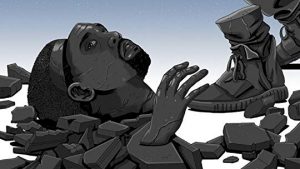 Jackson cranked up “Billie Jean” and I felt it too. For when I saw Michael Jackson glide across the stage that night at Madison Square Garden, mere days before the Twin Towers fell, I did not imagine him so much walking on the moon, as walking on water. And the moonwalk was the least of things. He whipped his mop of hair and, cuffing the mic, stomped with the drums, spun, grabbed the air. I was astounded. There was the matter of his face, which took me back to the self-hatred of the ’80s, but this seemed not to matter because I was watching a miracle—a man had been born to a people who controlled absolutely nothing, and yet had achieved absolute control over the thing that always mattered most—his body.
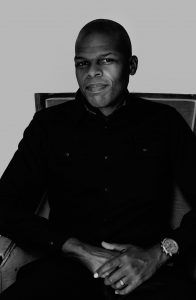 Good questions breathe life into the world. “We Cast a Shadow,” Maurice Carlos Ruffin’s debut novel, asks some of the most important questions fiction can ask, and it does so with energetic and acrobatic prose, hilarious wordplay and great heart.
 Einstein’s theory of general relativity is more than a hundred years old, but still it gives physicists headaches. Not only are Einstein’s equations hideously difficult to solve, they also clash with physicists other most-cherish achievement, quantum theory.
 These are difficult times for liberal theorists. Fewer than thirty years after the end of the Cold War ushered in a period of unprecedented liberal ascendancy, liberalism today is in retreat—or at least on the defensive—in many parts of the world. A new generation of authoritarian strongmen have come to power in a number of countries, riding waves of populist, nationalist, and anti-globalist sentiment, and other countries may well be headed in the same direction.
 Education is crucial to a democratic society because it is how we ensure that future citizens will have the knowledge and skills our societies need. In countries such as the United States, the United Kingdom and France, some educational institutions play a further role – they educate the elite. All of the current Supreme Court Justices in the US attended either Harvard University or Yale Law School. In the UK, 41 out of 54 of the country’s past prime ministers received their education at the University of Oxford or the University of Cambridge. Seven recent French presidents and 12 prime ministers attended the Paris Institute of Political Studies, commonly called Sciences Po. These universities pride themselves not only in offering superb educational opportunities, but in educating those who will go on to hold influential positions.
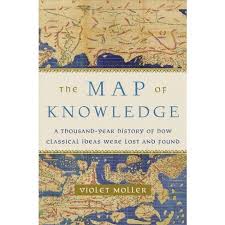 Adelard of Bath would be in demand in the present day. This 12th-century English scholar, arrayed in his striped hat, brilliant green or red cape and lapis lazuli shirt, ‘had a talent’, Violet Moller explains, ‘for communicating complex scientific ideas and adapting them for an amateur, but interested, audience’. Yet he also devoted a good part of his time to profound research, translating mathematical, astronomical and astrological texts from Arabic – astrology being regarded in his time, especially at the Norman court in Sicily, as a very exact science with medical as well as political uses. Adelard knew that court well, but what is particularly interesting is that when he translated Euclid’s Elements into Latin he chose to do it not from its original Greek, the language of nearly half the population of Sicily at that time, but from Arabic, the language of the other half. Nor was he alone in taking such a route: works such as Ptolemy’s Almagest, fundamental for the medieval study of the heavens, seemed to inhabitants of Christian western Europe easier to understand through translation of the Arabic version rather than of the Greek original. The Arabic translators had interspersed their texts with explanations of terms and concepts the meanings of which in the original Greek puzzled western European readers, even if (as was rarely the case) they could understand that language.
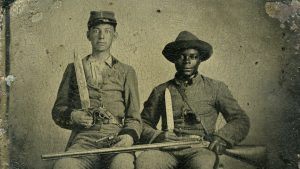 The yearbook photo that appears on Virginia Governor Ralph Northam’s personal page, featuring a man in blackface and another in a Klan robe, looks to me like a modern update of a familiar image from the Civil War, of a Confederate soldier from the slaveholding class posing with his body servant. The history of the Civil War pairing clarifies the meaning of the Northam scandal. Perhaps the most famous of the soldier-slave photographs depicts Sergeant Andrew Chandler and his uniformed body servant, Silas Chandler. Andrew served in the 44th Mississippi Infantry in the Army of Tennessee from 1861 to 1863. Camp slaves such as Silas were expected to oblige their masters’ every need, including by preparing food, tending to horses, and carrying personal supplies during long marches. Silas likely experienced many of the challenges of military life in camp, on the march, and even, on occasion, the battlefield.
 Born into slavery before the American Revolution,
  Few albums of the late 1970s and early 1980s have held up as well as those by Talking Heads, but what to call the music recorded on them? Rock? Pop? New Wave? In the difficulty to pin it down lies its enduring appeal, and that difficulty didn’t come about by accident: impatient with musical categorizations and expectations, frontman David Byrne and the rest of the band kept pushing themselves into new territories even after they’d begun to find success. When they set out to create their fourth album, 1980’s Remain in Light, “they were looking to change the way they made songs.” Instead of leaving the writing to Byrne, “the band wanted a more democratic process. And so they tried something they never had before.”
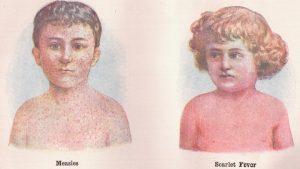 Before vaccination became widespread in the 1960s, pediatricians knew to check their patients’ throats for the spray of telltale spots. Scientists raced for decades to develop an effective vaccine. And in the meantime, newspapers printed matter-of-fact