Verb Tenses

by Gabrielle C. Durham

We can agree that a verb in the present tense means that action is occurring now. What about the present progressive, which I used in the previous statement? That apparently confounds non-native English speakers because it means that an action is in the middle of happening. Friends have asked me, “What is the difference between I am playing tennis and I play tennis?” That example is actually a softball because the present progressive indicates that the first person is in the middle of playing a game and the simple present indicates the playing of the sport in general.

This feeling of verbal instability perhaps approaches the bewilderment I still feel with some verbs in Russian when deciding whether to use perfect versus imperfect (honestly, not that common an occurrence, put play along with me, please). I understand when Misha went by train to Novgorod yesterday, no sweat. It’s when he ate a 3-day feast beforehand that I start getting itchy palms. Yes, the verb is in the perfect, or completed, past tense, but that piggish boy just kept engaging in the activity for 72 hours. Would you use the perfect or imperfect past? You could make a persuasive argument for either. According to the Oxford Dictionary, we can break this use of tense down to aspect, which would be either continuous or perfect.

So what does tense tell us? Verb tense refers to when a subject performed an activity (the verb). Easy, peasy, right? Not really if you start talking about other things that happened in relation to that time. That’s where pluperfects and subjunctives, among other infernal entities, come into play. Read more »
Earth Is (Still) A Clock

by Mary Hrovat

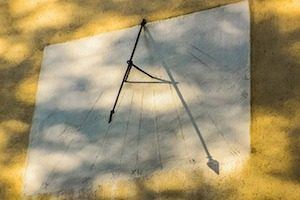
Image of sundial on an external wallBefore the second was defined in terms of the characteristics of the cesium atom, before leap seconds or leap days or Julian dates or the Gregorian calendar, before clocks, even before the sundial and the hourglass, there were sunrise, sunset, and shadows.

I’ve been thinking about timekeeping using shadows because a tulip tree in my backyard casts a shadow that traces a semicircle over the lawn on sunny days and moonlit nights, like the hand of a clock. The shadow is longest and most noticeable at this time of year, when the sun crosses the sky low in the south, and on summer nights around full moon. (The full moon crosses the sky low in the south in the summer, when the sun is riding high in the north.) However, I can see it year-round, given adequate sunlight or moonlight, although its appearance varies depending on the position of the sun or moon. I enjoy seeing this subtle demonstration of daily and seasonal cycles.

The gnomon on a sundial (the part that casts a shadow) was probably inspired by natural objects like this tree that cast useful shadows and roughly indicate the time of day. The first human-made gnomons were vertical poles or towers. For example, Egyptian obelisks, in addition to being tributes to gods or markers celebrating a ruler’s achievements, acted as gnomons, and their shadows marked the time of day for a city.

Sundials of various types were developed as these early timekeepers were refined by aligning the gnomon with Earth’s rotational axis and adding a dial that marks divisions in time. In addition, the natural or solar hours, which vary in length throughout the year if you’re not near the equator, were eventually replaced by hours of equal length. Thus was timekeeping made more useful but also distanced somewhat from its roots in solar time, particularly when clock time had to be coordinated across different regions and eventually across the globe. Read more »

Oh! What an Ugly War

by Thomas O’Dwyer

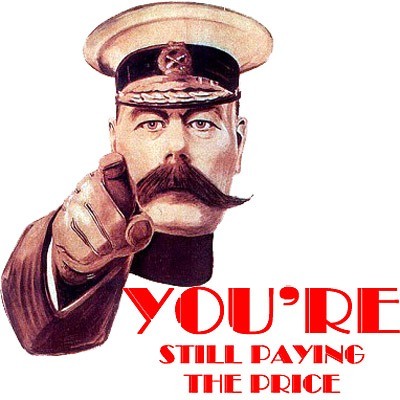
Kitchener poster

Now that the hundred years have passed, can we wrap up World War I, stick a label on it and dispatch it to the archives of dead history? Otherwise, it’s going to be with us forever. If you are old enough to remember the 1968 events for the 50th anniversary, then you’ve lived to see them happen all over again. The only difference this November has been the absence of interviews with living survivors – there are none left. Harry Patch, the last surviving man to have fought in the trenches at Passchendaele, died in Britain in 2009, aged 111. The last German veteran, Franz Künstler, died in 2008, aged 107. The last veteran from any country, Florence Green from England, who had been in the Women’s Royal Air Force, died in 2012, aged 110.

A notable British film came out around the 50th anniversary – Oh! What a Lovely War, directed by Richard Attenborough. It was a parade of stars – Maggie Smith, Dirk Bogarde, John Gielgud, John Mills, Kenneth More, Laurence Olivier, Jack Hawkins, and three Redgraves (Corin, Michael and Vanessa). They romped through two hours of popular songs parodying the war. It progressed from jingoistic optimism, through the stupidity of the generals and incomprehension of the soldiers, to a vast panorama of white crosses at the end. Attenborough nailed the pointless evil essence of the war (on the Western Front) with touching grandeur and sadness. In background shots, cricket scoreboards tallied the rising death toll in the “great game.”

Is it possible that in 100 years time the world will continue to stand in silence for the war dead on the 11th hour of the 11th day of the 11th month? Read more »

In Search of Big Dumb Objects

by Joshua Wilbur 

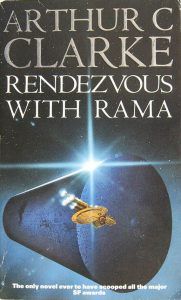
I first encountered a Big Dumb Object (“BDO”) in an underfunded school library in rural East Texas. Sitting cross-legged on the carpeted floor, I held a battered paperback just a few inches from my face, periodically turning it over to inspect the image on the book’s cover.

Rama.

I was twelve years old—“the real golden age of science-fiction”—and Arthur C. Clarke’s Rendezvous with Rama captivated my imagination. The novel’s premise is simple: an alien starship, a massive cylinder of unknown origin and construction, has entered the solar system, and a crew of scientists must investigate. Thin on plot (and even thinner on characterization), Rama lingers in my memory not for what’s hidden within the vessel but for what’s kindled from without, from the mere suggestion of a colossus come from the stars. It stirred in me what sci-fi critics have called the “sense of wonder,” a feeling of awe that courses through the heart of the genre.

Nothing better epitomizes this sense of wonder than “Big Dumb Objects,” a term coined by Roz Kaveney and lovingly adopted by fans of the science fiction genre. BDOs, as you’ll have guessed, are really big, dumb in the old sense of “mute, silent, refraining from speaking,” and usually serve as a focal point for narrative action. Mysterious thing is discovered; mysterious thing is explored. In a Weird Things column for The Guardian, Damien Walter defines the BDO:

“ … the Big Dumb Object (BDO) is a unique selling point of the sci-fi genre. It can be a broad term – usually, they’re alien architectures, ranging from the man-sized to the planetary. BDOs either look extreme or unusual, and can often do extreme or unusual things: everything from lurking on a horizon to creating worlds. Usually, BDOs are plonked into plots to awe us with their majesty and mystery – really, they’re science fiction’s equivalent of a MacGuffin.” Read more »

In-Gendered Empathy

by Max Sirak

Recently I embarked on an unexpected and enlightening adventure.

I went to Las Vegas with four of my oldest friends to see some music. The band, Phish, was playing for a four night run at the MGM Grand’s Garden Arena and we decided to meet up and attend. It also happened to be over Halloween.

For those unfamiliar, Phish is a four-piece band that owes its legacy to the Grateful Dead. Their fans are fiercely loyal and regularly tour with the band, traveling from location to location and seeing as many concerts as they can. This is because Phish shows are fun

They’re equal parts concert and carnival. Beach balls and balloons bounce around the room when the band plays. The fans are engaged. They dress up in costumes. They make signs in hopes of encouraging the group to play certain songs. At a peak musical moment, the crowd spontaneously begins throwing hundreds, if not thousands, of Glow Sticks around the venue. This is called a “Glow Stick War.”

The concerts are between three and four hours. There’s no opening act and always a set-break (intermission). The music is largely instrumental and is accompanied by one of the best light shows in the business.

In preparation for the trip, a group text emerged. There were all sorts of details to hash out. Flight times, hotel reservations, and Halloween costumes were all discussed. It was quickly decided we’d dress up differently for each evening. Read more »

Callous Doughboys Band

by Christopher Bacas

I stayed out late the night before I left for college, saying goodbye to friends whose future included institutions even more punitive than mine. My parents packed my belongings in two long, green army duffel bags purchased at “Sunny’s Surplus”, where you could buy Afro picks with folding handles, decommissioned grenades and a “knuckle knife”.

At Baltimore-Washington airport, I watched a young man carrying a black-leather trumpet case unload his luggage from a Rolls Royce. My parents thought he might be going to school with me. I doubted them. My throat burnt by cheap Mexican weed, trumpet kid looked as sullen as I felt. He boarded with me and we flew southwest. At Dallas-Fort Worth, we both headed to the baggage carousels, still avoiding eye contact. The area gradually cleared, leaving a cluster of freshman music students. A saxophonist unpacked a gleaming Yamaha alto and played scales with a windup, wooden metronome. He began them slowly and evenly, a proper music lesson, and ended each with a monsoon of notes whose velocity propelled his body backwards, a cephalopod in flight.

A few of us took out the letters promising shuttle bus service to our dorm in Denton. At the curb, unmarked vans pulled in, waited and left, sometimes without picking up passengers. They drove through a lattice of Texas sun and graphite shadow. It was one-hundred and fourteen degrees. Read more »

Sunday, November 25, 2018

Do You Have a Moral Duty to Leave Facebook?

S. Matthew Liao in the New York Times:

I joined Facebook in 2008, and for the most part, I have benefited from being on it. Lately, however, I have wondered whether I should delete my Facebook account. As a philosopher with a special interest in ethics, I am using “should” in the moral sense. That is, in light of recent events implicating Facebook in objectionable behavior, is there a duty to leave it?

In moral philosophy, it is common to draw a distinction between duties to oneself and duties to others. From a self-regarding perspective, there are numerous reasons one might have a duty to leave Facebook. For one thing, Facebook can be time-consuming and addictive, to no fruitful end. In addition, as researchers have demonstrated, Facebook use can worsen depression and anxiety. Someone who finds himself mindlessly and compulsively scrolling through Facebook, or who is constantly comparing himself unfavorably with his Facebook friends, might therefore have a duty of self-care to get off Facebook.

From the perspective of one’s duties to others, the possibility of a duty to leave Facebook arises once one recognizes that Facebook has played a significant role in undermining democratic values around the world.

More here.  [Thanks to Sean Carroll who left Facebook today and cited this article in his farewell note.]

Despite vast increases in the time and money spent on research, progress is barely keeping pace with the past. What went wrong?

Patrick Collison and Michael Nielsen in The Atlantic:

It’s surprisingly difficult to measure scientific progress in meaningful ways. Part of the trouble is that it’s hard to accurately evaluate how important any given scientific discovery is.

Consider the early experiments on what we now call electricity. Many of these experiments seemed strange at the time. In one such experiment, scientists noticed that after rubbing amber on a cat’s fur, the amber would mysteriously attract objects such as feathers, for no apparent reason. In another experiment, a scientist noticed that a frog’s leg would unexpectedly twitch when touched by a metal scalpel.

Even to the scientists doing these experiments, it wasn’t obvious whether they were unimportant curiosities or a path to something deeper. Today, with the benefit of more than a century of hindsight, they look like epochal experiments, early hints of a new fundamental force of nature.

More here.

Matt Taibbi: Why You Should Care About the Julian Assange Case

Matt Taibbi in Rolling Stone:

If you hate Assange because of his role in the 2016 race, please take a deep breath and consider what a criminal charge that does not involve the 2016 election might mean. An Assange prosecution could give the Trump presidency broad new powers to put Trump’s media “enemies” in jail, instead of just yanking a credential or two. The Jim Acosta business is a minor flap in comparison.
Although Assange may not be a traditional journalist in terms of motive, what he does is essentially indistinguishable from what news agencies do, and what happens to him will profoundly impact journalism.

Reporters regularly publish stolen, hacked and illegally-obtained material. A case that defined such behavior as criminal conspiracy would be devastating. It would have every reporter in the country ripping national security sources out of their rolodexes and tossing them in the trash.

More here.

The Autocracy App

Jacob Weisberg in the New York Review of Books:

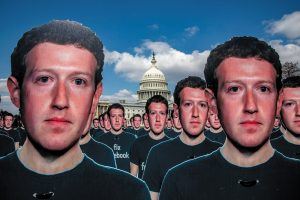
Cardboard cutouts of Mark Zuckerberg placed outside the Capitol to protest the spread of disinformation on Facebook, Washington, D.C., April 2018

Facebook is a company that has lost control—not of its business, which has suffered remarkably little from its series of unfortunate events since the 2016 election, but of its consequences. Its old slogan, “Move fast and break things,” was changed a few years ago to the less memorable “Move fast with stable infra.” Around the world, however, Facebook continues to break many things indeed.

In Myanmar, hatred whipped up on Facebook Messenger has driven ethnic cleansing of the Rohingya. In India, false child abduction rumors on Facebook’s WhatsApp service have incited mobs to lynch innocent victims. In the Philippines, Turkey, and other receding democracies, gangs of “patriotic trolls” use Facebook to spread disinformation and terrorize opponents. And in the United States, the platform’s advertising tools remain conduits for subterranean propaganda.

Mark Zuckerberg now spends much of his time apologizing for data breaches, privacy violations, and the manipulation of Facebook users by Russian spies. This is not how it was supposed to be. A decade ago, Zuckerberg and the company’s chief operating officer, Sheryl Sandberg, championed Facebook as an agent of free expression, protest, and positive political change. To drive progress, Zuckerberg always argued, societies would have to get over their hang-ups about privacy, which he described as a dated concept and no longer the social norm.

More here.

Rob Reich on “Is philanthropy bad for democracy?”

From Julia Galef’s Rationally Speaking:

This episode features political scientist Rob Reich, author of “Just Giving: Why Philanthropy is Failing Democracy, and How it Can Do Better”. Rob and Julia debate his criticisms of philanthropy: Does it deserve to be tax-deductible? Is it a violation of the autonomy of recipients to attach strings to their charitable gifts? And do philanthropists have too much power in society?
More here.

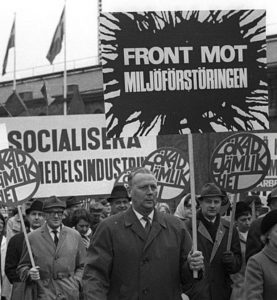
In the 1970s, the Swedish labor movement developed a plan to gradually socialize ownership. What can we learn from it today?

Peter Gowan and Mio Tastas Viktorsson in Jacobin:

Confronting the power of capital in the United States will require a plan.

We may be confident that the concentration of capital in the hands of a tiny minority represents both the primary obstacle to economic equality and one of the most fundamental threats to democracy in America, but without a concrete agenda capable of securing control over capital for the people, we will never succeed in overcoming these problems.

The potential benefits of public control over the 30 percent of the national income which flows to capital are immense: a society which can provide a level of comfort, security, and freedom currently unknown by most, a massive reduction in racial and gender wealth gaps, and a healthier democracy.

As such, the question of how to secure control of capital for the people must be engaged seriously, honestly, and by drawing upon the lessons of others who have tried to do so before.

More here.

A look at the life and career of Edward Said


From Al Jazeera:

Born to affluent parents in Palestine under the British mandate in 1935, Edward W Said devoted his adult life to raising awareness of the Palestinian cause on the world stage. A literature professor at Columbia University and celebrated intellectual, “he was a scholar and an ordinary man’s person,” according to the Independent’s Middle East correspondent, Robert Fisk.

A fatal diagnosis with leukaemia in 1991 prompted him to start working on Out of Place: A Memoir, a coming-of-age story of exile and a celebration of his irrecoverable past. In this masterpiece, Said rediscovers the lost Arab world of his early years in Palestine, as well as in Lebanon and Egypt.

Raised as a Protestant in a predominately Eastern Orthodox community in Jerusalem, he realised early in life that he had something of a split identity. His first name was British, his last name Arabic and he carried an American passport through his father’s US army service in the first world war.

More here.

Women Beyond the Verge

Lidija Haas in Bookforum:

Two Southern belles on the run get catcalled one too many times by the same schlubby dude; they blow up his truck. A couple of rough-and-ready French chicks talk their way into an architect’s house—his place is “like a drawing by a well-balanced child,” as is his smug, suave, symmetrical mug—and point their Smith & Wessons at him, all the while admiring both his book collection and his calm under pressure. “It’s clear to me,” one of them tells him affectionately, “that you stand out from our past encounters.” Then she shoots him in the face. “Get your fucking hands off me, goddamn it!” yells a leader of the National Women’s Political Caucus at the 1972 Democratic National Convention, addressing the member of the white-guy network-news crowd who is trying to restrain her as she rages over their failure to cover her group’s contributions. “The next son of a bitch that touches a woman is gonna get kicked in the balls.” A ten-year-old African American girl, menaced by a white boy, picks up a chunk of brick and aims it at him. When an avowed pussy-grabber tries to win a presidential debate against his female opponent by trotting out a bunch of women who’ve accused her husband of rape and other misconduct, a woman journalist takes to cable news to defend her beloved historic candidate, “shaking and red-faced with rage.”
Furious women make for good montage. It’s true that the examples above are angry for very different reasons and channel their anger in very different ways; it’s also true that the first two scenarios are fictional. Still, together they give you a glimpse of the kinds of pleasures and frustrations on offer for readers of Good and Mad, journalist Rebecca Traister’s reported manifesto on feminism after Trump. Traister’s thesis seems at first a seductively straightforward one. She argues that the rage of “nonwhite non-men” as a political force has so far not been given anywhere near its due in American history and culture, that it has been responsible for a significant portion of progressive change in this country, and thus that the newish angry-woman constituencies fired up by the 2016 election (many of them white and comfortably off) are part of a proud lineage, and should be celebrated and encouraged. It’s an intriguing double move—giving women of color their rightful, pioneering place in feminist and progressive history while also insisting on the automatic right of white liberal feminists to be directly identified with a more radical tradition.

More here.

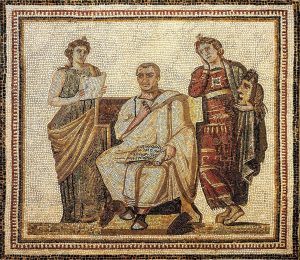
Is the Aeneid a Celebration of Empire—or a Critique?

Daniel Mendelsohn in The New Yorker:

Since the end of the first century A.D., people have been playing a game with a certain book. In this game, you open the book to a random spot and place your finger on the text; the passage you select will, it is thought, predict your future. If this sounds silly, the results suggest otherwise. The first person known to have played the game was a highborn Roman who was fretting about whether he’d be chosen to follow his cousin, the emperor Trajan, on the throne; after opening the book to this passage—
I recognize that he is that king of Rome,
Gray headed, gray bearded, who will formulate
The laws for the early city . . .

—he was confident that he’d succeed. His name was Hadrian.

Through the centuries, others sought to discover their fates in this book, from the French novelist Rabelais, in the early sixteenth century (some of whose characters play the game, too), to the British king Charles I, who, during the Civil War—which culminated in the loss of his kingdom and his head—visited an Oxford library and was alarmed to find that he’d placed his finger on a passage that concluded, “But let him die before his time, and lie / Somewhere unburied on a lonely beach.” Two and a half centuries later, as the Germans marched toward Paris at the beginning of the First World War, a classicist named David Ansell Slater, who had once viewed the very volume that Charles had consulted, found himself scouring the same text, hoping for a portent of good news.

What was the book, and why was it taken so seriously? The answer lies in the name of the game: sortes vergilianae. The Latin noun sortes means lots—as in “drawing lots,” a reference to the game’s element of chance. The adjective vergilianae, which means “having to do with Vergilius,” identifies the book: the works of the Roman poet Publius Vergilius Maro, whom we know as Virgil. For a long stretch of Western history, few people would have found it odd to ascribe prophetic power to this collection of Latin verse. Its author, after all, was the greatest and the most influential of all Roman poets. A friend and confidant of Augustus, Rome’s first emperor, Virgil was already considered a classic in his own lifetime: revered, quoted, imitated, and occasionally parodied by other writers, taught in schools, and devoured by the general public. Later generations of Romans considered his works a font of human knowledge, from rhetoric to ethics to agriculture; by the Middle Ages, the poet had come to be regarded as a wizard whose powers included the ability to control Vesuvius’s eruptions and to cure blindness in sheep.

However fantastical the proportions to which this reverence grew, it was grounded in a very real achievement represented by one poem in particular: the Aeneid, a heroic epic in twelve chapters (or “books”) about the mythic founding of Rome, which some ancient sources say Augustus commissioned and which was, arguably, the single most influential literary work of European civilization for the better part of two millennia.

More here.

Saturday, November 24, 2018

The Ethical Quandary of Human Infection Studies

Linda Nordling in Undark:

In February of last year, 64 healthy adult Kenyans checked into a university residence in the coastal town of Kilifi. After a battery of medical tests, they proceeded, one by one, into a room where a doctor injected them with live malaria parasites. Left untreated, the infection could have sickened or even killed them, since malaria claims hundreds of thousands of lives every year.

But the volunteers — among them casual laborers, subsistence farmers, and young mothers from nearby villages — were promised treatment as soon as infection took hold. They spent the next few weeks sleeping, eating, and socializing together under the watchful eye of scientists, giving regular blood samples and undergoing physical exams. Some grew sick within a couple of weeks, and were treated and cleared of the parasite before being sent home. Those who did not fall ill were treated after three weeks as a precaution and discharged, too.

As compensation, the volunteers received between $300 and $480 each, or roughly $20 a day, a rate based on the minimum wage for casual laborers in Kenya and the out-of-pocket allowance set for overnight stays by KEMRI, the Kenya Medical Research Institute.

More here.

Sean Carroll’s Mindscape Podcast: Lisa Aziz-Zadeh on Embodied Cognition, Mirror Neurons, and Empathy

Sean Carroll in Preposterous Universe:

Brains are important things; they’re where thinking happens. Or are they? The theory of “embodied cognition” posits that it’s better to think of thinking as something that takes place in the body as a whole, not just in the cells of the brain. In some sense this is trivially true; our brains interact with the rest of our bodies, taking in signals and giving back instructions. But it seems bold to situate important elements of cognition itself in the actual non-brain parts of the body. Lisa Aziz-Zadeh is a psychologist and neuroscientist who uses imaging technologies to study how different parts of the brain and body are involved in different cognitive tasks. We talk a lot about mirror neurons, those brain cells that light up both when we perform an action ourselves and when we see someone else performing the action. Understanding how these cells work could be key to a better view of empathy and interpersonal interactions.
More here.

Why Sexist and Racist Philosophers Might Still Be Admirable

Julian Baggini in The Wire:

Admiring the great thinkers of the past has become morally hazardous. Praise Immanuel Kant, and you might be reminded that he believed that ‘Humanity is at its greatest perfection in the race of the whites,’ and ‘the yellow Indians do have a meagre talent’. Laud Aristotle, and you’ll have to explain how a genuine sage could have thought that ‘the male is by nature superior and the female inferior, the male ruler and the female subject’.

Write a eulogy to David Hume, as I recently did here, and you will be attacked for singing the praises of someone who wrote in 1753-54: ‘I am apt to suspect the Negroes, and in general all other species of men … to be naturally inferior to the whites.’

We seem to be caught in a dilemma. We can’t just dismiss the unacceptable prejudices of the past as unimportant. But if we think that holding morally objectionable views disqualifies anyone from being considered a great thinker or a political leader, then there’s hardly anyone from history left.

The problem does not go away if you exclude dead white establishment males. Racism was common in the women’s suffrage movement on both sides of the Atlantic. The American suffragette Carrie Chapman Catt said that: ‘White supremacy will be strengthened, not weakened, by women’s suffrage.’

More here.

What if the Placebo Effect Isn’t a Trick?

Gary Greenberg in the New York Times:

Give people a sugar pill, they have shown, and those patients — especially if they have one of the chronic, stress-related conditions that register the strongest placebo effects and if the treatment is delivered by someone in whom they have confidence — will improve. Tell someone a normal milkshake is a diet beverage, and his gut will respond as if the drink were low fat. Take athletes to the top of the Alps, put them on exercise machines and hook them to an oxygen tank, and they will perform better than when they are breathing room air — even if room air is all that’s in the tank. Wake a patient from surgery and tell him you’ve done an arthroscopic repair, and his knee gets better even if all you did was knock him out and put a couple of incisions in his skin. Give a drug a fancy name, and it works better than if you don’t.

You don’t even have to deceive the patients. You can hand a patient with irritable bowel syndrome a sugar pill, identify it as such and tell her that sugar pills are known to be effective when used as placebos, and she will get better, especially if you take the time to deliver that message with warmth and close attention. Depression, back pain, chemotherapy-related malaise, migraine, post-traumatic stress disorder: The list of conditions that respond to placebos — as well as they do to drugs, with some patients — is long and growing.

More here.