
Pamela Heyne in Literary Hub:
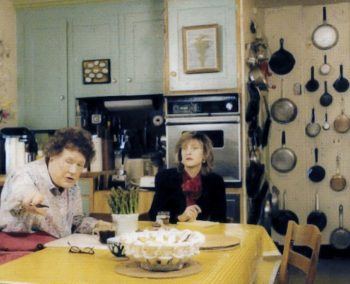 As I looked around, Julia said, “People are always surprised my kitchen is not more high tech.” Actually, I had imagined it would resemble one of the glamorous sets on The French Chef. My first thought was, “Where is the island? Julia Child always works at an island.” I admit now to being a little disappointed. I had been fooled by the illusion of TV. What I saw instead was a smallish, old-fashioned, eat-in kitchen with cluttered countertops and cabinets seriously in need of painting. By then it was nearly 30 years old—and it looked its age. Yet, the more I looked around, the more I realized that it was a fascinating and important place, with its old stove and its batterie de cuisine, with what looked like thousands of glistening cooking implements close at hand. It was a very comfortable and welcoming workroom full of carefully chosen tools and fixtures. Here are some of the most important things I noticed that day.
More here.
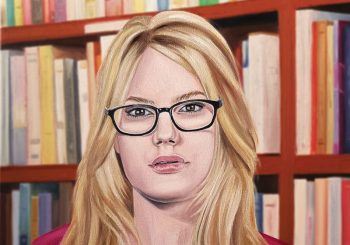 Last April, I decided to set up a satirical account on Twitter under the guise of radical intersectionalist poet
  Most Americans still cling to the meritocratic notion that people are rewarded according to their efforts and abilities. But meritocracy is becoming a cruel joke.
 I suppose it’s true that “Democracy Dies in Darkness,” as the Washington Post’s slogan says. But journalism may also die, by morphing into forms that can no longer be described as journalism. Journalism may come to mean a crooked scandal sheet, or high-minded propaganda. Sometimes squalor and self-righteousness are equally disreputable. The Post’s apothegm, somehow off-kilter, with its alliteration and self-importance, was a purposeful bit of branding, designed to claim high ground and to poke a thumb in President Trump’s eye every morning. Such partisan intent detracts from the slogan’s claim to universality. The self-serving implication—the notion that, against the Darkness, the Washington Postrepresents the Light—invites the reader to respond (as readers have always responded to the Chicago Tribune’s slogan, “The World’s Greatest Newspaper”) by muttering, “I’ll be the judge of that, pal.”
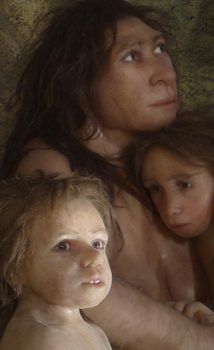 Who were the Neanderthals? Even for archaeologists working at the trowel’s edge of contemporary science, it can be hard to see Neanderthals as anything more than intriguing abstractions, mixed up with the likes of mammoths, woolly rhinos and sabre-toothed cats. But they were certainly here: squinting against sunrises, sucking lungfuls of air, leaving footprints behind in the mud, sand and snow. Crouching to dig in a cave or rock-shelter, I’ve often wondered what it would be like to watch history rewind, and see the empty spaces leap with shifting, living shadows: to collapse time, reach out, and allow my skin to graze the warmth of a Neanderthal body, squatting right there beside me.
 Our system—as evidenced by studies at
 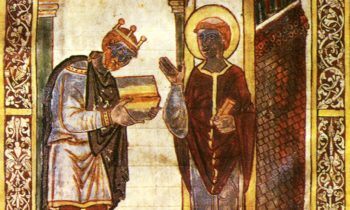 An essential fact about the Hebrew Bible is that most of its narrative prose as well as its poetry manifests a high order of sophisticated literary fashioning. This means that any translation that does not attempt to convey at least something of the stylistic brilliance of the original is a betrayal of it, and such has been the case of all the English versions done by committee in the modern period.
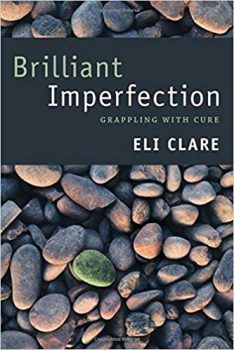 This “the ideology of cure” also focuses on the future of the disabled individual rather than on their present. Clare points out how various forms of activism often promote cure as the only response to body-mind difference and loss. For example, charity walks and runs exclude disabled individuals from participation and focus on the fear of becoming different or acquiring disability through a disease like cancer or cerebral palsy, rather than strive toward health and longevity of life for those that are suffering.
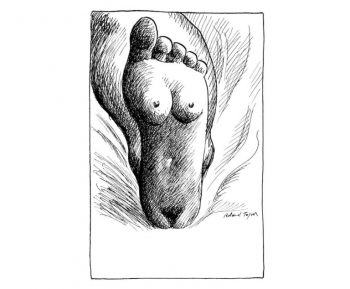 While he is best known in his native France as an artist, and perhaps for his turn as Renfield in Werner Herzog’s Nosferatu (1979), Roland Topor’s written works are still generally unacknowledged. In the scant body of critical writing surrounding his books, they are classed as “post-surrealist horror” that demonstrate “the same half-sane magnifications that strike home in Kafka.” And yet to read his novels, short stories, and plays is to enter a world far from the sleek poeticisms of Breton’s Nadja (1928) or indeed the safety of a barricaded room in which Gregor Samsa hides his transformation in The Metamorphosis (1915). Topor’s writing, much like his illustrations, plunges the reader again and again into predicaments in which grotesque metamorphoses are encountered already in advanced states of development and resultant crisis. In this way, the narratives lead us in a sense to the ground where Breton and Kafka leave off.
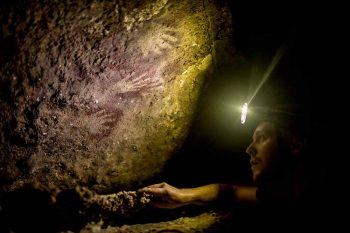 For years, archaeologists thought Europe was the site of the first creative impulses, with famous cave drawings like those at
 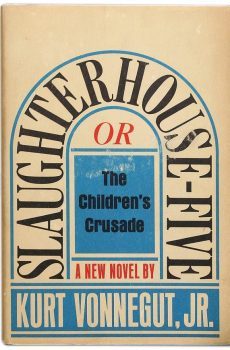 There is an eminently useful thought experiment with which I suspect you are familiar. It goes something like, “What would an alien think of ____?” The blank is typically filled in with something like sex, or our destructive relationship to the natural world, or money. War is sometimes used to fill that blank, too. The point of the thought experiment is to invent a kind of critical distance between a particular aspect of human behavior and ourselves, the ones behaving un-self-consciously like humans. This thought experiment is useful precisely because it forces a perspective so separate, or alien, that with a little luck we gain some insight into why we are the way we are or why we do the things we do, like procreate, or poison our habitat, or hoard digital proxies for paper proxies for bits of rare but not all that rare metals, or watch old people get machine-gunned to death, or firebomb medium-size German cities. I’ve often thought that “Slaughterhouse-Five” is a variation on this kind of thought experiment; it has few if any equals in creating the kind of distance that can offer insight into the mass insanity of modern warfare.
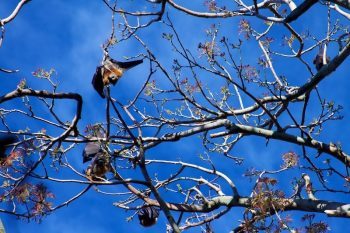 In ancient Rome, priests and officials called augurs would look for omens of the future in the weather, the movement of animals (especially animals encountered out of place), or the flights of birds. These days, we’re scrutinising the same things to tell the future, not as signs of the gods’ will but our own actions.
 It’s not a survey essay, or a popularization based on hand-wavy analogies. We’re going to dig down deep so you understand the details of quantum computing. Along the way, we’ll also learn the basic principles of quantum mechanics, since those are required to understand quantum computation.