
Andy Fitch in the Los Angeles Review of Books:
 ANDY FITCH: A New Foreign Policy takes the sustainable-development framework (prioritizing smart-infrastructure investments, significantly expanded renewable-energy production, more equitable income distribution, tech-fostering education) that you have outlined for various domestic contexts, and applies this to a broader international arena. Could you introduce that sustainable-development approach here by sketching how its basic principles might overlap whether one adopts a domestic- or global-policy vantage — and also by pointing to where this new book might need to provide a slightly different emphasis, argument, agenda? Specifically picking up this book’s subtitle, could you start to sketch how the follies of American-exceptionalist approaches (both at present, and amid a longer arc of US history) might contribute both to the necessity and to the difficulty of adopting this sustainable-development model as a guiding frame for today’s foreign policy?
JEFFREY D. SACHS: Sustainable development applies to each individual country, and also applies globally. In our economic, social, and political life, it aims for prosperous, fair, and environmentally minded societies. Within a United Nations context, most of the world already has accepted these basic principles — dating back to the 1992 Earth Summit in Rio, and then with the Sustainable Development Goals in 2015, and the Paris Climate Agreement in 2015. Of course we haven’t yet fulfilled those goals within our own country, much less globally. So this book (and my writing more generally in recent years) emphasizes the danger we have put ourselves in by not heading in a more sustainable direction. In fact, we seem to have displayed a collective tendency to head away from these goals, towards increased inequality and self-destructive habits ruining the planet.
More here.
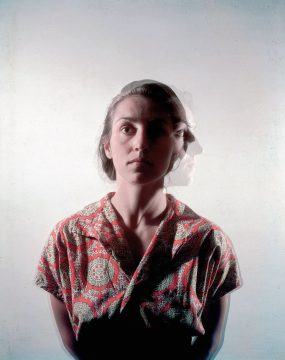 There’s no way to know, of course, if all this happened as Gilot says it did. (Lake said that she had “total recall,” a claim that tends to raise rather than allay suspicions.) She has the memoirist’s prerogative—this is how I remember it—and Picasso’s tyranny and brilliance are hardly in dispute. The bigger mystery is Gilot; the self in her self-portrait can be hard to see behind the lacquered irony and reserve. She goes along with Picasso’s more outlandish demands and schemes, but, she tells us, “not at all for his reasons.” Her dissent is withering and sarcastic rather than furious; like other women of her generation who pointedly overlooked the bad behavior of their husbands, she is concerned with preserving her own dignity. When she is seven months pregnant with Paloma, her doctor (an obstetrician this time) tells her that she is in danger; the labor has to be induced immediately. Alas, this is inconvenient for Picasso, who is due to be at a World Peace Conference elsewhere in Paris the same day.
 Mary Gabriel’s Ninth Street Women charts the rise of five female Abstract Expressionist painters in New York – Lee Krasner, Elaine de Kooning, Grace Hartigan, Joan Mitchell and Helen Frankenthaler – which is a bold move, since all of these women expressed vehement dislike of critics who used their gender as an ordering conceit. To be labelled a “lady painter” or the “wife of the artist” was an exoticization at best, a dismissal at worst. In 1957, Hartigan, Mitchell and Frankenthaler were featured in Life magazine’s feature “Women Artists in Ascendance”, photographed in their studios with their work. Each looks steadily at the camera. They knew the possible benefits of exposure, but they didn’t have to smile. In her introduction, Gabriel tells us that what she has written, “through the biographies of five remarkable women, is the story of a cultural revolution that occurred between the years of 1929 and 1959 as it arose out of the Depression and the Second World War, developed amid the Cold War and McCarthyism, and declined through the early boom years of America’s consumer culture”. Well, yes, but beyond these larger, sweeping assessments of society and gender there is a lot more.
 At a time where politicians across the world are calling for ever more secure borders, there are books whose mere existence feels radical. Afropean: Notes from Black Europe, by Johny Pitts, feels like one such publication. It is the story of the Sheffield-born author’s travel from his home town across the Continent, visiting several of its major cities and connecting – or not – with people of African heritage as he goes. Crucially, it is also the story of Pitts’s internal journey, to find where he, a working-class, mixed-race man from the north of England, might fit most comfortably within Europe’s complex past and its possibly chaotic future.
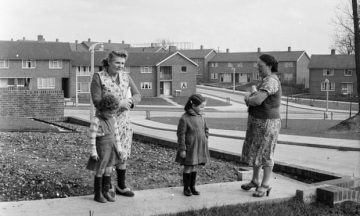 Remember when everyone left doors unlocked and borrowed cups of sugar? No? Then this richly researched history of community may well appeal. Jon Lawrence uncovers the reality behind romantic cliches of our postwar past. He convincingly suggests that the real history of community is one in which people have combined solidarity with self-reliance and privacy.
 Personalized medicine. Precision medicine. Genomic medicine. Individualized medicine. All of these phrases strive to express a similar vision—a reality where physicians treat based on each patient’s unique biology. The concept is poised to revolutionize clinical and preventive care. But even as the technologies helping to birth this new breed of medicine mature, the semantics surrounding the phenomenon are still experiencing growing pains. So, what should we call it? For a long time, “personalized medicine” was the preferred nomenclature. In the popular press especially, this was (and often still is) the go-to phrase to describe the medical paradigm shift that is underway. But about eight years ago, a committee convened by the director of the National Institutes of Health
  Two and a half years ago, feeling existentially adrift about the future of the planet, I sent a letter to Wendell Berry, hoping he might have answers. Berry has published more than eighty books of poetry, fiction, essays, and criticism, but he’s perhaps best known for “
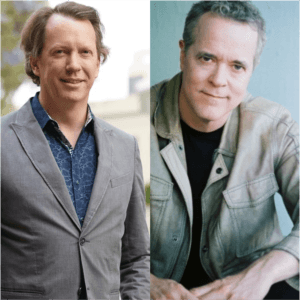 As you may have heard, I have a new book coming out in September,
 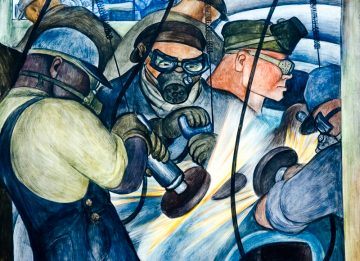 Officials eyeing you with contempt. Police treating you as scum. A sense of being constantly watched and judged by professionals. Living in fear of benefit sanctions. A lack of community facilities.
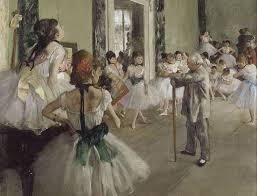 W
W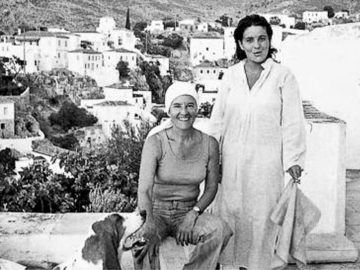 “That summer we bought big straw hats. Maria’s had cherries around the rim, Infanta’s had forget-me-nots, and mine had poppies as red as fire. When we lay in the hayfield wearing them, the sky, the wildflowers, and the three of us all melted into one.” The beginning of Margarita Liberaki’s Three Summers, at once vivid and hazy, evokes the season and the story of adolescent girlhood that the book will unfold. The novel tells the story of three sisters living outside Athens: Maria, Infanta, and Katerina, the youngest, who tells the tale. The house where they live with their mother, aunt, and grandfather is in the countryside. Focusing on the sisters’ daily life and first loves, as well as on a secret about their Polish grandmother, the novel is about growing up and how strange and exciting it is to discover the curious moods and desires that constitute you and your difference from other people. It also features a stable cast of friends and neighbors, all with their own unexpected opinions: the self-involved Laura Parigori; the studious astronomer David and his Jewish mother, Ruth, from England; and the carefree Captain Andreas. The book is adventurous, fantastical, romantic, down to earth, earthy, and, above all, warm. Its only season, after all, is summer.
 Many poets
 Nothing belongs to us any more; they have taken away our clothes, our shoes, even our hair; if we speak, they will not listen to us, and if they listen, they will not understand. They will even take away our name: and if we want to keep it, we will have to find our strength to do so, to manage somehow so that behind the name something of us, of us as we were, still remains.” So
 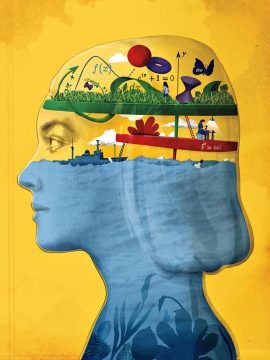 I was a wayward kid who grew up on the literary side of life, treating math and science as if they were pustules from the plague. So it’s a little strange how I’ve ended up now—someone who dances daily with triple integrals, Fourier transforms, and that crown jewel of mathematics, Euler’s equation. It’s hard to believe I’ve flipped from a virtually congenital math-phobe to a professor of engineering. One day, one of my students asked me how I did it—how I changed my brain. I wanted to answer Hell—with lots of difficulty! After all, I’d flunked my way through elementary, middle, and high school math and science. In fact, I didn’t start studying remedial math until I left the Army at age 26. If there were a textbook example of the potential for adult neural plasticity, I’d be Exhibit A.
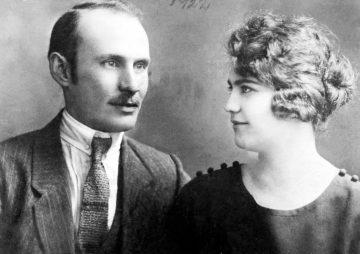 This genetic explanation of my Ashkenazi Jewish ancestry came as no surprise. According to family lore, my forebears lived in small towns and villages in eastern Europe for at least a few hundred years, where they kept their traditions and married within the community, up until the Holocaust, when they were either murdered or dispersed.