A couple of weeks ago I was invited to take part in a panel discussion on London based, arts radio station, Resonance FM. It was for The Thread, a lively show that aims to use speech and discussion as a tool for research, opening up new and unexpected angles through the unravelling of conversation.
The Thread‘s host, London Consortium researcher Seph Rodney, and I were lucky enough to share the discussion with Dr. Lane DeNicola, a lecturer and researcher in Digital Anthropology from University College London. We talked about encoding and decoding, about the politics of ownership and the implications for information technologies. We talked about inscriptions in stone, and the links we saw between the open-source software movement and genome sequencing.
Here is an edited transcript of the show, but I encourage you to visit The Thread‘s website, where you will shortly find a full audio recording of the conversation. The website also contains information about upcoming shows, as well as a rich archive of past conversations.
Inside Code: Encoding and decoding appear in contemporary context as a fundamental feature of technology, in our use of language and in our social interactions, from html to language coding and literary symbolism. How, and through what means, do people encode and decode?

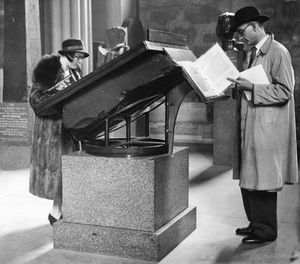
Lane DeNicola: Yes. I would say that one of the more interesting aspects of that are the material consequences. Whereas literacy before was largely a matter of human knowledge, understanding of a language, all the actual practices involved was a surface to mark on and an instrument to do the marking, whereas today, a great deal of the cultural content that is in circulation commonly involves technologies that are considerably more complex than a simple writing instrument. Things that individuals don’t really comprehend in the same way.
Seph: What are the technologies that are more complex? What’s coming to my mind is computer code.
Lane: Exactly. Apple’s Garage Band might be one example, these tools that many of us encounter as final products on YouTube. One of the things on the new program at UCL we have tried to give a broad exposure to is exactly how much communicating people are doing through these new forms, and how they take the place in some instances of more traditional modes of communication.
Seph: You’re calling it communication, and one of the things that occurred to me after talking to Daniel, and exchanging a few emails, was that he calls writing, at least, a system of exchange. I was thinking, wouldn’t that in other contexts be called communication, and maybe ten years ago we would have called it transmission? But why is it exchange for you?
Daniel Rourke: I just have a problem with the notion of communication because of this idea of passing on something which is mutual. I think to use the word exchange for me takes it down a notch almost, that I am passing something on, but I am not necessarily passing on what I intend to pass on. To take it back to the idea of a writing system, the history of writing wasn’t necessarily marks on a page. The technologies that emerged from say Babylonia of a little cone of clay that had markings on the outside, they said just as much about the body and about symbolic notions as they did about what it was the marks were meaning to say. So that’s why I use exchange I think. It opens up the meaning a bit.
Seph: Yeah. It doesn’t presume that there is a person transmitting and a person that’s receiving, necessarily? And it also says something about, what I thought was really fascinating, that there is so much more in the object than just the markings on a page. About how the materials tell us something about that particular age, that particular moment in history.
Lane: Yeah. Even in a contemporary context it may have been the case that the early days of the web were all about hypertext, but the great deal of what you call ‘exchange’ that is happening today, how are you going to qualify a group of people playing World of Warcraft simultaneously in this shared virtual space – calling that communication is a little bit limiting. In fact it is experienced much more as a joint space, or an exchange of things, more than simple information. It can be thought of as an exchange of experience, or of virtual artefacts for example.
Seph: That can happen certainly in simulated game play, but it also happens in the decoding of texts. Objects that come to us from antiquity. There is all this material to be decoded that’s wrapped up in the artefacts. It is also, how much we decode and what we decode has something to do with our moment in time.
Daniel: I think it might be worth picking an example out of the air, when we are talking about this.
Seph: OK



 These three novels of yours form a loose trilogy. The obvious way I can tie them together is to say all of them take place, in full or in part, in Japan. But in your own mind, what holds these books together?