How to Win an Argument About Guns

Nicholas Kristof in the New York Times:

Tragically, predictably, infuriatingly, we’re again mourning a shooting —this time at YouTube’s headquarters — even as the drive for gun safety legislation has stalled in Washington. Polls show that nine out of 10 Americans favor basic steps like universal background checks before gun purchases, but the exceptions are the president and a majority in Congress.

Usually pundits toss out their own best arguments while ignoring the other side’s, but today I’m going to try something new and engage directly with the arguments made by gun advocates:

You liberals are in a panic over guns, but look at the numbers. Any one gun is less likely to kill a person than any one vehicle. But we’re not traumatized by cars, and we don’t try to ban them.

It’s true that any particular car is more likely to be involved in a fatality than any particular gun. But cars are actually a perfect example of the public health approach that we should apply to guns. We don’t ban cars, but we do work hard to take a dangerous product and regulate it to limit the damage.

We do that through seatbelts and airbags, through speed limits and highway barriers, through driver’s licenses and insurance requirements, through crackdowns on drunken driving and texting while driving. I once calculated that since 1921, we had reduced the auto fatality rate per 100 million miles driven by 95 percent.

Sure, we could have just said “cars don’t kill people, people kill people.” Or we could have said that it’s pointless to regulate cars because then bicyclists will just run each other down. Instead, we relied on evidence and data to reduce the carnage from cars. Why isn’t that a model for guns?

More here.

WHEN MARGUERITE DURAS GOT KICKED OUT OF THE COMMUNIST PARTY

DurasEmily Temple at Literary Hub:

Fun fact about Marguerite Duras: in addition to being a brilliant novelist, Academy Award-nominated filmmaker, and playwright, she was, for many years, a committed communist. And she was very good at it. She joined the French Communist Party in 1944. She was a communist, writes Laure Adler in Marguerite Duras: A Life, “because it was the party of the working classes, because it defended the poor and the pure. But she was a particular kind of communist, a euphoric, utopian, idealistic communist.” She became fairly militant about it—knocking on doors, selling copies of L’Humanité, recruiting whomever she could find, and eventually became the secretary of her local cell. Sometimes she wrote short stories on the backs of communist pamphlets.

Her companions, Robert Antelme (her husband) and Dionys Mascolo (her lover)—by the way, did everyone know that Duras lived with both her husband and her lover and everyone was fine with it? I could not love her any more—joined too. But soon Duras began to have doubts; the Moscow trials and Stalinism, in particular, distressed her, and a new friendship with an alluring Italian named Elio Vittorini showed them a new model: “the free communist though not necessarily Marxist intellectual, the affective, protesting communist.”

more here.

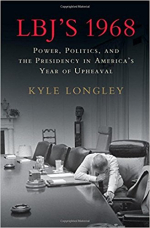
LBJ’s 1968: Power, Politics, and the Presidency in America’s Year of Upheaval

51f3vTCx+AL._SX326_BO1 204 203 200_Tim Stanley at Literary Review:

Everyone has a favourite president, but I’m suspicious of anyone who says it’s Lyndon Baines Johnson. Yes, he was the politician’s politician – one of the greatest legislators in US history – but he was also a monster. Kyle Longley recounts an episode when journalists were badgering Johnson to explain America’s war in Vietnam. LBJ unzipped his fly, pulled out his sizeable member and said, ‘This is why!’ They say the personal is political, but that’s taking things too far.

Longley’s new book examines a year in Johnson’s life – his final one as president – in microscopic detail. At first, you wonder why he bothers. The opening chapter deals with the writing of the State of the Union Address for 1968, an overlong speech never quoted today. The toing and froing of Johnson and his advisers makes for dull reading. But if you can stay the course as far as the third chapter, you start to get the point. Johnson’s final year in office was a fruitless struggle to get anything done at all: a cycle of trial and disaster. The State of the Union Address, in which Johnson tried to rededicate the nation to social reform, was delivered on 17 January and went down fairly well. On 30 January, the Viet Cong launched the Tet Offensive. For the first time, Americans really contemplated defeat in Vietnam. Johnson’s plans fell apart.

more here.

The Bloody Family History of the Guillotine

576cb32f05aae_louisetteEdward White at The Paris Review:

Killing was in the Sanson blood. The first of the family to act as the royal executioner was Charles-Henri’s great-grandfather, who was coerced into taking the position once his father-in-law had passed away. Over the next century, three other Sanson men inherited the role, before Charles-Henri succeeded in 1778. He was thirty-nine at the time, but already a capital punishment veteran. When his father had succumbed to a debilitating illness in 1754, Charles-Henri had taken over his duties on the scaffold, at the age of just fifteen. The boy exhibited astonishing qualities: a wisdom way beyond his years, and a stomach strong enough to see him through the strangulations, beheadings, and burnings that were his workaday life. While still a teenager, he conducted the last hanging, drawing and quartering in French history, inflicted upon Robert-François Damiens for an attempt on the King’s life. Sanson would later look back on this as a simpler time, when the worst sin imaginable was killing a king.

All we know of Sanson suggests he was an eloquent and thoughtful man. Erudite, well-read, and multi-lingual, he took his duties as a public official with the utmost seriousness. He may have felt, as his grandson would later claim, constrained and frustrated by the family business, eager to attain higher office but prohibited by the taint of the hangman’s noose.

more here.

Friday Poem

Elegy for a Dead Labrador

Here there may be, in the midst of summer,
a few days when suddenly it’s fall.
Thrushes sing on a sharper note.
The rocks stand determined out in the water.
They know something. They’ve always known it.
We know it too, and we don’t like it.
On the way home, in the boat, on just such evenings
you would stand stock-still in the bow, collected,
scouting the scents coming across the water.
You read the evening, the faint streak of smoke
from a garden, a pancake frying
half a mile away, a badger
standing somewhere in the same twilight
sniffing the same way. Our friendship
was of course a compromise; we lived
together in two different worlds: mine,
mostly letters, a text passing through life,
yours, mostly smells. You had knowledge
I would have given much to have possessed:
the ability to let a feeling—eagerness, hate, or love—
run like a wave throughout your body
from nose to tip of tail, the inability
ever to accept the moon as fact.
At the full moon you always complained loudly against it.
You were a better Gnostic than I am. And consequently
you lived continually in paradise.

Read more »

Intelligence-augmentation device lets users ‘speak silently’ with a computer by just thinking

From KurzweilAI:

Alter-EgoMIT researchers have invented a system that allows someone to communicate silently and privately with a computer or the internet by simply thinking — without requiring any facial muscle movement. The AlterEgo system consists of a wearable device with electrodes that pick up otherwise undetectable neuromuscular subvocalizations — saying words “in your head” in natural language. The signals are fed to a neural network that is trained to identify subvocalized words from these signals. Bone-conduction headphones also transmit vibrations through the bones of the face to the inner ear to convey information to the user — privately and without interrupting a conversation. The device connects wirelessly to any external computing device via Bluetooth.

A silent, discreet, bidirectional conversation with machines. “Our idea was: Could we have a computing platform that’s more internal, that melds human and machine in some ways and that feels like an internal extension of our own cognition?,” says Arnav Kapur, a graduate student at the MIT Media Lab who led the development of the new system. Kapur is first author on a paper on the research presented in March at the IUI ’18 23rd International Conference on Intelligent User Interfaces. In one of the researchers’ experiments, subjects used the system to silently report opponents’ moves in a chess game and silently receive recommended moves from a chess-playing computer program. In another experiment, subjects were able to undetectably answer difficult computational problems, such as the square root of large numbers or obscure facts. The researchers achieved 92% median word accuracy levels, which is expected to improve. “I think we’ll achieve full conversation someday,” Kapur said

More here.

Thursday, April 5, 2018

A Jar, a Blouse, a Letter

Maria Dimitrova in the London Review of Books:

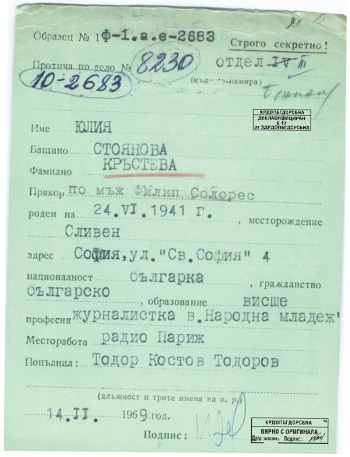
6244_Page_1In Laurent Binet’s novel The Seventh Function of Language (2015), Julia Kristeva is cast as a spy for Bulgarian intelligence, responsible for the death of Roland Barthes. Last Tuesday, the Bulgarian Dossier Committee, in charge of examining and declassifying communist-era State Security records, announced that Kristeva had been an agent of the First Chief Directorate.

On Thursday, Kristeva denied the allegations, describing them as ‘grotesque’ and ‘completely false’. On Friday, the Dossier Commission published her entire dossier – nearly 400 pages – on their website. Yesterday, Kristeva issued another statement, insisting she had ‘never belonged to any secret service’ and had not supported ‘a regime that I fled’. She criticised the ‘credence given to these files, without there being any questioning about who wrote them or why’:

This episode would be comical, and might even seem a bit romantic, were it not for the fact that it is all so false and that its uncritical repetition in the media is so frightening.

The dossier consists of a ‘Work’ file (documents attributed to Kristeva), a ‘Personal’ file (documents collected about Kristeva) and forms and cards registering her as a ‘secret collaborator’ (dated 14 November 1969) and an ‘agent’ (21 June 1971). A faint inscription in pencil next to her name on one of the forms says ‘Refugee’: a dangerous status for her to have, especially for her relatives. ‘The contact with our authorities should be kept alive,’ Kristeva’s father advises her in a letter. ‘People should feel that in you and your sister they have grateful, patriotic fellow citizens. Such a contact will make our life here easier.’

More here.

Quantum Correlations Reverse Thermodynamic Arrow of Time

Katia Moskvitch in Quanta:

Thermodynamics_1300ledeSome laws aren’t meant to be broken. Take the second law of thermodynamics, which states that entropy — a measure of disorder — never decreases in an isolated system. Glass shatters, cream disperses in coffee, eggs scramble — but never the reverse. This is why heat always moves from hot to cold: Doing so increases the overall entropy. The law is so fundamental to our physical reality that some physicists believe it is responsible for the apparent flow of time.

Yet quantum systems, as ever, have a way of introducing puzzling exceptions to what seem like inviolable rules. A team of physicists has made heat flow spontaneously from a cold quantum object to a hot one. The experiment underscores the intimate relationships between information, entropy and energy that are being explored in the nascent field of quantum thermodynamics.

The team, based in Brazil, took a molecule that consisted of a carbon atom, a hydrogen atom and three chlorine atoms. They then generated a magnetic field to align the nuclear spins of the two quantum particles, or “qubits” — the carbon and hydrogen nuclei. This caused the nuclei to become linked, or correlated, turning them into a single, inseparable whole, a two-qubit quantum state.

These correlations made the puzzling behavior possible.

More here.

Erasmus vs. Luther — a Rift That Defined the Course of Western Civilization

Rebecca Newberger Goldstein in the New York Times:

Merlin_135768453_f8e258a0-705c-4bb9-ad4d-d27a60162e13-superJumboOften the best way to understand opposing viewpoints is to imagine the proponents in dialogue. How would Euripides have responded to Plato, his Athenian contemporary, concerning the philosopher’s banishing poets from his utopia? Or picture George Eliot cornering Arthur Schopenhauer to challenge his argument that women are unsuited for artistic and intellectual greatness. The history of ideas is filled with pairs of contemporary minds who missed the opportunity to confront each other point blank, leaving us to dream up hypothetical exchanges.

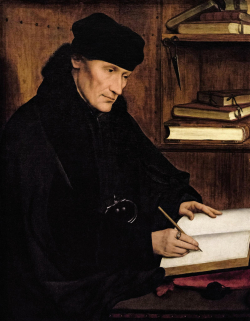
But sometimes our imaginations aren’t necessary. Desiderius Erasmus and Martin Luther, though they never met in person, were articulate in their assessments of each other. In their disdain for the power-hungry abuses of the church, the grotesque superstitions it encouraged in the laity and the equally grotesque scholasticism it encouraged in the era’s theologians, they might have been natural allies; instead they became implacable foes. Each, in opposing the other, clarified his own point of view. In the process, the two great reformist movements of their day — the Renaissance, embodied in Erasmus, and the Reformation, embodied in Luther — were torn asunder. Michael Massing’s riveting “Fatal Discord: Erasmus, Luther and the Fight for the Western Mind” is devoted to this fateful parting of ways.

More here.

Forget Killer Robots—Bias Is the Real AI Danger

Will Knight in MIT Technology Review (from six months ago but worth reading):

Googlex2760_0Google’s AI chief isn’t fretting about super-intelligent killer robots. Instead, John Giannandrea is concerned about the danger that may be lurking inside the machine-learning algorithms used to make millions of decisions every minute.

“The real safety question, if you want to call it that, is that if we give these systems biased data, they will be biased,” Giannandrea said before a recent Google conference on the relationship between humans and AI systems.

The problem of bias in machine learning is likely to become more significant as the technology spreads to critical areas like medicine and law, and as more people without a deep technical understanding are tasked with deploying it. Some experts warn that algorithmic bias is already pervasive in many industries, and that almost no one is making an effort to identify or correct it (see “Biased Algorithms Are Everywhere, and No One Seems to Care”).

“It’s important that we be transparent about the training data that we are using, and are looking for hidden biases in it, otherwise we are building biased systems,” Giannandrea added. “If someone is trying to sell you a black box system for medical decision support, and you don’t know how it works or what data was used to train it, then I wouldn’t trust it.”

Black box machine-learning models are already having a major impact on some people’s lives. A system called COMPAS, made by a company called Northpointe, offers to predict defendants’ likelihood of reoffending, and is used by some judges to determine whether an inmate is granted parole. The workings of COMPAS are kept secret, but an investigation by ProPublica found evidence that the model may be biased against minorities.

More here.

An Activist Filmmaker Tackles Patriarchy in Pakistan

Alexis Okeowo in The New Yorker:

SharmeenFor Sharmeen Obaid-Chinoy, anger is the most useful emotion. Anger was what motivated her to write for newspapers as a teen-ager and to make documentary films as an adult, and it is the reaction she habitually tries to provoke in audiences. Even when she is on camera, she cannot resist interrupting her own narration to register outrage at a particular injustice. Obaid-Chinoy is the best-known documentary filmmaker in Pakistan. Her films, which have won two Oscars and three Emmys, range from reportage on xenophobia in South Africa to an inquiry into the ethics of honor killings in Pakistan. “Anger is necessary for people to go beyond not liking what they see,” she said. “I need enough people who watch my stuff to be moved, and to be angry, and to do something about it.”

On a recent afternoon in Karachi, where Obaid-Chinoy lives, she visited a girls’ school in Shireen Jinnah Colony, a slum, to talk to students and to show some of her films. A volunteer administrator at the school, Tanvir Khwaja, her head covered with a pink dupatta, welcomed Obaid-Chinoy into a vast auditorium decorated with silver and green stars, where rows of eager girls in lilac-hued hijabs sat whispering. Some were as young as eight, while others were in their last year of secondary school. Khwaja had warned Obaid-Chinoy that most of the girls came from a “very, very conservative background.” Obaid-Chinoy, who is thirty-nine, wore a black shalwar kameez; her dark hair, streaked with gray, was pinned back. She is a natural reporter, watchful and carefully expressive, with a heightened impulse to gauge her companion’s mood; she has a habit of smiling quickly to offer reassurance during an uneasy silence. She is also unabashedly confident: at a party in Islamabad, I saw her tell a male guest, within moments of meeting him, that she was an Oscar winner. Soon afterward, she challenged another man, a politician, about his views on China’s business dealings with Pakistan. The politician smiled tightly and congratulated her on having her film about honor killings screened at the Prime Minister’s office. It was a shame, he added, that it showed the country in such a negative light.

Obaid-Chinoy is accustomed to this kind of mixed reaction to her work. Her critics in Pakistan have suggested that her films stoke outrage by confirming the prejudices of Western audiences. Obaid-Chinoy argues that these critics, many of whom are male, are in fact reacting against her own power as a woman, and against the misogyny she is exposing. The position of women in Pakistani society has been disputed since the country was established, in 1947. Muhammad Ali Jinnah’s vision for the republic involved a separation of religion and politics, the equality of all Pakistanis, and the nurturing of an intelligentsia. He spoke out against “the curse of provincialism,” and said in a speech, “It is a crime against humanity that our women are shut up within the four walls of the houses as prisoners.” In the decades since Jinnah’s death, in 1948, those in power, most notably General Muhammad Zia-ul-Haq, who ruled from 1977 to 1988, have eroded women’s rights, often in efforts to enforce a conservative, Islamic ideology. Although many Pakistani women attend college and pursue careers in the arts, law, and politics, they also face an entrenched patriarchy that dictates their choices when it comes to schooling, work, marriage, and self-presentation. Poor women have even less freedom. More than half of Pakistani women are illiterate, and many suffer domestic violence. They struggle to have their legal rights upheld, and face accusations of bringing dishonor upon their families if they report a rape or file for a divorce. Through her work, Obaid-Chinoy believes, she is combatting men’s power to define women’s lives.

More here.

the dazzling complexities of Mercè Rodoreda

Stories_highresColm Tóibín at the TLS:

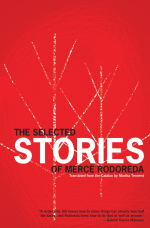
Rodoreda was born in Barcelona in 1908. At the age of twenty, having received ecclesiastical permission, she married her mother’s younger brother. They had one son. Between the early 1930s and the outbreak of the Spanish Civil War in 1936, she published several novels and pieces of short fiction, all in Catalan. In 1935 she began work for the Catalan Ministry of Information. Franco’s victory in the war forced her to go into exile, first outside Paris but then, as a result of the Nazi occupation, elsewhere in France. Before she left Spain, she broke up with her first husband. After much difficulty and hardship, she finally settled in Geneva, returning to Catalonia in 1979 where she died four years later.

In her best fiction, she allows the details to speak for themselves; the mind through which the world is seen is almost naive, almost detached. This means that much is achieved or hinted at by tone, through rhythm, by coiled implication. The world is viewed as though helplessly, as if it might not bear the weight of much analysis. It is up to the reader to understand the extent of the suffering, the quality of the pain. The less these things are actively named, the more deeply they will be evoked.

more here.

hating literature

51vhy7G9AkL._SX331_BO1 204 203 200_Jonathon Sturgeon at The Baffler:

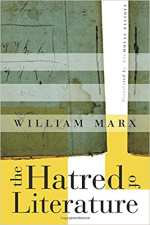
LITERATURE IS NOT LITERATURE UNTIL SOMEONE hates it on principle. Homer and Hesiod weren’t poets, in the way we’ve come to understand the word, until Xenophanes and Heraclitus and Plato attacked poetry’s governing credentials, its pipeline to the Gods. The last of these, speaking through Socrates, displaced poetry’s authority, itself drawn from the Muses, by banishing it from the well-ordered city; poetry’s tendency to arouse madness, its toleration of clashing voices, and its foundational place in the educational curriculum made it the enemy of an imagined republic where all positions were accounted for, where all discourse was to be phlegmatically compassed toward the truth. Paradoxically, though, this exile came to define poetry. Until their banishment, Hesiod and Homer were more like perennial Teachers of the Year or cool, dead popes—but universal. We don’t have a contemporary analogue.

This is the thesis, or a thesis, of William Marx’s The Hatred of Literature, another in a line of books, following Ben Lerner’s Hatred of Poetry, that defines literature through its strongest negative, hatred of it.

more here.

inside the dark and dreamlike world of Swiss writer Fleur Jaeggy

Fleur-Jaeggy-620 × 350-RGB-landscape-460x250Margaret Drabble at The New Statesman:

Fleur Jaeggy is multi-lingual and has also worked as a translator. Swiss by birth, born in Zurich in 1940 into an upper-class family, she writes in Italian, but she has also translated into Italian Thomas De Quincey’s The Last Days of Immanuel Kant and Marcel Schwob’s Imaginary Lives.

In These Possible Lives (2017, translated by Minna Zallman Proctor) she offers three very short biographical sketches of Keats, De Quincey, and the fin-de-siècle symbolist orientalist Jewish Parisian Schwob. Schwob is a character best known to me, bizarrely, as a kind friend to Arnold Bennett in his lonely Paris days; more pertinently, he was a friend of Stéphane Mallarmé and Alfred Jarry, and is said to have influenced Borges. Her three subjects are loosely linked by opium, by malady, by a delectatio morosa or morbid delight, and her essays are prose poems rather than factual narrations. She does not give facts or dates, but tells us of Wordsworth’s habit of cutting the pages of books with a butter knife, of De Quincey’s nightmares, of Schwob’s love for a tubercular working-class girl and her dolls, of Keats begging “in a lucid delirium” for more laudanum. Their hallucinatory intensity and heightened language recall the prose poems of Baudelaire’s Le Spleen de Paris, with their invocations of wine and hashish, their pose of le poète maudit.

more here.

Thursday Poem

.
Here’s a brook in all its April energy.


Up its steep and many-bouldered bank
a profusion of nasturtiums scatter
–“like bright syllables”
a transcendentalist poet might say.

Her eye would read that poem.
She’d hear harmonies of rock and water,
feel the soft touch of sun,
the warm taste of spring,
and think of what it meant.

Yet, air is full of a blue confidence in itself.
The world is full of fullness.

Nothing to transcend here.
.

by Nils Peterson
.

Wednesday, April 4, 2018

Freeman Dyson’s life of scientific delight

Ann Finkbeiner in Nature:

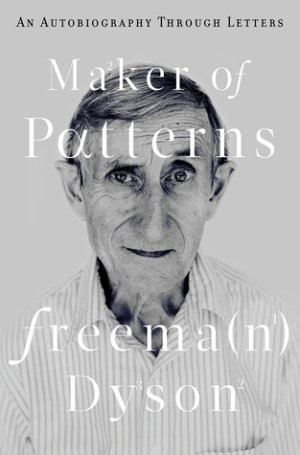
35187189Freeman Dyson is a mathematically inclined physicist who proved in 1949 that competing theories of quantum behaviour were equivalent. In a career spanning seven decades, he branched out into myriad fields. They included condensed-matter physics, nuclear reactors, astronomical technology, extraterrestrial habitation and advising the US government on national security, sometimes as part of the elite post-war research group JASON.

Dyson grew up in Winchester, UK, and left in 1941 for the University of Cambridge, where he studied mathematics. There, he began a lifelong habit of writing regular letters home. Now, aged 94 and living in the United States, he has published some of them in Maker of Patterns. They cover a remarkable range of scientific interests, acquaintances, opinions and adventures.

The patterns Dyson says he made were first those of ideas in mathematics and physics, and then those in his writing about literature and history. Readers might hope that Dyson’s own pattern — the reference frame in which his remarkable range becomes a coherent whole — would be found in his letters. As a writer who has interviewed Dyson, I would advise against such hope.

The letters read like a travel journal written for people he loves and trusts. “I think the reason I write so openly is just this,” he tells his parents in 1949, “that all these adventures in this strange new world are still somewhat unreal to me, and in writing to you about them, I bring them in contact with my familiar world and lend them some of your reality.”

Dyson notices everything. He describes Americans’ friendliness as a result of their inattention to the past, and thus of their loneliness in time.

More here.

The Epidemic of Wrongful Convictions in America

Elie Mystal in the New York Times:

ScreenHunter_3028 Apr. 04 19.05America’s bottomless fascination with “true crime” stories and “murder porn” has been capitalized on by some content creators seeking to inspire changes in the criminal justice system. But the genre tends to let the system itself off the hook. The titillating and gory details of any one case narrow readers’ focus onto particular bad actors, relegating law enforcement to a largely offscreen menace. Literature as a tool for social and legal reform further requires the reader to accept the author’s assertion that the highlighted case produced an incorrect result, which is a big ask in a country that can’t even agree on whether Han Solo shot first.

“The Cadaver King and the Country Dentist,” by the Washington Post journalist Radley Balko and Tucker Carrington, a law professor at the University of Mississippi, avoids these generic problems. There is no murder mystery. The book details the wrongful convictions of two men, Kennedy Brewer and Levon Brooks, in the separate murders of two girls in the same rural Mississippi town in the early 1990s. But the real killer of both 3-year-olds is revealed to the reader before the wrong men are even put on trial. We are also spared the anguish of wondering if the system will ever get it right, for we know the men have already been freed thanks to the work of the nonprofit criminal exoneration organization the Innocence Project.

The crime having been solved early on, Balko and Carrington devote the bulk of the book to pulling back the curtain on the justice system’s little-known but systemic problem that put Brewer and Brooks behind bars: faulty and biased forensic evidence. Junk science convicted these men; real science set them free. The inability of judges and jurors to tell the difference is why innocent men languish in jail while the prosecutors who put them there run for higher office.

More here.