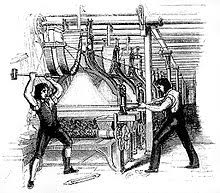
One Tennessee community’s odyssey from slavery to Freedom

John Baker in BlackPast.Org:
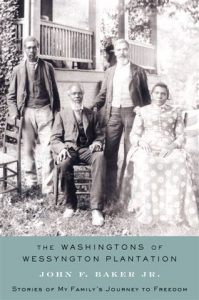
When I was in the seventh grade, I spotted a photograph of four former slaves in my social studies textbook.  Although the photograph was entitled Black Tennesseans, I noticed a strong family resemblance between them and my family members. When my grandmother told me that two of them were actually her grandparents, I began the lifelong research project that became The Washingtons of Wessyngton Plantation: Stories of My Family’s Journey to Freedom.

I tell the story of my ancestors Emanuel and Henny Washington, who were enslaved on Wessyngton Plantation owned by the Washington family.  This is also the story of the hundreds of other African Americans connected with the plantation for more than two hundred years. It is a story of family, faith, and community. Founded in 1796 by Joseph Washington, a distant cousin of America’s first president, Wessyngton Plantation covered 15,000 acres in Robertson County and held an enslaved population of 274 African Americans. They comprised the largest enslaved population on a single plantation in the state of Tennessee and they worked on the largest tobacco plantation in the United States and the second largest in the world.

During the Civil War many African American men from the plantation enlisted in the Union Army, others ran away and worked on the military fortification, Fort Negley, in Nashville.  After the emancipation in 1865 many of the freedpeople returned to Wessyngton as sharecroppers.  Others purchased their own farms including several who bought land on which they had previously been enslaved.  Some of this land remains in their descendants’ possession.

Only two slaves were ever sold from Wessyngton Plantation so the African Americans there formed family groups that remained intact for generations.  Many of their descendants still remain in the area close to the plantation, others now numbering in the tens of thousands live throughout the United States.  Some of the African Americans on Wessyngton also retained true African names, which was very rare for that period.  This has made it possible to trace their African ethnic group heritage, which has been confirmed by DNA testing.

More here. (Note: Throughout February, we will publish at least one post dedicated to Black History Month)

Everywhere in the Animal Kingdom, Followers of the Milky Way

Natalie Angier in The New York Times:

Most female flies take a low-rent approach to parenthood, depositing scores of seed-sized eggs in the trash or on pet scat to hatch, leaving the larvae to fend for themselves. Not so the female tsetse fly. She gestates her young internally, one at a time, and gives birth to them live. When each extravagantly pampered offspring pulls free of her uterus after nine days, fly mother and child are pretty much the same size. “It’s the equivalent of giving birth to an 18-year-old,” said Geoffrey Attardo, an entomologist who studies tsetse flies at the University of California, Davis. The newborn tsetse fly looks like a hand grenade and moves like a Slinky, and if you squeeze it too hard the source of its plumpness becomes clear — or rather a telltale white. The larva, it seems, is just a big bag of milk. “Rupture the gut,” Dr. Attardo said, “and the milk comes spilling out.”

And milk it truly is — a nutritional, biochemical and immunological designer fluid that the mother fly’s body has spun from her blood meals and pumped into her uterus, where her developing young greedily gulped it down. Thus fattened on maternal largess, a tsetse fly larva can safely burrow underground and pupate for 30 days before emerging as a full-blown adult with a nasty bite and a notorious capacity to transmit a deadly disease called sleeping sickness. In a recent chemical and genetic analysis of tsetse fly milk, Dr. Attardo and his colleagues were startled to discover how similar it was to the product of the beloved gland that stamps us as mammals. “I was expecting something completely off the wall and different,” he said. “But there are frightening, fascinating overlaps with mammalian milk in the kinds of proteins we see.”

More here.

There’s a serious philosophical argument supporting the man suing his parents for giving birth to him

Olivia Goldhill in Quartz:

A man is suing his parents for giving birth to him without his consent. That might sound ridiculous, but he has a point. The plaintiff behind the lawsuit, 27-year-old Raphael Samuel, believes in “anti-natalism,” namely the philosophical theory that parents do not have moral standing to bring an unwitting child into the world. And there are some seriously legitimate philosophers who advocate for this argument.

The best-known anti-natalist is David Benatar, head of the philosophy department at the University of Cape Town and author of the 2006 book Better Never to Have Been: The Harm of Coming into Existence. (Though Benatar is heralded as a philosopher, he’s controversial at the University of Cape Town for comments he’s made about race, and was dismissive of African philosophy in a recent interview with Quartz.) A 2012 New Yorker article on the theory highlights a central premise of Benatar’s work: If a couple have multiple hereditary genetic diseases and live in horrendous conditions, we might well agree they have a moral obligation not to procreate and so avoid bringing into the world a child who will suffer terribly. Conversely, if a couple is wealthy and disease-free, we would not consider them morally obliged to create a child.

More here.

There’s No Good Reason To Trust Blockchain Technology

Bruce Schneier in Wired:

In his 2008 white paper that first proposed bitcoin, the anonymous Satoshi Nakamoto concluded with: “We have proposed a system for electronic transactions without relying on trust.” He was referring to blockchain, the system behind bitcoin cryptocurrency. The circumvention of trust is a great promise, but it’s just not true. Yes, bitcoin eliminates certain trusted intermediaries that are inherent in other payment systems like credit cards. But you still have to trust bitcoin—and everything about it.

Much has been written about blockchains and how they displace, reshape, or eliminate trust. But when you analyze both blockchain and trust, you quickly realize that there is much more hype than value. Blockchain solutions are often much worse than what they replace.

First, a caveat. By blockchain, I mean something very specific: the data structures and protocols that make up a public blockchain. These have three essential elements.

More here.

Zucked: Waking Up to the Facebook Catastrophe

Tom Bissell in the New York Times:

The dystopia George Orwell conjured up in “1984” wasn’t a prediction. It was, instead, a reflection. Newspeak, the Ministry of Truth, the Inner Party, the Outer Party — that novel sampled and remixed a reality that Nazi and Soviet totalitarianism had already made apparent. Scary stuff, certainly, but maybe the more frightening dystopia is the one no one warned you about, the one you wake up one morning to realize you’re living inside.


Roger McNamee, an esteemed venture capitalist, would appear to agree. “A dystopian technology future overran our lives before we were ready,” he writes in “Zucked.” Think that sounds like overstatement? Let’s examine the evidence. At its peak the planet’s fourth most valuable company, and arguably its most influential, is controlled almost entirely by a young man with the charisma of a geometry T.A. The totality of this man’s professional life has been running this company, which calls itself “a platform.” Company, platform — whatever it is, it provides a curious service wherein billions of people fill it with content: baby photos, birthday wishes, concert promotions, psychotic premonitions of Jewish lizard-men. No one is paid by the company for this labor; on the contrary, users are rewarded by being tracked across the web, even when logged out, and consequently strip-mined by a complicated artificial intelligence trained to sort surveilled information into approximately 29,000 predictive data points, which are then made available to advertisers and other third parties, who now know everything that can be known about a person without trepanning her skull. Amazingly, none of this is secret, despite the company’s best efforts to keep it so. Somehow, people still use and love this platform.

More here.

Bolsonaro’s Brazil

Perry Anderson in the London Review of Books:

The teratology of the contemporary political imagination – plentiful enough: Trump, Le Pen, Salvini, Orbán, Kaczyński, ogres galore – has acquired a new monster. Rising above the ruck, the president-elect of Brazil has extolled his country’s most notorious torturer; declared that its military dictatorship should have shot thirty thousand opponents; told a congresswoman she was too ugly to merit raping; announced he would rather a son killed in a car accident than gay; declared open season on the Amazon rainforest; not least, on the day after his election, promised followers to rid the land of red riff-raff. Yet for Sérgio Moro, his incoming justice minister saluted worldwide as an epitome of judicial independence and integrity, Jair Bolsonaro is a ‘moderate’.

To all appearances, the verdict of the polls last October was unambiguous: after governing the country for 14 years, the Workers’ Party (PT) has been comprehensively repudiated and its survival may now be in doubt. Lula, the most popular ruler in Brazilian history, has been incarcerated by Moro and awaits further jail sentences. His successor, evicted from office midway through her second term, is a virtual outcast, reduced to a humiliating fourth place in a local Senate race. How has this reversal come about?

More here.

Tuesday Poem

Sol/o

my love
there are no accidents
in war – no kisses
on the belligerent lips of crocodiles
no loves greener than
the dancing hearts of children
no reveller jollier than the worm
in columbus’s boiling head

there are no songs beautifuller
than the stern indifference of the hills
there are no flowers more clamorous
than the seas of children
home in my little heart

i tell u this
as the sun recedes
into the quaking pinstripe
of my warriors
grinning & vulgar in their muddied dreams
of power

i tell u this love
because the roads
have become hostile

by  Seitlhamo Motsapi
from earthstepper/the ocean is very shallow
publisher: Deep South, South Africa

Monday, February 11, 2019

The Duty To Forgive Murderers

by Thomas R. Wells

There are people living among us who have done terrible things to other human beings – murder and rape, for example – yet who nonetheless deserve society’s forgiveness. They have been convicted for their crimes and punished by the laws we collectively agreed such moral transgressions deserve. Now they deserve something other than punishment. They deserve to be treated with respect rather than resentment, contempt, and suspicion. They deserve a real chance to overcome their history and make something of their life.

I

When someone commits a morally terrible act against another that is a concern for the whole society rather than only the victim. Hence the institutions of police, courts and prisons administered by the state on behalf of the people. These systems are designed to discover the moral facts of each case: how bad the crime was, how responsible the perpetrator, and how much they deserve to be punished. This is important to make sure that we punish the people who do terrible things (and only those people), and also that we punish them to the degree that they deserve it and no more.

The last point is essential. We have a duty to punish the people who do bad things, but we have no right to punish them more than they deserve. For the same reason that it is wrongful to punish the wrong person for a crime, it is wrongful to punish the right person in the wrong way. This is why it is important for us to leave the judging to specialist institutions with the resources and authority to do it properly. When we try to do it ourselves we get mob justice – i.e. punishment only stops when those with the most extreme feelings about the case are satisfied.

In most developed countries the criminal justice system is trusted well enough to decide who is guilty and deserves punishment, i.e. who is a criminal. However, it seems that some people hold a lingering belief in their personal right to decide how much punishment criminals deserve to receive, and to inflict that privately if they have the chance. Thus, people with convictions for murder are routinely harassed and denied employment or access to opportunities like university education. Read more »

Cultural Appropriation, Camp, and Israel’s bid for the Eurovision

by Abigail Akavia

Conchita Wurst (by Ailura)

As was to be expected, artists are now calling to relocate the next Eurovision Song Contest, which is to be held in Israel in May. No less predictably, supporters are saying, more or less, “let’s leave politics out of it”. As if the Eurovision is nothing but a celebration of music, a friendly competition where sportsmanship is what counts above else. As if, indeed, athletic competitions have nothing to do with politics. The Eurovision has been described as the “Gay Olympics” or the “Gay World Cup.” The analogy brings to mind the controversies surrounding Russia’s hosting of the 2018 world cup games, despite the country’s well-documented violations of human rights. The example of Russia is telling, since there was quite a lot of criticism aimed at FIFA this summer, not for allowing Russia to host per se, but for failing to secure the games as a racism-free zone. In the 2014 Eurovision held in Copenhagen, the Russian representatives were loudly booed in response to Russia’s recent annexation of Crimea and its stance on gay rights. Like it or not, Eurovision participants are held as representatives of their nation, and are judged as such. Thus, even though Eurovision fans display a “playful nationalism” in their celebratory participation in the events, and often support not only their nation’s song but also the one they deem most worthy, the Eurovision remains an overt political arena where two issues are at stake: nationalism and queerness.

A local controversy surrounding one of the runner-ups to become Israel’s contestant to the Eurovision illuminates these two contexts and how they intersect. The next performer to represent Israel on the Eurovision Song Contest will be chosen in a pre-competition reality show called “The Next Star.” Since the competition began two and half months ago, one of the contestants has gained particular attention. Rotem Shefi, a Jewish Israeli singer, performs under the stage-persona of Shefita, an Arab diva, whose props include tacky gowns, heavy jewelry, a glittery walking-cane (yup), and, the most important in her toolbox, a thick Arabic accent. Shefi’s songs in the competition have so far been almost exclusively covers, remakes of rock and pop hits rendered in a non-specific Middle Eastern, pseudo-Arabic sound, performed in English. Despite some signs of unease, especially among one of the show’s judges, Shefita is consistently voted up, and is still presented as a likely contender to win and become Israel’s representative to the Eurovision. Read more »

World Enough and Time

by Samia Altaf

“Let’s go look at the flowers outside,” I say, as I sense Dad sinking into the recesses of his fading memory. I wheel him out. Look at the petunias. What a riot—purple, pink, white, that ordinary pedestrian flower in such abundant glory. I hold a bunch to his nose and he takes a deep breath. “Wow,” he says, and opens his eyes. The misty and faraway look hits me hard. It is like looking inside a bombed-out building that has few windows left intact and very little light. But he tries, never having been one to give up; he blinks shortsightedly at the greenery, the flowers, and the blue sky, and shakes his head at the wonder of it all—and of him being there in the middle of it. He struggles to say something but gives up halfway—words too have faded. “Wow,” he says again.

Dad has steadily and imperceptibly lost all memory to Alzheimer’s. Memories of his children, friends, family, his wife now gone. Only shards of crystallized knowledge—encoded so deeply—remain beyond the cognitive deterioration, He recognizes the simple beauty of flowers, they are still real. We look at the yellow rose bush, the petunias and the marigolds, this lovely spring evening. His face lights up. “Wow,” he says, over and over. And then: “I have these in my house” and “when will I go there?” He asks, a complete sentence, and looks anxiously at me, his brow scrunched with a look fit to break your heart. That he remembers—his house and the feeling of wanting to go there. One he had to leave when he and mom got to be too sick to live on their own. Do memories plague his ears, like flies?

“Do memories plague their ears like flies?

They shake their heads. Dusk brims the shadows.

Summer by summer all stole away,

The starting gates, the crowds and cries.”

(Philip Larkin)

Read more »

The Enlightened Luddite

“Luddite” is a word that is thrown around a lot these days. It signifies someone who is opposed to technological progress, or who is at least not climbing on board the technological bandwagon. 21st century luddites tend to eschew social media, prefer presentations without PowerPoint, still write cheques, and may even, in extreme cases, get by without a cell phone. When used in the first person, “luddite” is often a badge of honour. “I’m a bit of a luddite,” usually means “I see through and am unimpressed by the false promise of constant technological novelty.” Used in the third person, though, it typically suggests criticism. “So-and-so’s a bit of a luddite,” is likely to imply that So-and-so finds the latest technology confusing and has failed to keep up with it, probably due to intellectual limitations.
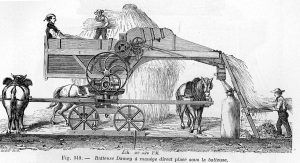

The original Luddites were English textile workers in the Midlands and the North who organized themselves in secret and destroyed machines in the newly established factories and mills. They were called “Luddites” after their fictitious leader, “General Ludd.” Peak Luddism occurred around 1812-1813, although there were incidents of machine breaking before and after then. The most notable of these were the Swing riots that swept across parts of Southern England in 1830 when impoverished agricultural labourers, sometimes carrying out threats issued by the fictitious Captain Swing, smashed threshing machines, burned barns, and demanded higher wages.

A common view today of these machine-breakers in the early stages of the industrial revolution is that they represent a clearly futile attempt to block technological innovation. One can sympathize with their plight, of course. Weavers who were proud of skills they had spent years mastering could now be replaced by relatively unskilled workers operating the new machines. Agricultural labourers who counted on threshing with hand flails for several months of employment following the harvest now faced winters without work or wages. But the times they were a-changing. Quite simply, the new methods of production could produce much more in less time and at lower cost. Trying to halt progress of this sort is as pointless as ordering back the tide. Resistance is futile.

But this view of the people who smashed stocking looms and threshing machines is oversimplified and somewhat unjust. It also carries some questionable ideological freight. Let me explain. Read more »

Sparrows in Winter

by Liam Heneghan

The traffic had been slow all day but by four pm, it was reduced to a trickle. Those cars that passed him on the street did so in two and threes as if they were sticking together for safety like lumbering animals caught out in a storm. It was, in fact, a very harsh winter day. The afternoon temperatures dipped well below zero: one of the coldest days ever recorded in Chicago. The only sounds now were from an occasional plane passing overhead, and from distant cackling from those venturesome neighbors who had left snug homes to experience the cold. He could hear the sound of his feet crunching through the snow.
The husband and wife had left the house to drop off a bag of groceries to a nearby homeless shelter. Peanut butter, cans of peaches, mandarin oranges in a light syrup, crackers, nuts, and so on: things that people accumulate in abundance for emergencies that rarely materialize. He stepped out of the car to drop off the goods, and walked down the short flight of stairs into a reception area in the basement of the church. The volunteer welcomed him with gusto; she had said “Welcome”, rather grandly, and looked at him expectantly. She seemed confused when he extended his shopping bag. “Donations,” he said. “Ah…!” she replied as she realized that he would not be staying. Another volunteer elaborately produced a receipt and he was required to jot down the list of items he was leaving behind. He found that he could not remember all the items, and made a few of them up.

As he left the shelter, he suppressed a smile and once back in the car he and his wife laughed at the confusion as she drove them away. It seemed like the sort of thing that always happened to him. The sort of thing that would also happen to his father, he reflected. After a few minutes, they fell silent, both ruminating, no doubt, on those now suffering without shelter. The husband abruptly declared he wanted to walk home and got out of the car. “I am looking more and more like my father,” thought the husband. The wife drove on. Read more »

God wanted me to write this column

by Joseph Shieber

One of the biggest early 20th century philosophical challenges to the belief in God stemmed from the doctrine of verificationism.

Roughly, according to verificationism, a claim has meaning just in case it is possible to verify the claim — either through empirical evidence or logical proof.

Now here’s the problem for a claim that expresses belief in God. There is no empirical evidence that can prove the existence of God, nor is it possible, purely through logic alone, to prove God’s existence. So, according to verificationism, a claim like “God exists” is quite literally meaningless. It’s just nonsense. Though grammatical, it’s no more meaningful than “Colorless green ideas sleep furiously”.

What made me think of verificationism and theism recently is the fact that, in the last couple of weeks  (and, indeed, years), a number of religious people have claimed that God had a particular interest in the outcome of the 2016 United States Presidential election.

Now it seems to me that we can show that such claims are pretty obviously nonsensical. And it seems to me that we can do this without accepting anything as strong as the verificationist thesis. In fact, we can do this even according to the standards of a committed religious believer. Read more »

Sunday, February 10, 2019

Reading in the Age of Constant Distraction

Mairead Small Staid in The Paris Review:

“I read books to read myself,” Sven Birkerts wrote in The Gutenberg Elegies: The Fate of Reading in an Electronic Age. Birkerts’s book, which turns twenty-five this year, is composed of fifteen essays on reading, the self, the convergence of the two, and the ways both are threatened by the encroachment of modern technology. As the culture around him underwent the sea change of the internet’s arrival, Birkerts feared that qualities long safeguarded and elevated by print were in danger of erosion: among them privacy, the valuation of individual consciousness, and an awareness of history—not merely the facts of it, but a sense of its continuity, of our place among the centuries and cosmos. “Literature holds meaning not as a content that can be abstracted and summarized, but as experience,” he wrote. “It is a participatory arena. Through the process of reading we slip out of our customary time orientation, marked by distractedness and surficiality, into the realm of duration.”

Writing in 1994, Birkerts worried that distractedness and surficiality would win out. The “duration state” we enter through a turned page would be lost in a world of increasing speed and relentless connectivity, and with it our ability to make meaning out of narratives, both fictional and lived. The diminishment of literature—of sustained reading, of writing as the product of a single focused mind—would diminish the self in turn, rendering us less and less able to grasp both the breadth of our world and the depth of our own consciousness. For Birkerts, as for many a reader, the thought of such a loss devastates.

More here.

The Special Sleep That Kicks In During a Sickness

Ed Yong in The Atlantic:

In 1909, the Japanese scientist Kuniomi Ishimori collected spinal fluid from sleep-deprived dogs and injected it into active, rested pooches. Within hours, the latter fell into a deep sleep. By coincidence, a pair of French researchers did the same experiments a few years later and got the same results. These studies, and others like them, suggested that the blood of sleepy animals contains some kind of soporific secret sauce of chemicals. Ishimori called these “hypogenic substances.” Others labeled them “somnogens.”

The sources of these sleep-inducing chemicals have proved surprisingly elusive, and scientists have found only a few that fit the bill. Now Hirofumi Toda from the University of Pennsylvania has discovered another—a gene called nemuri that triggers sleep, at least in fruit flies. Unexpectedly, it alsobecomes active during infections and acts to kill incoming microbes. It seems to be part of a self-regulating system, analogous enough to an internal thermostat that we might call it a sleep-o-stat. It can send animals to sleep when they most need shut-eye, whether because they’re sick or because they just haven’t slept enough.

This sleep-o-stat works separately from the daily body clocks that make us feel more tired at night.

More here.

‘There Is No Such Thing as Emancipatory Technology’: Marxist Scholar David Harvey

Jipson John and Jitheesh P.M. in The Wire:

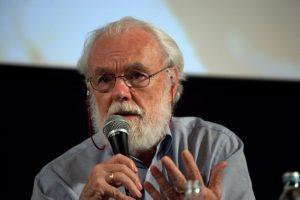
British scholar David Harvey is one of the most renowned Marxist scholars in the world today. His course on Karl Marx’s Capital is highly popular and has even been turned into a series on YouTube. Harvey is known for his support of student activism, community and labour movements.

In an interview with The Wire, he talks about the problems arising out of the neo-liberal project, the resulting surge of populist politics and right-wing movements. He also talks about the relevance of Marx’s critique of capitalism in the present context and the threat to labour from automation.

Could you trace the origin of neo-liberalism? What were the structural reasons for its emergence?

The idealist interpretation of liberalism rests on a utopian vision of a world of individual freedom and liberty for all guaranteed by an economy based on private property rights, self-regulating free markets and free trade, designed to foster technological progress and rising labour productivity to satisfy the wants and needs of all.

More here.

Meet the Guardian of Grammar Who Wants to Help You Be a Better Writer

Sarah Lyall in the New York Times:

With his finely tuned editing ear, Benjamin Dreyer often encounters things so personally horrifying that they register as a kind of torture, the way you might feel if you were an epicure and saw someone standing over the sink, slurping mayonnaise directly from the jar.
There is “manoeuvre,” the British spelling of “maneuver,” for example, whose unpleasant extraneous vowels evoke the sound of “a cat coughing up a hairball,” Dreyer says. There is “reside,” with its unnecessary stuffiness. (“You mean ‘live’?”) There is the use of quotation marks after the term “so-called,” as in “the so-called ‘expert,’” which just looks stupid.

And there are the words Dreyer currently dislikes most, even more than he dislikes “munch” and “nosh” and other distasteful eating-adjacent terms. Sitting recently in his book-crammed office at Penguin Random House, where he is vice president, executive managing editor and copy chief for Random House — a division within the larger company — Dreyer scribbled “smelly” and “stinky” on a card and slid it speedily across the desk, as if the card itself was emitting a foul stench. “I can’t say them out loud,” he said.

More here.

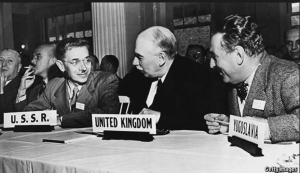
“A new Bretton Woods” and the problem of “economic order” — also a reply to Adler and Varoufakis

Adam Tooze at his own website:

Davos 2019 was a downbeat affair. That at least is how regulars described it To a newcomer it did not seem that way. Indeed, that gloomy assessment would seem to call for a reality check. Most thoughtful people are a lot gloomier than the folks you bump into at Davos. The 2019 meeting may not have had heroes to celebrate. The luster may have come off crypto. But if Davos lacked pizzazz, neither was it overshadowed by the sense of fundamental crisis that should surely color any realistic assessment of the current world situation.

It may sound paradoxical, but is it not the case that our sense of what is realistic is as much defined by mood (Stimmung) as it is by specific empirical facts?

In this sense the mood of Davos is profoundly unrealistic. What sets the tone is a Vegas-style festival of corporate PR and self-presentation, adorned with a barrage of exhortatory slogans worthy of a Mao-era pep rally.

More here.