
Category: Archives
Toyin Ojih Odutola’s Visions of Power
Zadie Smith at The New Yorker:
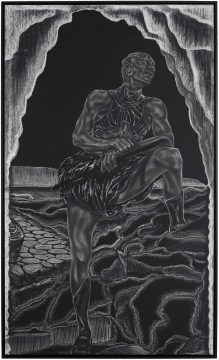 A woman stands in an otherworldly landscape, looking out. The landscape is sublime, though not the European sublime of cliffs, peaks, and mist. Here the sublime is African. It has many textures—conglomerations of stone, waterfalls, verdant grasslands—and may remind Nigerians of their own Jos Plateau. The woman stands with her left leg raised, surveying it all, with no sense of urgency; indeed, she appears to be in a state of philosophical contemplation. She seems assured both of her mastery over this land and of her natural right to it. This sovereignty is expressed primarily by her body—the fabrics she wears, the pose she strikes, all of which find their reflection in the land around her. The same dark lines tracing her impressive musculature render the rippling rocks; the ridges of her bald head match the ridges in the stone; the luxurious folds of the fabric are answered by the intricate layering of the earth beneath her feet. Toyin Ojih Odutola’s “The Ruling Class (Eshu)” appears, at first glance, to be a portrait of dominion. For to rule is to believe the land is made in your image, and, moreover, that everyone within it submits to you. Structurally, it recalls Caspar David Friedrich’s depiction of Enlightenment dominion, “Wanderer Above the Sea of Fog”: the same raised left leg, the same contemplation of power in tranquillity, the echoes of hair, pose, and fabric in the textured landscape. But the red-headed man with the cane and his back to us has been replaced by a black woman with a staff, facing forward. The script has been flipped.
more here.
A Lost Dystopian Masterpiece
Lucy Scholes at The Paris Review:
 It’s apt then that much of the novel’s power lies in its mystery. The narrator—if, indeed, we’re listening to the same single voice throughout—seems to be a writer, who lives in a book-filled ex-coastguard’s cottage, alone apart from their dog. They are never named. Nor is his or her gender revealed, something that’s in line with what Kris Kirk, in an interview with Dick in the Guardian in 1984 described as Dick’s “androgynous mental attitude.” Dick had just finished explaining why the “overall tone” of the personal relationships depicted in her books is always bisexual, which is how she herself identified. She also notes that although she’s sexually attracted to both men and women, there’s “something extra” in her relationships with the latter; “this love, this emotion,” she clarifies. “I have certain prejudices and one of them is that I cannot bear apartheid of any kind—class, colour or sex,” she tells Kirk. “Gender is of no bloody account and if anything drives me round the bend it’s these separatist feminist lessies.” Given that Dick made a habit of loosely fictionalizing her own experiences, I’ve come to think of her protagonist in They as female. Even more inscrutable though are the “they” of the book’s title; “omnipresent and elusive,” as Howard describes them, extremely dangerous and violent, but also strangely vacant and automaton-like. “They” are rarely distinguished as individuals, which situates them in stark contrast to the narrator and her acquaintances.
more here.
Thursday, August 13, 2020
Don’t let the victors define morality – Hiroshima was always indefensible
Kenan Malik in The Guardian:
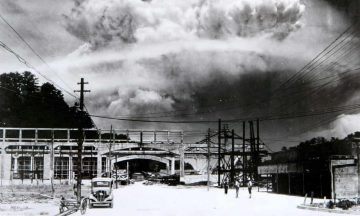 If we’d lost the war, we’d all have been prosecuted as war criminals.” So said Curtis LeMay after America obliterated Hiroshima and Nagasaki with two atomic bombs in August 1945.
LeMay was no bleeding-heart liberal. The US air force chief of staff who had directed the assault over Japan in the final days of the Second World War, he believed in the use of nuclear weapons and thought any action acceptable in the pursuit of victory. Two decades later, he would say of Vietnam that America should “bomb them back into the stone ages”. But he was also honest enough to recognise that the incineration of Hiroshima and Nagasaki was not regarded as a war crime only because America had won the war.
Last week marked the 75th anniversary of the world’s first nuclear attacks. And while Hiroshima has become a byword for existential horror, the moral implications of the bombings have increasingly faded into the background. Seventy-five years ago, LeMay was not alone in his verdict. “We had adopted an ethical standard common to the barbarians of the Dark Ages,” Fleet Admiral William Leahy, chair of the chiefs of staff under both presidents Roosevelt and Truman, wrote in his autobiography, I Was There. Dwight Eisenhower, too, had, as he observed in the memoir The White House Years, “grave misgivings” about the morality of the bombings.
More here.
How scientists can stop fooling themselves over statistics
Dorothy Bishop in Nature:
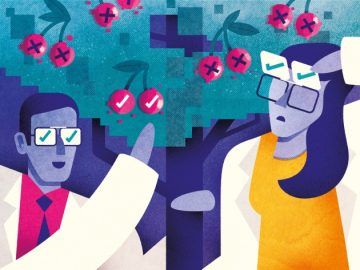 The past decade has seen a raft of efforts to encourage robust, credible research. Some focus on changing incentives, for example by modifying promotion and publication criteria to favour open science over sensational breakthroughs. But attention also needs to be paid to individuals. All-too-human cognitive biases can lead us to see results that aren’t there. Faulty reasoning results in shoddy science, even when the intentions are good.
Researchers need to become more aware of these pitfalls. Just as lab scientists are not allowed to handle dangerous substances without safety training, researchers should not be allowed anywhere near a P value or similar measure of statistical probability until they have demonstrated that they understand what it means.
We all tend to overlook evidence that contradicts our views. When confronted with new data, our pre-existing ideas can cause us to see structure that isn’t there. This is a form of confirmation bias, whereby we look for and recall information that fits with what we already think. It can be adaptive: humans need to be able to separate out important information and act quickly to get out of danger. But this filtering can lead to scientific error.
Physicist Robert Millikan’s 1913 measurement of the charge on the electron is one example.
More here.
Lee Smolin, Sabine Hossenfelder, and Eric Weinstein discuss Theories of Everything in Physics
Noam Chomsky on the pandemic, the election, the word Bernie Sanders needs to stop using, the Harper’s letter, the 1619 Project, patriotism, and the greatest social movement in U.S. history
Anand Giridharadas in The Ink:
ANAND: Talk to me about how you have lived this pandemic moment, which has obviously been such a difficult moment for everybody personally, but also a political crisis and, potentially, a moment of opening for a lot of people in how we think about these systems.
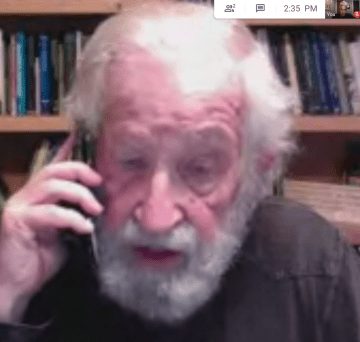 NOAM: For me it’s been extremely busy. I’m isolated, don’t go out, and don’t have any visitors. Constantly occupied with interviews, requests way beyond what I can accept. Busier than I can ever remember.
But you’re quite right. The pandemic is providing an opportunity for choices about what kind of world will emerge from it. Very different choices. Those who essentially created the crisis and have given us 40 years of the neoliberal assault on the global population are working very hard, relentlessly, to ensure that what emerges will be a harsher version of what created this system. Greater surveillance, greater control.
Other forces, ranging from what you see in the streets in the United States to the environmental movement to DiEM25 in Europe. Many other popular forces are trying to move towards a very different world. It’s kind of a class struggle on a global scale.
More here.
Cancel Culture
Magdalena: River of Dreams
Patrick Wilcken at Literary Review:
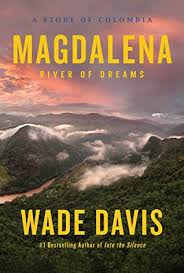 But the Magdalena has also been a place of unimaginable violence, death and environmental destruction. Colombia’s modern history, recounted here in episodic vignettes, appears to be one drawn-out conflict, from the bloodletting of the conquistadors, to the War of Independence and the multiple civil wars that followed, to a post-Second World War era known as La Violencia, which pitted liberals against conservatives in a brutal struggle for power.
All this before the more familiar story of the emergence in the 1960s of the left-wing guerrilla group FARC and its right-wing paramilitary counterparts, and, of course, the rise and fall of Pablo Escobar and the US-sponsored ‘war on drugs’. By the 1980s, thousands were being slain annually. Davis describes horrific scenes of victims being tied to trees and dismembered with chainsaws while still alive, the resulting mess disposed of in the river.
more here.
Didn’t They Almost Have It All?
Niela Orr at The Believer:
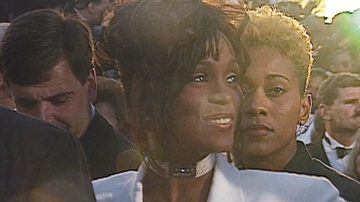 The clichés of romantic ballads can be a comforting reprieve from the coldness of the world. Pop ballads are fugue states of feeling, offering reams of experience in three minutes or less. Leon Russell’s “A Song for You,” is the ultimate alternate-universe lament, as if Russell translated the multiverse theory from the jargon of physics into lyrics. Semi-unofficially, Wikipedia says “A Song For You” has been covered over 217 times, on studio albums, live recordings, tours, and American Idol stages. It’s been recorded by musicians as diverse as Donny Hathaway, Aretha Franklin, Beyoncé, Bizzy Bone, Amy Winehouse, Justin Vernon of Bon Iver, and Indiana Pacers star Victor Oladipo. Seriously unofficially, the song has been covered thousands more times, interpolated, sampled, and strummed at cafés, quoted in marriage vows, hummed at memorials, two-stepped to at ‘70s spring dances, and poignantly blared in two-person car concerts. Like every great ballad, the song’s lyrics lend themselves to an easy expression of intimacy. “A Song for You” is as blank-slate heart-rending as any song that’s been dedicated to a lover on a radio station’s dedication hour, when the lyrics are cherry-picked to pluck at heart-strings.
more here.
Quantum researchers create an error-correcting cat
From Phys.Org:
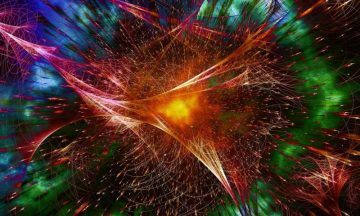 Yale physicists have developed an error-correcting cat—a new device that combines the Schrödinger’s cat concept of superposition (a physical system existing in two states at once) with the ability to fix some of the trickiest errors in a quantum computation. It is Yale’s latest breakthrough in the effort to master and manipulate the physics necessary for a useful quantum computer: Correcting the stream of errors that crop up among fragile bits of quantum information, called qubits, while performing a task.
…In a traditional computer, information is encoded as either 0 or 1. The only errors that crop up during calculations are “bit-flips,” when a bit of information accidentally flips from 0 to 1 or vice versa. The way to correct it is by building in redundancy: using three “physical” bits of information to ensure one “effective”—or accurate—bit. In contrast, quantum information bits—qubits—are subject to both bit-flips and “phase-flips,” in which a qubit randomly flips between quantum superpositions (when two opposite states exist simultaneously).
Until now, quantum researchers have tried to fix errors by adding greater redundancy, requiring an abundance of physical qubits for each effective qubit. Enter the cat qubit—named for Schrödinger’s cat, the famous paradox used to illustrate the concept of superposition. The idea is that a cat is placed in a sealed box with a radioactive source and a poison that will be triggered if an atom of the radioactive substance decays. The superposition theory of quantum physics suggests that until someone opens the box, the cat is both alive and dead, a superposition of states. Opening the box to observe the cat causes it to abruptly change its quantum state randomly, forcing it to be either alive or dead. “Our work flows from a new idea. Why not use a clever way to encode information in a single physical system so that one type of error is directly suppressed?” Devoret asked. Unlike the multiple physical qubits needed to maintain one effective qubit, a single cat qubit can prevent phase flips all by itself. The cat qubit encodes an effective qubit into superpositions of two states within a single electronic circuit—in this case a superconducting microwave resonator whose oscillations correspond to the two states of the cat qubit.
More here.
The Big Reason Lefties Aren’t Upset About Kamala Harris
Elaine Godfrey in The Atlantic:
 The far left of the Democratic Party spent much of the primary attacking Kamala Harris, decrying her as an untrustworthy “cop” whose overtures to the left were half-hearted and opportunistic. But with Joe Biden naming the senator from California as his running mate, some progressive leaders and activists, including Harris skeptics, sound reluctantly optimistic about what the pair could achieve. The progressives I interviewed seem to view Harris and Biden as similar figures, occupying an “in-between space” in American politics, as one activist put it to me. Their political identities and agendas are a muddled mix of the old establishment Democratic politics and the progressivism of the surging Millennial left—a combination progressives believe they can work with. They think that, just as Biden has already welcomed progressive input in his campaign, Harris could be malleable, a potential vice president they can push in their ideological direction. “The same guy who was willing to sit down with Strom Thurmond is now talking like he wants to be the 21st-century FDR,” Julian Brave NoiseCat, the vice president of policy and strategy at the progressive polling firm Data for Progress, told me. “A savvy politician like Harris is going to see where the winds are blowing and move in that direction.”
…There’s no pretending that Harris was their ideal candidate for vice president, the progressives I talked with acknowledged. They still want and expect Biden to demonstrate his commitment to party unity by appointing more liberal Democrats to key roles in his administration, such as tapping Warren to oversee the Treasury Department. And they’re prepared to apply constant pressure to extract the most progressive policy outcomes if the ticket wins in November. “Harris didn’t run on big reforms and neither did Joe Biden, so progressives are going to be pushing them to go as big as they can,” said Charles Chamberlain, the executive director of the lefty political-action committee Democracy for America. But the former vice president has surprised them so far. The next one might too.
More here.
Thursday Poem
Venus & Serena Play Doubles on Center Court
I find an upscale bistro with a big screen at the bar.
The Williams Sisters will step out on to this Center Court,
for the very first time as a team. I celebrate the event
with my very first Cosmopolitan. I feel like a kid
watching TV in the Before Times: miraculously, Nat King Cole or
Pearl Bailey would appear on the Dinah Shore Show or Ed Sullivan.
Amazed, we’d run to the phone, call up the aunts and cousins.
Quick! Turn on Channel 10!… Three minutes of pride…
Smiling at no one in particular, I settle in to enjoy the match.
What is the commentator saying? He thinks it’s important
to describe their opponents to us: one is “dark,”
the other “blonde.” He just can’t bring himself to say:
Venus & Serena. Look at these two Classy Sisters:
Serious. Strategic. Black. Pounding History.
by Kate Rushin.
from the Academy of American Poets
Wednesday, August 12, 2020
The historical amnesia of culture warriors
Dorian Lynskey in Unherd:
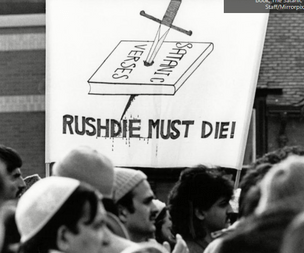 His work was substantial, his opinions horrendous, his reputation a battleground. It was February 1949 and the Fellows in American Letters of the Library of Congress had decided to award the inaugural Bollingen Prize for Poetry to Ezra Pound for The Pisan Cantos. Pound, a giant of modernism, had begun the poems in a US Army detention camp and finished them in a psychiatric hospital under indictment for treason, having spent much of the war broadcasting anti-Semitic, fascist propaganda for Mussolini. The judging panel, which included W. H. Auden, Robert Lowell and Pound’s friend T. S. Eliot, justified its decision on purely aesthetic grounds, because to take into account Pound’s politics “would in principle deny the validity of that objective perception of value on which any civilized society must rest”.
The prize and its justification ignited an argument which blazed for six months: can art be separated from politics? Should the intolerant be tolerated, let alone rewarded? Should liberalism take account of the consequences of speech even as it defends the right to speak? To put in in 2020 terminology: “Should Ezra Pound be cancelled?”
More here.
How Scientists Solved One of the Greatest Open Questions in Quantum Physics
Spyridon Michalakis in Scientific American:
 It all began with a simple question.
My adviser at Los Alamos, Matthew Hastings, a rising star and one of the sharpest minds in physics, was sitting across from me at a sushi restaurant when he popped the fateful question: “For your postdoc here at the lab, do you want to start with a warm-up, or do you want to work on something interesting?” Without asking for further clarification, I answered, “I want to work on something interesting.” He seemed pleased with my answer. Later that day he sent me a link to a list of 13 unsolved problems in physics maintained by Michael Aizenman, a professor at Princeton University and a towering figure in mathematical physics. I was to work on the second problem on that list, a question posed by mathematical physicists Joseph Avron and Ruedi Seiler: “Why is the Hall conductance quantized?”
More here.
Kamala Harris & Mindy Kaling Cook Masala Dosa
America Could Control the Pandemic by October
The Editorial Board of the New York Times:
 Six to eight weeks. That’s how long some of the nation’s leading public health experts say it would take to finally get the United States’ coronavirus epidemic under control. If the country were to take the right steps, many thousands of people could be spared from the ravages of Covid-19. The economy could finally begin to repair itself, and Americans could start to enjoy something more like normal life.
Six to eight weeks. For proof, look at Germany. Or Thailand. Or France. Or nearly any other country in the world.
In the United States, after a brief period of multistate curve-flattening, case counts and death tolls are rising in so many places that Dr. Deborah Birx, the Trump administration’s coronavirus response coordinator, described the collective uptick as a sprawling “new phase” of the pandemic. Rural communities are as troubled as urban ones, and even clear victories over the virus, in places like New York and Massachusetts, feel imperiled.
More here.
The Far Unknown
Eileen: The Making of George Orwell
Martin Tyrrell at the Dublin Review of Books:
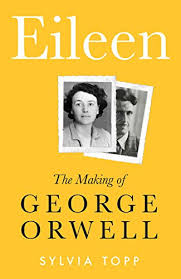 Eileen Blair, George Orwell’s first wife, is the subject of this welcome and assiduously researched biography by Sylvia Topp. Eileen married Orwell in 1936 when he was a virtual unknown and, until her death in 1945 at the age of just thirty-nine, shared with him a life that was lived primarily on the unreliable income from his writing. She did not live to see even the beginnings of the worldwide fame that would come her husband’s way with Animal Farm, which was published in the year of her death.
“She was a good old stick,” Orwell famously remarked when Stephen Spender offered his condolences. To Spender this was an affected stoicism: deep down, he reckoned, Orwell was hurting. Others thought the same. Still, it is that throwaway “good old stick”, ever so faintly on the wrong side of cold-heartedness, that has, well, stuck.
more here.
1 February 1974: The evolution of Lucian Freud
Robert Melville at The New Statesman:
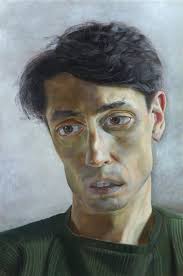 Immediately afterwards, the paintings take a turn towards our grosser world, and the realism begins to hurt. The portrait of John Minton has a piercing sadness. The portrait of Francis Bacon with lowered eyes has a Germanic intensity; it’s as if Grunewald had started a noli me tangere. The wide-eyed girl appears once more, in a green dressing gown, with a dog resting its head in her lap, but she has come back to our edgy, nerve-ridden world. Another girl appears. She has yellow hair and a charming face, and the images of her are still controlled by line.
By the end of the Fifties Freud is drawing with a loaded brush, and the faces ate marred by broad, highly visible paint strokes. In the frightening Woman Smiling he takes no account of human pride. He finds or invents a fearsome tattoo of blood clots under the skin.
more here.