Jeannie Gersen in The New Yorker:
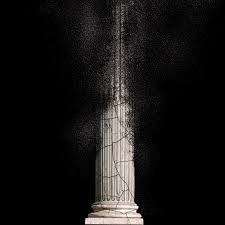 The Court Chamber inside the Pantheon-like building of the Supreme Court of the United States is adorned with marble friezes depicting ancient lawgivers, including Hammurabi, Moses, and Confucius. To begin each session of the Court, at ten o’clock in the morning, the marshal strikes a gavel and commands, “All rise!” The audience goes silent and obeys. The nine Justices, in dark robes, then emerge from behind a heavy velvet curtain to take their seats on the elevated mahogany bench, as the marshal announces, “The Honorable, the Chief Justice and the Associate Justices of the Supreme Court of the United States. Oyez! Oyez! Oyez! All persons having business before the Honorable, the Supreme Court of the United States, are admonished to draw near and give their attention, for the Court is now sitting. God save the United States and this Honorable Court!” It is the closest thing we have, in the American civic sphere, to a papal audience.
The solemn ritual was supposed to have preceded the Supreme Court’s revelation from the bench of its decision in Dobbs v. Jackson Women’s Health Organization, the case about Mississippi’s ban on abortion after fifteen weeks of pregnancy. It still surely will, later this spring, but it will feel as if we’ve already been behind the curtain in Oz. On Monday, a leaked first-draft opinion by Justice Samuel Alito, writing for a majority, which was apparently circulated to all the Justices in February, was published by Politico. It states that the Court is overruling Roe v. Wade, which declared a constitutional right to an abortion, in 1973, and Planned Parenthood v. Casey, which reaffirmed Roe’s “central holding” under the Fourteenth Amendment’s due-process clause, in 1992.
The leak has launched abundant speculation about the leaker’s motives. Commentators have wondered whether leaking the draft was intended to corner a “squishy” conservative Justice into staying onboard with the majority or, alternatively, to create pressure to jump ship from the majority.
More here.

 The first tank hadn’t yet rolled across the border before the
  T
T Today almost as many Caribbeans reside overseas than live at home. Outward and inward migration from and to the region provides an illuminating case study into the pattern and history of migration. Immigrant has become a dirty word, a term of abuse. But Caribbean pioneers have been, and continue to be, a great expeditionary force that keeps the world turning.
 For the millions who were enraged, disgusted, and shocked by the Capitol riots of January 6, the enduring object of skepticism has been not so much the lie that provoked the riots but the believers themselves. A year out, and book publishers confirmed this, releasing titles that addressed the question still addling public consciousness: How can people believe this shit? A minority of rioters at the Capitol had nefarious intentions rooted in authentic ideology, but most of them conveyed no purpose other than to announce to the world that they believed — specifically, that the 2020 election was hijacked through an international conspiracy — and that nothing could sway their confidence. This belief possessed them, not the other way around.
 A major reason why new vaccines are important – and why the world is still dealing with COVID-19 – is the continued emergence of
  Concern about the proliferation of hate speech motivates many who oppose the recent acquisition of Twitter by billionaire Elon Musk, who says he plans to turn the
  Two events occurred Monday night — one historic, the other rather insignificant — which placed an unflattering spotlight on the Supreme Court of the United States. The historic event was that Politico published an unprecedented leak of a draft majority opinion, by Justice Samuel Alito, which would
  Russian impresario, Sergei Diaghilev, trained his spyglass on modernism, plotless ballets of pure motion with cubist sets and minimal costumes, but he also knew box office when he saw it, and because his Ballets Russes was a touring company that never performed in the country for which it was named, he also presented fantastic ballets that audiences loved, happy to be cast under the spell of Scheherazade, the Firebird, Giselle. Diaghilev, always ready to go overboard, staged a version of The Sleeping Princess with huge trompe l’oeil sets and over three hundred costumes. Courtiers and princes wore jewelled plumed turbans, ladies of the court were dressed in ornate gowns with trains and capes and gold-buckled shoes. The evil Carabosse had bony arms that ended in claws, a long haphazardly leopard-spotted cloak, conical hat, and in silhouette, she looked like a rat. Critics called the productions a gorgeous calamity. In London, in 1921, it wasn’t Aurora, Keynes fell in love with, but the Lilac Fairy, the creature who put the kingdom to sleep, so as to delay the effects of the jilted fairy’s curse. The Lilac Fairy was danced by Lydia Lopokova, and when attendance fell off, he made sure to sit in empty box where she would notice him.
 I have a story in my book about Greenberg that relates to this idea of charms and to formalism. In his book Sade, Fourier, Loyola (1971), Barthes talks about the style of a great writer as the writer’s “charm.” Once, after Greenberg had died, I was asked to be part of a panel at Harvard University in honor of the 80th anniversary of Greenberg’s birth. Heading to Boston on the train I thought, “I can’t be part of this panel celebrating Greenberg and trash him.” I had trashed him, for instance, in The Optical Unconscious — the last part about Jackson Pollock was meant to demolish Greenberg. So, I asked myself, what can I say about Greenberg at Harvard that won’t be hypocritical but will be positive? Then I thought about Barthes’s notion of charm.
 Why is the Anglo-Saxon world so individualistic, and why has China leaned towards collectivism? Was it Adam Smith, or the Bill of Rights; communism and Mao? According to at least one economist, there might be an altogether more surprising explanation: the difference between wheat and rice. You see, it’s fairly straightforward for a lone farmer to sow wheat in soil and live off the harvest. Rice is a different affair: it requires extensive irrigation, which means cooperation across parcels of land, even centralised planning. A place where wheat grows favours the entrepreneur; a place where rice grows favours the bureaucrat.
 Evolution has equipped species with a variety of ways to travel through the air — flapping, gliding, floating, not to mention jumping really high. But it hasn’t invented jet engines. What are the different ways that heavier-than-air objects might be made to fly, and why does natural selection produce some of them but not others? Richard Dawkins has a new book on the subject,
  Among the many
  Theologians sometimes argue that, without the existence of God, life would be meaningless. Some secular people agree. For instance, in his