
Anita Jain in the Washington Times:
 In his latest book, Age of Revolutions: Progress and Backlash from 1600 to the Present, Fareed Zakaria proffers his own 21st-century spin on storied historian Eric Hobsbawm’s seminal work The Age of Revolution: Europe, 1789–1848. Like the famed 20th-century historian, Zakaria recounts how the French and Industrial Revolutions profoundly shaped the structures, norms, and guiding principles that made our society what it is. The ubiquitous commentator also identifies a few more “revolutions” that aren’t generally considered revolutions, both pre-industrial era and contemporary.
While Zakaria may not be in Hobsbawm’s league, the Mumbai-born son of a political family who was a wunderkind editor of Newsweek International and remains a Washington Post columnist is still going strong at 60. Those who just see the erudite scholar on TV, where he presides over an eponymous CNN program, may not be aware that he earned a Harvard political science PhD under Harvard mainstays like Samuel Huntington of Clash of Civilizations fame and Joseph Nye.
More here.
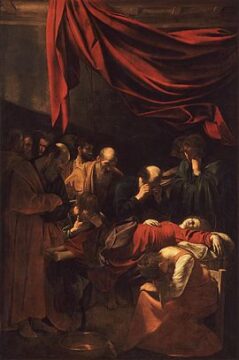 When the water-logged, bloated corpse of the drowned Maddalena Antognetti, a sex worker who used the name “Lena,” was dredged from Rome’s Tiber river in the summer of 1604, she was still beautiful. We know this because her sometimes-lover Michelangelo Merisi, who hustled under the name Caravaggio, used Lena’s dead body as a model in a masterpiece entitled “Death of the Virgin.”
  Traditionally, love is seen as a profound and enduring connection. Yet, as Lacan and Deleuze describe, love is also a mad compulsion where we throw ourselves repeatedly against the wall between self and other. Insofar as love is necessary, Sinan Richards writes, it lies in identifying and seeking this madness in each other, and embracing imperfection. While writing
  T
T Although the dictionary was not founded at the university, the OED might be described as the Oxford of dictionaries, so revered is it among reference works and books in general. It is the gold standard of academic English-language lexicography and a key tool behind many research projects into the history of English, including many other dictionaries. “It is as unthinkable that any contemporary lexicographer be without the OED,” wrote Sidney Landau in Dictionaries: The Art and Craft of Lexicography, first published in 1984, “as it is that a professional photographer fail to own a tripod to support his camera when needed.”
 Suddenly, everyone is talking about aliens. After decades on the cultural margins, the question of life in the Universe beyond Earth is having its day in the sun. The next big multibillion-dollar space telescope (the successor to the James Webb) will be tuned to search for signatures of alien life on alien planets and NASA has a robust, well-funded programme in astrobiology. Meanwhile, from breathless newspaper articles about unexplained navy pilot sightings to United States congressional testimony with wild claims of government programmes hiding crashed saucers, UFOs and UAPs (unidentified anomalous phenomena) seem to be making their own journey from the fringes.
 Chip Walter’s new book is titled “Immortality Inc.: Renegade Science, Silicon Valley Billions and the Quest to Live Forever.” It’s about the money, and the research, that’s seeking a way to extend human life indefinitely. Sounds like science fiction, but Walter thinks breakthroughs are just around the corner. “I think it’s going to begin to happen in the next five years,” said the Pittsburgh-based science writer in a recent interview.
 Stem-cell researcher Carolina Florian didn’t trust what she was seeing. Her elderly laboratory mice were starting to look younger. They were more sprightly and their coats were sleeker. Yet all she had done was to briefly treat them — many weeks earlier — with a drug that corrected the organization of proteins inside a type of stem cell. When technicians who were replicating her experiment in two other labs found the same thing, she started to feel more confident that the treatment was somehow rejuvenating the animals. In two papers, in 2020 and 2022, her team described how the approach extends the lifespan of mice and keeps them fit into old age
 Religion reinforced Ptolemaic queenship. The influential Egyptian priesthood and the Ptolemaic court were politically co-dependent. In discussing this relationship, the author makes skilful use of the art and hieroglyphs found in Egypt’s temples. These showcased favourably the role of the Ptolemaic queen, hedging it with a prestigious divinity. How much this ‘propaganda’ rubbed off on ordinary Egyptians is debatable. Llewellyn-Jones also highlights the colonialist and racist character of the Graeco-Macedonian occupation of Egypt and describes the so-called Great Revolt of around 199 BC. Setting southern Egypt alight, it was put down by Alexandria only after a real show of force.
 To answer the question of what we’re losing, think about what nightlife has given us. It was always a haven for outsiders trying to find, establish or shape their own communities. It brings people together and remains an insistently communal experience in an increasingly individualistic and closed-off late capitalist society. Gigs and clubs require us to be together – as friends, but also with those we don’t know. Luis Manuel Garcia-Mispireta, an academic who researches dance-music scenes, calls this “
 Our sun is the best-observed star in the entire universe.