
by Scott Samuelson
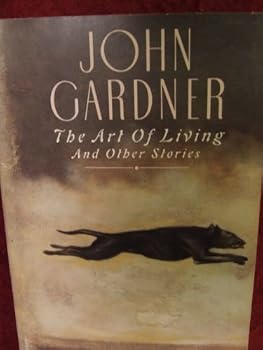
Let me say upfront that I have nothing against dogs. In fact, I’ve loved certain dogs more than I’ve loved certain family members. That said, one of my favorite stories in American literature is about eating a dog and thereby getting a glimpse into the meaning of human life. (Admittedly, part of why I love the story so much is that it’s about cooking, and I’ve just written a book about how making and sharing food is a useful paradigm for thinking about the good life.)
John Gardner’s short story “The Art of Living” is about Arnold Deller, a good cook in a small-town restaurant in the late 1960s, and a gang of greaser kids who hang out to chat with him because he talks about real things, things that matter, unlike the rest of society. A tale of disillusioned American youth seeking meaning in a semi-hostile culture is likely always going to be relevant, but it feels especially so in a time when the stage set is collapsing (as Camus once said) and the absurdity of our politics, our economy, our foreign policy, and our educational systems is being laid bare.
So, what’s the art of living? Sometimes Arnold Deller can sound like a downhome Socrates.
You kids had any brains, you’d ask me what to do with oregano. Educate yourself, learn a good honest trade, or, rather, art . . . But I’ll tell you one thing. Better to ask me these grandiose questions than ask somebody thinks he knows the answers.
He diagnoses the deep problem of our culture as a pervasive loss of care.
Everything’s easy, easy as pie!—TV dinners of chicken that never in its life felt the ground under its toes, instant potatoes, lettuce that’s been put in some stuff to make it fresh till the day of the Antichrist—and what’s the result? All humanity begins to be like sheep. That’s right! They baby themselves till they don’t care about themselves.
As it turns out, he manages to sum up my philosophy of cooking in a few sentences.
The thing a person’s gotta have—a human being—is some kind of center to his life, some one thing he’s good at that other people need from him, like, for instance, shoemaking. I mean something ordinary but at the same time holy, if you know what I mean. Very special. Something ritual—like, better yet, cooking! . . . That’s what it’s all about. Making life startling and interesting again, bringing families together, or lovers, what-not.
Halfway through the story, the cook mentions a letter he once received from his son Rinehart, a soldier who was killed in Vietnam. It describes an unforgettable meal that Rinehart had there. As Arnold says, “It wasn’t just food. It was an occasion. It was one of the oldest dishes known in Asia. Sit down to that dinner—this is what he wrote, and he was right, dead right—you could imagine you were eating with the earliest wisemen in the world.”
The dish was Imperial Dog.
Arnold becomes obsessed with recreating his dead son’s favorite meal, and the greaser kids are reluctantly convinced to help him by stealing a dog from a pet store (they can’t bring themselves to take somebody’s actual pet). He slaughters the animal, cooks it up with expertise, and serves it after hours to a small band in the restaurant.
For Americans like me, dogs are basically holy. Eating them is taboo. But what does the violation of that taboo have to do with the art of living?
In the anthropological classic Purity and Danger, Mary Douglas makes the point that categories of holiness and pollution don’t have to be absolute. What’s taboo can be the most sacred thing in another context. As an example, she references the idea of “respect-pollution” among the Havik peoples, for whom cow dung is a cause of defilement in most situations but also a cleansing agent for major forms of pollution, in part because cows are thought to have a thousand gods residing in them. Things like art, sex, and jokes are still constituted by such spiritual ambiguities for us. Cultural understanding, for instance, involves knowing when a dirty joke is just what the doctor ordered—and when it isn’t.
When Arnold is preparing the meal of Imperial Dog, everyone in the restaurant is on edge. In fact, they’re beyond the edge—in a kind of spiritual freefall. But they’re suddenly able to see the whole world in a fresh light: their superficial culture, the brutality overseas, their grief, their love, even the dead. A thousand gods are present.
As the narrator of the story, one of the greaser kids, says about the meal:
There was no sign of the thousands and thousands of dead Asians, or of Rinehart either, but it felt like they were there—maybe even more there if there’s no such thing in the world as ghosts, no life after death, no one there at the candlelit table but the few of us able to throw shadows on the wall. Say that being alive was the dinner candles, and say they burned forever over this everlasting meal of Imperial Dog. Then we were the diners there now, this instant, sent as distinguished representatives of all who couldn’t make it this evening, the dead and the unborn . . . The dog was terrific, by the way, once you talked your stomach past the idea.
In the Poetics, the word that Aristotle famously uses to describe the function of tragic art is katharsis, which originally refers to the act of getting rid of dirt (katharma). It means something like “cleaning out,” “purging,” even “defecating.”
Maybe you remember that a thousand outrages ago Trump smeared Haitian immigrants in Springfield, Ohio by claiming that they were stealing and eating dogs. It was yet one more example of his instinctive genius for finding and pushing our buttons—not utterly unlike John Gardner’s talent as a writer. Trump’s proposed katharsis continues to be that purging the country of immigrants will make America great again.
Interestingly, Gardner’s katharsis is almost the exact opposite. It involves going into the heart of what we fear, the heart of our cultural taboos, the heart of darkness behind imperial disasters like the Vietnam War that have obscured our humanity and caused untold suffering. Perhaps that’s how we find some kind of center to our lives, something ritual like cooking, something capable of making life startling and interesting again, and bringing families together, or lovers, what-not.
One of the gang’s members, who can’t abide eating a dog, walks out when it’s being served. The narrator says of him,
He was the one who’d been right—sane and civilized from the beginning. But also his walk was oddly mechanical, and the way he shook his head when he looked back at us from the door, it was as if under his hair he had springs and gears.
***
Scott Samuelson’s book To Taste: On Cooking and the Good Life comes out in November. It’s now available for pre-order.
Enjoying the content on 3QD? Help keep us going by donating now.