
by Akim Reinhardt
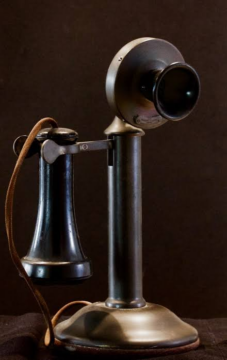 I was born before language. Only waterfalls and wind and tumbling rocks.
Nothing needed to be said if you only knew how to listen.
I still remember my grandparents phone number. 828-3973. They, on the other side of the Bronx, had the same area code as us, as the whole city: 212. No need to add it. Seven digits were plenty.
Placing my finger in our rotary phone’s circular template led to a swirling dance when dialing their number. Long, short, long short, long, long, short. Our own number was a marathon for whoever dared to spin it. 2 sixes, 3 sevens, an eight, and a nine.
My grandmother was the talkative one. A natural polyglot who got spit out of the Austro-Hungarian Empire and eventually into the Lower Eastside before she married my grandfather and he took her up to the South Bronx. Hungarian from her family, Yiddish from being a European Jew, Romanian from the post-WWI schools, and English in the new country. She was completely fluent in her fourth language, with some slight quirks. “Do you have what to drink?”
My grandfather never spoke another word of Polish after he and his family got chased out, and just in time. Despite coming over as a teen, his English was forever deeply accented and a little broken. Yiddish was his main language, and as a result, my mother’s first. She learned English on the playground. I loved my grandfather deeply, but talking to him on the phone was awkward. He would ask rote questions, mostly the same ones each time. I would offer quiet, curt responses. We were much better in person, where he taught me how to play chess and read the stock page.
My best friend during elementary school lived in the next building. Our phone time was minimal. Why bother when we could just meet in the playground, or one of us could hop over to the other’s apartment on a bad weather day. You home? Okay, I’m coming over.
By high school, some of my friends were a little further flung, a neighborhood away. But by then we were building our masculinities. Our fathers and popular culture made it clear that yakking on the phone was for girls. Don’t be a chatty Cathy. Or a yenta, in my grandparents’ lingo.
When I walked into my college dorm room for the first time, one of the first things I saw was the phone, affixed to the wall near the door. I lifted the hand piece from the cradle and saw that the last four digits were 1871. “Huh. The year of the Franco-Prussian War,” I thought to myself. This phone was for just me and my roommate, an art major from some St. Louis suburb. I was 600 miles home, free to do whatever I wanted, and missing my friends. But long distance calls were expensive. Ma Bell had been carved up, and the new telecommunications companies were significantly cheaper, but not actually cheap. I made hardly any long distance calls. But the night that roommate’s girlfriend back in Missouri dumped him, he was on the phone with her, crying and begging, for hours. I shudder to think what it cost. Afterwards, he kicked over a large box of pretzels.
In my mid-20s, I ditched my Discover Card and got an AT&T Mastercard so I could make reasonably priced long distance calls from a payphone when needed. This became a vital tool of my many cross country trips. It meant pressing a lot of buttons: the number to connect to AT&T, the number you were calling, and all 16 digits of the credit card. One time, my numbers got stolen, probably by someone with a zoom lense while I punched it into a payphone at the other end of Port Authority in Manhattan. I ultimately did not have to pay the several hundred dollars worth of long distance and international calls that got rung up on my card.
I first saw a cell phone out in the wild some time around 1996, while back in the Bronx for the holidays. I assumed they were for douchebags and doctors. Then I saw HS kids with them. Just another teen fad, I figured. Why the fuck would anyone wanna talk on the phone while they were walking down the street?
Then came the wizard phones. The first one I saw was at a poker game. A friend brought something called an “Eye Phone” or whatever. He showed us how, if he paid a 99¢ for an “app,” he could press a button and make fart sounds whenever he liked. I was in no rush. I stuck with my regular phone, but soon started referring to it as a “land line,” lest people not know what I was talking about. “Phone” had come to mean something you carried around with you even though people were using it less and less as a phone.
I didn’t bother getting a basic cell phone until 2012, when I finally had nowhere left to turn; there just weren’t anymore payphones left. Communicating while traveling without one was more difficult than it had been since the 19th century. Progress. I gave in and got a little brick cell phone.
In the early 2020s, I finally gave up the land line. The scumbags at Verizon were not only charging way too much for it, but also letting their land line infrastructure fall apart. At least once a year, my land line would go down for a few days. Why pay 80 bucks a month for a land line hardly anyone called and occasionally didn’t work, when I my flip phone was running me only $10/month?
This whole thing started with my parents, I guess. They were always late adopters, entirely uncharmed by new technology. My father the general contractor didn’t even like screw guns. He couldn’t quite get the hang of those early models, which had no adjustable torq, and he kept stripping screws. All the summer and winter breaks I worked for him, we did everything with screwdrivers and hammers.
It spilled over to the home. We were the last family to get a VCR or a touch tone phone. The one timely exception was the answering machine so that my father wouldn’t miss messages from customers while we were out. He died nine years ago never having been on any kind of computer device. Sometimes he wrote poems on the back of a cardboard cereal box. My mother didn’t get cable TV until the co-op apartment building she lives in foisted it upon her as part of her utilities in the early 21st century.
I inherited a certain skepticism from them. They told me and my sister that Mother’s Day, Father’s Day, and that ilk were all bullshit holidays to be scorned, not celebrated. No one had coined the term Hallmark Holidays yet, but they knew. Just another way for corporations to rip off insecure and shallow people. Stick to the real holidays if you must, and do them sincerely. Don’t go through the motions; put something heartfelt into it, or don’t bother. Halloween costumes and birthday cards should be handmade, not bought. Birthday and holiday gift-giving should be expressive, thoughtful, and meaningful, not an orgiastic display of wealth or some desperate purchasing of love. My parents weren’t cheap. Rather, they were sincere about living life in a late 20th century America that was increasingly plastic, disposable, and status-conscious. They weren’t hippies, a little too old for that. They were just a couple of people set on doing things the right way, and not being suckers.

When I was a kid, like most kids, I found new gadgets and toys to be exhilarating. I had cajoled my parents into getting me a handheld electronic football game. And they let me spend part of my Bar Mitzvah money on an Intellivision video game console. But by my late teens, any lust for the shiny and the new had worn off. I loved music, but wasn’t interested in getting CDs. I kept buying vinyl records as long as I could. When that was no longer possible, I got my first CD player at a pawnshop in 2001. And now, a quarter-century later, when no one plays CDs anymore, I still play CDs. I finally got on a Spotify account a couple of months ago when my sister added me to hers. I was also among the last to get home internet (2006), a flat screen TV (2011), or even a microwave (2017), a used that doesn’t spin.
And now I have a lot of explaining to do to a lot of people.
On Thursday, July 23rd, a new smartphone arrived on my porch. Not from Amazon, of course; I don’t have an account. And not a big name. Some marginal, intentionally misspelled brand you’ve probably never heard of. It was $65 new and delivered.
It took me another week to eventually get around to setting it up and switch over from my flip phone. I was less than eager. But much like the faltering land line before it, and the very heavy, big box TV before that, replacing an old, faltering flip phone with another one longer made sense. The old one was breaking down. New ones are getting harder to find. And this new, shitty, little handheld computer was actually twenty dollars cheaper than a new version of the flip phone model I had.
I spent the first forty minutes removing as many pre-loaded apps as I could. The first call I made was to my sister. She would understand. I got her voicemail and left a brief message explaining why I wanted to kill myself. She sent me a video of Gene Kelly dancing with Sugar Ray Robinson.
When I showed up at pub trivia an hour later, announced that a new era was upon us, and laid my new smartphone on the table, my friends, uh, well, they flipped. Shocked gasps, exaggerated facial expressions, and ringing exclamations. All of it genuine. One friend, among the most articulate I know, said: “I don’t actually know how to respond.” I asked his twenty-one year old daughter how old she was when she got her first smart phone. Twelve, she said. I’m fifty-eight.
When I got home and called one of the only two people I know who still has a flip phone, he accused me of a grave betrayal before quickly pivoting and quietly admitting that his own flip phone sucks.
I will die after language. Only the skittering of bugs, rustling of leaves, and lapping of waves will remain. I will say nothing and no one will listen.
***
Akim Reinhardt’s website is ThePublicProfessor.com