
by David William Sheehan
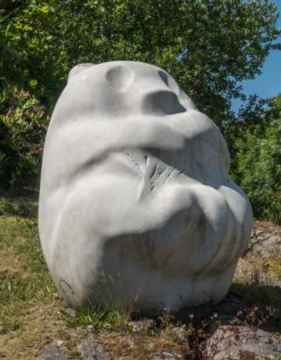 There is a white marble panda at the edge of the pier road in Sneem, and as a boy I walked past it most mornings on the way to Christian’s shop without once wondering why a panda should be standing in Kerry. It was cold in the mist and faced whatever the morning brought in off the bay, and I gave it about as much thought as I gave the wet tarmac.
This seems strange to me now because there is nothing remotely local about it. It looks as though it has been dropped out of another country and told to make the best of things. But children are good at accepting whatever is already present when they arrive. You could not have called it beautiful, though it was not ugly either. The panda belonged to Sneem in the same way as the smell of the sea, the sound of the Sneem River gathering itself under the bridge, and the grey light coming slowly over Lomanagh.
It came from China.
In 1986 the People’s Republic of China sent the sculpture to the village in memory of Cearbhall Ó Dálaigh. Sneem had fewer than three hundred people, which makes the whole business stranger the longer you look at it — states do not, as a rule, send diplomatic gifts to remote villages on the edge of the Atlantic. When they do, it is a sign that the real work was finished somewhere else long before. Ó Dálaigh had been Chief Justice of Ireland, a judge of the European Court and, in the end, President; he had also supported the admission of the People’s Republic to the United Nations at a time when saying so cost something. The panda arrived eight years after his death, and I knew none of this, growing up beside it.
Sneem was full of things like that. There was the Steel Tree in the north square, polished stainless steel catching whatever light Kerry happened to provide; four stone structures beside the river that everyone called the pyramids; a statue of Isis in the south square; a memorial to Charles de Gaulle on the road towards the strand; the great figure of the Risen Christ in the grounds of St Michael’s. Later, there was a Millennium Seat with a time capsule beneath it, meant to be opened only in 2100. Nobody sat the children of the village down and explained the collection. You simply grew up among it.
I think that matters, because the knowledge you take from a place does not always begin as information. Long before I knew why the panda was there, I knew it was important enough to be placed there, and the same went for the face on the de Gaulle memorial. I could recognise significance before I understood the reason for it. Only much later did the stories begin to attach themselves to the objects, and Ó Dálaigh’s was the first that changed the panda for me — not the jurist or the office, but the distance between the thing he had done and the recognition that eventually found its way back to Sneem.
He resigned the presidency in 1976, after the Minister for Defence, Paddy Donegan, called him a thundering disgrace for referring an Emergency Powers Bill to the Supreme Court before signing it — which is to say, for exercising a power the constitution had given him. The government did not properly reprimand the minister, so he resigned. He retired to Sneem, died here in 1978, and lies in the churchyard now. Years afterwards, a marble panda arrived from China. There is something appealingly indirect about that order of events: a man takes a position in one corner of his public life, other people remember it, time passes, he dies, and then an object appears in the village, sent by people thousands of miles away who were settling a debt he never felt he was owed.
Later, in other institutions, I sometimes saw recognition arrive before the thing it was meant to recognise. There would be a plaque, a photograph, a press release or a ceremony while the actual work still felt unfinished. Sneem had given me a different sense of the order of things. The panda appeared years after the decision that gave it meaning.
The Steel Tree came late too, and out of a friendship that started on a Dublin street. Ó Dálaigh grew up near the South Circular Road, in the quarter the city called Little Jerusalem, and among the neighbours was the family of Ireland’s Chief Rabbi, Yitzhak HaLevi Herzog, who would later become the first Ashkenazi Chief Rabbi of Israel. His son Chaim knew Ó Dálaigh as a boy, spent childhood summers in Kerry, and grew up to become President of Israel as his friend became President of Ireland. In 1985, seven years after Ó Dálaigh was buried here, Herzog came back to the country where the two of them had been children and unveiled a stainless steel tree by the Israeli sculptor Tamara Rickman in the north square; on the same visit he opened the Irish Jewish Museum in Dublin. The plaque beside the tree runs in three languages — Hebrew, Irish, English — and its formal name is Arbor Chalybeia Immaculata, the immaculate steel tree, though I doubt anyone walking through Sneem has ever called it that, which is probably healthier for all concerned.
The sculpture was several things at once — political, personal, Irish, Israeli, local, international — and it did not need any one of those meanings to cancel the others. That held until much later, when the tree became a surface for protest connected to conflicts far from Kerry. I had been interested in it as an object long before I had the vocabulary for the politics that gathered around it, and perhaps that is why the later trouble bothered me: the tree had not chosen any of it, and neither had the people who had lived beside it for years. We sometimes ask a place to carry an argument much larger than the relationships that made it. It taught me something about consent, in a roundabout way — that not every silence is agreement, and that people are sometimes simply holding a thing together rather than endorsing everything it has come to mean.
A third memorial stands on the fair green in the south square — a work by the Cork artist Vivienne Roche, unveiled by President Hillery in 1983. Three separate attempts to hold one man in mind, arriving from three directions for three different reasons. He himself is in the ground behind the church.
Sneem’s connection with another president, Charles de Gaulle, is different again. He came to Kerry in the spring of 1969, two weeks after losing a referendum and resigning the French presidency — not the general who had broadcast from London in 1940 with almost nothing behind him and spoken as though history had already taken his side, which in the event it had, but a man who had finally put all of that down. He spent six weeks in Ireland, including a fortnight in Sneem at Heron’s Cove, drawn to the area partly through Yvonne de Gaulle’s family connection with Kerry. He walked, read, rested and looked at the sea. He died at Colombey-les-Deux-Églises in November 1970, while playing patience.
He left his own account of what Ireland had given him, and the words appear on the memorial in Sneem’s north square, a bronze plaque set into local limestone by the Valentia sculptor Alan Hall: At this grave moment of my long life, I found here what I sought — to be face to face with myself. Ireland gave me that, in the most delicate, the most friendly way.
What interests me about that stone now is not de Gaulle’s greatness — Europe has monuments enough for greatness. It is that Sneem enters his story precisely when greatness had become something he wanted a rest from. There are people who seem able to recognise when a part of their life is over and leave it there, without needing the position to go on proving who they are. Institutions are not always very good at allowing for this. They tend to admire endurance, even when endurance has ceased to be especially useful, and leaving can easily be mistaken for failure simply because staying is easier to explain.
De Gaulle resigned when the referendum went against him and did not return to political life. I do not know whether he thought of that as an act of responsibility, pride, exhaustion, or simply keeping his word, and perhaps it does not matter. What remains in Sneem is the record of what came afterwards: a man who had spent most of his adult life carrying an enormous public identity finding, for a few weeks in Kerry, somewhere he could put it down. The north square has held that small part of the story ever since.
Then there is Steve Casey, another Sneem man who travelled farther than most. Before the wrestling, the Caseys were rowers. Steve and his brothers won the Salter Challenge Cup at Killarney in 1930 and 1931; there was no regatta in 1932, and when they won again in 1933 the organisers initially argued that this did not count as three successive victories. The Caseys argued otherwise and went home with the cup. Three years later, four of the brothers won the All-England rowing championship and seemed bound for the Berlin Olympics, until it emerged that Steve and Paddy had been paid for wrestling and had therefore lost their amateur status. Nothing about that discovery made them poorer rowers. It simply put them on the wrong side of a definition.
The distinction interests me because amateur rowing had long been full of definitions of that kind. For years its rules had excluded men simply for earning their living through manual labour, and although those rules were changing by the time the Caseys arrived, the assumptions behind them had a long life. Sporting ability and eligibility were not quite the same thing, particularly if you came from the wrong kind of work.
Casey went on to Boston and became a world heavyweight wrestling champion. He was also good enough as a boxer to challenge Joe Louis, who declined, prompting the New York Post to report that “Even the greatest run scared of the Sneem Machine.” By then there was not much doubt about Casey’s ability.
I have thought about that distinction in schools. We are used to saying that a student has not met a standard, and sometimes that judgment is perfectly fair. What is harder is remembering that the standard is itself something people made: somebody decided what would count, how it would be demonstrated and which abilities would be easiest to see. Casey’s story does not make standards unnecessary, but it makes me slower to confuse failing to fit one with lacking ability altogether. His statue in the south square, by Alan Hall again, is life-size, which in Casey’s case requires a good deal of bronze.
The pyramids beside St Michael’s are four narrow structures of local stone and coloured glass, built in 1989 by the Kerry sculptor James Scanlon and a crew of local men. Scanlon wanted to call the work Slíghe na Síoga, the Way the Fairies Went, after the siodh ghaoth, the fairy wind he had watched as a boy on the family farm in North Kerry — the small whirl that gets up out of nowhere on a still day, lifts the top off a haycock, and is gone. His crew called them the pyramids, and a local priest settled the matter by observing that there were only two sets worth discussing, the ones in Egypt and the ones in Sneem, which is a difficult kind of confidence to argue with.
We were never formally taught much of the folklore behind any of this. It was simply around us. There were places where you were a little more careful, things you did not interfere with, and stories carried by older people that did not have to be proved before they were listened to. One of my classmates had a grandmother who wrote about encounters with the fairies in the woods nearby. Her family was Jewish and had come to Ireland from South Africa, yet she had become one of the people who kept those local stories alive. Nobody I knew seemed to find that unusual. The stories did not require ancestry papers; if you lived among them long enough, listened carefully and treated them with respect, you could become responsible for carrying them too.
I have thought about that often since. Belonging to a tradition does not always begin with believing every part of it, and inheritance is not always something received by blood. Sometimes it begins simply by paying enough attention to realise that something has been entrusted to you.
Isis stands not far away, an Egyptian goddess given by the people of Egypt in 1993, and for years she endured the Kerry weather with the composure the situation demanded of a deity. She has since been moved indoors, and I am not sure whether that counts as an improvement from her point of view.
As a child I knew nothing of the mythology. I knew only that you slowed down around certain things, did not climb on them, and did not assume that everything in the landscape had been put there for your use. Much later I learned the story of Isis gathering together what had been broken apart, and that gave the statue another layer of meaning for me. Not because an Egyptian goddess had somehow become Irish, but because Sneem had made room for something foreign without needing to absorb it or explain it away. It could remain entirely itself and still become something the village looked after. There is a kind of belonging in that which has very little to do with possession.
John Egan grew up down the road from me in Tahilla, and his mother ran the little shop beside the church where teachers would send me for tea bags or milk and where she would usually slip me a Stinger bar as well. Long before I understood what he had done in football, that was where he belonged in my mind: somebody from down the road whose family had the shop.
Egan went on to win six All-Ireland senior medals with Kerry, eleven Munster titles, four National Leagues and five All-Stars, becoming one of the great players of his generation. Yet he never won a Kerry county championship with his own club. I have always found something moving in that imbalance. A man can collect almost everything the wider world has to give him and still carry one absence attached to the place nearest home.
After his death, Sneem gave him a place in the village anyway. In 2017 a life-size bronze by Alan Hall was unveiled in the south square, facing the sports field where Egan had played for years. He is not standing on a heroic plinth. Hall has him seated with a football in his hand, close enough to the ordinary life of the square that people can sit beside him.
And finally there is the Millennium Seat, near the bridge, with its capsule waiting underneath for 2100. The people who buried it knew perfectly well they would not be there when it was opened. Someone chose what went inside; someone will have argued about what might still make sense a hundred years later, whether a newspaper would survive, whether a photograph might outlast a letter, and what a stranger in 2100 could possibly want to know about a small Kerry village in the year 2000. Then they sealed it, put it in the ground beneath a bench, and went home to their dinner.
I have grown more interested in that gesture as I have got older. So much institutional life is organised around things that can be seen within the term, the year or the tenure of the person responsible for them. The capsule belongs to a different timescale. The people who buried it prepared something for people they would never meet, with no certainty that those people would find it important and very little chance that they would know who had put it there. There is a kind of leadership in being willing to work at that distance from recognition, making provision for a future in which you have no part except whatever you chose to leave ready for it.
None of these things belong together in any curatorial sense. A Chinese panda, an Israeli steel tree, a French president in limestone, an Egyptian goddess, a champion wrestler, four Kerry pyramids raised in honour of a fairy wind, a capsule addressed to strangers in 2100 — propose the collection as a public-art strategy and you would probably be sent back to write a clearer concept. That is exactly what I have come to love about it. Sneem did not decide one morning to become a lesson about memory or service or internationalism. The objects accumulated because people had lived lives that happened to cross the village — some born here, some returning here, some coming here because they wanted to disappear for a while. Those crossings left things behind, and eventually the things began to look as though they had always belonged. A place acquires its symbolic life in much the same untidy way that it acquires everything else.
We spend a great deal of effort in education deciding what children should know, writing curricula, specifying outcomes, sequencing what comes next and naming the language in which learning ought to be demonstrated. All of that has its place. But some of the most durable things Sneem gave me were never formally taught. They were simply there: the knowledge that important lives could lead far away and still leave something at home; that recognition might arrive years after the work; that presidents could resign, champions could come from small places and old friendships could outlast whole careers; that you could look after something without owning it; and that grown men might build pyramids beside a river because someone once watched a wind lift the top off a haycock.
I could not have explained any of that as a boy, and certainly could not have passed an examination on it. The names, dates and histories came much later. Later still came the connections between them, some of which I am probably making now rather than recovering intact, because memory has its own way of arranging a place after the fact.
Yet when I think of Sneem I still begin with the panda on the pier road, because it is the object I understood least and somehow knew longest. I can picture the walk to Christian’s shop, the wet road, the river under the bridge, the morning coming slowly over Lomanagh and the panda where it always was, facing whatever came in off the bay. It never explained why it was there, and nobody seemed particularly troubled by that.
Education is usually described in terms of what we deliberately put before children, but much of formation happens before anyone has decided to call it a lesson. A child learns how adults behave around certain objects, which stories are spoken carefully, what is looked after, what is allowed to remain unexplained and what a place considers worth keeping. I did not know I was learning any of this in Sneem. By the time I had enough words to describe it, most of the teaching had already happened.
***
Enjoying the content on 3QD? Help keep us going by donating now.