
by Gary Borjesson
If you don’t have a plan, you’ll become part of someone else’s plan. —Terence McKenna
1. Wearables
This morning I headed outside first thing with my dog Theila for our daily short morning walk in the woods around our home, to stretch our legs, sniff around, and get some morning light. I looked at my new Garmin Forerunner 165 smartwatch, which I’d just started wearing the afternoon before. The first thing I saw was my sleep score, which was 67, and in case there was any confusion about the meaning of this, above the 67 was the word ‘Poor.’

I felt resentment at getting such harsh feedback first thing in the morning. Then I asked myself whether I agreed with its blunt assessment. Not really. I’d have given my sleep a score of 85. Was I missing something? Was the watch missing something? Whom should I trust? This tension raises a key theme of this essay. Put as a question: what authority should we give such feedback? How do we weigh it against the authority of our self-experience? A related question is whether we want to adopt its proposed terms of discourse in the first place. For example, the watch measures the charge of my “body battery.” Is this a playful nod to the Matrix, or are we encouraged to reduce our aliveness to the same terms we use for our phones?
I have come to admire the watch’s straightforward, metric-driven honesty. Even that first morning, it felt like I was being challenged in a useful way. The watch wasn’t tiptoeing around my feelings but calling it like it computes it, the way a tough-love coach might.
I soon realized, however, that I didn’t understand how the feedback was calculated, and what exactly it meant. For instance, take two key data points used in a range of assessments, V02 max and Heart Rate Variability (HRV). V02 max measures overall aerobic conditioning, while more variability is a sign of a rested, adaptable nervous system, and less signals stress or fatigue. The watch could meaningfully help me improve my health and fitness if I prepared myself by getting to know all this. It offers real-time, cumulative, data-crunched biofeedback that gets more accurate as the adaptive AI gets to know me. For example, the watch gathers data about your HRV for three weeks before determining your baseline score against which further scores are measured. The biofeedback can help us become more sensitive and attuned to ourselves, or it can become a substitute for this, depending on how we use it.
In any event, the technology is here to stay, it’s getting better fast, and it’s being widely adopted. Somewhere between a fourth and fifth of the US population owns a smart watch or smart ring. Adoption is also spreading fast in Europe and Asia. The demographics are what you’d expect: use is generally higher among more educated and socioeconomically advantaged people, though I was surprised that some studies show more women than men are regular users—25% versus 18%.
The technology raises many issues, from data privacy and surveillance, to whether so much feedback delivered in this fashion is actually helpful to most of us. It tells you something that many trainers discourage clients who are anxious or obsessive from using wearables. That first morning was a good example of how it can go either way. I felt as bothered by the watch’s confident tone as by its feedback. Some people will tend to regard the feedback as the final authority, even perhaps experiencing it like a parent who is quick to judge actions as good or bad, or ‘poor.’ Which is why you need a plan.
2. The Wonder
We’re surrounded by so much astonishing technology that we forget to be wowed by it, and by how affordable it is. I have Garmin’s entry-level smartwatch, which you can find on sale for $200. The watch is small, light and comfortable to wear, even while sleeping. It is optimized for running and other sports. It’s good at compiling overall health and fitness metrics. It has an easy-to-use touchscreen and a battery that lasts up to 11 days. It connects with a phone via bluetooth, feeding data to the Garmin Connect app. The app is the interface between the data collected by the watch and Garmin’s servers and algorithm-wielding data-crunching software, which returns a variety of assessments.
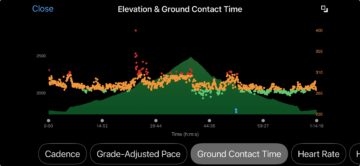
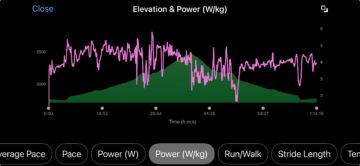
The watch employs a variety of sensors, mapping movement in space, and in your interior. To name just a few, there’s an optical heart-rate sensor, a pulse oximeter, an altimeter and accelerometer, compass and GPS. Once the device “knows” your sex, age, weight, and height, it provides tailored evaluations of sleep architecture, stress, cardio fitness, recovery, and your ‘body battery’s’ level of charge. (Right now, late afternoon, my body battery is just under halfway charged, which feels about right.) This is not to mention all the data gathered from runs and other exercise.
3. Update
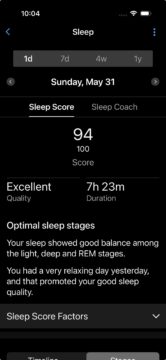
Over three weeks have passed since my wearable and I spent our first night and morning together, and I’m feeling optimistic about the relationship. That is, I’m willing to make the effort to make it work for me, rather than letting the watch devolve into an attention-grabbing busybody, a nervous nelly, or—best of all—a shameless suck up. (As much as I resented that 67, it did feel pretty good to wake up to a shiny sleep score of 94.)
Having learned the basics, I’m more able to use it without getting overwhelmed or confused by it. Customizing the watch has helped further clarify what I want from this feedback and accountability ally. For example, I know I want to drive the interactions, which means I don’t want it interrupting me. So I’ve turned off notifications, and I don’t use messaging or audio functions. I wanted a smart watch, not a social one. Moreover, the research suggests that without clear intentions, users become bored with it. A Gartner consumer survey found 29% of smartwatches are abandoned, with boredom named as a leading cause. But that study is 10 years old, and the wearables keep getting better and, no doubt, less boring.
4. Conclusion
As for my smartwatch’s blunt assessment of my poor sleep quality that morning, I suspected that the hot tub I enjoyed before bed misled the device. Sure enough, the watch had me falling asleep over an hour later than I actually fell asleep. On most days since, however, I’ve agreed with its assessment. The watch is proving useful because it prompts me to give more attention to my habits and behaviors and their effects; I find it is encouraging more self-awareness, as long as I resist accepting at face value its view of how rested or recovered or wakeful or energized I feel. In this way, wearables can help develop our capacity to be aware and attuned to our somatic selves. Like a good-enough parent or coach or therapist, they can provide an external source of feedback and guidance. Ideally, however, they’re working themselves out of a job; for as our own capacity grows, we need less outside help.
Having said all this in their favor, I’m aware of how ready, indeed eager, this technology is to get out ahead of us, to rob us of developing our somatic awareness by jumping in with an evaluation before we’ve made our own. I’m aware of the narrowing view of our life and health that comes from adopting the language of data and optimization. I’m aware that all of my data is a free gift to corporations and the growing culture of surveillance. I’m aware of how intrusive it can be, making frequent claims on our already exhausted attention. And I’m aware how easily it can amplify anxiety and obsession, exacerbating health issues rather than addressing them.
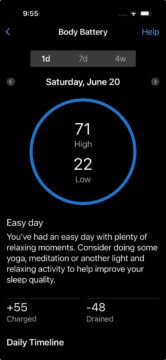
The watch has elicited the same uncanny feeling I have when using an AI: that I’m interacting with a living intelligence. We associate being alive with being responsive and adaptable. The watch seems smart because it offers not just raw data but a reflection on what the data means, and suggestions about how one should behave. For instance, the second night I had the watch, around 10pm, the watch called for my attention by vibrating. I looked at the screen and noticed it was recapping my day. “Easy Day” it said at the top of the screen. In smaller print were a couple sentences summarizing how I’d helped my recovery from a hard workout the day before, and suggesting I could aid my sleep by some yoga or meditation before bed. This felt weirdly intimate, as though someone had been tagging along with me all day, continuously evaluating how I was doing. It felt as though the watch was keeping an eye on how I was performing my life, and what score I merited. No wonder it’s easy to feel resentment or pride or shame in the face of its feedback.
Interested readers can subscribe for free to my Substack and receive my weekly note the art, science and philosophy of alliances—including those with technology.
Enjoying the content on 3QD? Help keep us going by donating now.