
by Rafaël Newman

Zurich’s electorate went to the polls earlier this month on an Abstimmungstag, or “voting day”, to choose its new city parliament, the Gemeinderat; its new city council, the Stadtrat; and its new mayor, known in Zurich as the Stadtpräsident*in, or Stapi. The Gemeinderat, with 125 seats, is the largest municipal legislature in Switzerland, since Zurich is the country’s largest city; the Stadtrat, made up of nine members, each the head of a Departement or ministry, is Zurich’s government; and the Stapi, who is also a member of the Stadtrat, presides over meetings of the council, manages the city’s administration, and represents Zurich in the Swiss capital, and internationally.
The voters this month returned a Stadtrat with a composition much like that of the outgoing, already left-leaning executive, in which Zurich’s main parties were represented roughly in proportion to their citywide share of support, now however with a slight further shift to the political left. Of the nine newly elected (or re-elected) members, four belong to the Socialist Party (SP), three to the Greens, who are traditionally allies of the SP, one to the Green Liberal Party (GLP), representatives of a more business-oriented ecological movement, and one to the Free Democratic Party (FDP), the center-right party that usually views itself as the generator of Switzerland’s “natural” leaders, having formed governments at the national level from the Confederation’s earliest days. Zurich’s leftward shift this cycle came with one of the two seats on the city council held by the FDP in the previous period being won by the Greens, who had brought in a candidate with name recognition and considerable experience in Bern explicitly to “attack” that FDP seat. The Bürgerliche or center-right parties—the FDP and GLP—have thus now had their minority in Zurich’s government further eroded, from three to two seats out of nine.
The Gemeinderat also saw an increase in seats for parties on the left of the spectrum, with the SP the big winner in virtually all city districts, and the SVP, Switzerland’s reactionary right-wingers and the country’s most popular party, remaining very much in the minority at the Zurich city level.
As for the Stapi, Raphael Golta, the SP candidate, was comfortably elected to the Stadtrat as an incumbent (he had headed the Sozialdepartement during the previous legislature) but faces a runoff election for mayor in May, having failed to achieve the required absolute majority in the mayoral race. But unless another member of the Stadtrat chooses to run against him—an unlikely scenario—Golta’s election as Stapi, and the maintenance of the mayor’s office in SP hands, is all but certain
Now, as it happens, polls across Switzerland this past month, of which Zurich’s was just one, took place on March 8, International Women’s Day. Not much was made of this conjunction during the leadup to the Zurich vote, although the ballot also contained a federal measure to individualize taxation of married couples, and thus make it easier for married women to enter, return to, or increase their participation in the work force. (The measure passed by a comfortable margin.) And in the event, a record number of female candidates were elected to the Gemeinderat, bringing the proportion of women in Zurich’s parliament to a historic high of 45.6%. Not a bad way to celebrate March 8, all in all.
There were also, however, reasons for Zurich’s incumbent Red-Green alliance not to thematize Women’s Day during their campaign. The city’s long-serving Stapi, Corine Mauch, who had decided after 17 years as mayor not to run again, had been the first woman (and out queer person) to lead the city in its long political history—; but the SP had last year chosen as its candidate for Stapi in the 2026 election Golta, a man, as the probable successor to Zurich’s historic first female mayor, and had decided against running Mandy Abou Shoak, a woman. That Abou Shoak is also an immigrant, and a person of color, only made the SP look further out of step with the times, a PR problem of which the FDP took advantage by fielding candidates with visibly ethnic and/or immigrant backgrounds. A campaign recently launched by the city’s SP-dominated Stadtrat to raise awareness about violence against women, and to attempt a refashioning of the traditional model of manhood, with locals and politicians, including the outgoing mayor and members of the government, posing for billboard ads, has perhaps been intended to counteract this retrograde effect.

But the most remarkable thing about any Swiss election held on International Women’s Day is the fact that, until February 1971, just 55 years ago last month, women in Switzerland were not eligible to vote in federal elections at all; and they would continue to be disenfranchised at the cantonal level, in the canton of Appenzell Innerrhoden, until 1990, when a finding by the Supreme Court of Switzerland mandated female suffrage in the holdout region.
Switzerland’s shamefully rogue tardiness in the emancipation of women as political subjects did not, of course, go unnoticed during the recent semicentennial celebrations of the 1971 vote, whether domestically or abroad. In Voting Day, Clare O’Dea imaginatively reconstructs the life of four Swiss women in the period before their country was finally dragged into political modernity, well past the middle of the 20th century. The novel was published in the original English of its Irish-born, naturalized Swiss author, as well as in translations into all three of Switzerland’s official languages, on International Women’s Day in 2021, in the fiftieth anniversary year of the successful referendum. But it is set twelve years earlier, on a day that had been a potential watershed for women’s rights in Switzerland.
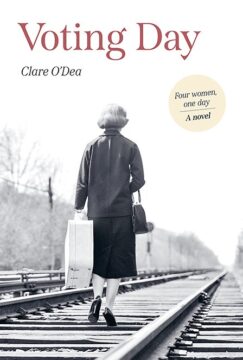 On February 1, 1959, following the introduction of voting for women cantonally in parts of Switzerland’s French-speaking region, Swiss men went to the polls to decide on a referendum, supported by the SP and opposed by the forerunner of the SVP, to introduce female suffrage at the federal level. The runup to the vote featured intense campaigning on both sides, with emotionally charged appeals to “traditional” values made by the referendum’s opponents; and the proposal was ultimately rejected, by a two-thirds majority, with “No” votes coming overwhelmingly from the conservative German-speaking cantons.
 O’Dea’s novel follows four main characters—all women, and thus unable to participate in the day’s decision on their political fate—as they go about their daily business on February 1, 1959. Vreni, a farmer’s wife and homemaker, is consumed by her preparations for a prolonged hospital stay, and relishes the prospect of a spell of unimpeachable freedom from her household duties; her daughter Margrit is experiencing life as an independent young adult in the city, with increasing responsibilities but severely limited power, particularly when faced by workplace harassment; Esther, a Swiss-Romani woman alienated from her birth family by racist authorities, yearns to be reunited with her son, taken from her in his turn; and Beatrice, a professional woman from a well-to-do family and the only one of the four protagonists actively involved in campaigning for female suffrage, awaits the returns together with her brother, who is obliged, in prudish Switzerland, to live a clandestine life as a homosexual.
 Beatrice worries throughout the book’s day-long timeline that the referendum will fail at the polls—as it eventually does, with the “No” vote meaning that the political agency of Voting Day’s main characters will continue to be curtailed for another 12 years. But Beatrice is able nevertheless to effect a certain progressive change in her immediate environment thanks to her ownership of property, which allows her to improve the social circumstances of another of the book’s characters.
 O’Dea thus subtly re-inscribes the significance of the written conveyance of real-world authority—in this case, by way of a name on a deed, if not a mark on a ballot—into the substance of her narrative. It is a theme that the author, who worked as a journalist before turning to fiction and who has produced excellent guides to the socio-politics of her twin homelands, is well positioned to consider. Her latest novel, Before the Leaves Fall (2025), is not explicitly a sequel to Voting Day. But it does feature two of the characters from the earlier book, encountered many decades later; and it lends the idea of suffrage a new dimension by insisting on the role of writing in the nexus of political agency and personal autonomy.
The new novel’s main character—Voting Day’s Margrit, now, in present-day Switzerland, an elderly woman in her eighties—has decided to end her chronic suffering with assistance in dying, which has been legal in Switzerland for many decades (indeed, Switzerland was an international pioneer in legalizing assisted suicide). As she prepares for her chosen end, Margrit is attended by a volunteer from Depart, the organization that provides assistance in suicide. (O’Dea bases her fictionalized group on Exit, the actual Swiss assisted-suicide organization.) The volunteer, who is wrestling with the challenges of his own early old age, gamely encourages Margrit to consider the reasons not to end her days, and provides her with a notebook in which to set down an inventory of her life, and thus perhaps to realize what has made it worth living—and may continue to make it worth living.

As she follows the volunteer’s suggestion, Margrit, whose professional life featured the secretarial and bookkeeping activities traditional for a mid-20th-century Swiss woman of the middle class, and who has never felt intellectually or creatively inclined, discovers her talent as a writer. And as her initially cursory notes on the various decades of her life grow into something richer, as recollections of chance encounters become vignettes with a profound philosophical resonance, Margrit’s resolve is strengthened: not necessarily in the binary particulars of her decision—whether or not to end her life, which remains unknown until the novel’s conclusion—but in her assumption of a more generalized agency. An agency in which her own memory, her own will, and her own perspective are central.
Margrit’s control over the fate of her own body, both in life and in death, is the ultimate prize of emancipation, in the face of the various authorities that have sought, during her long life, to exert power over it by dictating (and circumscribing) its moral, sexual, and political potential. And it is significant that she perfects this control in writing, a technology that comprises both the simplest forms—making a mark on a ballot paper or signing a living will—and the most complex—setting down the peculiar details of one’s own past, and thus making sense of a life—and which had been, for much of premodern and even early modern human history, the preserve of a privileged few.
What Margrit does, by writing herself into agency, is often described in a commonplace expression as “finding her voice”. In this case, however, in the linguistic context of the novel, the cliché is lent new force by the fact that the German-language word for “voice”—Stimme—is also the root of the term Abstimmungstag, or “voting day”: since Stimme, in German, means both “voice” and “vote”.