
by Rafaël Newman
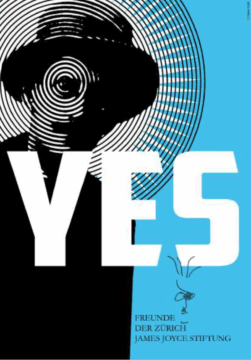
Zurich was James Joyce’s home on several occasions. The writer’s first sojourn there, in 1904, was brief: when the prospect of a job teaching English in Switzerland didn’t pan out, he and his partner, Nora Barnacle, freshly arrived from Dublin, soon moved on to Trieste, then still the Austro-Hungarian Empire’s only seaport. Joyce and Nora returned to Zurich in 1915 and spent most of the Great War there, renting apartments in various districts as Joyce worked on Ulysses and took part in the intellectual life of a city teeming with refugees. Finally, having spent the interwar period for the most part in Paris, by 1940 the couple were back in Zurich, where Joyce died the following year. He remains in the city to this day, in Fluntern Cemetery, where his seated memorial gazes out wryly, if myopically, at Lake Zurich and the Alps beyond.
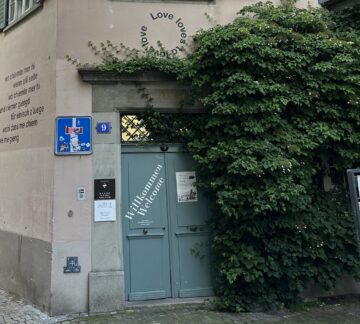
That the Swiss metropolis boasts the Zürich James Joyce Foundation, however, an internationally renowned center for Joyce research and scholarship, is due less to the Irish writer’s tenancy in the city, in life as in death, than it is to the achievements of another man, a Swiss native and Zurich local named Fritz Senn, who has devoted much of his long life to the study and promotion of Joyce’s work. Among Senn’s many publications are Joyce’s dislocutions: Essays on reading as translation (1984); Nicht nur Nichts gegen Joyce. Aufsätze über Joyce und die Welt (1999); Joycean Murmoirs (2007); and, most recently, Ulysses Polytropos (2022). Senn has founded and edited international journals, initiated Joyce symposia, and, together with Klaus Reichert, compiled the Frankfurt James Joyce Edition, in seven volumes.
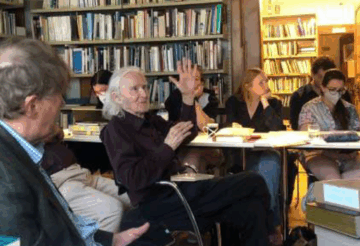
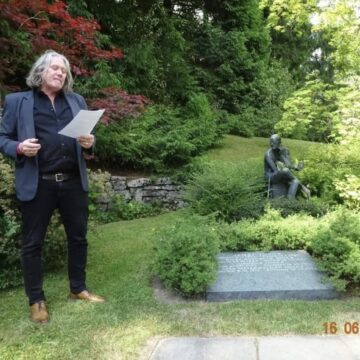
The Zürich James Joyce Foundation (ZJJF), which celebrates its 40th birthday this year, was established in 1985 with financial assistance from the Schweizerischer Bankverein (today’s UBS) to house Fritz Senn’s collection of first editions, secondary literature, and Joycean memorabilia, and to allow visiting scholars to profit from Senn’s personal expertise along with the library and archive. The ZJJF holds open reading groups, typically led by Senn himself, in which participants read Ulysses and Finnegans Wake together over the course of many months, and organizes a series of talks, known as the Strauhof Lectures, by noted Joyce specialists. It hosts a translators’ roundtable and regularly stages convivial celebrations of Joyce’s work, with readings and music at Christmas and, of course, a yearly Bloomsday event every June 16, commemorating Joyce and Nora’s first assignation and the date on which Ulysses is set.
Working alongside Senn since the ZJJF’s earliest days, running its daily business and planning its future undertakings, have been its two curators (who latterly also served as its managing directors), Ruth Frehner and Ursula Zeller.
Ruth Frehner, who retired at the end of 2024, was a fixture at the Foundation from its inception in 1985 and for nearly all its forty years of existence since. Frehner organized Senn’s collection into a proper public library, developed an electronic catalogue, acquired additional rare volumes, and guided visitors (who have included two Irish presidents and a Nobel prizewinner) around the holdings. She wrote a PhD dissertation on “The Colonizers’ Daughters: Gender in the Anglo-Irish Big House Novel,” has published on various thematic aspects of Joyce’s oeuvre as well as on issues of translation and other topics in modern Irish literature, and has collaborated on literary-historical editions.
Ursula Zeller came to the ZJJF in 1990 and joined Frehner as co-curator the following year; she entered semi-retirement alongside her colleague this past fall but remains a part-time contributor on a continuing roster of Foundation projects. Zeller was especially active, during her regular tenure at the ZJJF, as a designer and organizer of Joyce-related exhibitions and theatrical productions, often in collaboration with Frehner, with whom she has also edited volumes in the field of Joyce studies. Zeller’s own publications include essays on Jewish themes in Joyce’s work—she pursued Jewish studies at the University of Basel and spent a year studying in Tel Aviv—as well as on aspects of literary history. She has been the guiding force behind the presentation of Joyce’s work mounted on the ZJJF’s annual Bloomsday event: this year’s selection of readings, in a pleasing mise en abyme, features “Scenes of Reading in Ulysses”.
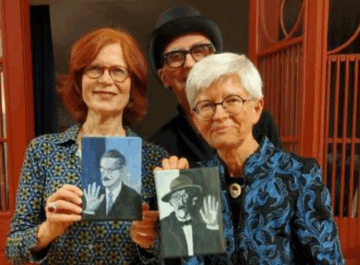
Ruth Frehner and Ursula Zeller, while serving as dedicated curators and managers of the ZJJF, have thus also been literary scholars in their own right. Indeed, together they have made signal contributions to the field of Joyce studies. Aside from the exhibitions they co-curated at Zurich’s Strauhof Museum and Central Library, for which they produced handsome and useful catalogs, they collaborated on a revision of Hans Wollschläger’s celebrated German version of Ulysses and on a new partial translation by Harald Beck, edited a festschrift for Fritz Senn, and, in 2021, published “Your friend if ever you had one” – The Letters of Sylvia Beach to James Joyce, the meticulously prepared documentation of their pioneering archival reconstruction of the communications to Joyce, in the 1920s and 1930s, from the proprietor of Shakespeare & Company in Paris who was the first publisher of Ulysses. And, in February 2022, in commemoration of the centenary of that publication, Frehner and Zeller were on hand for a marathon dramatic reading of the novel’s 18 episodes at appropriate locations in and around Zurich. (I was fortunate enough to be able to participate in that marvelous occasion and wrote about it here.)
I have known Ruth Frehner and Ursula Zeller for several years and, as a member of the board of the Friends of the Zürich James Joyce Foundation, which acts as a liaison between the ZJJF’s members and its staff, have had the pleasure of working with them since 2023. And when they are jointly awarded the Max Geilinger Prize this November, for their “decades of great work at the James Joyce Foundation,” and for their contribution to literary and cultural exchanges between Switzerland and the Anglophone world, it will be my privilege to say a few words of tribute.
As I prepare my remarks for that Laudatio, I have been thinking about what it means to be a curator, of the many honors Frehner and Zeller have done that august but occasionally misunderstood designation, and of their expansion of its scope—beyond museology and the visual arts. Their lively spirit of innovative preservation has been passed on to their successor, Martin Mühlheim, who took over as general manager of the ZJJF last fall and among whose first projects this spring, in a busy anniversary year, was a delightfully erudite juxtaposition of Aidan Hickey’s illuminations of Ulysses alongside documentation of Joyce’s entanglements with the justice system, mounted in Santiago Calatrava’s soaring Law Library at the University of Zurich. (Zeller, in one of her post-retirement interventions, also contributed directly to that show.)
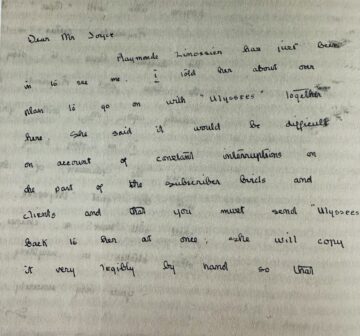
Frehner and Zeller’s inventive spirit has inspired me as well. My title for this post, “Ulyssees on the Limmat,” is an echo of “Ulysses an der Limmat: Stationen einer Odyssee,” one of the many events the two curators organized during their tenure at the ZJJF, this one under the aegis of the Zürcher Festspiele, an annual summer festival of arts and culture, in 2012. I’ve added the extra “e” in Ulysses in a Joycean (Frehnerian, Zellerian) echo of the eccentric orthography deployed by Sylvia Beach in her early correspondence with Joyce, as can be seen in this facsimile, from the edition of the letters prepared by Frehner and Zeller:
The additional “e,” furthermore, is also meant to suggest a sort of French feminine plural of the ancient Greek hero’s name, in homage to Frehner and Zeller themselves: those two heroically ingenious adventurers in the world of Joyce, and well beyond it. And to wish them both luck on their further Odyssees.