
by Leanne Ogasawara
1.
London Falling opens in late 2019 when nineteen-year-old Zac Brettler steps onto the balcony of a luxury apartment in London and jumps. The building sits directly across from Britain’s intelligence service MI6, which is how the Metropolitan Police came to have the surveillance footage of what happened.
The police suggested suicide. But Zac’s parents did not believe them. They do however acknowledge that there were some red flags about their son’s recent behavior. In the previous year, they tell the police, Zac had been spending quite a lot of time in the company of two older men. One of them, Verinder Sharma fifty-five, was allowing Zac to practically live with him in that luxury apartment across the river from MI6. The cameras showed that Sharma, also known as “Indian Dave,” was in the apartment when Zac jumped. But so was another older man named Akbar Shamji.
When Zac’s parents questioned their son about his relationship with these men, the teenager explained that they were successful businessmen and were mentoring him. Sounds strange and yet having a son about Zac’s age, who also studies business in university, I can imagine a similar scenario. Like Zac, my son is personable and enthusiastic to learn how businesses are run, so I can see him shadowing a friend’s father at work or playing golf with one of them. He does things like that already. But still, Zac’s parents were concerned about it—mainly because it was so much.
And anyway, what kind of businesses were these men running?
 2.
2.
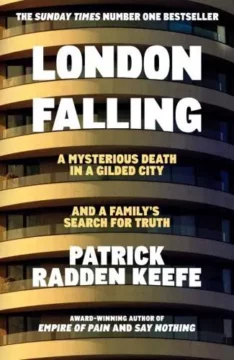
London Falling: A Mysterious Death in a Gilded City and a Family’s Search for Truth, by Patrick Radden Keefe, which started off as a longform essay in The New Yorker, is hands-down the best work of nonfiction I’ve read in years. Initially, I shied away from the book. Being thin-skinned, having a boy around the same age as Zac, I wasn’t planning to read it until a friend started telling me how fantastic the storytelling was.
And it’s true. I could not put it down. Not because the outcome was ever in doubt though, since it’s clear from the early chapters that these older men are not what they claim to be: one a violent gangster, the other a criminal of the white-collar variety. The suspense isn’t whodunit. It’s something subtler: the book works the way the best social novels do, using one story to illuminate an entire world.
I am thinking of the way Kawabata’s Snow Country does this. A man travels to a remote hot spring town and what unfolds is less a plot than a portrait: of transience, of beauty that exists only because it will disappear, of a Japan caught between tradition and modernity. The Great Gatsby does it differently but with the same precision, using one reckless summer on Long Island to expose the hollowness at the heart of the American dream.
London falling is the story about Zac Brettler, but it is also the story of pre-pandemic London. About the extreme forms of wealth inequality, the super-rich, and gangster capitalism that define the city. And London has the added sauce of being one of the biggest money-laundering cities in the world; specifically, it is where Russian oligarchs have arrived to buy extremely expensive properties with their dirty money, often educating their kids in fancy British boarding schools.
In what was a huge disappointment to him, Zac did not pass the entrance exam to the elite private school where his brother was going and instead entered another school, one that was less prestigious but happened to be full of the children of oligarchs and the ultra-wealthy. Being young and impressionable, it wasn’t long before Zac became completely enamored and obsessed by the lifestyle of these rich kids. They were glamorous in a way he had never seen before.
And before long, he wanted to be like them.
 3.
3.
On Facebook, something strange happened to me recently, when I must have inadvertently slowed down in my scrolling over a video of this very wealthy woman, an heiress, opening bag after orange bag from Hermes. I didn’t know who she was or why anyone would want to watch such utterly conspicuous consumption! Why was she doing this? And why was Facebook targeting me?
The woman surely didn’t need more money. I’d never seen anything like it, and so I lingered, I guess. And before long, I was inundated with Becca Bloom videos. As if that wasn’t weird enough, these were shown alongside videos made by Aon Somrutai, a viral TikToker and wealthy socialite in Bangkok. All of a sudden, every time I went on Facebook, these two women were all over my feed. And guess what? I found myself wondering, “So how much does a Hermes bag cost anyway?”
I could easily imagine Zac seeing the children of the super-wealthy every day and thinking that he wanted what they had. And so, he started telling people he was the son of a Kazakh oligarch. Speaking with a fake Russian accent, he explained to people that he was estranged from his parents and his mother was in Switzerland or that she was dead (!) When friends at school called him on this, he would just shrug his shoulders and apologize for lying.
It’s very sad, because it wasn’t as if Zac was living on the wrong side of the tracks or the family was struggling in some significant way. His real father did very well in finance and Zac was going to an excellent private school. The grandson of Holocaust survivors on both sides, one of his grandfathers was a prominent London rabbi. Zac had a Bar Mitzvah and his parents were in a happy marriage. They traveled in Europe and even if the family car was not a Bentley, still he had it pretty good by any measure.
And yet, he wasn’t happy.
 4.
4.
A significant part of the book is spent with Keefe wondering if Zac was mentally ill. Did Zac actually believe he had this alternative backstory? Was he perhaps schizophrenic?
But if you think about it, these days we’re all in the storytelling business. Especially online.
Even before the era of social media, back when I was in high school, my best friend woke up one day bored with her life. The daughter of middle-class parents in the suburbs, she was a public-school student without any driving interests in books, music or sports. And so, she decided to reinvent herself, telling anyone she encountered that she was Australian, studying abroad in America for a year. She was absolutely obsessed with Olivia Newton-John, and I don’t know how she managed it, but she had a fantastic Australian accent. She was even able fool Australian people. Not surprising for living in the boring suburbs, the accent was a shot of instant glamour.
My friend grew out of her charade quickly. It lasted maybe a year (which is actually a long time). And I think she had to back away from a few of her new friends because those people knew her as an Australian girl with a backstory that was every bit as elaborate as Zac’s.
And this leads me to Walter Mitty; for what is an intelligent and imaginative person to do when mundane life bores them? Ordinary life can be tedious, and it only gets worse into adulthood, especially if you are like Mitty with relentless work to pay the rent, put food on the table and raise your future kids. Even harder to hold a marriage together, especially if you’re living in small town America or anywhere less glamorous than London.
So, what do you do if your mind craves more, but you’re trapped in a boring existence, especially for someone with a rich inner life? In the original story version, Walter Mitty never acted on his fantasies. But in the film version he did go out into reality to do something personally meaningful, almost as if to say being trapped in the boredom of everyday life is something not to be suffered in our lives any longer.
 5.
5.
We want. We want. We want. We want. And we will apparently do almost anything to get it.
It all reminded me of a recent book by German philosopher Byung-Chul Han, The Crisis of Narration. Han is not the first thinker to worry about the way our lives are more and more isolated from others. Social media has done so much to undermine true connection. At least this has been true in my life. When I first went on Facebook back in 2009, it was a way for me to connect professionally with other translators. Our Japanese translation group moved from an online list-serve to Facebook. And so, Facebook was where I did business, even getting some wonderful translation jobs via Facebook connections. In addition, Facebook was also the place where friends shared photos of food and music.
Quickly this sharing morphed into a place where, in the words of my ikebana teacher, old people spent all their time yelling at each other.
It has become pretty tiresome actually, the more I felt I was being lectured to, the less happy I was being there. Communication, at least in my feed, was concerned almost exclusively in persuading.
As Han says, we live in an age, not of storytelling but of STORY-SELLING, which is not a return to traditional narrative and storytelling, but rather is a style that “serves to instrumentalize and commercialize narration. Storytelling is becoming established as an efficient communication technology, one that is often manipulative and has an ulterior motive.” Simply put: is a way to self-brand.
I think this is where Zac differed from my high school friend. My friend was storytelling and engaging in fantasy. She wasn’t trying to get anything from the people she provided her invented backstory to, but rather was playing around with her own life story. These were not people she would be dating or forming deep bonds with. Whereas Zac made up this story for an aspirational reason. It was economic. He wasn’t just performing a more glamorous self for social pleasure, but was trying to gain entry to an actual world he believed he had been excluded from. Like the famous fraudster Anna Delvey, Zac was invited to exclusive nightclubs and given a place to live in a luxury condo with a view of the Thames.
The Kazakh oligarch backstory wasn’t whimsy, it was a ladder. That changes the stakes entirely because it required the lie to keep escalating and to actually deliver something — access, money, status — rather than just entertain. He was story-selling. And he wanted to make a deal.
What was so heartbreaking was that the people he was telling this story to—well, at least two of them—actually believed him, that he was heir to a massive fortune.
London Falling was a tragic story. Since it was his fake self as the son of a billionaire that attracted the notice of Shamji and Sharma. Such a waste to lose someone so young—and where was the justice? My high school friend eventually grew out of her Australian accent and came back to herself. Zac never got the chance.
 For more:
- Another compelling nonfiction read is How to Rule the World: An Education in Power at Stanford University, by Theo Baker. The book is in some sense the polar opposite of Zac’s story. For the Stanford Trump connection, please see my Substack Post How to Rule the World.
- Rabih Alameddine’s The True True Story of Raja the Gullible (And His Mother) is another related read. The novel, which won the National Book Award, was my own favorite novel of 2025. I loved it. Jaya Bhattacharji Rose of the Times of India, conducted a fantastic interview with the author in which Alameddine mentioned that in writing the novel, he wanted to show the importance of storytelling—not story-selling!– in our lives. He says he feels it is not what happens to us in life that actually matters most. Rather it is the stories we tell about our experiences. Raja the Gullible is a brilliant example of meaningful storytelling.
- Novelist Daniel Silva publishes a new spy thriller every July. From several of his books, I have learned about London’s role as the world’s money-laundering center. In addition to novels, there are many articles, books and documentaries about how Russian oligarchs established a significant presence in London—dubbed “Londongrad“—by exploiting the UK’s open economy, legal, and financial services, which welcomed foreign capital with minimal scrutiny for three decades. They acquired residency through now-abolished “golden visas” and used complex shell companies, often located in British Overseas Territories, to buy premium property anonymously, typically engaging in legal tax planning rather than evasion. The law was recently changed but much of this was actually done tax-free if the non-dom (non-residency) investment status was utilized.