
This is a lightly edited transcript of an online video conversation. You can get more information about Ravi Shavi’s new album Wild Rock Dove here. Instagram link here.
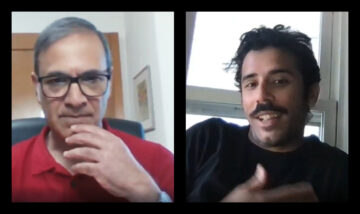
Abbas: I’m happy to have Rafay Rashid with me today and now I’m just going to read the bio he sent me: “Rafay was born in Islamabad, Pakistan, and grew up in New York and Rhode Island. He makes experimental pop and no-wave songs under the moniker Ravi Shavi that are confessional, ecstatic, and confrontational. His writing emerged as a response to growing up a Muslim kid in the neoliberal hellscape of post-9/11 America. Ravi Shavi became a persona and vehicle for both radical healing and anarchic humor as he crafted a niche amid the noise and freak-folk music scenes of Providence, Rhode Island, in the late aughts. Since then, he has cut his teeth touring independently throughout the past decade, opening for such acts as Charles Bradley, Of Montreal, Man Man, Budos Band, Los Lobos, and The Black Lips. Ravi Shavi will be performing with Spoon on June 19, 2026, in Providence, Rhode Island. He has a new album coming out, which is what we are here to talk about. It is called Wild Rock Dove.”
So, Rafay, thanks for coming. It’s good to see you.
Rafay: The biography sounds so loaded coming out of your mouth.
Abbas: People compare my personality to that of a shotgun. I can be loaded; I can also be locked.
Rafay: I was picturing the Ken Burns effect, with photographs from my life. I had never pictured that while reading the bio before, so thank you for that. Thanks for having me.
Abbas: Sure thing. Just to let everybody else know, I really like Rafay’s music. Full disclosure: Rafay is a friend, and in some distant way, through marriage, we are also related. No blood relation, as far as I know.
I have only met Rafay a few times, but it has always been real, and we have always had interesting conversations. And, as I already said, I love his music. I heard one of your songs today, Rafay, not completely deliberately but because several of your songs are part of my exercise playlist. As I was doing a little workout, your voice came on.
A song from one of Rafay’s older albums
You have done so many things. You got a master’s in… tell me about that. In what?
Rafay: In mental health counseling, or, more colloquially, therapy. It was something I had never really seriously considered for myself until my own process of getting sober. I don’t know why they always call it a journey, getting sober, but I got sober in 2020. Then the pandemic happened, gigs started slowing down, and the work I was doing on art exhibitions had ended and dried up. So I thought, well, I had a good time in rehab. Maybe I could run some groups. I always liked socializing with people and getting the conversation going.
Abbas: Is that something you have specialized in – recovery from addiction of various sorts – in your counseling practice now and in your education? Or do you just do general counseling: people have problems, they want to talk, and you talk to them?
Rafay: I just run substance abuse groups.
Abbas: Okay.
Rafay: That is my vibe. I am fully committed to that little subsection of therapy. It is funny, because when I was growing up and through my twenties as an anthropology student at SUNY Purchase, I was deeply critical of self-help culture, therapy, the Western biomedical model, and all of that. So it is sometimes a conceptual struggle for me to identify as a therapist or a counselor. But it is not a struggle for me to identify as somebody who runs addiction recovery groups. That feels cool.
Abbas: How interesting. I saw a therapist for a while in my early thirties in New York City. In retrospect, it did not turn out to be a particularly helpful experience for me. But I read all kinds of self-help books – books about how to become happier, or how to develop discipline and habits. Sometimes you get a few little tips that actually work.
Rafay: Absolutely. I think I have come around to that. My problem was not so much with the insights being offered in those pages, but with the overarching idea of selling happiness, or making a profit from inventing ways to become, in some sense, a more subservient member of society. The implication is that the problem is not cultural; it is a you problem that needs to be fixed.
Abbas: Right. We are here to talk primarily about your music, because you have this new album coming out and because, as I will say for the third time, I like your music so much. But besides music, you have worked in museums, at the Venice Biennale, in art galleries and public art, and now you do recovery counseling. Do you see these things as completely separate careers, or as some kind of long, personal investigation into human nature? Are they connected somehow?
Rafay: I see it as a long, personal investigation into human nature. For a while, it felt very separate. It did not quite make sense. There was a tension between these many different paths I had started to walk down. Recently it has not felt that way, and I think a lot of it came together in Rec Room, a project I am doing in Providence. Rec Room takes influence from participatory public art exhibitions I have worked on, folds in elements of AA recovery meetings, and also folds in music and experimental drones that run throughout while people play ping-pong and chess. Basically, it is a dream I have had since I was a kid: to make a rec center. I do not think it is a coincidence that I started to have this dream while I was getting high for the first time. As much fun as I was having getting high, in the back of my head I was also thinking, I cannot use this as my only source of enjoyment. What are the more wholesome ways of having fun? I thought I would probably have to figure that out someday, because this well was going to run dry. Now, twenty years later, I am starting to make pop-up versions of Rec Room, and I think it folds all of those different paths together.
Song from the new album Wild Rock Dove
Abbas: That makes sense to me because there is a playful spirit in pretty much everything you do. It is my impression that, even as a musician, you are not in it to become the next Coldplay or something. That would not be the sort of ambition I would expect you to have. You do it because it is fun and because it is you. You must enjoy the energy of being in a band and feeling the vibes of your bandmates. As the frontman, you get to project that energy onto a crowd that has come to listen to you. There is something playful about every activity I have noticed you engage in with passion. So it makes complete sense to me that a rec room would be something you would create. You have worked with highly conceptual artists like Tino Sehgal, your cousin Asad Raza – who is also my nephew – and Philippe Parreno. On the other hand, you have also worked in underground rock settings. What did the art world teach you, if anything, that you could apply to your music career? Or vice versa?
Rafay: That is a cool question. Providence, to me, is also an art world; it is just a separate art world from the international art world I have worked in. All of these are different little art worlds. Some are bigger than others, and they inevitably influence each other. I grew up going to warehouse shows in Providence as a young person. Those shows emerged from art school graduates from RISD who had made experimental noise bands and noise rock – bands like Lightning Bolt and Arab on Radar.
Abbas: David Byrne wannabes.
Rafay: Sure! But they had gone in their own completely wild directions.
Abbas: I only say that because David Byrne went to RISD, as you know.
Rafay: Of course. But they had gone in these wilder directions. It was all dark warehouses, feedback, a very DIY aesthetic, and things kind of crafted together – the classic artist squat in a warehouse or factory setting. There was an element of realizing that you do not need to wait for an institution to give you a green light, and you do not need to wait for grant proposals to be accepted in order to do something meaningful, cool, and unique. That gave me a level of confidence in myself to build my own little world. I do not know how much working in the wider art world has influenced my music practice, but it has certainly influenced Rec Room and the scope with which I try to approach any creative project. Why limit it to our little scene here? As much as I like an audience to be specific, there is also an element of universality that is nice in bigger institutions. You get all sorts of different people walking in. If you can make something engaging for anybody, that is ideal. That is the spirit of most of the projects I have worked on with Tino, Asad, and Philippe. They are not making abstract expressionist paintings that require a certain level of training to appreciate.
Abbas: Right. I do not have that kind of training, although I like some Jackson Pollocks as much as the next guy, I guess.
Rafay: They make you feel something.
Abbas: I think I once said to you that I find a lot of high art throughout the twentieth century turned itself into a third-rate brand of philosophy. It left the aesthetic realm and tried to make its audience think in the realm of knowledge and also in the moral realm – the realm of the good. Art became very preachy sometimes. It had all kinds of messages, or it was trying to make you think hard, but in my opinion not in a particularly great way. If you want to do philosophy, just do philosophy: write a paper and publish it in a journal. It started early in the century, while other people were doing very interesting things in painting, sculpture, and other arts. But you had Duchamp with his Fountain, the upside-down urinal, which is there to scream questions at the audience: Why am I here? What does this mean? What is the role of the institution in which I have been placed by Mr. Marcel? I find all that quite boring, actually, because it went on and on, with people becoming more and more invested in this kind of make-you-think art. Do you want to respond to that?
Rafay: Yes. I just saw the Duchamp retrospective at MoMA. He has a big retrospective in America right now. I think that with anything, people sometimes get carried away, and the cultural scale tips too much in one direction. Personally, I love Duchamp. But I see exactly what you are saying about how art can become third-rate philosophy when the message is given more power than the thing that is actually being delivered.
Abbas: And if it is repeated too often. Duchamp was a kind of genius for having thought of doing such things that early; I will give him that, at least. But nowadays, when you see things like that, or artists are constantly talking about the message they are trying to deliver – about climate change or whatever – it becomes tiresome.
Rafay: It does. You end up reading a bunch of mini-essays that are vague and full of catch-all language. You are basically going from one wall text to the next.
Abbas: Exactly. I had that experience at the Venice Architecture Biennale.
Rafay: You went last year?
Abbas: No, the one before that, I think – the one my nephew Jaffer co-curated. I found that so much of it was impossible to figure out. There would be a pile of concrete blocks lying somewhere, and then a long text written in the impenetrable postmodern jargon that many architects love so much.
Rafay: It reminds me of something Asad Raza said: the museum became a cemetery of objects. But now it is almost as if the museum has become a cemetery of words.
Abbas: Precisely. That is exactly what I am complaining about. Of course, not everything is like that, but there is too much of it. Back to the music: do you write your own songs? Most of them? Some of them?
Rafay: Yes. I can almost only write my own songs, to a fault. I have always wanted to do covers, but I never found the motivation. I have collaborated with a good number of different musicians, mostly in Providence, as far as co-writes go. I like when I can work with another writer, especially on lyrics, but I usually follow my own intuition as far as the music goes.
Abbas: Do you write the lyrics first, or the music first, or is it a mixture?
Rafay: It is a bit of a mixture. Lately – or maybe always – I have been really into improvising melody and lyrics on the spot, then listening back and changing a word here and there, or seeing what sticks over time through playing songs live. Often I would not have a second verse. I would have a verse and a chorus, and live I would make up the second verse. Over time, whatever felt good would stay. It is like comedy, where you try out material and make minor tweaks each set. That is how I approach music.
Abbas: When you are writing a song through that process, do you think you are trying to reveal something about yourself? Or are you taking on a persona and perhaps even disguising yourself? Are you trying simply to entertain people? What is going on inside?
Rafay: I think I have probably done a bit of all of those things. When I first started, it was really just about getting everybody in the room to do the same thing, and that thing would hopefully be enjoyable and repetitive. Later I found that it had a lot of similarities to something like qawwali, when everyone is chanting together. Now it has come full circle a bit. I have a minor morning ritual of sitting down at a harmonium and allowing myself to improvise in Urdu, which I do not speak that well at all. It becomes this strange process, almost like an incantation, where I am improvising words in Urdu that are just in my word bank. They come out, and it inevitably feels a little like poetry, because the words do not always make much sense together and do not sound so plain. Then I think about what I have just said.
Abbas: Are you using that as an exercise for coming up with musical ideas, not finished Urdu songs, but a way to help you express yourself in your normal music, which is all in English? Or are you trying to produce finished pieces of music in which you play harmonium and sing in Urdu?
Rafay: Right now, definitely not finished songs. We are just putting this album out, so for now it is more of a personal exploration.
Abbas: I would bet it has some effect on what you write for your other music. I am not a musician, so I do not really know, but I would imagine it does. The harmonium is a strange instrument because you have to pump air through it with one hand while playing with only the other hand.
Rafay: Exactly. And you have to play on the floor. That was nice for me because I have been trying to do my version of a daily prayer, to get out of my own way and stop thinking I am the center of the universe. It is nice to be forced to be on the ground and to try to channel something through that instrument.
Song from the new album Wild Rock Dove
Abbas: Interesting. When you started your band, you were not sober yet. How has sobriety changed your relationship to performance, if it has?
Rafay: It has affected the moments around the performance more than the performance itself. When you are actually performing, the music, the audience, and the lights create the desired effect anyway. But in the moments leading up to it, and the moments after, you have to negotiate with your energy and attention span. You cannot just keep playing the perfect cocktail game – thinking, if I get just the right amount of amphetamine salts and alcohol together, it will create this perfect combustion. Because once the show is over, that searching and reaching does not end when you are partying.
Abbas: That makes complete sense to me. It would affect the moments around the performance much more, because for the performance itself you have to be so concentrated on that one thing that you are in a different world anyway. There is this old romantic idea that suffering somehow makes art deeper. As someone who has personally been involved in recovery and who works with other people going through that process, do you think there is any truth to that idea? Does deeper art come out of some kind of suffering, or is that a dangerous myth artists tell themselves?
Rafay: I have wondered that many times. Was all the suffering necessary to arrive where I am now? I do not want to say yes, as if it is necessary. But I think suffering can be indicative of someone’s willingness to be open to experience, and that openness can lead you down roads that teach hard lessons.
Abbas: There is certainly good music that does not make you feel as if the person who wrote it was suffering very much. You think of something like Good Vibrations by the Beach Boys. It is hard to imagine Brian Wilson suffering very much while writing that.
Rafay: Probably not while he was writing that, but definitely while writing a lot of his later material. If you put a gun to my head and asked me that question, I would say no, you do not need the suffering. Also, everybody suffers their private hell.
Abbas: Some people more than others, it seems to me. I know people who are congenitally happy. I do not understand them.
Rafay: Do you think they are actually happy, or are they performing?
Abbas: Some of them, I think, are not performing. They just are not bothered by the same things most of us are bothered by. They do not suffer the same insecurities or depressions. Of course, there are congenitally depressed people, too. This reminds me of your observation about chronically nice people. Do you remember that? It can sometimes be difficult to deal with such a person.
Rafay: Yes.
Abbas: As an undergrad, you studied anthropology. As you move through these various worlds we have been talking about – the music scene in Providence, an international art show like the Venice Biennale, and so on – is there a part of you that still observes what is going on around you like an anthropologist? Do you have that habit of almost doing fieldwork?
Rafay: As I get older and happier, I find myself less in that mindset. It is hard to participate fully when you are doing the participant-observation thing too much. The observation part ends up winning if your brain is firing on all cylinders as a rational meta-machine. I am more interested now in how I can make this moment enjoyable, rather than how I can make this moment make sense. I remember being young, being at a party, watching people perform a party, and feeling like we were all collectively creating this illusion of a party and of fun. It was a performance we had engaged in. As I got older, I realized that this distance was not letting me have as much fun as I could be having.
Title song from the new album
Abbas: Right. Immersing yourself is a kind of mindfulness, I guess: being present in the moment. I feel this sometimes. I have a habit of taking walks, and I almost always carry a fairly serious small camera with me. But then I find that I am looking for things to photograph, and that takes something away from the enjoyment of simply walking for no reason. It is as if I am doing the walk in order to produce interesting photos. That takes up the part of your brain that might otherwise be enjoying the breeze, or the sight of a bird singing on a tree branch, or something silly that would momentarily make me happy if I were paying attention to it. Instead, I am wondering if I can shoot the bird, whether I have enough zoom, and so on. So I have started alternating. I still like to take the camera on some walks, and sometimes I deliberately leave it at home so that I am just fully immersed in the walk itself. That reminds me very much of what you just said.
Rafay: At least with photography, you are focused on nature, landscape, and architecture as much as you are focused on humans. With anthropology, you are just so dialed in on the humans. But I like the idea of alternating. I think that is good.
Abbas: Although I do the same walk so often – I live in a small town, as you know – that at first I was photographing obvious things: buildings, mountains, and so on. Recently, I almost exclusively photograph the ground and the things on it as I walk. It can be a piece of gum flattened into a bizarre shape that looks like a cat, or a bunch of ants swarming, or anything like that. So I am not really paying attention to the trees or the mountains. These days, when I have my camera with me, I am scanning the ground as I walk along. That is just a recent and weird development.
What do you think about the presence of social media, smartphones, and constant confrontation by memes and little things designed to grab your attention? They are very good at getting your attention. I am as susceptible to that as anybody else. Sometimes I go to YouTube to look at one video and then I am down the rabbit hole, watching other videos it suggests. The same thing can happen on social media. How do you think that affects the way your art and music are received? Have people become too distracted to pay attention in a deep way that was possible thirty years ago, or has it not changed that much?
Rafay: I think the paranoia about the culture losing its attention span is valid, but I do not see myself as especially cynical about where that will lead us. As for my personal approach, I have started to embrace the fact that everyone is their own little TV station. You can choose what the programming is going to be, and you can choose to have as much fun or as little fun with it as you want. I do not see myself as a slave to technology, and I think people have a choice about how they interface with it.
Abbas: How would you react to this question: does art have to be useful, or is its uselessness part of its dignity? We are at the point where I am going to start throwing some heavy questions at you. Ha ha…
Rafay: I believe that dichotomy gets erased when you are dealing with really good art.
Abbas: Interesting. So it can be both. It could be useful or not useful, and that has nothing to do with whether it is good art?
Rafay: Yes. And one person’s trash is another person’s treasure. If looking at a painting brings you deep satisfaction, then it is useful.
Abbas: One person’s ceiling is another person’s floor.
Rafay: Exactly. If it brings you deep satisfaction to look at a painting, then it is useful. If it brings you deep satisfaction just to be at a gallery show and feel dignified, that is also useful.
Abbas: About your new album: your bio describes your songs as “confessional, ecstatic, and confrontational.” Of those three, which word feels most central to this album? Once again, the words are confessional, ecstatic, and confrontational.
Rafay: You said that like a game-show host.
Abbas: Maybe there is a future for me in game-show hosting.
Rafay: Who wants to be a millionaire? I would say ecstatic is the closest. The political demo tape was the most confrontational, and Kitchen Weapons, my solo album, felt the most confessional. So I am left with the third word. This is definitely the happiest sounding of the records.
Abbas: I have heard only one song from your new album so far – Moneyback – and I like it very much.
Rafay: Thank you.
Abbas: I think you have already released a second song, which I have not yet heard.
Rafay: That’s right. I am excited for you to hear it.
Abbas: I will take a listen soon. You know that I am very interested in artificial intelligence and in the rapid, accelerating pace of development in these things. Do you have any thoughts about how AI might affect the production of music, or even the appreciation of music? I hear all the time from people about this. A friend of mine told me that his nephew’s favorite band on Spotify, which he had been listening to for a year and had really gotten into, turned out to be completely nonhuman: AI was producing all the music. Things like that are starting to happen, and of course AI’s ability to write and produce music is getting better. What are your general thoughts about this? Or is it something you have not thought about much?
Rafay: I have not thought much about its application to music personally, because I would not want to rob myself of the experience of having to struggle to make something I like. But I did recently hear something about artificial intelligence implanted in jewelry that is supposed to help you make decisions – to guide decisions. I do not know whether that was completely made up or whether it is a very real thing that exists.
Abbas: Those glasses with speakers, cameras, and so on built into them are definitely real, and they do similar things. They look at what you are looking at. If you are looking at a menu, they can probably tell you, “You are not supposed to have that much saturated fat. Maybe do not eat number seven.”
Rafay: That application is slightly exciting to me as someone who is sometimes crippled by choice, especially small choices that might affect your physical and mental health over time.
Abbas: I am forgetting who said the phrase “the tyranny of choice” – somebody famous.
Rafay: I definitely struggle with it. I am under the totalitarian regime of choice-making.
Abbas: With trivial choices, I feel it too – what soap to buy at the grocery store, for example. The way I deal with it is that I make the choice once, then assume I had a good reason for making that choice, and never change. I just buy the same thing again and again forever.
Rafay: I do that with a kind of mediocre pho at a restaurant I go to every week. I do not love it, but I have committed to getting it every time.
Abbas: Funny. I hope you will send us, for 3 Quarks readers, some videos of songs from your new album. We probably should not make this too long; we do not want to bore the people reading. So I will ask whether you have any last thoughts, or whether there is anything you wanted to say or ask me?
Rafay: This has been a real dream. I have wanted to have this conversation for a while. I grew up reading 3 Quarks and idolizing you in many ways. The fact that you have been a mentor to one of my mentors feels very appropriate. I do not like the word spiritual, but it feels spiritually appropriate to have a conversation like this in connection with a project that feels really important to me. Thank you so much.
Abbas: That is so sweet of you to say, and very kind. As I said at the beginning, I always enjoy talking to you. Thanks for doing this. We will talk again soon. Be in touch, and visit sometime when you have time.
Okay, ciao for now!
Rafay: Bye-bye.
***
Once again, you can get more information about Ravi Shavi’s new album Wild Rock Dove here. Instagram link here.
***
Enjoying the content on 3QD? Help keep us going by donating now.