
by Marie Snyder
 A couple months ago I wrote that we should not feel blame-worthy if we can’t do all the most courageous things in order to protect our neighbours or help stop a war or try to undermine the entire system. There are less courageous things we can do within our capacity. While that’s true, it doesn’t mean we shouldn’t try to push ourselves to do a little more, and it doesn’t make the people who do the incredibly courageous things any less laudable.
We have heroes for a reason. The people who put themselves in danger when they stand up to injustice often present ideals of action. They’re never perfect embodiments of living, nor should we expect them to be. After all, they’re still human. But people who are noted for their courage, persistence, strength, generosity, etc. help remind us what it looks like, giving us a direction to move towards.
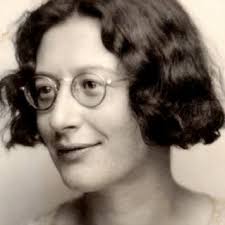
This recognition came to light in reading Kieran Setiya’s Life is Hard: How Philosophy Can Help Us Find Our Way. In his chapter on injustice, he explores the life and work of Simone Weil.
I might have a soft spot for Weil because she was born in Alsace, which is where my great-grandfather lived until crossing the ocean to Canada. It was also home to Albert Schweitzer, another flawed hero who put on concerts in order to make money to build a hospital in Gabon, Africa, but decades later was called racist for arrogantly deducing, of the sick and dying people he treated, “I am your brother, it is true, but I am your elder brother.” As a person, maybe he’s not entirely to be celebrated, but we can still look to his actions to provoke us to help others. Expecting heroes to be flawless is a ridiculous bar to set, but even worse is tossing them aside once we find out they have a flaw.
Weil was the rare philosopher or person who lived by her ideals. She believed in worker’s rights enough to share her sugar and chocolate rations with them and eventually get a job in a factory to work alongside them. She’s someone who moved towards danger and, in 1936, joined the Loyalists during the Spanish Civil War despite teaching school in Paris at the time, far from the chaos of the conflict. She wrote, “I don’t like war; but I found the position of those outside the war far more horrifying.” After coming home with an injury (from stepping in hot oil), she changed her mind about the righteousness of the fighting. In a letter to the writer Georges Bernanos, she wrote a prescient warning:
“I no longer felt the inner necessity to participate in a war that was no longer what it had appeared to be in the beginning, a war of starving peasants against landholders and a clergy in cahoots with them, but rather a war between Russia, Germany, and Italy. … I almost witnessed the execution of a priest; during the minutes spent waiting, I asked myself if I was just going to watch, or get myself shot by trying to intervene; I still don’t know what I would have done if a lucky chance had not prevented the execution. … I acquired the feeling that, whenever the temporal and spiritual authorities have placed a category of human beings outside of those whose life has a value, there is nothing more natural to a man than to kill. When one knows it is possible to kill without risking either punishment or blame, one kills; or at least one surrounds those who kill with encouraging smiles. If perchance one feels a little disgust, one keeps quiet about it, and before long one extinguishes it, for fear of seeming to lack manliness. One is swept up; it is an intoxication impossible to resist without a strength of soul I am obliged to consider exceptional, since I have never encountered it anywhere.”
We don’t always know what we’ll do in difficult moral situations, but our environment can tip the balance of the scales to one side if we’re not careful. And it can be very hard to be careful.
She left France for the US in 1942 only because her parents wouldn’t leave without her. From there, she moved to England alone to work on the Free France movement. She often went without food in solidarity with the poor and hungry, and her malnutrition, coupled with tuberculosis (or perhaps her lack of appetite was exacerbated by TB), caused her death the following year. She was fiery and motivated by her own integrity. Despite having weak eyesight and a tiny frame that couldn’t manage munitions, she was willing to risk her own life to help others.
Today, we might pathologize her, and maybe admonish her for not practicing enough self-care. Most of us don’t really stand for things anymore. But surely she can be admired, at least, for her integrity in the face of injustice. Right?
When looking for how best to approach injustices, we need to steady our moral compass. It can help to have a few role models we admire to help us find the way. My heroes include Weil and Schweitzer among many other fallible humans, like MLK and Chomsky. Some suggest that Weil’s a failed hero because nothing she did worked; she wasn’t good at military service. I’d counter that she demonstrated bravery and undeniable other-centeredness in her attempts to help to make a difference. She has moral character, even though her body wasn’t always up to the task.
Setiya has a different criticism:
“If there are models of what it would be to take injustice and human suffering seriously, to make no excuse for oneself, there is none better than Simone Weil. The problem is that her model is terrifying. Inspiring, yes, but terrifying, too. I couldn’t do with my life what Weil did with hers; who among us could? If that is what it means to care about injustice, maybe I don’t care, after all” (125).
She’s too good at being good, which makes her a bad role model for developing fortitude.
I wonder if this idea, that a role model must be achievable to be a good guide, comes from a capitalist notion of acquisition. That sounds ridiculous, but I’ll try to explain. We used to have ideals that helped us find a direction: ideals of honour, courage, strength, beauty, etc. We held people up as a standard for comparison, but we never really expected to get to their level. They were held up in part because they were so out of reach by most of us. At some point, though, some of these became reachable without needing to be innate or an extraordinary effort, particularly those last two examples. Suddenly, we could be strong or beautiful, or both, with help from modern medicine. Once more people could reach the ideal, then it no longer was an ideal, but instead became a target. People saved up for plastic surgery to get a perfect nose, or took steroids to buff up their biceps. And maybe that’s affected how we look at role models of justice as well. People who are not within reach are rejected instead of honoured because we’ve forgotten what it is to look up to a higher, unachievable standard of being: as a direction, not a destination.

Something like that.
Unfortunately, the alternative is more comfortable. We can find heroes who don’t make us feel like crap by comparison. Instead of suffering cognitive dissonance by noticing the difference between ourselves and our heroes, which might spur us on to change for the better, we can find someone a little less daunting. But that’s as if to suggest that claiming a moral marker with a similar level of debauchery, means we’re moral.
Later, Setiya makes a weak argument that life can’t just be about being good, since it’s also important to enjoy things like “telling funny stories, amateur painting, swimming or sailing.” It feels oddly placed in a chapter on overcoming injustice and at a time in which the current global injustices include committing unbearable atrocities. Weil was capable of self-sacrifice, but he doesn’t hold her up as a good model of justice because she didn’t have enough fun in her life; she didn’t nurture “the little human thing.” She did, however, write extensively and was considered an excellent teacher, and she had many close friendships. The weakness with his argument is seen in a parallel example: our exemplar of courage might be someone who fought valiantly but died in war, and I can’t imagine remarking that they don’t really count as a great role model because they took war too seriously and didn’t enjoy a good game of golf as well. I kind of get it when I consider Chomsky who, way back in Manufacturing Consent, remarked something to the effect that the average American is brilliant but wastes their thinking on football stats. Instead, they clearly could understand the global political situation and thus alter the world for the better. We can counter that most of us don’t want to. We’d rather enjoy a game of football than a political debate. But this misses the point that, if we’re looking for extraordinary people to use as the direction to go in, Chomsky is certainly an intellect of note (even if we don’t agree with all his arguments or question his involvement with Epstein).
We might feel better to believe that this level of self-sacrifice or knowledge shouldn’t be expected of us, except it isn’t expected of us at all. However, if we care to be seen as, or to see ourselves as, learned, courageous, generous, benevolent, or just, looking to extraordinary people provides a path to follow towards the peak, despite that we’re likely to only get part of the way up that particular mountain.
At the end of this chapter, Setiya describes Weil’s (20) meeting with Simone de Beauvoir (21) at the École Normale Supérieure. Here’s the scene straight from de Beauvoir’s Memoirs of a Dutiful Daughter (p.239):
“I managed to get near [Weil] one day. I don’t know how the conversation got started; she declared in no uncertain tones that only one thing mattered in the world today: the Revolution which would feed all the starving people of the earth. I retorted, no less peremptorily, that the problem was not to make men happy, but to find the reason for their existence. She looked me up and down: ‘It’s easy to see you’ve never gone hungry,’ she snapped. Our relationship did not go any further. I realized that she had classified me as ‘a high-minded little bourgeois,’ and this annoyed me.”
Setiya’s reaction:
“Though Weil had the final word, Beauvoir was right. When I think about the horrors of climate change, part of what disturbs me is the suffering of millions in storms and floods, droughts and famines, but part is the prospect of cultural devastation. I think of the history that will drown, the traditions that will starve, the impoverishment of art and science and philosophy. That is not a world in which we can be at home. If we cannot see our way to a better future, what meaning can we find in life today?” (146)
This response is ironic for a few reasons, if I understand his point correctly. First, he agrees with Beauvoir’s desire for meaning over making men “happy” by working on feeding the poor and fighting for a more equitable system of distribution. But when we look at many answers to the question of our meaning, we often find service to others right up there. The Dalai Lama calls the feeling of joy we get from helping others “positive selfishness,” and one way to find meaning is looking at what we’re willing to sacrifice for. Both of these concepts are emblematic of Weil’s actual life. Secondly, without working on the serious political aspects of climate, we won’t have any culture. If we have to choose one (which we don’t, but that’s how he’s setting it up), then it’s more important to have an earth to live on where culture can exist, than to have a thriving culture without a habitable planet to host our garden parties. Of course, we can also praise scientists and activists fighting to slow the destruction while we paint and write or play games. And thirdly, relative to Weil, Beauvoir is a crappy role model. There’s just no comparison. I love some of her writing, particularly The Second Sex and Ethics of Ambiguity, but Beauvoir comes across as self-absorbed in her wartime diaries, like any regular person might. While France was under occupation, she discussed her outfits and lamented the dearth of lovers available to her. About the time Weil was hiding TB from her family, Beauvoir wrote, “I have such an ugly pimple on my cheek that I decided to put a plaster on it. It’s horrible and gives me sleepless nights.” She documented her sexual adventures and drinking habits, and asked her friends to ask men if they think she’s pretty.
Beauvoir certainly lived a passionate life, and an entertaining life, but, beyond her groundbreaking work on gender equity, it’s by no means a life driven by the fight to help rid the world of social ills. Not that that’s a problem; not that it’s not enough to write, and Beauvoir’s writing was clearly a game-changer, but in a chapter titled “Injustice,” in a book about using philosophy to help us find our way, she not the aspirational example that Weil is. How can it be right or more just to have philosophical debates about our meaning than to feed the poor? Of course art and culture are important, but we also need to get involved in the very unsexy work of reducing our use of fossil fuels, and that likely means a small, commendable group of people will take a stand in very public, and sometimes dangerous ways. For some people, they are serious and singularly focused on the cause, and that’s praiseworthy.
To fight injustice, writing is vital; ideas and truthful coverage are absolutely necessary (like de Beauvoir’s Djamila Boupacha), but writing is not sufficient. Justice requires many small acts of conscience, but also large acts from heroes with a profound ability to be other-centered and a willingness to make sacrifices for their cause. It likely won’t be me on the front lines; I certainly don’t have what it takes. But I admire the people who do have that level of courage and persistence, and they spur me on to be a little better than I am.
Enjoying the content on 3QD? Help keep us going by donating now.