Part One
Justin E. H. Smith
I.


Part One
Justin E. H. Smith
I.
By Aditya Dev Sood
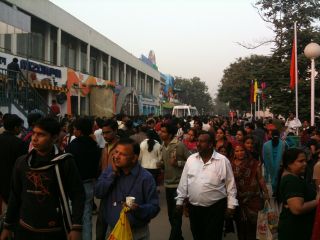
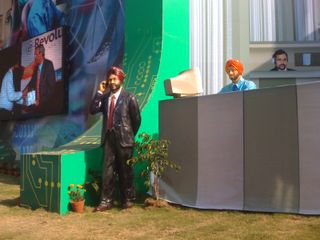
The sun has been hanging low for a while now, so different from the high summer. I find myself imagining the extreme angle of its likely incidence, the cause of its fleeting presence nowadays. The garden gets next to no sun, and cold is setting into the house for the short but sharp winter that Delhi experiences. The cool dry air and gentle sun make this the season for mela-s, festivals of culture and commerce that are scripted into the cultural geography of all north India, but brought to exalted expression in the social calendar of New Delhi.
We began by buying soap made at an ashram in Gangotri, the Himalayan mouth of the river Ganga at the Dastkar handicraft mela. We traipsed through the sarees displayed at the Chinmaya Mission mela, and enjoyed the root-beer at the American Women's Association mela, and bratwurst with beer at the German Mela. This morning we're back from the Delhi Commonwealth Wives Association mela, where we bought woolen slippers and hats at a stall run by the wives of diplomats from Kyrgyztan.
Geese
This morning when the sky’s red skin is
drawn across a beginning and the grass
is taut with frost and the clarity
of the edge of things recalls
the precision of an engraver’s point
an irregular V of geese passes left to right
like beads of an animated rosary
each a honking Hail Mary
a striving prayer
an individual articulating dot
an I-am of we-are
we are moving south
we are honking like hell
we are drifting up and down
in a wandering V together
to reach some destination
by a means coded in our cells
by a wisdom unknown
by an accident or lovely intention
on a whim or a want
on an updraft or drawn down
by a turn in the weather
we have been invited and
we are moving south implacably
as life moves
by Jim Culleny
December 4, 2009
Tolu Ogunlesi summarizes the ‘Big Ideas’ arising from discussions at the two-day African Media Leaders Forum 2009, which took place in Lagos, Nigeria, in November.
THE CENT AND THE CONTENT
Monetising content – especially in the Age of the Internet – will remain one of the media’s biggest challenges.
It was the recurring query in the Forum’s discussions: “How do we monetise this content?”
John Lavine, Professor and Dean of the Medill School of Journalism, Northwestern University, USA advocated a shift in perspective; from a “consumer media” outlook to a “business media” outlook. He argued for a micropayment model, saying that farmers for example would not mind paying a small fee for “farm information” (improved varieties of seed and water usage); and that a penny from each of a million people is a more sustainable revenue model than a dollar from ten persons. He classified audiences into two: “general” and “deep.” The general audience, he said, will be attracted, and satisfied, by the breaking news and the “go-to-do” information, while the deep audience will pay for premium content – “deeper news” and “analyses”.
What is certain is that most media businesses will have to struggle with balancing the journalism and the business. The observation by Robert Kabushenga, CEO of Uganda’s New Vision, that: “New [media] versus old [media] is a problem of the newsroom, not the boardroom,” helps to illustrate the often-conflicting realities faced by the content-producing and the content-marketing wings of any media business.
by Norman Costa
Scientific Psychology, an Oxymoron?
In the minds of many, including scientists from the more successful sciences, the field of psychology is not a science and may never be a science. The Nobel Laureate, Richard Feynman, was kind in his criticism of psychology as a science when he said that we have the form [of science] down, but we are not producing any laws of nature. In my view, psychology as a science has made some important contributions to describing mental life and behavior in animals and humans, but, on the whole, I tend to agree with Feynman.
I care about psychology as a science, very deeply. But, why should I care? Why should anyone care? Scientific psychology must care if we are to have confidence in our discipline as a science, in ourselves as scientists, and be respected by the larger scientific community as colleagues on an equal footing. For anyone who doubts that psychological science had a serious problem of credibility, consider the following:
Students today are not as [insert your own text] as when I was a student.
I began teaching psychological research methods at the undergraduate and graduate levels after two careers in research psychology – one at IBM Corporation, and another as a social science research consultant. The new mission I gave myself was the training of the next generation of research psychologists. Very quickly, I fell in love with teaching, and I fell in love with my students (not inappropriately, I might add.) For the father in me, it felt like having my children back home again.
By Namit Arora
Part 1: The Rise of Islam / Part 2: The Golden Age of Islam / Part 3: The Path of Reason
(This five-part series on early Islamic history begins with the rise of Islam, shifts to its golden age, examines two key currents of early Islamic thought—rationalism and Sufi mysticism—and concludes with an epilogue. It builds on precursor essays I wrote at Stanford’s Green Library during a summer sabbatical years ago, and on subsequent travels in Islamic lands of the Middle East and beyond.)
__________________________________________
‘Mysticism is ultimately rooted in the original matrix of religious experience, which grows in turn out of man’s overwhelming awareness of God and his sense of nothingness without Him, and of the urgent need to subordinate reason and emotion to this experience.’ [1]
Sufism, or Islamic mysticism, first arose in Syria and Iraq in the 8th century CE. Arab conquerors, a century earlier, had taken Islam all over the Near East, which included lands with a long tradition of ascetic thought and eastern Christian monasticism—a tradition that valued religious poverty, contempt for worldly pleasures, and a secret world of virtue beyond that of obedience to law—no doubt encouraged by the fact that for three centuries, until after the conversion of Constantine to Christianity, Christians in the Near East were a minority subject to suspicion and persecution by the pagan Romans.
But old habits die hard, and even as Islam spread, many new converts, beneath a slim veneer of their new faith, persisted with asceticism and detachment. What transformed asceticism into mysticism was something quite radical: an unabashed love of God. This transformation has been symbolically ascribed to a woman from Basra, Rabi’ah al-Adawiyah (d. 801?), among the first to articulate the mystic ideal of a disinterested love of God, as in her prayer below.
‘O God, if I worship Thee for fear of Hell, burn me in Hell, and if I worship Thee in hope of Paradise, exclude me from Paradise; but if I worship Thee for Thy own sake, grudge me not Thy everlasting beauty.’ [2]
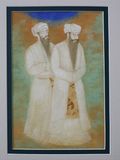
A systematic destruction of the ego (fana) and surrender of the self to God became central to the Sufi ideal: one who discards his ego to discover the divine presence at the heart of his own being would experience greater self-realization and self-control. ‘Man becomes dead unto himself and alive unto God.’ [4] Many practiced celibacy as a mystic ideal, flouting the example of matrimony set by Muhammad himself. Scholars like Majid Fakhry have noted Hindu influences on ‘this bold concept of annihilation of the ego and the reabsorption of the human in the divine’ (many early mystics in Persia had Hindu teachers).
Part one, Short Takes, can be seen here.
——————————————————
You can recognize the people who live for others by the haunted look on the faces of the others.
—Katherine Whithorn
*
Waiter to a table of Jewish Women: Is anything all right?
*
Atheist’s notation in the Bible: If true, then important
*
To err is human, to forgive supine
—S. J. Perelman
*
by Edward B. Rackley
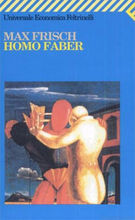
Nature captivates in Thailand. Its beaches and islands are legend; its birdlife and tropical flora endlessly entertain. On this visit though, nature bored me. A relentless jetlag was partly to blame. Its disorientations so warped my perceptions and instincts that I acquiesced to its inversions, accepting the Thai night as my day. Also, I was hungry not for nature but for the artifice of human imagination: grand emanations of culture, artisanry, cosmology. Has our petty species generated anything that I’ve never seen, never imagined? In creativity is there redemption for Homo Faber? For answers to this question Thailand is a gold mine.
Heavily subject to international marketing strategies and thus cast as the ‘Land of Smiles’, Thailand wants desperately to be permeated by magic. Of all possible reasons to be ‘desperately seeking’, permeation by magic is worthy enough, and seemingly free of ulterior motive. Orientalism and its facile seductions be damned, I thought, after my first week in country. If this place holds even one treasure of the human spirit, its authenticity will be self-evident to the most gullible and the most jaded.
From where I live it’s an 18-hour flight to Thailand. I learned to stop fighting jetlag long ago; it is now my companion and confidant. Wandering Bangkok streets and alleys at 3 am, nothing remained of the diurnal parade of human pursuit to entertain me. Roaming dog packs and the occasional buzz of a moto taxi broke the surprising silence of a vast urban labyrinth. I was left with night’s shadows and breezes, long walks along empty boulevards and closed shop fronts, the constant hum of yellow street lamps and neon. Repetition sets in and one begins inspecting a city for its anomalies, its artifacts of human touch, the physical traces of the shopkeeper at home ensconced in dreams.
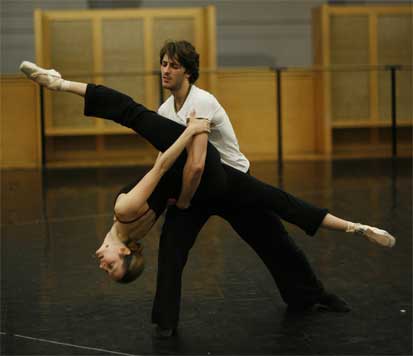
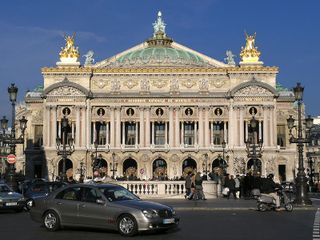
Rehearsal is everything and Frederick Wiseman knows it. As usual for this eminent American documentarian, his interest lies in the workaday world, but in his latest project he finds the harmony of place serving the artistic process. The opening shot fills the screen with a bird’s eye view of the rooftops of Paris as the white domed confection of Le Sacre Coeur entices the eye to the horizon line. Then the camera cuts to a closer view of the ninth arrondisement with its stately mansard roofs and street life before dropping down to gaze upon the facade of the 19th century Beaux-Arts Palais Garnier, home to the world's oldest ballet company.
YOU ARE THERE
Wiseman intercuts scenes of rehearsal with architectural snapshots of the busy hive that is the Palais Garnier – an apt metaphor because he finds an actual beekeeper harvesting honey on the roof. Multiple close-ups in underground quarters show lighting instruments rigged to pipe and thick ropes coiled in meticulous spirals on the floor. Just as meticulous is the student footwork in ballet class. Throughout, Wiseman cuts away from the dancers to admire the graceful curved balustrade of the central spiral staircase that connects cupola to basement. He stops in at the cafeteria at lunchtime, watches ballet shoes being dyed in the costume shop, and visits the empty opera house as a young man cleans its plush scarlet velvet seats. Meanwhile an underground stream (the legendary hiding place of the Phantom of the Opera) hosts not only living plants…but swimming fish. Wiseman sees everything.
Chapter One: The Little Coffee Shop
Chapter Three: Dreaming Dulles
There is no telling what a murdered man is capable of doing.
Murdered, in the cross hairs of a surveillance camera mounted on an unmanned predator drone; murdered on national and international television—murdered on CNN, murdered on Fox News, murdered on MSNBC and murdered on BBC— the last word in murders. Incinerated over and over again on a 24 hour news cycle—killed, burned, assassinated, maligned, analyzed, sermonized, eulogized murdered, dead.
A murder of a man killed in a burning building expanded and super sized on television screens all over the world—in cafes, and in sports bars—in airport terminals and subways, in doctors’ waiting lounges—in old people’s homes, in tea stalls, in currency exchange kiosks, in living rooms and bedrooms, in newspapers and radio talk shows and in the aspiring manuscripts of hundreds of post killing literature.
by Olivia Scheck
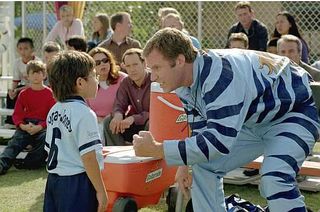
To be honest, it was a disappointing year.
Practices were primarily spent rolling in mud, fighting over who would retrieve a lost ball, and pleading for practice to end early. In games, most of the kids avoided the ball like a booger on the finger of a schoolyard enemy. They were desperate to be put in prestigious positions, but didn’t do anything when they got there.
Increasingly frustrated, I took it upon myself to crack the whip: Laps for the losers during competitive drills, personal callouts for lazy play, and – the nuclear option – public demands for chatting children to “stop flirting”.
When one of our players would flee the ball in terror, I would fantasize about running a drill in which we pelted him with soccer balls. In theory this would teach the kids that getting hit only stings for a second, though I admit it’s not a proven method. Jordan convinced me not to test it.
For the most part, the kids we’re unresponsive to criticism and I could sense their parents’ disapproval when we gave them negative feedback during games.
Following our regular Saturday afternoon loss, I would rant to Jordan about the need to stop coddling our players, invoking maxims about life lessons learned on the playing field. Then, Jordan would remind me, “They’re 9.”
***
by Sarah Firisen
Some of my basic premises are drawn from Daniel Pink’s A Whole New Mind and Thomas Friedman’s The World is Flat, both of which I thoroughly recommend. My premises are as follows:
A combination of technological advances and globalization have increased outsourcing and automation of tasks to the point where soon, any rule-based, linear thinking business activity that can be outsourced to a computer process or to another country will be. Countries, like China and India, have highly educated populations who are increasingly able and willing to perform the white-collar jobs of Americans and Europeans at a fraction of the cost, and these are only the most recently successful recipients of outsourcing, other countries are quickly catching up. Technological advances have meant that the outsourcing of this work can often be seamless and transparent to the end-user. In addition, time-differences enable companies to have a 24-hour workforce without paying anyone overtime to work a night shift.
The real opportunity the US has to continue to be a dominant economic force in the new economy lies with its proven track record for inventiveness and innovation. This NPR story is very illustrative of my point; while almost all of the components of Apple’s iPhone are made and assembled in Asia, the lion’s share of the profit from each sale remains in the US, “[Apple] gets as much as half the profit for every gadget it sells. That's because Apple creates and designs things — that's where the real money is. And the best jobs.”
by Sam Kean
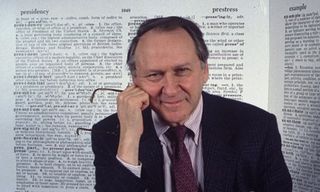
I’m hoping here, now, after a combined twenty-three months of their being dead, and two full months after the most recent death, that the statute of limitations has expired on de mortuis nil nisi bonum, and that I may be allowed to speak, if not ill of the dead, at least in a frank and semi-unflattering way.
Not that I want to, exactly. The thought of speaking ill-ish of these two men still rattles me, still stokes a bourgeois fear of being found out as less than cultured. Combined, they reigned over the Brahmin caste of American literary English users for close to a century (I’d pulled that figure out of the air, as hyperbole, before I realized it was practically true!), and while they maybe don’t have ghosts, they were grammatical prescriptivists and do have disciples, descendents, and defenders of repute, who are more vigilant and vengeful than ghosts ever were anyway. There’s also, admittedly, a sort of guild guilt. Both men were writers, fancy ones, deploying octosyllabics most of us would have trouble pronouncing if spelled out fo-net-i-cal-ly. They’re smarter than me; they spoke French and Latin and Sanskrit probably; and it just sounds so philistine, downright sans-culotte, to criticize someone for writing too well.
Nonetheless. With all due respect and paces to their skill and influence, when it came down to doing what they built their reputations doing—trying to putting the best words in the best order—William Safire and William F. Buckley struck me as pretty dreadful writers.
Ah.
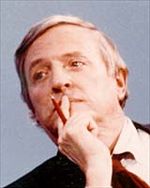
by Evert Cilliers
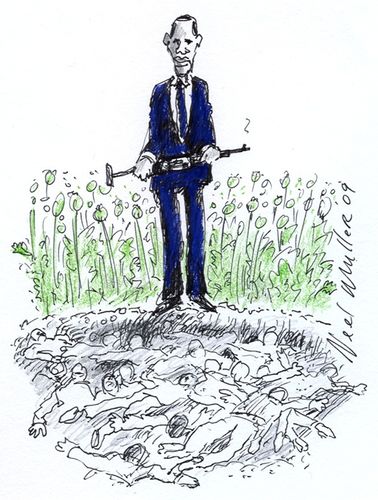
If you'd have told me that this civil war was a fight over who controls the world's opium production, and that we'd picked the losing side in this battle of criminals, I would've said your cerebellum is on an intravenous drip of LSD spiked with toad venom.
That sort of dumbass bellicosity happened back in the 19th century, when Britain smuggled opium into China and got into two wars with China about it.
America is a dumbass nation, for sure: we use most of our spare time to follow the lives of pretty but dim bulbs in Hollywood, and millions of us will be reading a book credited to Sarah Palin, the current all-time queen of dumbosity.
But we can't be THAT dumb, can we?
Or that criminal. It would be like backing one side of the Mafia against another, where both are equally bad.
Yet we are.
In fact, we are responsible for the whole dumbolical return of Afghanistan to form as the major supplier of illegal drugs to a grateful planet of barbecued minds.
Before we got involved in Afghanistan, its opium industry was on its knees, down by 94%, because its crazy Taliban government, besides banning music and snuffing women who had sex outside of marriage, didn't like drugs either.
But we jumped in there, and toppled the Taliban from their puritan perch — something to do with the fact that they were harboring Osama Bin Laden, whose handover to us they were willing to negotiate, but our dumbfuck administration wasn't.
And so, without the crazy Taliban government around to tell them what not to do, the Afghan people got down to what they do best, which is growing opium, and they could again more or less feed themselves.
Making Way
—Narragansett Bay 1960
We part from the dock
slow as disengaging lovers
one landlocked the other a
floater who won’t be
kept at bay
The diminishing pier slides back
its bollards and planks deploy
to some other place not here
but to a distancing otherworld—
the tether breaks
as stern-first we pass the
channel buoy
….Quarter back, the O-D says.
….Quarter back, aye sir,
….and we slip away
….Steer two one zero, half ahead.
….Two one zero, half ahead, aye sir,
….and we slow-slide down
….the gleaming bay
The sun’s so keen it indicates
a tern on the roof of a big estate
a half mile away
with its long lawn hill
off the starboard bow
which slopes down clear
through the wind-wove air
to a point where jades meet blues
…………….–which passes now
as we part the sea while
making way
Further south the sea’s first chops
begin to unsettle our sheltered
adolescent cruise
Near the harbor mouth all decks
rise then make their first
supplicating bows to whatever
god it is that intervenes
to call-off wrecks
—we’re juggled gently first in
Neptune’s law as
pitches rolls & heaves
meet yaws
Gray billows diesel from our raked stacks
Halyards snap against the mast’s steel
Gulls abundantly rise & reel
over the white chaos of our wake’s track
Sunlight splinters
into rippled billions
upon each breaker’s
sequined breast
before it folds
in a white rush falling
to the soul percussion
of a bow-wave’s
,,,,,,,,,,,,,,,,,,,,,,,,,,,,shush shush shush
by Jim Culleny; Nov, 2009
David Schneider
In September of 2008, we found a safe-house of ruination, and blessed it. My girlfriend and I had wandered over to the Bruckner Bar, Grill & Gallery, which over the past couple of years had become a hub for the South Bronx's rising art scene.
Inside, people were streaming out from the opening reception of a full-gallery exhibition unfortunately titled “The Catcher in the Eye,” a collaborative “visual novel” by Garrett Klein, Kenneth Park, Melissa Starke, Jon-Paul Rodriguez and Marcin Wlodarczyk. Astonishingly, no visual record of this exhibition seems to exist on the internet, so I'll try to describe what I recall from it.
The gallery's bare-brick walls formed a coherent visual narrative, wrapping around the room. On the near left, an enormous stylized image in bright reds and yellows stormed up the wall – an image halfway inbetween superhero comics and Asian Communist propaganda posters, leading to Garrett Klein's nervous assemblages. Then, toward the back, a handful of Starke's severe abstract expressionist works were hallowed with ornate gilded frames. On the back right, broken Classical columns and fractured lintels collapsed down upon a chaos of intricately-detailed, tangled, junkyard mosaics (I believe by Wlodarczyk). By degrees, they rose along the wall to adorn a hazy, golden icon. This latter radiated with a primitive holiness, as if the prehistoric Lascaux painters had received a vision of the Madonna and Child in a Dead Sea cave.
Overly readable? Didactically discursive? Perhaps. But in September 2008, as the Presidential campaign accelerated in a crescendo of cacophonous triviality, as the worldwide capitalist engine exploded with a sickening lurch, this room seemed – at least to me – a rare repository of all the horrors and hopes of the moment. Bathed in dim blue and red light, and dashed with glints cascading from a disco ball, the room appeared a secret chamber of safety, in which artists and patrons nodded to one another, acknowledging: we can yet create beauty and meaning from the wreckage, we can yet dance in the chaos.
Michael Blim
As the battle of the bedpans drags on, consuming what little is left of the short attention span of the Congress, Democrats are taking up financial reform.
Representative Barney Frank is responsible for legislation in the House and Senator Christopher Dodd in the Senate.
Neither of them is exactly presenting a profile in courage. Frank has virtually lifetime tenure in the House. Fall-out from arrests of a callboy network being run out of his Washington apartment in 1990 triggered his only electoral close call. Seventeen consecutive congressional election victories have enabled him to amass a lot of political clout and his role as the Democrats’ pivot person on financial reform has made him a leading recipient of campaign contributions. The Boston Globe (October 23) reported that Frank had raised $1.2 million thus far this year, even though the next election is still a year away. He is likely to double his total and pick up a bit more over the next 11 months.
Barney Frank is often called the smartest member of the House, something he has not cared to deny. He is apparently so smart that he thinks he can outsmart the financial and insurance companies that account for his campaign largesse by taking their money and giving nothing back in return. “I’m casting the same votes I was casting 20 years ago,” Frank tells the Globe. He stopped taking money from the top ten banks that took government money beginning last fall, and he will be giving $500,000 of his stash to the House Democratic campaign fund.
As smart as Barney Frank may be, he appears to lack common sense, for he must be the last person in America to believe in a free lunch. Who is the greater fool, his corporate campaign donors, who believe they are getting something for their money, or those of us Frank asks to believe that the contributions don’t figure in his votes and those of the rest of the House Democratic Party for whom he plays Santa Claus?
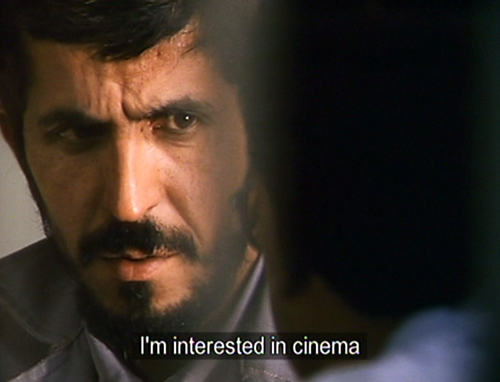
Quoth Abbas Kiarostami,
I don't like to engage in telling stories. I don't like to arouse the viewer emotionally or give him advice. I don't like to belittle him or burden him with a sense of guilt. Those are the things I don't like in the movies. I think a good film is one that has a lasting power and you start to reconstruct it right after you leave the theater. There are a lot of films that seem to be boring, but they are decent films. On the other hand, there are films that nail you to the seat and overwhelm you to the point that you forget everything, but you feel cheated later. These are the films that take you hostage. I absolutely don't like the films in which the filmmakers take their viewers hostage and provoke them. I prefer the films that put their audience to sleep in the theater. I think those films are kind enough to allow you a nice nap and not leave you disturbed when you leave the theater. Some films have made me doze off in the theater, but the same films have made me stay up at night, wake up thinking about them in the morning, and keep on thinking about them for weeks. Those are the kind of films I like.
Both the filmmaker's followers and detractors would agree that, yes, this little speech does indeed encapsulate his cinematic sensibility. The pro-Kiarostami crowd gets hooked by the characters and images that keep them up at night and distracted in the morning, while those on the anti-Kiarostami side of the fence… well, they fall asleep. No living director seems quite so critically divisive: some eminent observers of cinema as sharp as Roger Ebert have expressed nothing more than bored irritation at his pictures, while others, like Jonathan Rosenbaum, have gone so far as to author tomes on the man and include no fewer than four of his films on their all-time top 100.
I submit that it all depends on how you, the viewer, want to experience cinema. While it's entirely valid to ask that a movie grab you and yank you for a couple hours into a spectacle, an utterly fantastical escape from life couldn't be more different from what Kiarostami's selling. Per the quote above, he doesn't demand the audience's attention. If the audience gives it, excellent; he'll serve up the substance. But it makes no nevermind to him if they look away for a while. You experience a Kiarostami film, you see what you can see and you hear what you can hear, but only later does it grow within your mind into an entity that will affect you for years to come. Compare this to, say, a Hollywood disaster blockbuster, the sort so terrified you'll stop watching that its every detail looms several stories tall, whose events seem dreadfully important at the time but which washes clean from your memory immediately after viewing.
That model assumes an impenetrable bulkhead between cinema and life. You buy your ticket in order to reside temporarily in a totally foreign artificial space, ostensibly jammed with more motion, more color, more thrills and much more CGI than the real one to which you'll shortly shamble back. In Kiarostami's model, cinema is inseparable from life: one is the other, the other is one, and each draws heavily from its counterpart. Nowhere in the man's filmography does this worldview shine through more brightly than in Close-Up, a cinematic imitation of real events in which a real man's love of cinema leads to a bit of real-life fakery and fiction that's ultimately reconstructed with the aid of reality itself. If you find that too straightforward, wait until you read the next few paragraphs.
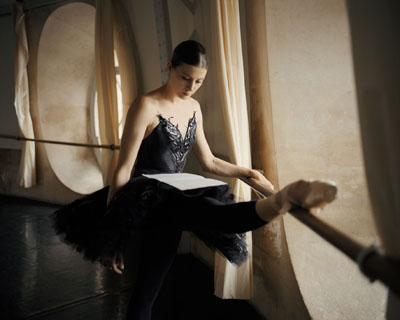
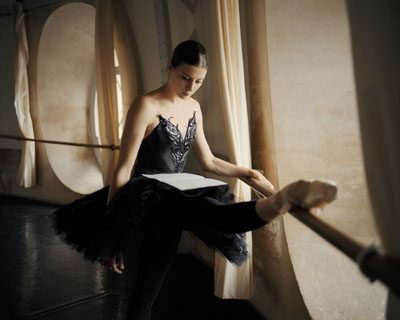
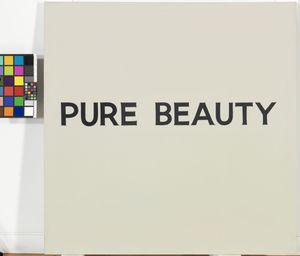
Left: Sophie Calle, Etoile dancer at the Opera de Paris, Marie Agnes Gillot, (detail) Take Care of Yourself, 2007.
Image copyright ADAGP Courtesy Galerie Emmanuel Perrotin, Paris/Miami; Arndt & Partner. Berlin/Zurich; Koyanagi, Tokyo; Gallery Paula Cooper, NY
Right: John Baldessari, Pure Beauty 1966-68, acrylic on canvas, 1152.5 x 1152.5 x 34.9 mm.
Image copyright John Baldessari, Courtesy of Baldessari Studio and Glenstone
Sophie Calle at the Whitechapel until 3rd January 2010
John Baldessari at Tate Modern until 10th January 2010
Sue Hubbard
by Tolu Ogunlesi
To the outside world, we are all “Africans”.
‘Africa’, that continent of “colourful emergencies” (a term coined by novelist Helen Oyeyemi in a 2005 essay); ‘African’, that oversized brush dripping a paint handy for tarring every living thing found within a thousand-mile radius of the Sahara desert.
As Africans – and by extension African writers – we’re supposed to be united by geography, culture and experience (mostly of the negative sort), and thus a herd of interchangeable entities. There is after all such a thing as African literature, written by African writers, dealing with African issues – poverty, wars, AIDS, Aid, military dictatorships, coup d’états, corruption, civilian dictatorships, and very lately, dubious power sharings.
Never mind that Nigeria and Uganda are no more similar (in my opinion) than America and Russia. Or that Nigeria’s religious dichotomy (and the resulting tensions) confers on it a greater similarity with India than with South Africa. Or that Nigeria and fellow English-speaking Ghana are separated by two impregnable walls of language known as Benin and Togo. Or that a conference proclaimed as a “Festival of Contemporary African Writing” will very likely be no more than a Festival of Anglophone African Writing.
Chimamanda Adichie’s short story, Jumping Monkey Hill (first published in Granta 95, and which appears in her story collection, The Thing Around Your Neck) – which William Skidelsky, writing in the Guardian (UK) calls “the most obviously autobiographical (and funniest) of the stories in The Thing Around Your Neck” – tells the story of an “African Writers’ Workshop” for which the British Council has selected participants.
The workshop is overseen by Edward Campbell, “an old man in a summer hat who smiled to show two front teeth the colour of mildew.” Campbell is British, with a “posh” accent, “the kind some rich Nigerians tried to mimic and ended up sounding unintentionally funny.” He is also the final authority – using what one might call his “Africanometer” – on the quality and plausibility of the stories produced during the workshop.
At the workshop are a Ugandan, a white South African, a black South African, a Tanzanian, a Zimbabwean, a Kenyan, a Senegalese and Ujunwa, a Nigerian. East, West and Southern Africa are represented, the North is not, as is often the case in real life reporting about the continent where the term ‘Africa’ is used to refer to “sub-Saharan Africa” and North Africa is somewhat set apart like some entity off the coast of the real Africa. And, needless to say, the workshop is conducted in English, not French or Swahili.
One of the more interesting scenes in Adichie’s story is when all the writers (except for the Ugandan) gather to drink wine and make fun of one another, and make comments such as: “You Kenyans are too submissive! You Nigerians are too aggressive! You Tanzanians have no fashion sense! You Senegalese are too brainwashed by the French!
This scene took me right back to Crater Lake, venue of the 2006 Caine Prize workshop, in which I participated. NM, a young South African novelist and I were roommates at the Crater Lake resort where the workshop took place. As ‘African writers’, we should have instinctively known everything about each other’s countries. We should have been able to complete one another’s sentences.
But not exactly. We were different people, with little experience of each other’s daily realities.